Venezuela - US Conflict: News, Updates

The course your wife suggests, would require Madura to accept the the specific USA court has jurisdiction over him and local USA laws apply to him.
The court is not going to care whether or not he is a subject to the court, and frankly, regardless of how he got there, he is a prisoner under the jurisdiction of the DOJ. This is basically the same defense of any Sovereign Citizens, you cannot ignore the US court when you are in the US, even tho if you claim they don't have jurisdiction over you (in this case, this claim is proper, unlike Sovcit)

The rendition and the sovereign immunity bit is to be the concern of the international court, which the state department may or may not comply with (most probably not) but of course they are going to mount a habeas corpus challenge, but the chance it will go all the way to the SCOTUS is slim, and if it does, it was packed by Trump appointee. Where do you think it will end up?
 
Once again, you are starting a discussion from a position that I have never taken.

First you claimed that I wrote anything about cowardice and changed the discussion to Arabs. While in reality I never wrote anything about cowardice even once.

Now you are talking about (for the 10th time or more) China growing in power. Once again, I never wrote the opposite even once nor do I disagree.

NONE OF THE ABOVE HAS ANYTHING TO DO WITH WHAT I WROTE INITIALLY OR MY INITIALLY POINTS MOST OF WHICH YOU INITIALLY AGREED WITH OR DID NOT COUNTER.

My short point, to make it painfully short and clear, is that China needs to redefine and change its historical millennia old philosophy of looking inwards and viewing China as the center of the world, and become more proactive globally, including aiding your allies or potential allies more aggressively, if you want to challenge the US truly on a global scale. That is all.

As I view it this is the main current problem with China that prevents it from truly challenging the US.

The Belt and Road project should have had a military component from the very beginning for instance.

Given the size of China, huge population (1.5 billion people - do you realize how many people that is), lack of any local competitors historically speaking (Japan, Korea, Vietnam etc. were irrelevant for the most part - only exception was the short-lived Mongol Empire that died fairly quickly - look at Mongolia today - least sparsely populated country on the planet), China should be an ABSOLUTE regional hegemon and those mentioned states, Philippines included, should be Chinese vassal states.

The reality though is completely different. To the point that most Koreans, Japanese, Vietnamese for whatever reasons seem to dislike China and Chinese.

So something has gone wrong here. Whatever it is or has caused this, China must first gain regional supremacy before dreaming about challenging the US on a global scale.

That China has not yet created something akin to a Warsaw Pact that the USSR did almost 80 years ago is also a big weakness as I see it.

And I am only writing all of this (I could care less otherwise to be honest with you, it does not impact KSA, Arabs, Arab world etc.) because I genuinely believe that China has the potential to challenge the US and that it is healthy for the world to have more than 1 global power.

It is therefore frustrating to see this Chinese passivity globally.

This whole Venezuela/Maduro fiasco was another confirmation as I see it of this passivity. Another one was Iran last summer. A third one is Russia, with tiny North Korea being more active in their support for Russia which is fighting against NATO/US while we speak or at least did under Biden.

Now Trump is ironically trying to charm Putin and the Jewish oligarchy that runs Russia in order for him to prevent a real alliance with China and for Russia to return to the European/Western fold.

That is all. Last post on this topic from my part.
This Arab friend, what are you trying to prove in a hurry? Did you submit your paper within the time limit? I don't know if there is an emperor's mindset in the Arab world, and what happens today will have to be put on the table tomorrow, and the results of the investigation and the handling report will be put on the table. In my opinion, international relations are a very complex game. It takes a long time for both sides to play and communicate to accomplish something, rather than black and white. Don't believe any news or politicians' shouts. I suggest that if you want to truly understand the level of the relationship between the two countries, Look at the content of the agreement signed by both parties. Whether it's public or private, starting from this aspect is more real than looking at eye-catching headlines.
 
Al Jazeera is the first media outlet which uses the word abducted.
To view this content we will need your consent to set third party cookies.
For more detailed information, see our cookies page.
 

Thirty-two Cubans killed during US attack on Venezuela​


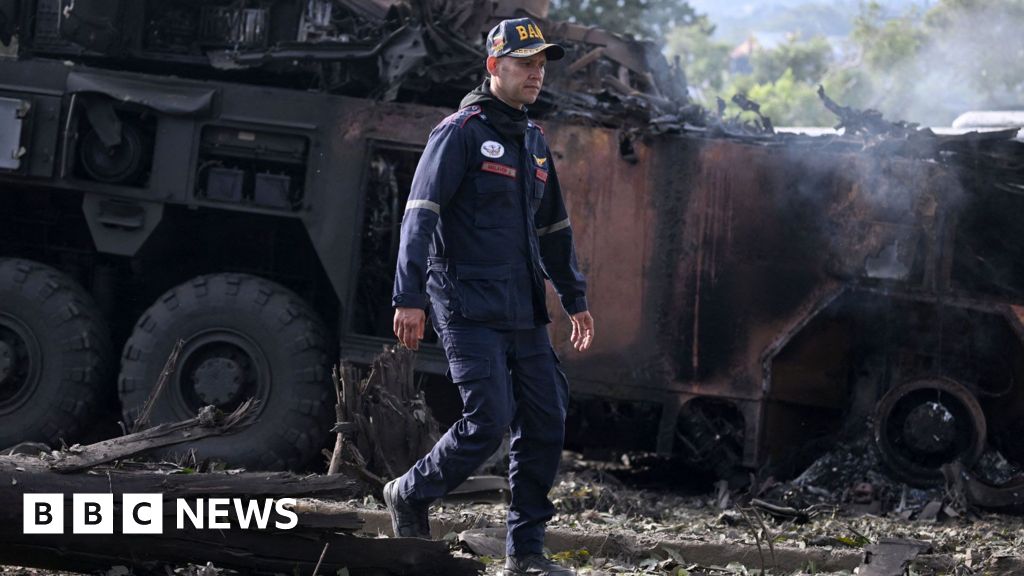
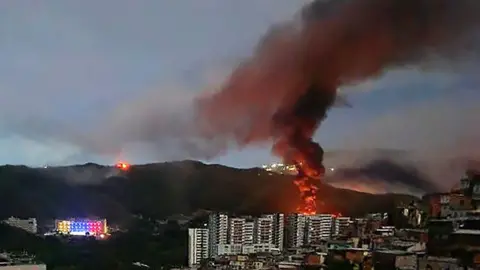
Getty Images Fire at Fuerte Tiuna, Venezuela's largest military complex, is seen from a distance after a series of explosions in Caracas
Getty Images
The US carried out a number of air strikes against targets in Venezuela as an elite military unit made its way to Nicolás Maduro's compound
The Cuban government says 32 of its nationals were killed during the US operation to seize Venezuelan leader Nicolás Maduro.

It described the dead as members of its armed forces and intelligence agencies were killed "in combat actions", declaring two days of national mourning.

The armed forces added the Cubans "fell, after fierce resistance, in direct combat against the attackers or as a result of bombardments of installations"

Cuba, a long-standing ally of Venezuela, has for years supplied Maduro with his personal security detail and has personnel throughout the Venezuelan military.
Cuban President Miguel Díaz-Canel said the country had been providing protection to Maduro and his wife "at the request" of Venezuela.

US spies had been monitoring Maduro's movements for months before US forces struck, according to US General Dan Caine.

Gen Caine said that they had learned where the former leader moved, lived, travelled, ate, and worked.

The New York Times reported that the CIA had also recruited a "Venezuelan source" who it says informed the Americans of Maduro's exact location.

Many of those killed are believed to have been part of Maduro's close security detail, who were with him at the time.

Venezuela has not confirmed how many people were killed, but its armed forces have said that a "large part" of Maduro's security team were among the casualties.

An official statement from the Cuban government read: "Our compatriots fulfilled their duty with dignity and heroism".

The total death toll - according to an unnamed Venezuelan official cited by the New York Times - stood at 80 and was expected to rise. BBC News has not independently verified that report.

p0ms4h99.jpg


0:45
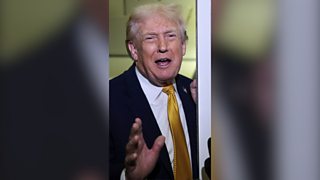
Watch: Venezuela is 'a mess' and Cuba is 'ready to fall', says Trump
In the days following the seizure of Maduro, questions have been raised over whether the Trump administration could consider a similar operation against Cuba, which, like Venezuela, has had decades of adversarial relations with the US.

Speaking to reporters on Sunday, US President Donald Trump said military action would not be necessary because "Cuba is ready to fall".

He continued: "I don't think we need any action. Looks like it's going down. It's going down for the count."

On Saturday, US Secretary of State Marco Rubio described Cuba as a "disaster" run by "incompetent, senile men".

"If I lived in Havana, and I was in the government, I'd be concerned - at least a little bit," Rubio said.

In July last year, Trump signed a memorandum imposing tighter restrictions on Cuba, reversing moves by his predecessor, Joe Biden, easing pressure on the Caribbean island nation.

The White House said it would end "economic practices that disproportionately benefit the Cuban government, military, intelligence, or security agencies at the expense of the Cuban people".

It also said existing restrictions on Americans visiting Cuba would be more stringently enforced.

During his first term as president, Trump took a similar approach to Cuba, implementing a raft of additional sanctions.

His administration has continued an economic embargo on Cuba, despite calls by international organisations including the United Nations to end it.

The blockade was initially imposed in 1962 and has been in place ever since.
 
Yes, you are right. But the American economic model is designed to work that way. The money flows in the MIC and the sheer level of employment it has generated is staggering. Now the issue is about how to rebalance USD flows so that American industrial base have a shot at expanding further and competing with the Chinese industrial base. There are reports that Trump is restructuring American military footprint worldwide and compelling various companies to invest in the US. Interesting times ahead.
Trump said it’s their oil they’re selling it to other countries at a profit to American companies if an occupation occurs Venezuela is paying for it so does this help Venezuela when everything so far is trump saying they own Venezuela will American soldiers turn their weapons on Venezuelans if an occupation occurs after a year and seeing American companies and government is taking over making Venezuela into a banana republic with no actual say by the Venezuelan people but controlled by American oil companies and cia black ops
 
To view this content we will need your consent to set third party cookies.
For more detailed information, see our cookies page.
 
To view this content we will need your consent to set third party cookies.
For more detailed information, see our cookies page.
 
To view this content we will need your consent to set third party cookies.
For more detailed information, see our cookies page.
 
Pianists everywhere

To view this content we will need your consent to set third party cookies.
For more detailed information, see our cookies page.
 
Another member @_Arabia_ also complained that China is keeping its distance from distant conflict situations. Is China supposed to fight a war with the US for other countries when they do not seem to have a sound foreign policy? China and the US fought a war in the Korean peninsula in the 1950s. The US-led forces managed to preserve South Korea despite heavy regional odds. The communist forces suffered heavy losses in the war and they remember it to this day. Both China and North Korea have respected the armistice in the region since which is commendable. The Chinese are very smart. They observe and seem to understand mindsets in different regions. The Chinese counter-view in this thread is sensible and enlightening. They do not desire entanglements in distant conflict situations for reasons they have pointed out already. They are focused on regional developments close to them. They will fight when it is absolutely necessary but for something very close to them as happened in the Korean peninsula. However, war is the last resort option to them. And it should be.

Fight when it is absolutely necessary but distance yourself from corruption and mischief in other lands. Let them figure out how to address their problems.

The US have cultivated state-level partnerships with several countries in the Middle East. These relationships cannot be rolled back by force. These relationships are different from how the Axis of Resistance works. The Axis of Resistance elements function like a state within a state in other countries and dragged them into a war they were not interested in when Iran encouraged them. The Axis of Resistance failed, not surprisingly. Pakistan for all its power, also attempted to prevent Indo-Afghan engagement but it continues. Nevertheless, Pakistan does not pick a fight everywhere but strive for balance and a way forward with various parties on a broader level. It works for us. When there were tensions between the KSA and Iran, Pakistan encouraged both sides to have dialogue. Pakistan seems to practice what it preach which is good. China also benefit from Pakistan having a sound foreign policy. Pakistan facilitated the US-China dialogue in the 1970s.


Typical "churan" from a man so wise.
Saddam had all that, he and his regime are history.
Iran had all that, now it finds itself on the receiving end.
People in the Middle East tend to hit first and ask questions later. They are idiots.
There are other examples to cite in different regions. Learn from history. A regional power can endure with a sound foreign policy, not by picking a fight left, right, and center. Don't try to emulate the US when you are not that strong. It is important to understand your options and chart your course accordingly. Pakistan is a good teacher in fact. Keep a strong army but also have a sound foreign policy. Don't FAFO.
Your assumption is wrong dude. No one expects China to fight others' wars.

We can pull our own weight. My own favourite axis would be an alliance between KSA Iran and Pakistan to meet the threats.

Before forming such alliances we need a replacement for dollar and swift. That's where we need China.
 
To view this content we will need your consent to set third party cookies.
For more detailed information, see our cookies page.

Know how you can tell those two videos are fake and not US SF in Venezuela..? Those chappaz have their nav lights on which they didn't have during the actual operation.
 
To view this content we will need your consent to set third party cookies.
For more detailed information, see our cookies page.
 
Screenshot_20260105_183220_X.jpg

To view this content we will need your consent to set third party cookies.
For more detailed information, see our cookies page.
 
Manuel Noriega.


Technology enabled US to do these unexpected things.


As an Air Force guy, my opinion is that it would be foolish to assume that we would encounter no air opposition. Why do you think the EA-18s were involved? We scrambled their radars and communication. We had air superiority 'just in case' anyone foolish to peek his head. Our helos flew at 100 ft altitude to avoid any radar detection. The mission success was precisely because we had assets to cover contingencies that discourage others. But in the end, I want everyone to think of US the way you just did because it will make possible even more outrageous things we can do.


Catching an opponent unprepared is what Sun-Tzu and Clauswitz advocate.

Here is what I repeated often on this forum since I was invited here back in '09, and I learned this from a chief when I was active duty.

In a fight, you win not by fighting under your opponent's rules but by forcing him to fight under yours. And cheating is allowed.

A 'rule' is any advantage you have over him, or he has over you. If you have more powerful engines, keep the fight fast. If you can outturn him, keep the fight maneuverable. If you have a better radar, keep the fight at a distance. If you, but not him, can see in the dark, then attack at night. And the list goes on.

Severing communication and blind radars when he least expected are what every military wish they could do to their potential opponents. So what is the problem?

Historically, conquering armies lived off the land, but with Desert Shield and Desert Storm, the US became the only military that transport everything it needed transhemispherically. No one expected that as they watched in awe at Desert Shield buildup. Then with Desert Storm, no one expected any military to execute multiple missions with near instantaneous effects to overwhelm Iraqi defense at every level. What is the problem with that?

War is not a contest but survival. Other than dishonorable tactics, to fight in a war is to fight unfair. We can separate out the 'abduction' of Maduro under moral and legal umbrellas, but it is absurd to say that we cover every aspect of Venezuelan defense as somehow 'unfair' because they were caught off guard.
This is all very much plausible in the context of the Venezuelan defences being caught "off guard" by genuine US military supremacy and pre-planning.

However, it is HIGHLY LIKELY that some Venezuelans, at least, were paid to stand down.

This episode is not therefore a well controlled study of pure American military strength and is rather a manifestation of the Americans' ability to manipulate others - also certainly an advantageous trait - but not contributory specifically to the overall military capability of a nation.

Israel pays off plenty of citizens (and indeed refugees) in its target countries to achieve its goals. USA seems to behave similarly.

In simple terms of effectiveness, these strategies work brilliantly - but was USA's military might actually tested by a force that may well have largely stood itself down?
 
was USA's military might actually tested by a force that may well have largely stood itself down?

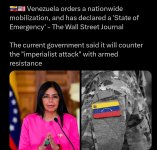
There is still time to actually test it, if Venezuela wishes to do so, of course. Reports of national mobilization to resist USA are coming in.
 

Users who are viewing this thread

Back
Top