Navigation
Install the app
How to install the app on iOS
Follow along with the video below to see how to install our site as a web app on your home screen.
Note: This feature may not be available in some browsers.
More options
Style variation
You are using an out of date browser. It may not display this or other websites correctly.
You should upgrade or use an alternative browser.
You should upgrade or use an alternative browser.
Vietnam Defense and News forum
- Thread starter Viet
- Start date
More options
Who Replied?


- Thread starter
- #2,028
Australian patient discharged within 24 hours after robotic gallbladder surgery in Vietnam
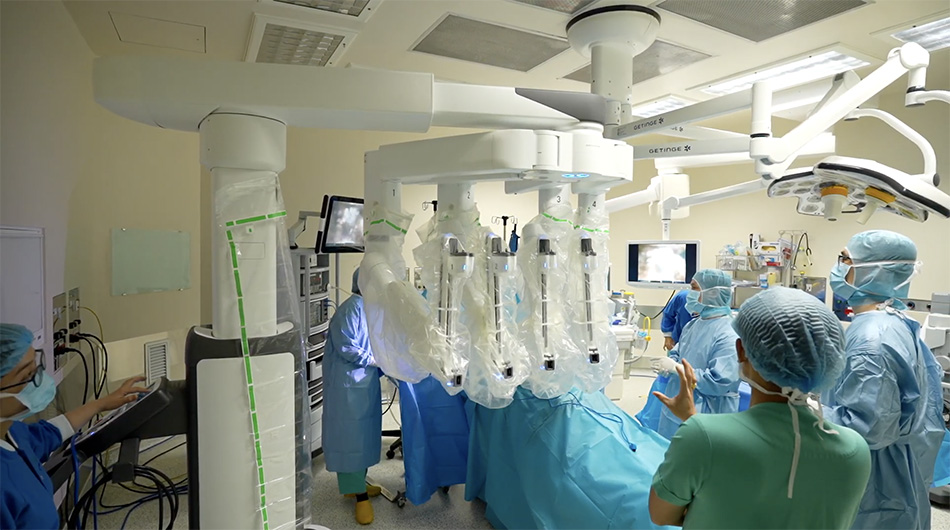
The General Surgery team at FV Hospital performing robot-assisted gallstone surgery using the Da Vinci Xi system. (Image: FV)
A patient with class III obesity (BMI 40) has successfully undergone gallbladder surgery (cholecystectomy) using the robotic Da Vinci Xi surgical system at FV Hospital (HCMC). This marks the first robotic surgery performed by the General Surgery Department, representing a significant expansion in the use of advanced technology to treat complex surgical conditions.
Surgical challenge of cholecystolithiasis in a class III obese patient
Mrs M.A.T., a 60-year-old Australian national, had been living with gallstones (cholecystolithiasis) for several years. As her symptoms progressively worsened and began to significantly affect her daily life and overall health, she decided to seek treatment at FV Hospital.
Following clinical examination and diagnostic imaging, Dr Phan Van Thai, MSc, Specialist Level 2 – Head of the General Surgery Department at FV Hospital, confirmed the presence of approximately ten gallstones ranging from 7 to 10 millimetres in diameter within the gallbladder. However, the primary surgical challenge was not the stone burden itself, but rather the patient’s physical condition: severe obesity with a BMI of 40.
“In patients with severe obesity, open surgery would require a considerably long incision, access to the operative field would be extremely complex, and the risk of post-operative complications would be significantly elevated. Even with conventional laparoscopic surgery, the thick layer of fat makes manoeuvring and visualisation more difficult,” Dr Thai explained.
Da Vinci Xi robotic system completely removes gallstones within 60 minutes
To maximise safety and optimise treatment outcomes, Dr Thai decided to use Da Vinci Xi, a leading, highly advanced robotic-assisted surgical system.
According to Dr Phan Van Thai, robotic surgery offers several key advantages over conventional laparoscopy: “The robotic arms can rotate and fold at flexible angles, allowing access to difficult anatomical areas. The 3D imaging system, magnifying by 10-20 times, provides a crystal-clear visualisation of blood vessels, nerves, and tissue layers, enabling much more precise dissection. As a result, the surgery proceeds smoothly with minimal blood loss, less pain, and a faster recovery for the patient.”
The procedure lasted just over an hour. Utilising the Da Vinci Xi’s flexible manoeuvrability and sharp magnified imagery, Dr Thai and his team removed all gallstones while perfectly preserving the surrounding vital structures.
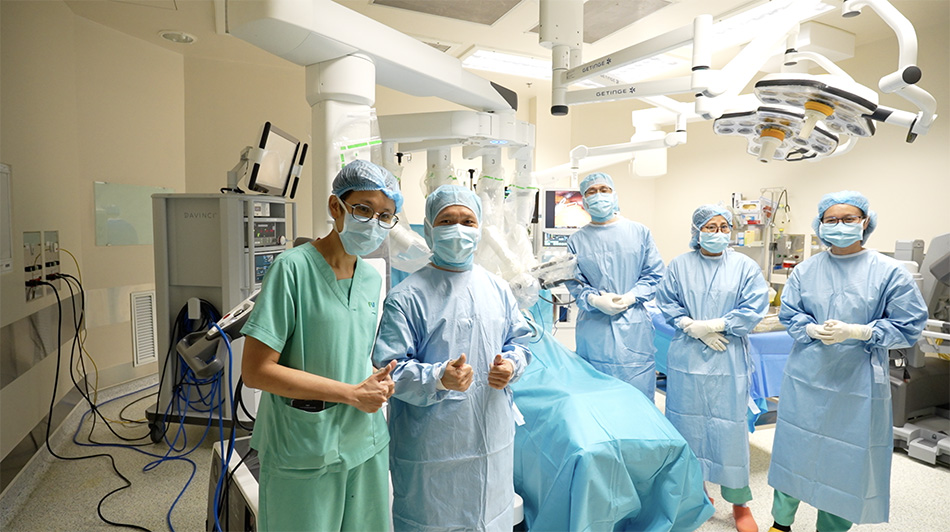
Dr Wipawee Inthasotti (far left) congratulating doctors from FV Hospital’s Department of General Surgery following the successful procedure. (Image: FV)
Dr Wipawee Inthasotti, a robotic surgery specialist from Rajavithi Hospital in Thailand, who was present during the operation in an advisory role, said: “A patient with a high BMI presents a significant surgical challenge, but the FV surgeons demonstrated excellent control of the robotic system, with smooth and precise movements and meticulous preservation of critical structures like the cystic duct and cystic artery. The outcome was truly impressive!”
He further noted that the robotic system and operating theatre facilities at FV fully meet international standards, comparable to major surgical centres across the region.
Rapid recovery: Discharged within 24 hours
The most remarkable benefit of robotic surgery was evident in the post-operative period. Just one hour after the procedure, Mrs M.A.T. had regained consciousness and was transferred to the inpatient ward. “I hardly felt any pain, only some mild discomfort. It was amazing that I could go home the very next morning,” said Mrs M.A.T. cheerfully upon discharge.

Dr Phan Van Thai, MSc, Specialist Level 2 congratulating the patient on her discharge one day after surgery. (Image: FV)
The patient added that the attentive care from the nursing team, from reassuring her before anaesthesia to providing detailed post-operative instructions, helped a foreign patient like her feel at ease throughout the entire treatment process.
Expanding the scope of robotic surgery at FV
According to Dr Phan Van Thai, mastering robotic technology opens many opportunities to develop minimally invasive surgery within General Surgery, particularly for complex cases or high-risk patients.
“The transition from traditional laparoscopy to robotic-assisted laparoscopic surgery represents a leap forward for modern surgical practice. For complex procedures such as cancer treatment, robotic surgery enables surgeons to meet higher technical standards and optimise long-term treatment outcomes,” Dr Thai emphasised.
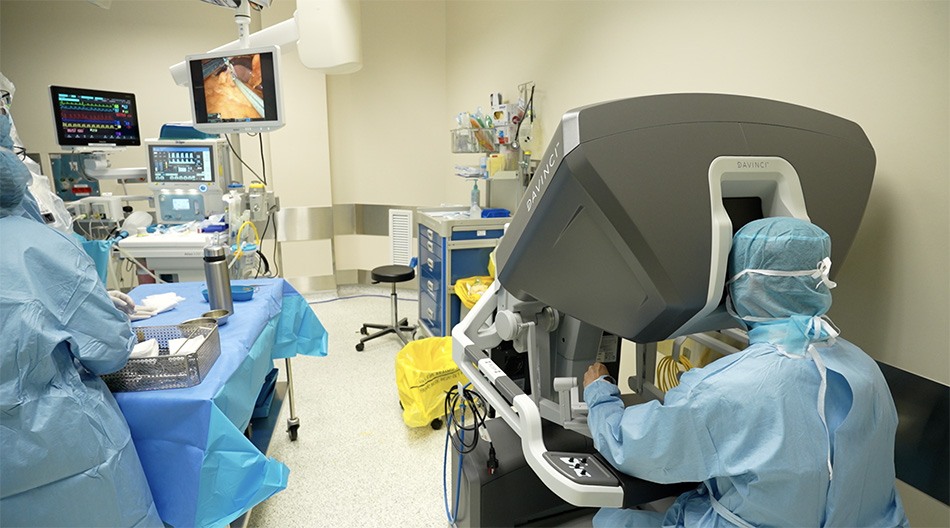
Dr Phan Van Thai, MSc, Specialist Level 2 head of the Department of General Surgery at FV Hospital, operating the Da Vinci Xi robotic system during the procedure. (Image: FV)
The recent successful deployment of robotic surgery across specialties including Thoracic Surgery and General Surgery not only affirms the technical proficiency of FV’s surgical team, but also lays the foundation for the development of FV’s dedicated Robotic Surgery Centre.
The da Vinci Xi system is currently being expanded for use across multiple medical specialties:
- Urology: prostate cancer, bladder cancer
- Gastroenterology: gastric and colorectal cancer (particularly tumours in anatomically narrow locations); hepato-pancreato-biliary and splenic surgery
- Gynaecology: uterine and ovarian cancer; uterus-preserving myomectomy
- Thoracic Surgery: lung cancer, mediastinal tumours, thymectomy for myasthenia gravis

Australian patient discharged within 24 hours after robotic gallbladder surgery in Vietnam - FV Hospital
A patient with class III obesity (BMI 40) has successfully undergone gallbladder surgery (cholecystectomy) using the robotic Da Vinci Xi surgical system at FV Hospital (HCMC).
 www.fvhospital.com
- Thread starter
- #2,039
Vietnam targets Q2/2026 contractor selection for North-South high-speed railway
By Minh HueFri, March 20, 2026 | 1:58 pm GMT+7
Vietnam aims to select contractors for its flagship North-South high-speed railway project in the second quarter of 2026, as preparatory work gathers pace, the Ministry of Construction said.

The ministry has approved tasks related to forest land-use conversion and environmental impact assessments. Consultants are finalizing bidding plans and tender documents for survey and feasibility study packages, expected to be completed by March to enable contractor selection in the following quarter.
Authorities across all 15 localities along the route, together with state utility Vietnam Electricity (EVN), have actively reviewed land clearance requirements, relocated power infrastructure, and developed resettlement areas to keep the project on schedule.
Meanwhile, the Thang Long Project Management Board has been tasked with completing tender documents to appoint consultants for the feasibility study, also targeted for the second quarter.
Progress is also advancing on the Lao Cai-Hanoi-Hai Phong railway line, whose construction began in December 2025. Work is underway at five stations, namely Lao Cai, Phu Tho, Bac Hong, Luong Tai and Hai Duong Nam.
Contractor selection has largely kept pace with the project schedule. All five consultancy packages in the investment preparation phase have been completed, along with six of 12 packages in the project implementation phase. The remaining six - three construction and three supervision consultancy packages - are being carried out alongside Sub-project 2.
Regarding technical design, five of 21 stations have approved design documents, while the remainder are under survey, expected to be completed by June 2026 to support construction.
For Sub-project 2 (railway construction), the ministry has selected contractors for 14 of 16 consultancy packages in the investment preparation phase. The remaining two packages, covering finalization of the feasibility study and legal advisory services, are expected to be completed in March.
Selection procedures are also underway for eight packages in the project implementation phase, with priority given to survey and technical design contracts.
The initial feasibility study report is expected to be available by the end of March 2026. It will be followed by internal appraisal by Vietnamese and Chinese authorities in April, completion of documentation in May, and a joint appraisal in June before submission for approval.
Technical design work is being fast-tracked. By April 2026, contracts with a Vietnam-China consultancy consortium are expected to be signed. Several sections, especially those passing through Hanoi and intersecting with the road project connecting to Gia Binh International Airport in Bac Ninh province, will be prioritized to allow early construction start by late 2026 in preparation for the APEC Economic Leaders’ Meeting in 2027.
Land clearance is ongoing, coordinated by local authorities and EVN, including the relocation of power facilities of 110kV and above. The ministry is expected to hand over site clearance documents to localities by the end of March 2026.
Approved by the National Assembly on November 30, 2024, the North-South high-speed rail project will stretch 1,541 kilometers from Ngoc Hoi Station (Hanoi) to Thu Thiem Station (Ho Chi Minh City), passing through 15 provinces and cities after recent administrative reorganizations.
Designed for speeds of up to 350 km/h, the dual-track railway will use standard gauge (1,435 mm) and accommodate 23 passenger stations and five freight stations.
While primarily focused on passenger transport, the line will also be equipped for dual-use purposes, including national defense and emergency freight capacity. The project will use public investment capital and be implemented in phases, with feasibility studies beginning in 2025 and targeted completion by 2035.
According to the parliament's resolution, the route is estimated to cost VND1,700 trillion ($67 billion).
Users who are viewing this thread
Total: 35 (members: 0, guests: 35)
Pakistan Defence Latest
-

-
Federal cabinet gives nod to imposition of emergency in KP; summary sent to president (21 Viewers)
- Latest: Desprado123
-

-

-

Country Watch Latest
-
 India Has Lost Air Superiority to Pakistan, No Jets Left to Fight (23 Viewers)
- Latest: Hakikat ve Hikmet
-
-

-

-

Latest Posts
-

-

-

-
 Makkah Defence Alliance: Turkey, Saudi Arabia, and Pakistan, news & updates (89 Viewers)
- Latest: PakFactor
-
India Has Lost Air Superiority to Pakistan, No Jets Left to Fight (23 Viewers)
- Latest: Hakikat ve Hikmet