Water Management and Flood - Updates

To view this content we will need your consent to set third party cookies.
For more detailed information, see our cookies page.
 
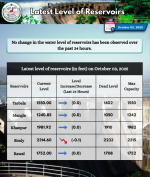
The Flood Forecasting Division reported that Tarbela Dam has reached 99 percent of its capacity at 1,549.20 feet, while Mangla Dam is 76 percent full at 1,219.40 feet. Levels at Rawal, Khanpur, and Simly dams have also risen significantly, prompting authorities to open spillways at some reservoirs to ease pressure.

High flood conditions were recorded at Guddu Barrage on the Indus River, where inflows reached more than 543,000 cusecs. The Sutlej River also surged to dangerous levels, particularly at Ganda Singh Wala in Kasur and Head Sulemanki, where authorities confirmed moderate to high flooding. Officials attributed the rising Sutlej levels partly to India releasing additional water upstream.

The floods have already submerged thousands of acres of farmland, destroying crops and displacing residents. In Kasur district, more than 30 villages lost ground access, and thousands of acres of agricultural land were inundated. Similar devastation was reported in Pakpattan, where floodwaters entered residential areas, forcing mass evacuations.
 

Kotri Barrage attains low flood as water level rises


The Newspaper's Staff Correspondent
August 26, 2025

1756209071488.png

HYDERABAD: The Kotri Barrage started passing low flood from Monday evening with the discharge recorded at 202,675 cusecs.

While Sukkur Barrage was passing medium flood, Guddu returned to the low flood state remained in low flood state after passing high flood of over 500,000 cusecs.

Irrigation department’s flood discharge figures at Guddu showed a discharge of 339,074 cusecs downstream at 6pm on Monday.

Guddu kept passing peak of medium flood since Monday noon before its discharges started receding.

Sukkur Barrage, however, was passing a medium flood of 428,400 cusecs at that time. Its upstream discharge was recorded at 481,720 cusecs.

The barrage received a flow of 481,720 cusecs flow at 12 noon on Monday.

At Kotri Barrage, a low flood was passing at 6pm on Monday after it received a discharge of 217,490 cusecs upstream against the downstream discharge of 202,675 cusecs.

A flow of 200,000 to 300,000 cusecs at Kotri Barrage is considered low flood. During last year’s flood, this barrage had passed a maximum flood of 335,618 cusecs on Sept 4 against upstream discharge of 342,368 cusecs.
 
At 12:30pm, the spillways of Tarbela Dam were to be opened to release water, according to a post by the National Disaster Management Authority (NDMA).

The authority expected the water levels to reach 250,000 cusecs as a result and urged the public to avoid going near waterways in adjoining areas of the Indus River, where increased water flows were likely.
 
At Mangla on the Jhelum, inflow was 34,000 cusecs and outflow 8,000 cusecs. Chashma saw inflows of 326,600 cusecs and outflows of 329,000 cusecs, while at Head Marala on the Chenab, inflows reached 107,500 cusecs against 89,500 cusecs outflow.

In Nowshera, the Kabul River registered 39,400 cusecs both in inflow and outflow.

Reservoirs remained under pressure, with Tarbela at 1,549 feet holding 5.67 million acre-feet (MAF), Mangla at 1,220.95 feet also holding 5.67 MAF, and Chashma at 647 feet with 0.21 MAF.

The combined usable storage across Tarbela, Mangla and Chashma stood at 11.55 MAF. Since 1 April, however, 11.8 MAF of water – estimated at US$11 billion – has flowed into the sea.

The Indus carried the largest volume to the sea, with flood-like conditions reported from Chashma downstream to Kotri. At Sukkur, discharge reached 449,000 cusecs; at Guddu, 312,000 cusecs; at Taunsa, 345,000 cusecs; and at Kalabagh, 271,000 cusecs.

On the Chenab, flow at Head Marala touched 902,000 cusecs, while no dam exists to store its waters.

PDMA Director General Irfan Ali Kathia said the Head Marala structure had remained safe, with floodwaters having passed and water levels beginning to recede.

Flood peaks were recorded at Khanki, Qadirabad, Ganda Singh, Jassar and Shahdara, with flows in the Ravi touching 240,000 cusecs.
 
To view this content we will need your consent to set third party cookies.
For more detailed information, see our cookies page.
 
Pakistan is home to some of South Asia’s oldest and largest headworks, vital for flood management:

🔹 Sukkur Barrage – 1932
🔹 Balloki Headworks – 1911
🔹 Trimmu Headworks – 1939
🔹 Panjnad Headworks – 1932
🔹 Marala Headworks – 1968

These structures, many 70–110 years old, were engineered for a bygone era. Today, they face unprecedented strain in the wake of record-breaking floods.
 
To view this content we will need your consent to set third party cookies.
For more detailed information, see our cookies page.
 
The downstream pressure has impacted Sindh’s Guddu and Sukkur barrages, which continue to record medium flood levels with flows exceeding 400,000 cusecs.

In Rahim Yar Khan, authorities reported 660,000 cusecs passing through Chachran Sharif, though no immediate threat to localities was identified.

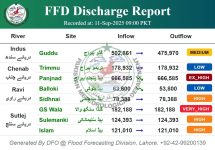
According to the Flood Forecasting Division (FFD) data, Panjnad witnessed outflows of over 668,000 cusecs, with a steady trend, while Guddu and Sukkur barrages had a flow of over 400,000 cusecs.

On the other hand, flood levels in Punjab rivers receded further, with Ganda Singh Wala on the Sutlej River near the Indian border in a “medium” flood.

PDMA River Flows report released at 6:30pm revealed that on the Chenab River, Marala Headworks was steady at 68,986 cusecs, Khanki Headworks was rising at 82,411 cusecs, and Qadirabad Headworks was steady at 84,440 cusecs.

At Chiniot Bridge, the flow was rising at 57,463 cusecs, while the Rivaz Bridge gauge level was steady at 518 feet.

At Trimmu Headworks, the flow was steady at 140,007 cusecs. The Head Muhammad Wala gauge was falling at 412.38 feet, the Sher Shah Bridge level was steady at 393.20 feet and Panjnad Headworks was flowing extremely heavy at 658,845 cusecs.
 
On the Ravi River, conditions were steady at all locations: Jassar was reporting 19,500 cusecs, Ravi Syphon 32,120 cusecs, Shahdara 31,682 cusecs, Balloki Headworks 59,580 cusecs, and Sidhnai Headworks 75,549 cusecs.

On the Sutlej River, flows were predominantly steady: Ganda Singh Wala was at 98,165 cusecs, and Sulemanki Headworks was at 121,459 cusecs. An exception was Islam Headworks, where the flow was falling at 113,956 cusecs, while the Mailsi Syphon was steady at 120,150 cusecs.

For the Indus River upstream of Guddu, the Chachran Bridge gauge was steady at 298.25 feet, and the Guddu Barrage flow was steady at 506,433 cusecs.
 

All major water reservoirs ‘filled to brim’


Khalid Hasnain
October 10, 2025

LAHORE: Mangla Dam, Pakistan’s largest reservoir in terms of storage capacity, reached its maximum conservation level of 1,242 feet on Thursday, and now stores 7.277 million acre-feet (MAF) of water, according to Wapda.

Now, all three of the country’s main water reservoirs — Tarbela, Mangla and Chashma — are filled to their maximum levels, holding a cumulative live storage of 13.316 MAF, considered a boon for irrigated agriculture and hydroelectric power generation.

“Tarbela Dam attained its maximum water conservation level of 1,550 feet on Aug.21, followed by Chashma lake that also attained its maximum level of 649 feet above mean sea level,” an official source told Dawn. “And, finally on Thursday [Mangla] also hit its maximum level of 1,242 feet.”

The official attributed the filling of the reservoirs to a high-flow season.
 
“The filling of Mangla and Chashma reservoirs to their maximum capacity is mainly due to rains, floods etc.,” he said. “However, the snow melting factor also contributes considerably in filling Tarbela Dam.”

Completed in 1967, Mangla Dam contributes to the country’s economic stability by helping ensure water supply for irrigation, mitigating floods, and providing hydel electricity to the National Grid.

At the time of its construction, Mangla Dam had a live storage capacity of 5.88 MAF, which gradually decreased to 4.6 MAF by 2004 due to sedimentation. WAPDA later began the Mangla Dam Raising Project, which not only regained the lost capacity but also enhanced it to 7.5 MAF.

Originally built with an installed power generation capacity of 1,000 MW, the dam is currently undergoing a phased refurbishment project. According to Wapda, the Mangla Refurbishment Project will increase the power generation capacity from 1,000 MW to 1,310 MW.
 

Replacing colonial-era water laws

Mohammad Hussain Khan
January 12, 2026

An entirely new unified water law is on the anvil to govern the water sector in Sindh. The idea is to run the sector more effectively and efficiently, and to address, institutionally, the fast-emerging challenges of disaster mitigation, climate change, and environmental issues.

The draft of the new law is under preparation, primarily at the Sindh Irrigation Department (SID). It would be a broader legal instrument to regulate water-related components, from canal commands to drainage, groundwater aquifers, and wetlands.

It was being drafted in the light of the Sindh Water and Agricultural Transformation (SWAT) project, a multi-million-dollar World Bank (WB) funded project that is already underway.

The new water law aims to merge the over 150-year-old, colonial-era Sindh Irrigation Act 1879 and Sindh Water Management Ordinance (SWMO) 2002. This would also eventually decide the fate of the Sindh Irrigation and Drainage Authority (SIDA), which was an offshoot of SWMO 2002.

The SWMO was introduced under WB-led intervention in Sindh in the shape of SIDA, established to promote a participatory irrigation system by ensuring farmer-led elected set-ups in the canal command areas of each of Sindh’s three barrages. The ordinance had also substituted the Sindh Irrigation and Drainage Authority (SIDA) Act 1997.

A new provincial law aims to merge century-old irrigation rules into a single framework to tackle climate change and ease management

Since then, two parallel irrigation systems have existed in Sindh. SIDA then produced the Farmers Organisation (FO) and the Area Water Board (AWBs) for the regulation of irrigation supplies and recovery of water charges, ie, abiyana.
 

Users who are viewing this thread

Pakistan Defence Latest

Back
Top