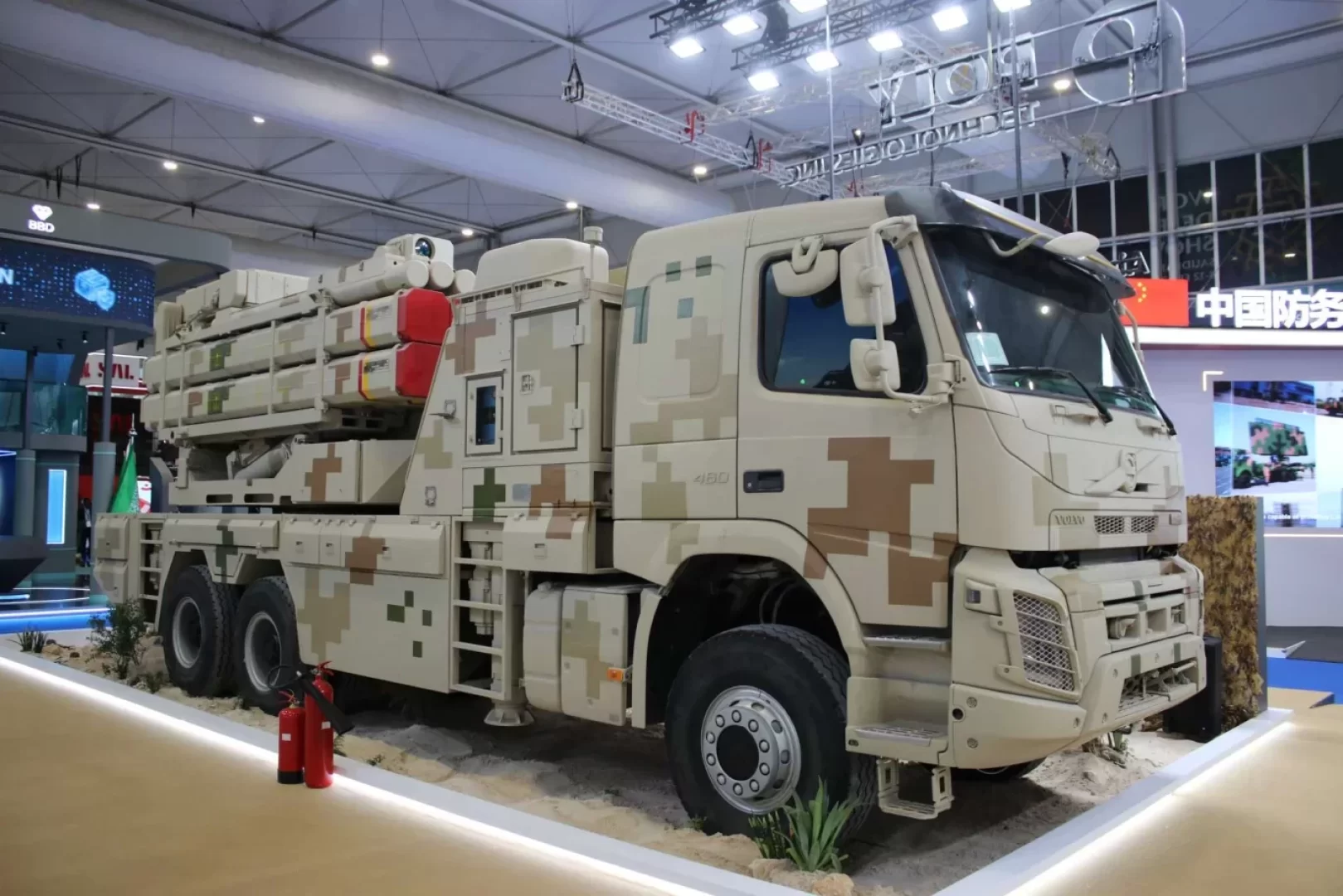
China showcases the LY-70 mobile air defense system at the World Defence Exhibition 2026
China Unveils LY-70 Integrated Anti-Aircraft, Anti-Drone, and Anti-Missile System (Image credit: Army Recognition Group)
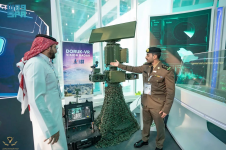
Army Recognition reported that on the opening day of the World Defence Exhibition 2026 in Riyadh, China’s Poly Defence showcased the LY-70 mobile surface-to-air missile system. This ground-based air defense solution is designed to counter a wide range of aerial threats in contested electromagnetic environments and high-density operational scenarios.
According to the website, the demonstration represents a Chinese push into a competitive market where militaries favor mobile, multi-layered air defense systems to protect both maneuvering forces and fixed infrastructure.
Capabilities of the Chinese LY-70 Air Defense System
The website states that the LY-70 system is designed to intercept targets including high-performance fighter jets, cruise missiles, anti-radiation missiles, air-to-ground munitions, drones, and attack helicopters.
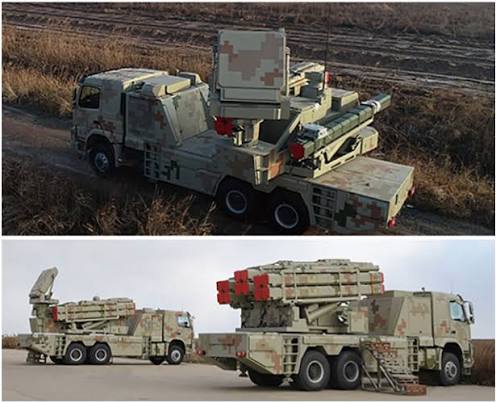
Image credit: Army Recognition Group The manufacturer announced that the system was specifically designed to protect critical assets and for tasks accompanying mobile formations, and that the focus is on its operational capability in saturated environments, where multiple simultaneous paths and electronic jamming can pose a challenge to command chains and fire control loops.
Features of the LY-70 System
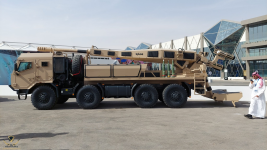
The website explained that mobility is a central element of the design concept. The launch platform is mounted on a multi-axle truck chassis, enabling redeployment along road networks and supporting operations while in motion.
The system relies on an infrared detection and targeting radar. It boasts the ability to detect over one hundred targets and track eight simultaneously. A single combat vehicle can launch up to sixteen missiles in flight to engage eight threats concurrently.
Operational Performance of the LY-70 System
The website reported that the system has an oblique interception range of up to 40 kilometers against fixed-wing aircraft, with altitude coverage ranging from very low to upper-middle altitudes. The detection range against similar targets is 70 kilometers. The system offers two types of missiles, each with different probability of hitting depending on the target's characteristics.
The World Defence Exhibition in the Saudi capital brings together official delegations, purchasing authorities, and industry representatives from the Middle East, Africa, Europe, and Asia, providing an opportunity to showcase the system to customers seeking to expand their medium-range air defense capabilities.
**Lockheed Martin (USA):**
We used to sell our products to Saudi Arabia, and now we manufacture them there.
The F-35 deal is part of a Saudi-American economic agreement that passed through the U.S. Congress and includes the relocation of headquarters of some defense companies to the Kingdom of Saudi Arabia.
Among them is the company that manufactures the F-35 fighter jet.
And none of what was mentioned has anything to do with the so-called Abraham Accords.
His speech in the video:
Lockheed Martin has been in the Kingdom since 1965 delivering really quality platforms. For example planes, helicopters, satellites, radars. We are proud of our relationship and again we have been here since 1965. Our strategy has been adapting though in line with Vision 2030. We used to sell things here, now we actually produce things here. It's a win-win. It creates jobs in the US and it creates jobs and opportunities in KSA so both partners can win. Some examples of that would be producing components in the Kingdom for our key defense articles. But now we have gone beyond that. We also do maintenance repair and overhaul so when things need to be sustained we can do it in the Kingdom and don't need to send it back to the US. We are also looking to coproduce defense articles in the Kingdom and in the future codevelop. In other words work with KSA to develop the future systems that will met the needs of the Kingdom but also the region and markets outside of the Kingdom.
Finally we are investing in the human capital and the next generation of Saudi Arabian youth - the engineers. And let me tell you, there are plenty here and they are talented, they are smart and we want to get them real world experience and take them out of the college environment and have them learn with us so we can enhance their capabilities to lead KSA in the market of defence and aerospace industry.
Within the Science and Technology Wing, we showcase one pathway that connects manufacturing, integration, and investment to transform capabilities into scalable impact. We look forward to meeting you tomorrow and visiting you