Who Created Harappan / Indus Valley Civilisation? | How Did It End? | Samvaad With Devdutt Pattanaik

India derives from and takes pride in its civilisation rooted in the Bihar province of India. The national emblem, the Ashoka Pillar, comes from Bihar; the Circle of Dharma, or Ashoka Chakra, on the Indian national flag also comes from Bihar. The motto of India, “Satyameva Jayate,” meaning “Truth Alone Triumphs,” comes from the Rig Veda.
Nalanda, regarded as the world’s earliest great centre of higher learning, is located in Bihar and remains an important part of India’s national pride and civilisational identity. The new Nalanda University, established as an international university for students from around the world, has also been built at Rajgir in Bihar, further reinforcing Nalanda’s place in India’s modern civilisational narrative.

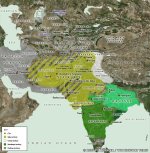
All the ancient empires and the very concept of Akhand Bharat come from the boundaries of the Maurya Empire created by Chandragupta Maurya.
Bihar is the armpit, groin and taint of India, all combined together. I know you take great pride in ancient kingdoms from thousands of years ago, but to a non-Bihari, it's pretty ridiculous to think one of the hubs of rape, corruption, and crime in India is the civilizational continuation of the Mauryan empire.

If Pakistanis have "lost" their connection to IVC because they're not practicing the "original culture", then why isn't the same standard applied to Bihar? Surely the Mauryan empire wasn't a hotbed for heinous rape and crime. Or was it? What have Biharis contributed to South Asia in the last 1000 years to make such grandiose claims about their region? What have Bhumihars and Thakurs actually done besides serve the British, Mughals, etc and terrorize their lower-caste Hindu brothers in the state?
 
Last edited:
Yeah giant ants that dig I didn't bother with the details but they are larger than foxes smaller than dogs. Not relevant anyway.

This was not the first time gangetic plains and Indus region came under one ruler but that's topic for another time. First let's address an important point.

"very Precisely" in the satrap of Hindukush my foot. Achaemenid Hindus was not “from the Hindu Kush to the IVC". They seperately used Gandhara, as an exclusion which is interesting considering their exclusion from Aryan fold and their anarya status. The Iranians also excluded Gandhara region.

Also just because a geographical name originates from a river/region doesn't mean the geographical term must forever possess exactly the borders of an Achaemenid administrative province.

Now megasthenes doesn't describe India as regions conquered by Maurya, he describes region outside Mauryan Empire too like the Southern parts. So it's not entirely a Mauryan Empire extension as you claimed. You opened the door to Greeks interpretation now you want to exclude certain ones? Very convenient.
I opened no doors of any sort.

I described the origin of the terminology "India" as a Persian Satrap and then I pointed out the historical delineation of the Satrap in question.

The term was bequeathed unto you, and you adopted it all and sundry. So why then pretend you can define the actual boundaries of the political/geographical region named after the original "Hindush".

Now the question is, why? Why did the Achaemenids delimit India to the region that is mostly now Pakistan, I.e. the Indus Valley, as its eastern extent?

It is precisely because a different tribe existed to the east. A savage group of elephant jockeys who were not known for building cities and advancing their people in a civic sense.
 
Now megasthenes doesn't describe India as regions conquered by Maurya, he describes region outside Mauryan Empire too like the Southern parts. So it's not entirely a Mauryan Empire extension as you claimed. You opened the door to Greeks interpretation now you want to exclude certain ones? Very convenient.
You're polishing your own turd of a theory here. Who cares what Maurya, Ashoka and the rest of these brigands did or didn't do? They certainly overran the region of Hindush, which is only relevant here as the origin for the naming of "India" given to this precise region.

It didn't include Pataliputra and all these temple townships to the east.

Wiki:"The territory of Hindush may have corresponded to the area covering the lower and central Indus basin (present day Sindh and the southern Punjab region of Pakistan).[9][10][11] Hindush bordered Gandāra (spelt as Gaⁿdāra by the Achaememids) to the north. These areas remained under Persian control until the invasion by Alexander.[12] Alternatively, some authors consider that Hindush may have been located in the Punjab region.[10][13]"

Map_Bactria-&-India-50BC_full.jpg
 
Last edited:

Users who are viewing this thread

Pakistan Defence Latest

Back
Top