Why AI and energy are key to global power

Beijingwalker

VIP Member
Joined
Nov 4, 2011
Messages
92,600
Reaction score
113,228
Reputation
2,089.2
Country of Origin
Country of Residence
China and US energy consumption-AI devours mountains of energy
April 29 2025

President Putin once said, “He who controls AI, rules the world.”Why? Because AI is the accelerator of all technologies. It supercharges invention, discovery, automation and production.

But… AI also devours mountains of energy.

You don’t just need GPUs. Data alone won’t suffice. You also need vast amounts of cheap, reliable electricity to fuel the AI driven future.And on this front, the U.S. is falling far behind China with no serious plan in sight to close the gap.

Perhaps China’s President Xi has developed his own corollary:“He who generates the most energy, rules the world.”If so, China is racing ahead here too. As the clock ticks, the multi-domain lead grows wider…

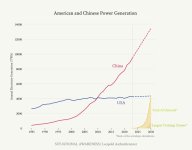
1745814949639.jpg
 
Energy consumption is the single most reliable indicator to gauge a country's overall economy size and prowess.
 
Wow!

China's electricity consumption is already more than twice that of the US.
 
well China does have a much larger population

but I see China does rely on electricity for many things much more especially in transport
 

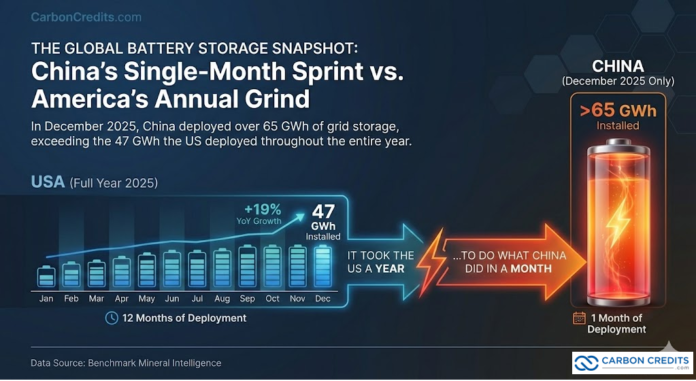
China’s One Month Lithium Battery Energy Storage Installations Beat America’s One Whole Year

Updated: January 26, 2026

Lithium battery energy storage systems (BESS) are now an essential part of the world’s energy transition. These systems store electricity from wind, solar, and other clean power and help keep grids stable when demand rises.

In 2025, the BESS market grew at a record pace. China has taken the lead, and global demand for lithium batteries is climbing fast. These trends show how battery storage is reshaping energy systems around the world.

2025: A Record-Breaking Year in BESS Deployments

Lithium‑ion chemistry remains the dominant technology in both large‑scale and behind‑the‑meter storage systems. These batteries help balance power grids. They support renewable energy and allow utilities and businesses to use energy flexibly.

BESS installations are becoming essential for clean energy infrastructure. This is due to more renewables being added and demand for stable power increasing.

The year 2025 was a landmark year for lithium BESS installations. According to Benchmark Mineral Intelligence, around 315 GWh of battery energy storage capacity was installed worldwide in 2025. This figure represents nearly 50% year‑on‑year growth compared with 2024. China and the United States led global deployments, with China far outpacing all other countries.

A striking sign of China’s dominance came in December 2025. China installed 18 GW (65 GWh) of large‑scale battery storage in that month alone. That amount of capacity was greater than all the battery storage that the United States installed over the entire year. This shows how rapidly China has expanded its energy storage footprint.

CC-Infographic-696x381.png


Through October 2025, global grid‑scale BESS capacity reached 156 GWh, a 38 % increase from the same period in 2024. China contributed a significant share of this growth, but Europe, North America, and the rest of the world also showed gains in deployment.

Data from Benchmark Mineral Intelligence shows a clear trend: BESS capacity grew in several months of 2025. In October, installations surged by 29% compared to last year. China contributed around 8.8 GWh of new grid-scale capacity that month.

Global Lithium‑Ion Demand Skyrockets

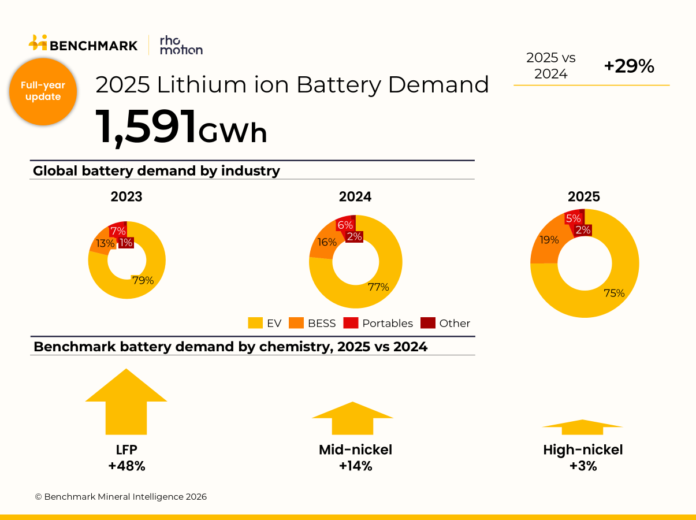
The surge in BESS deployment is part of a larger rise in lithium‑ion battery demand. In 2025, global demand for lithium‑ion batteries grew 29 %, reaching about 1.59 terawatt‑hours (TWh).

global-lithium-ion-battery-demand-rose-29-in-2025-image1-e1768975031273-696x520.png


Energy storage growth in 2025 outpaced demand in the electric vehicle (EV) market. This increase came from both stationary storage and EVs.

Stationary storage demand in particular jumped by 51 % in 2025, compared with 26 % growth in EV battery demand. This shift signals that storage is becoming a major driver of lithium consumption alongside traditional EV markets.

Researchers highlight that battery chemistries also changed in 2025. Lithium iron phosphate (LFP) batteries grew faster than other cell types, with demand rising 48% year‑on‑year. China’s EV sector remains strong, but LFP’s share outside China also climbed to over 30 % of global battery demand.

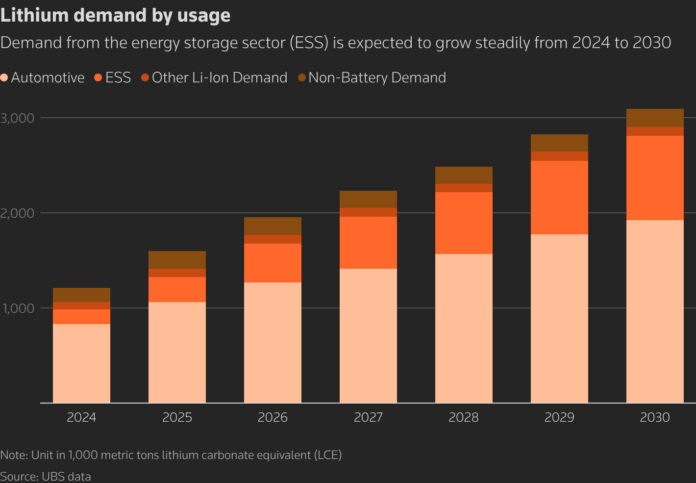
Industry analysis shows that global lithium use for energy storage may rise by 45.6% from 2025 to 2030. By 2030, it could reach about 312,934 metric tons. This forecast reflects the growing use of storage systems on power grids and for industrial demand.

Why China Leads the Storage Boom

China’s expansion in the BESS market traces back to sustained support and rapid industrial growth. China’s cumulative battery storage capacity doubled in 2024, reaching roughly 62 GW (141 GWh) by year‑end. Lithium‑ion batteries made up over 96 % of this capacity.


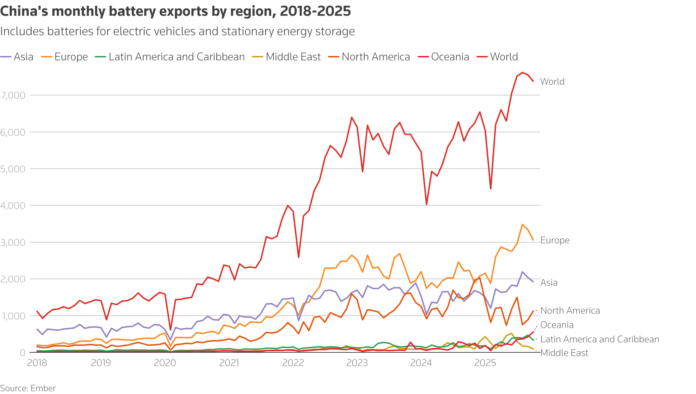
Chinese firms dominate both production and deployment. In 2025, Chinese manufacturers boost global shipments of lithium-ion cells for storage by around 75%. This growth is fueled by demands from power grids, renewable energy, and the expansion of data centers.

china-monthly-battery-exports-by-region-696x394.png

Source: Reuters
  • Chinese exports of battery systems were valued at over $65 billion in the first ten months of 2025, reflecting strong global demand.
China’s leadership also stems from policy reforms that improve storage economics. Changes in market rules have allowed more battery storage to operate profitably. Batteries that can capture price differences throughout the day now have stronger business cases. This shift encourages more installations and higher utilization of grid‑connected storage.

Energy Storage: The Grid’s New Backbone

Lithium BESS installations play an important role in supporting the clean energy transition. Storage systems help keep electrical grids stable even when wind or solar power is variable. These systems can store excess renewable electricity during low demand and release it in times of high demand.

This capability helps grids handle peak demand and reduces the need to rely on fossil fuel peaking plants. It also helps spread renewable energy. It smooths out output and offers backup when sunlight or wind decreases. As renewable energy generation expands, storage will remain critical to grid flexibility.

The growth of storage also reflects falling battery costs. Battery pack prices for stationary storage dropped significantly in 2025.

Some industry reports say stationary storage costs dropped to about $70 per kilowatt-hour. This makes it one of the cheapest parts of the battery market. Lower costs help accelerate deployment and make storage investment more attractive for utilities and developers.

Looking Forward: Challenges, Innovation Paths, and Projected Growth

While growth remains strong, the battery storage sector faces some challenges. S&P Global forecasts a small drop in global storage installations in 2026. They predict capacity will fall by about 2.7% by 2025. This expected dip is linked to changes in China’s requirement for pairing storage with new solar projects.

Despite this short‑term dip, long‑term forecasts still point to strong growth through the 2030s as storage becomes central to grid modernization. Battery demand from grid installations is expected to rise even as some geographies adjust policies.

Beyond supply, the industry must also address innovation in long‑duration storage technologies. Lithium-ion systems still lead the market. However, alternatives like flow batteries and sodium-ion cells are starting to emerge. These technologies may help meet storage needs that require longer discharge durations.

Global production capacity for rechargeable lithium‑ion batteries is also growing rapidly. In 2025, total production capacity is set to surpass 2 TWh per year, having doubled from 1 TWh just a few years earlier. This expansion supports both EV demand and energy storage.

As storage continues to scale, its share of overall lithium demand is expected to grow. Some industry estimates suggest that by 2026, energy storage could account for around 31% of total lithium consumption, up from about 23 % in 2025. This shift underscores how storage is gaining ground relative to other uses like EV batteries.

lithium-deamnd-by-use-2030-696x483.jpg

Source: Reuters

China has emerged as the dominant force in both production and deployment. Its policy reforms and manufacturing scale are driving rapid growth. Meanwhile, falling battery costs and strong demand from grids and renewables are pushing stationary storage into the mainstream.

As BESS becomes more important for clean energy and grid reliability, investments, deployments, and innovations in lithium systems are likely to continue rising well into the next decade.
 
Last edited:
China vs. the USA?

That's in the past.

China is already on another level.
 

Global 'Transformer Shortage'! China's exports surge 61% in two months, with a 182% spike in exports to the US; shortages in the US may persist until 2028.​

Mar 27 17:31

The imbalance between global supply and demand for transformers continues to intensify, with Chinese manufacturers seizing the opportunity to make significant inroads. According to a recent report by Goldman Sachs, China's exports of high-power transformers surged 61% year-on-year in January and February 2026, with exports to the United States skyrocketing by 182%.

Meanwhile, Goldman Sachs has raised its forecast for U.S. transformer import dependency to 60%, indicating that the supply-demand gap will persist longer than previously anticipated. This implies that behind China’s current 4% share of the U.S. market lies significant potential for further penetration.

The global power transformer market is facing a severe imbalance between supply and demand, while Chinese manufacturers are leveraging this opportunity to accelerate their capture of international market share.

According to the Wind Information platform, Goldman Sachs stated in its latest research report released on March 26 that China's exports of transformers above 10MVA increased by 61% year-on-year from January to February 2026, further accelerating compared to the annual growth rate of 52% in 2025. Notably, exports to the United States surged by 182% year-on-year.

Meanwhile, Goldman Sachs has revised upward its forecast for the supply-demand gap of transformers in the United States. Originally projected to narrow from the current 72% to 57% by 2028, the forecast has now been adjusted to approximately 60%, indicating a more prolonged shortage than previously anticipated.

The root cause of the supply-demand imbalance lies in the rapid expansion of demand coupled with significant lag in local production capacity. The acceleration of data center construction and grid modernization upgrades have jointly driven up transformer demand in the United States and Europe, while delivery times for large transformers have extended to between 18 and 30 months.

Goldman Sachs estimates that U.S. transformer demand will increase by 9% to 12% during 2027 to 2028 due to incremental contributions from data centers, but domestic capacity expansion is expected to grow only by about 2% to 4%. This widening gap creates significant opportunities for non-traditional suppliers such as China, South Korea, Brazil, and Turkey.

Severe delays in local production expansion in the United States continue to widen the supply-demand gap.​

According to a Goldman Sachs report, major global transformer manufacturers announced capacity expansion plans in the first quarter of 2026. However, most of the new capacity will not come online until 2027 to 2028 or even later.

$GE Vernova (GEV.US)$On March 10, an announcement was made regarding a $200 million investment to build a transformer factory in Haiphong, Vietnam, primarily to serve high-voltage direct current transmission projects, with operations expected to commence in 2028.$SIEMENS ENERGY AG (SMEGF.US)$In February, GE Vernova announced a total investment of $1 billion across multiple U.S. states, including $421 million allocated to expand large power transformer production capacity at its North Carolina facility. Based on this, Goldman Sachs estimates that the expansion plan will increase U.S. domestic transformer production capacity by only 2% to 4% between 2027 and 2028.

At the same time, Goldman Sachs' U.S. team raised its forecast for data center electricity consumption in February this year. Accordingly, U.S. transformer demand is projected to increase by 9% to 12% during 2027 to 2028. The pace of capacity expansion significantly lags behind demand growth, causing the supply-demand gap to widen instead of narrowing. Goldman Sachs has revised upward its forecast for U.S. transformer import dependency from the original 57% to approximately 60%. Currently, China accounts for about 4% of U.S. demand, with overall import satisfaction standing at approximately 72%.

China’s exports are accelerating comprehensively, with both volume and value of exports to the United States rising significantly.​

Against the backdrop of global supply and demand imbalances, China's transformer exports are entering an accelerated growth phase. From January to February 2026, the total export value of China's high-power transformers (>10MVA) reached RMB 4.4 billion, representing a year-on-year increase of 61%, which further accelerated from the already robust growth rate of 52% for the whole year of 2025 (with the total export value reaching RMB 22.5 billion in 2025).

In terms of export destination distribution, the Middle East contributed the most (accounting for 34%, with a year-on-year increase of 32%), followed by Asia showing the sharpest growth (accounting for 26%, with a year-on-year increase of 151%). Europe accounted for 21% (growing by 36% year-on-year), the Americas accounted for 14% (increasing by 45% year-on-year), and Africa accounted for 6% (surging by 344% year-on-year).

Among these, exports to the United States stood out particularly. From January to February 2026, China's transformer exports to the U.S. increased by 182% year-on-year, significantly surging from the annual growth rate of 48% in 2025. In terms of product mix, transformers in the range of 10-220MVA accounted for approximately 59% of exports to the U.S., those in the range of 220-330MVA accounted for about 20%, and those above 330MVA also accounted for around 20%. Despite this, China currently holds only about 4% of the U.S. transformer market share, while the overall reliance of the U.S. on imported transformers is as high as approximately 72%, indicating vast room for penetration of Chinese products.

In terms of pricing, the average export price of China's transformers to the U.S. has generally shown an upward trend. According to a Goldman Sachs report, from January to February 2026, the average selling price of China's transformer exports to the U.S. increased by 6% year-on-year. Notably, the high-capacity segment of 220-330MVA performed exceptionally well, with the three-month rolling average price (from December 2025 to February 2026) increasing by 53% year-on-year; whereas the average price for the 10-220MVA segment decreased by 14% year-on-year due to changes in product mix, reflecting significant data volatility.

Additionally, in the U.S. domestic market, the Producer Price Index (PPI) for power and specialty transformers has doubled compared to the 2020 level, with a slight increase recorded in December 2025. Since 2026, it has remained flat month-on-month but still shows a year-on-year increase of approximately 6%. Goldman Sachs pointed out that the period of hyperinflation in 2022 has passed, yet prices remain at historically high levels. Regarding key raw materials for transformers, the price of grain-oriented electrical steel (GOES) stabilized in early 2026 after a substantial increase in 2022, while copper prices have continued to rise, exerting some pressure on costs.


China’s transformer output hits $43.54 B​

Transformer production grows as China pushes for smarter, more efficient power solutions.​

Source: China Daily
March 23, 2026

China, Beijing: China’s transformer manufacturing sector has strengthened its role as a global leader, with total output exceeding $43.54 B (300 B yuan) in 2025. Industry estimates released on 20 March show that the country now accounts for more than half of global production capacity.

The sector has also produced a number of major, influential companies, according to Luo Junjie, executive vice-president of the China Machinery Industry Federation.

Luo highlighted that transformers are essential to power systems. In recent years, the industry has moved away from simply expanding production, instead prioritising better quality and higher efficiency. This shift has led to improved energy performance in key products, including silicon steel and amorphous alloy transformers.

Looking forward, industry players are expected to concentrate on technological progress to tackle material challenges, while also promoting digital and intelligent integration to support smarter transformer operations, Luo added.

By 2028, China aims for energy-efficient transformers to make up more than 75 % of new installations. At the same time, efficient units are expected to account for 15 % of those already in use, according to a recently issued plan by the Ministry of Industry and Information Technology and other central authorities.
 
Last edited:

Constellation CEO says US not ‘going to win’ race with China on building out energy for AI​

Apr 14, 2026, 10:49pm GMT+8

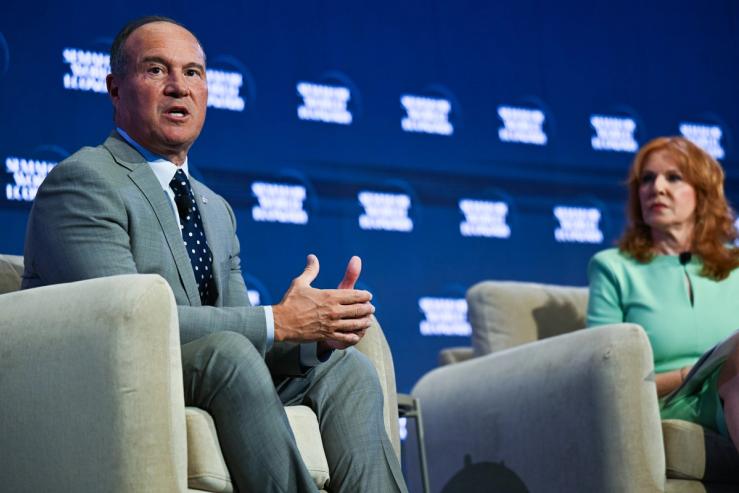
Joe Dominguez, Constellation CEO, speaks at Semafor World Economy 2026.
Annabelle Gordon/Semafor

Constellation Energy Group CEO Joseph Dominguez said Tuesday the US is “very behind” China in the race to build up energy to feed AI data centers.

If building more power plants as quickly as China is the strategy to keep pace with the AI infrastructure expansion, “we’re in some trouble,” Dominguez said at Semafor World Economy in Washington, DC on Tuesday.

“If this is going to be a race between China and the US to build energy, might as well call it a day,” he said, noting that since 2010, China has built the entirety of the US electric system plus 50% more in terms of capacity.

But the US can catch up if it uses its grid more efficiently, Dominguez said. The US is now less industrialized, which means power demand is no longer around the clock, compared to China, he noted.

“Their system is running pretty much 24/7 at high capacity,” Dominguez said. “Most of the time in the country, most of the power plants, most of the lines, most of the substations aren’t being used … So if we could manage the peak energy demands, we [would] have a lot of slack in the system we could take advantage of.”

It’s possible that American consumers could end up with lower energy prices if this strategy is successful, he said.

Asked about local opposition to data center construction, Dominguez said the US will lose the AI race and risk national security if it doesn’t successfully compete with China.

“It’s imperative that we win this … for the defense of the nation and our way of life,” he said.

The US needs a national policy in place instead of state-by-state approvals for power projects, he said.

“If NIMBYism becomes the reason we lose the AI race, for whatever reason, we’re in a whole lot of trouble in this country,” he said.

Nuclear power has been growing more popular with Americans as an option for power buildup, Dominguez said. About 65% of Americans approve of nuclear power — the highest it’s been in 30 years, he said. That’s higher than offshore wind, while only 20% to 25% support data centers.

Half of planned US data center builds have been delayed or canceled, growth limited by shortages of power infrastructure and parts from China — the AI build-out flips the breakers​

By Anton Shilov published April 3, 2026

U.S. still depends on China, despite years of onshoring efforts.

The trade-war between the U.S. and China has forced server makers out of the People's Republic, greatly reducing reliance of American companies on producers from Tianxia. However, China remains the world's largest producer of electrical equipment that is required to build power infrastructure inside and outside of AI data centers. To that end, shortages of power delivery equipment, including devices from China and other countries, are slowing project timelines, Bloomberg reports.

Despite the unprecedented level of investment in AI infrastructure — Alphabet, Amazon, Meta, and Microsoft are expected to spend more than $650 billion in 2026 to expand AI capacity — close to half of the planned U.S. data center builds this year are projected to be delayed or canceled, according to Bloomberg. One major reason behind these setbacks is the availability of key electrical components — such as transformers, switchgear, and batteries — that are used both at data center sites and outside of them, as AI companies must expand grid infrastructure to supply enough power to their data centers. Meanwhile, grid infrastructure is also stressed by electric vehicles and electrified heating systems.

Approximately 12 gigawatts (12 GW) of data center capacity is expected to come online in the U.S. in 2026, according to data by market intelligence firm Sightline Climate cited by Bloomberg. Yet only about one-third of that capacity is currently under active construction because of various constraints.

Electrical infrastructure represents less than 10% of total data center cost, but it is as vital as compute hardware. A delay in any single element of the power chain can halt the entire project, which makes transformers, switchgear, and similar devices critical items despite their relatively small share of CapEx.

Due to high demand, lead times for high-power transformers have expanded dramatically in the U.S.: delivery typically took 24 to 30 months before 2020, but waiting periods can stretch to as long as five years today, according to Sightline Climate cited by Bloomberg. For AI data centers, this is a catastrophe as their deployment cycles are under 18 months.

To address shortages, companies are turning to global markets. As a result, Canada, Mexico, and South Korea became the biggest suppliers of high-power transformers for AI data centers to AI data centers. At the same time, imports of high-power transformers from China surged from fewer than 1,500 units in 2022 to more than 8,000 units in 2025 through October, according to Wood Mackenzie data cited by Bloomberg.

The volatility of exports from China does not end with transformers, as the PRC accounts for over 40% of U.S. battery imports, while its share in certain transformer and switchgear categories remains near 30%, according to Bloomberg.

Without resolving constraints in transformers, switchgear, and batteries, even trillions of dollars in AI investment may not translate into actual AI capacity, as deployments will depend on power infrastructure availability, not capital or compute hardware constraints.

Despite a decade of reshoring initiatives, U.S. manufacturing capacity for electrical equipment remains insufficient, which means that AI companies continue to rely on imports even amid tariffs and national security concerns. Meanwhile, tensions between China and the U.S. threaten to further disrupt supply chains, which will raise costs and could delay deployments of advanced AI data centers.

Maine legislature approves first US moratorium on big data centers​

By Reuters
April 15, 20266:56 AM GMT+8Updated 3 hours ago

WASHINGTON, April 14 (Reuters) - Maine lawmakers have passed a bill that could make it the first U.S. state to put a moratorium on new data centers as ‌opposition to the electricity-hungry facilities grows across the country over their impact on household energy bills and the environment.

The bill, which still needs final approval from Democratic Governor Janet Mills, would freeze approvals for data centers requiring more than 20 megawatts of power until October 2027, while a state-appointed council analyzes ⁠their impact on the local grid, electricity bills, air and water.

AI Data Center Moratorium: Balancing Energy, Community, and Growth Risks​

Industry leaders analyze the proposed pause on AI data centers and the need to balance growth, sustainability, and community concerns.

April 15, 2026

The era of rapid data center expansion is facing new scrutiny, as a growing push to pause new data center development in the US is colliding with surging demand for AI infrastructure, as lawmakers weigh the environmental, economic and societal risks of rapid expansion.

Senator Bernie Sanders and Congresswoman Alexandria Ocasio-Cortez recently proposed legislation that would impose a federal moratorium on new AI data centers until national safeguards are established.

The Artificial Intelligence Data Center Moratorium Act calls for protections covering environmental impact, energy consumption, labor, and civil liberties before additional capacity is built.

Now, as lawmakers push for safeguards on AI data center development, industry leaders underline the need to balance growth, sustainability, and community impact.

Between May 2024 and June 2025, at least 36 US data center projects were delayed or blocked, disrupting an estimated $162 billion in investment, according to a report from Data Center Watch.
 

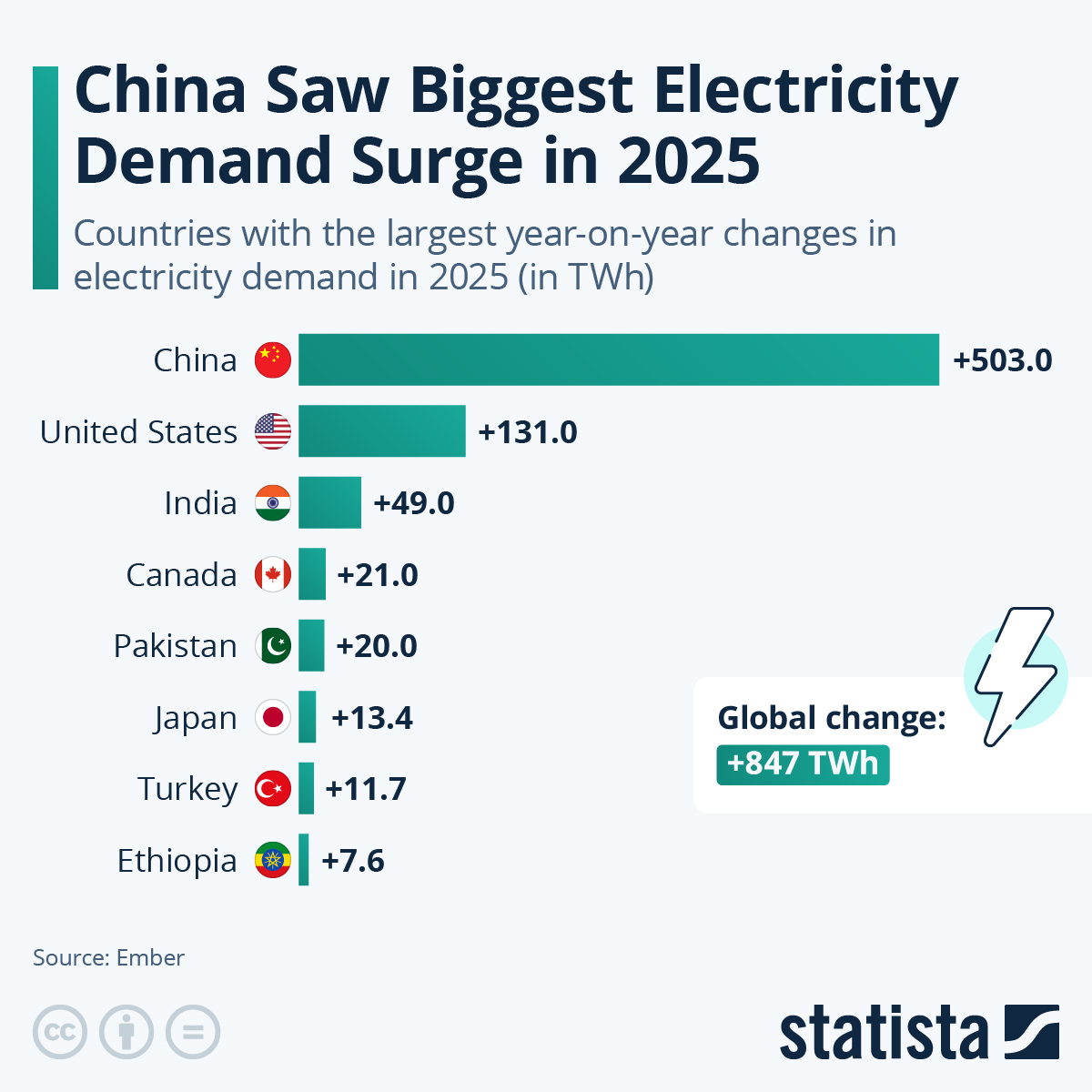
China Saw Biggest Electricity Demand Surge in 2025

by Valentine Fourreau,
Apr 22, 2026

Global electricity demand rose by 2.8 percent in 2025, according to a new analysis by independent energy think tank Ember. In its Global Electricity Review 2026, Ember reports that electricity demand grew by 849 terawatt-hour (TWh) globally last year, to a new record high of 31,779 TWh. As our infographic shows, China alone accounted for over half of the increase: the country's electricity demand grew by 503 TWh, way ahead of the United States (+131 TWh) and India (+49 TWh). In 2025, China's electricity demand accounted for a third of the global total for the first time.

While India's electricity demand had the third largest increase last year, Ember points out that it grew at the third-lowest annual rate in two decades in 2025 amid milder weather conditions. Ember points out that the global electricity demand increase in 2025 showed a notable slowdown from the 4.3 percent (+1,265 TWh) surge in 2024, but it aligns with the ten-year average of 2.7 percent. According to Ember, this slowdown is in part due to the fact that there were no temperature-related demand changes, while heatwaves drove a sharp rise in electricity demand globally in 2024. Furthermore, clean power sources fully covered the world’s growing electricity demand last year.

36120.jpeg


China’s Gotion and Richardson Electronics partner for US-made BESS
May 14, 2026

Electronics manufacturer Richardson Electronics announced it would partner with Chinese lithium battery company Gotion to produce more large-scale battery energy storage systems in the United States.

Gotion operates an battery manufacturing site in Manteno, Illinois, and Richardson has a contract manufacturing site in LaFox, Illinois.

“This partnership reflects Gotion’s long-term commitment to building a localized, resilient battery supply chain in the United States,” said Jacky Yu, VP of Sales, Gotion, Inc. “By combining our advanced battery technology with Richardson Electronics’ deep market expertise, we are enabling scalable, domestically supported energy storage solutions that meet the growing reliability, cost and performance needs of U.S. customers across commercial, industrial and utility segments.”

The two companies say that they will collaborate and introduce two new BESS platforms: a 760-kWh system for commercial storage applications, and a 5-MWh system for utility-scale. The BESS will be manufactured and assembled in Gotion’s Manteno plant.

“Richardson Electronics is excited to partner with Gotion as we expand our power management and energy storage solutions portfolio,” said Greg Peloquin, Executive Vice President and General Manager of Power & Microwave Technologies and Green Energy Solutions groups. “Gotion’s advanced battery technology combined with Richardson’s deep knowledge of the U.S. power market and global engineering support capabilities positions us well to bring reliable, high-performance battery energy storage solutions to customers across utility and commercial markets.”
 
Energy consumption is the single most reliable indicator to gauge a country's overall economy size and prowess.

Is that just your opinion, or do you have any actual data to prove that contention?
 
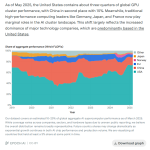
Well, the US still leads the rest of the world in total GPU computing power and data centers (not all data centers are AI-related though) by far.

And I reckon that a significant share of data centers outside of the US are actually being invested/utilized by American companies, so US tech firms are tapping into the energy supply of other countries as well.

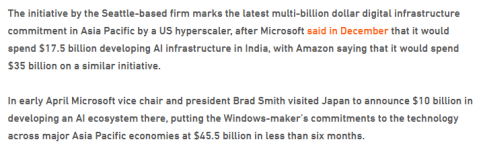
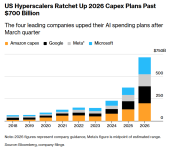
The hyperscalers are investing tens of billions in building AI-related infrastructure in Asia-Pacific. They are spending nearly $700bil in capex this year. It's crazy. No country comes close.

1779303393953.png
1779303448114.png

/

1779303895398.png

/


1779302590190.png
1779302676145.png
 

New York's AI data center pause sparks warnings US could lose ground to China​

New York's decision to pause the construction of large artificial intelligence data centers is drawing criticism from some lawmakers and energy officials, who argue the move could weaken the United States' ability to compete in the global AI race while encouraging investment to move elsewhere.

FOX Business' Madison Alworth joined "Varney & Co." host Stuart Varney to discuss New York's first-in-the-nation pause on large artificial intelligence data centers, the debate over the state's energy capacity and the broader concerns about U.S. competitiveness with China.

Critics argue that restricting new artificial intelligence infrastructure could have consequences beyond New York because demand for computing power continues to grow. Sen. John Fetterman, D-Pa., reacted on X to the state's decision with a brief warning: "China wins."

Gov. Kathy Hochul has defended the policy, arguing the state's electric grid cannot currently support additional large-scale facilities.

"A giant data center, that one 50-megawatt center... consumes as much power as 50,000 homes… I've got an energy grid that is already overtaxed," Hochul said.

Energy Secretary Chris Wright disputed that argument, saying large technology projects can help strengthen energy investment rather than strain it.
 

Users who are viewing this thread

Country Watch Latest

Latest Posts

Back
Top