Why India’s oil marketing companies are losing over Rs 500 crore daily

retaxis

Trusted Member
Joined
Nov 16, 2007
Messages
4,262
Reaction score
5,705
Reputation
2,209.7
Country of Origin
Country of Residence

Why India’s oil marketing companies are losing over Rs 500 crore daily​

Recent flare-ups in the West Asia conflict are leading to significant pain for the three PSUs — Indian Oil, Bharat Petroleum, and Hindustan Petroleum — in the absence of a hike in retail fuel prices.​

Written by: Sukalp Sharma
8 min readNew DelhiSep 24, 2026 06:36 AM IST
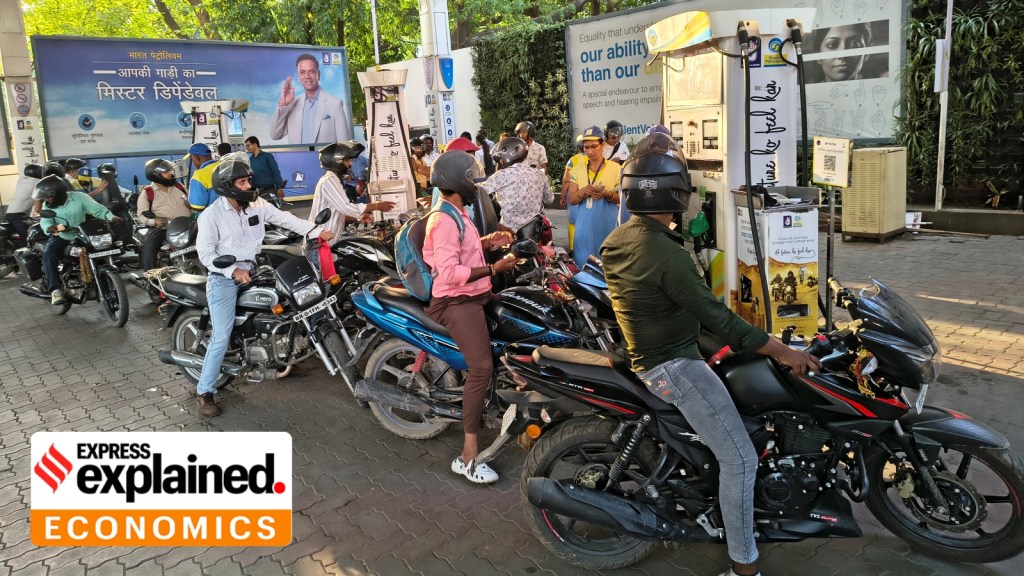
Oil marketing companies


For over three months now, retail petrol and diesel prices haven’t changed. Prices were last revised in May by a total of Rs 7.35 per litre for petrol and Rs 7.53 per litre for diesel in four rounds. Photo: Rahul Sharma
Make us preferred source on Google


The jump in crude oil and petroleum product prices globally amid the recent flare-ups in the West Asia conflict is leading to significant pain for the three public sector oil marketing companies (OMCs) — Indian Oil, Bharat Petroleum, and Hindustan Petroleum — in the absence of a hike in retail fuel prices. These companies are currently estimated to be losing Rs 9 per litre on diesel sales, Rs 8 per litre on petrol sales, and Rs 300 per cylinder on domestic liquefied petroleum gas (LPG) sales, with their daily fuel marketing losses pegged at about Rs 530 crore, according to calculations by ratings agency ICRA.

Moreover, if oil prices remain elevated beyond $105 per barrel for the second half of the current financial year and petrol and diesel prices are not revised upwards, the OMCs could be facing under-recoveries of over Rs 64,000 crore on the two automobile fuels for 2026-27. Additionally, their combined under-recoveries on LPG sales in the absence of a price hike could be upwards of Rs 1 lakh crore for the full financial year if oil prices sustain beyond $105 per barrel in the October-March period, as per ICRA’s estimates.

Crude oil prices have increased sharply in recent weeks amid escalating geopolitical tensions and supply disruptions in West Asia. The surge was driven by renewed US-Iran conflict, the shutdown of Saudi Arabia’s East-West pipeline, and heightened Houthi threat around the Bab el-Mandeb and the Red Sea region. The Indian crude basket rose to $117.4 per barrel on September 21 from the 2025-26 average of around $66.

e the OMCs are benefitting from high gross refining margins (GRMs) in their refinery operations owing to a surge in fuel margins globally, these gains are likely to provide only a partial cushion to the companies’ overall financials. This is primarily because the OMCs retail higher volumes of fuels than they produce by buying them from other refiners, including standalone refiners that don’t have much of a retail network of their own. The three public sector OMCs account for about 90% of India’s petrol and diesel retail network, and are the only players in LPG retail to households.

Fuel retailers’ finances under pressure​

India is the world’s third-largest consumer of crude oil and depends on imports to meet over 88% of its requirement. Amid the West Asia conflict, which has been ongoing for over six months now, the OMCs only partially passed on to retail consumers the international price increase in fuels like petrol, diesel, and LPG, resulting in heavy losses to the companies.

After narrowing over the past two-three months, marketing losses on fuel sales are now widening again amid the recent spurt in global prices and margins, increasing pressure on the OMCs’ finances. The three companies collectively reported a net loss of over Rs 18,000 crore for the April-June quarter. For over three months now, retail petrol and diesel prices haven’t changed. Prices were last revised in May by a total of Rs 7.35 per litre for petrol and Rs 7.53 per litre for diesel in four rounds. Despite these hikes, the OMCs continued to incur losses on retail fuel sales.

Also read | On ethanol-blended fuel, sugar and grains, the tail is wagging the dog
“Elevated crude prices and unchanged domestic fuel prices would put pressure on profitability and cash flows of OMCs. The same would also elevate their short-term borrowings for increased working capital requirements. The impact on OMCs’ earnings in 2026-27 will depend on crude prices, product cracks, retail price revisions and government support for LPG under-recoveries,” said Prashant Vasisht, senior vice president and co-group head of corporate sector ratings at ICRA.

Story continues below. Subscribe to see fewer ads.

The government usually refrains from compensating the OMCs for losses on sale of petrol and diesel, which are officially deregulated. In the case of domestic LPG, which remains a regulated fuel, the government has over the past few years stepped in to help the OMCs with special financial grants to cover their losses.

The cumulative negative LPG buffer increased sharply to Rs 61,940 crore as on June 30, 2026, as the rise in international LPG prices following the West Asian supply disruptions was not fully passed on to consumers, ICRA noted. The estimated loss per cylinder stood at about Rs 500 in the June quarter and was at around Rs 300 in September 2026. LPG under-recoveries are likely to rise further if elevated international prices persist without a commensurate increase in domestic selling prices or additional compensation from the government.
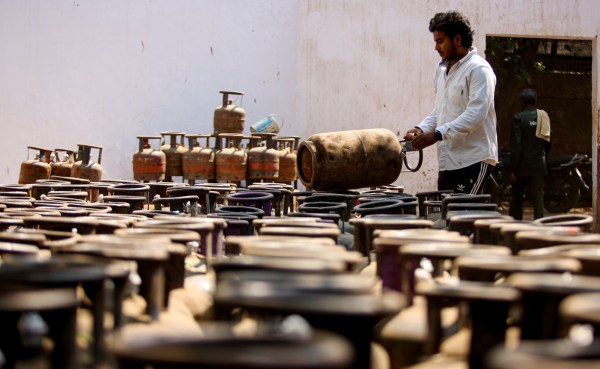
LPG
The estimated loss per cylinder stood at about Rs 500 in the June quarter and was at around Rs 300 in September 2026. Photo: Praveen Khanna
ICRA analysts noted that the combined refining and marketing operations of OMCs only break even when crude prices remain in the range of $85 to $90 per barrel. Beyond that price range, and in the absence of retail fuel price hikes, the OMCs are expected to incur marketing losses that can’t be fully offset by gains in the refinery operations, they said. It is worth noting that the West Asia crisis has not only led to a surge in crude oil prices, but has also led to a significant expansion in cracks spreads or margins of petroleum fuels in the international market.

Benchmark Singapore gross refining margins have remained above $10 per barrel since the start of the West Asia crisis, supported by refinery and product supply disruptions, inventory drawdowns and outages across West Asian refining capacity, ICRA said, adding that the additional supply shortages arising from damage to Russian refineries further tightened product markets, supporting elevated refining margins. Put simply, GRM is the difference between the total value of petroleum products produced by an oil refinery and the cost of the crude oil used to make them.

OMC under-recoveries in different price scenarios

Story continues below. Subscribe to see fewer ads.

The ratings agency’s analysis shows that if the benchmark Brent crude averages between $105 and $115 per barrel for the remainder of the financial year and domestic retail fuel prices are not increased, OMCs face projected under-recoveries of around Rs 64,000 crore on petrol and diesel for the full financial year 2026-27. In these two scenarios, marketing losses would be neutralised if retail auto fuel prices are hiked by Rs 4-6 per litre.

If the price of Brent averages in a higher band of $130–$140 per barrel, under-recoveries on auto fuels could escalate to around Rs 1.9 lakh crore. In this oil price band, even a price increase of Rs 6 per litre is unlikely to cover the losses, the projections show. However, if Brent averages in the range of $85-$95 per barrel, the OMCs fuel retail operations are expected to be profitable even without any price hike.

Also in Explained | Brent beyond $100: Why oil prices are up again, worry for India
In the case of LPG sold to households, the OMCs are expected to incur under-recoveries even if the price is hiked by up to Rs 90 per cylinder. If oil price averages between $85 and $95 per barrel, the annualised under-recovery on LPG is estimated at Rs 70,000 crore on an annualised basis if there is no price hike. If the price is hiked by Rs 90 per cylinder, the annualised under-recovery is pegged at around Rs 52,000 crore.

In the oil price band of $95-$105 per barrel, LPG under-recovery is pegged at Rs 87,000 crore in a no-price-hike scenario and Rs 69,000 crore if cylinder prices are hiked by Rs 90. If oil prices average at $105-$115, ICRA estimates the annualised under-recovery at Rs 1.03 lakh crore if there is no price hike, and Rs 87,000 crore in case of Rs 90-per-cylinder increase.

Story continues below. Subscribe to see fewer ads.

Similarly if the oil price of $115-$125 is considered, the LPG under-recovery would be Rs 1.21 lakh crore if domestic LPG prices stay where they are. Even if LPG prices are hiked by Rs 90 per cylinder, the under-recovery would still be Rs 1.03 lakh crore, according to the analysis by the ratings agency.
 
Bragging about exporting diesel meanwhile at home:

India’s dependence on imported LPG and years of poor preparation have left household kitchens exposed to a deepening gas crisis. Now, mandatory Aadhaar authentication adds another hurdle for families trying to buy subsidised cylinders.​

Published : Sep 26, 2026 16:50 IST - 6 MINS READ


Mitali Mukherjee
COMMents 0


SHARE

READ LATER
Due to a shortage of LPG cylinders, a small tiffin centre on the famous Poigai cattle shandy is using a clay tub as a stove with firewood to do its business in Poigai, Vellore district, on March 17, 2026.

Due to a shortage of LPG cylinders, a small tiffin centre on the famous Poigai cattle shandy is using a clay tub as a stove with firewood to do its business in Poigai, Vellore district, on March 17, 2026. | Photo Credit: C. Venkatachalapathy
Life in India has begun to resemble a Mortal Kombat video game, where attending to basic needs like cooking gas and fundamental rights like voting requires fighting layer after layer of technological red tape and incompetence.


Let us start with the truly unfortunate bunch, India’s oil marketing companies. No one recognises how bad the oil crisis is more than Indian Oil, Bharat Petroleum, and Hindustan Petroleum. The numbers are already pointing that way; estimates from rating agencies indicate deep losses of Rs.8-9 per litre on diesel and petrol sales, and Rs.300 per cylinder on domestic liquefied petroleum gas (LPG) sales, staggering daily fuel marketing losses of over Rs.500 crore.

But there is a bigger loser here. India’s citizens.

Despite these oil marketing companies continually absorbing such deep losses, Indians are feeling the brute impact of rising fuel costs. India’s domestic LPG customer base has declined for the first time in more than a decade. Around 6.2 million households have dropped off between April and August, while a shift to piped natural gas makes up only a fraction of this loss in LPG customers.

The question is, what are these 6.2 million households now turning to? If they are not using LPG cylinders and they have not transitioned to piped natural gas, how are these families cooking and providing food for themselves?

And while the mystery of how these millions of households are running their kitchens remains unsolved, there is an additional layer of friction added to an already fraught process with the government now saying Aadhaar authentication is compulsory for buying subsidised domestic cooking gas.

The answer to what is truly going on inside the homes of Indians may not be immediately clear or even forthcoming. What is clear is that a large part of India has recognised what the government is still tiptoeing around: a scary and imminent fuel crisis.

If you are trying to understand what exactly is happening under the hood with LPG availability, good luck. In 2025, India sourced close to 90 per cent of its LPG imports from West Asia. That all changed with the crisis in West Asia, where fuel supplies were hit hard.

In March this year, the government invoked emergency measures to ensure petrochemical feedstocks were rerouted from industry to households. India then turned to the US for help. The American share of India’s LPG imports quickly climbed to around 53 per cent in July and August. But this month, supplies of LPG from the US to India have crashed by around 70 per cent compared with August, and even more sharply from July.

The UAE has again replaced the US as India’s largest supplier, even as large tenders have reportedly been issued to import LPG from the US for delivery in 2027—this despite the reality that Indian refiners have very little appetite and spending capacity for purchasing such long-distance fuel supplies. Even trickier, considering the unpredictable nature of American policymaking and the idea now being floated in the US of export bans across different fuel groups.

What has all of this exposed? India’s energy security vulnerability, for one. Where capacity can neither be ramped up overnight, nor, it seems, has it been a priority in the last decade. Twelve years of leadership by a single party and a single leader, and yet, imports account for 66 per cent of India’s LPG consumption. Where is the atmanirbharta (self-reliance) when we need it the most?

The outcome and resolution for the conflict in West Asia remain thick as mud, which means India, in turn, will continue to flail between options and sellers that help address its domestic cooking needs.

In the meantime, oil marketing companies will dig a pit so deep they may not know how to climb out of it.

Mounting pressure​

Most importantly, India’s most needy will face another digital brick wall in needing to provide Aadhaar documentation to buy subsidised cooking gas for their homes.

As the world’s third-largest consumer of crude oil, with an extremely high dependence on imports to meet its needs, India has a cooking gas crisis on its hands, no matter what sort of boost in purchases its state-owned refiners are promising.

We could have attended to it if it were ever a real priority. As the last decade and some has shown us, clearly it was not.

In a rare moment of uncharacteristic candour and for the first time since the Iran war began, financial institution JP Morgan’s global research team wrote a note describing their view on oil. They no longer have a baseline view on oil, they said, because “we simply don’t know how to model the endgame”, and, more worryingly, the assumption that the West Asia disruptions are temporary is “becoming increasingly difficult to sustain”.

They are not alone. Chevron’s CEO has said the fuel crisis has officially arrived; the head of the International Monetary Fund warned at a public event that the energy shock from the Iran war will get worse before it gets better and, in her words, “We should prepare for people being more unhappy, more in many places, maybe on the street”.

The world can see the writing on the wall with the fuel crisis and the people of India can feel it.

In a few weeks, India will head into a peak festive period with millions of households either without a cooking gas cylinder or unable to purchase it. If the country’s leadership believes they are responsible for all of India’s perceived wins, then it is the Prime Minister and the Oil Minister who should also be held accountable for this glaring gap in one of the most critical needs for India’s households.
 
GPT-

3. Historical Example: Sinopec & PetroChina (The 2008 & 2022 Fuel Crisis)
While Chinese oil PSUs are highly profitable right now, they have acted exactly like India’s OMCs in the past when the global market became unmanageable.
  • The 2008 Scenario: In 2008, global crude oil prices touched a historic $147 per barrel. Just like India today, China froze pump prices to prevent hyperinflation ahead of the Beijing Olympics.
  • The Bleed: Because China's economy was growing at 10%+ and domestic drilling couldn't keep up, Sinopec was forced to import massive amounts of global oil at $140+ and sell it cheap domestically
 
Jealous chinese
Yes we are higher IQ, much wealthier, much more educated, 100x better at sports and much fairer skin with much greater infrastructure but we are jealous of slumdog indians lol

If any chinese read this they would think you are on crack
 
In a few weeks, India will head into a peak festive period with millions of households either without a cooking gas cylinder or unable to purchase it. If the country’s leadership believes they are responsible for all of India’s perceived wins, then it is the Prime Minister and the Oil Minister who should also be held accountable for this glaring gap in one of the most critical needs for India’s households.
India hit hardest now have to go back to firewood technology for cooking. Lack of infrastructure due to Modi corruption is hitting Indians hard!
 
India hit hardest now have to go back to firewood technology for cooking. Lack of infrastructure due to Modi corruption is hitting Indians hard!
Yeah sure. If Modi is so bad for India that your ass is on fire watching him as Indian PM. Or you are not a high IQ chinese to keep mouth shut when enemy India is making mistake ?🤣

Dont worry India will sail through.
 
Yeah sure. If Modi is so bad for India that your ass is on fire watching him as Indian PM. Or you are not a high IQ chinese to keep mouth shut when enemy India is making mistake ?🤣

Dont worry India will sail through.
I don't worry because I been on this forum for almost 20 years. I hear India superpowa 2020 by Indians when I joined this forum and India now has no technology and completely reliant on West and China for everything. That is why India is firewood reliant culture and China is electro state culture

I hope Modi and his corruption stays in power for another decade because nothing will change other than more talk and talk and poverty to follow lol
 
Do you know how hard it is to keep a 5x lead over someone? Right now China GDP is 5x that of India and it was the same story back in 2014 when Modi came to power lol. This is an epic failure of epic proportions by modi.

In 2014, China's nominal GDP was approximately $10.44 trillion, while India's nominal GDP was roughly $2.04 trillion, making China's economy about 5.1 times larger than India's.

📊 Economic Comparison for 2014
    • 📈 China Nominal GDP: $10.44 trillion (World Bank data)
    • 📈 India Nominal GDP: $2.04 trillion (World Bank data)
    • 🔎 GDP Ratio: China was over 5 times larger in absolute nominal output.
    • 🗒 Per Capita GDP (Nominal): China was around $12,513, while India was significantly lower at roughly $1,570.
    • 🗓 Growth Rate (2014): China grew at 7.3% annual real GDP growth, and India grew at 7.4%.

In 2025, China’s nominal GDP reached approximately $19.5 trillion, making its economy roughly five times larger than India’s nominal GDP of about $4.0 trillion. [1, 2]

Economic Size and Output
    • Nominal GDP: China stood at around $19.5 trillion, while India recorded roughly $4.0 trillion.
    • GDP (PPP): On a Purchasing Power Parity basis, China's GDP reached about $41.3 trillion, compared to India's $17.2 trillion.
    • GDP Per Capita: China’s nominal per capita was approximately $13,862, while India's sat at around $2,702. [1, 2, 3]
Long Live Modi!! may China always keep 5x lead over India forever!
 
I don't worry because I been on this forum for almost 20 years. I hear India superpowa 2020 by Indians when I joined this forum and India now has no technology and completely reliant on West and China for everything. That is why India is firewood reliant culture and China is electro state culture

I hope Modi and his corruption stays in power for another decade because nothing will change other than more talk and talk and poverty to follow lol
Haha electrostate, i have seen enough chinese village vloggers who joined YT because of falling Chinese economy cooking on firewood.

Let me guess, Why is your behind on fire with Modi in power..
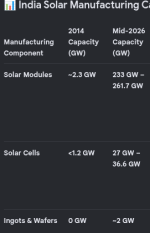
Soon even in Indian wafer market China will be thrown out..

Screenshot_20260926_231830.png

.
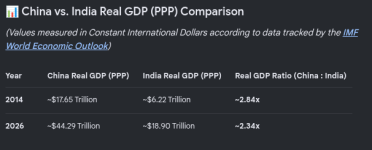
Real GDP gap is also being wrapped up.
Screenshot_20260926_231310.png
 
Indian companies extra profit after Ukraine war $16bn by buying discounted Russian oil. Loss after Iran war $13bn.

I think its fair they now have to payback after years of discounted Russian oil. Not sure for how much more though.
 
Haha electrostate, i have seen enough chinese village vloggers who joined YT because of falling Chinese economy cooking on firewood.

Let me guess, Why is your behind on fire with Modi in power..
Soon even in Indian wafer market China will be thrown out..

View attachment 216994

.
Real GDP gap is also being wrapped up.
View attachment 216991
Using PPP lol lets be real for a second shall wel?

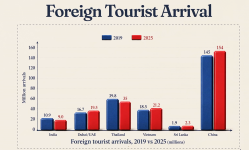
Chinese live far longer than Indians in a far cleaner, safer and the best infrastructure in the world. Indians live in the worst conditions in the world and thus does not even receive any tourists because of how disgusting the place is. Don't compare your turd world country with ours ok?

The average life expectancy at birth is about 78 to 79 years in China compared to 71 to 73 years in India. [1, 2]

Life Expectancy Breakdown
    • China: The average lifespan is roughly 78.2 to 79 years. Men live to about 74 years, and women live to about 81 years.
    • India: The average lifespan is roughly 70.8 to 72.7 years. Men live to about 65 to 68 years, and women live to about 69 years.
    • The Gap: China leads India by about 6 to 7.5 years in overall life expectancy. [1, 2, 3]

Key Health Factors
    • Infant Mortality: China has about 5.1 deaths per 1,000 live births. India has a higher rate of about 25.5 deaths per 1,000 live births.
    • Healthcare and Sanitation: China invested heavily in rural healthcare, sanitation, and infrastructure over the past few decades.
    • Progress: India has improved its numbers significantly over the years, but it still faces challenges in rural access and disease prevention. [1]
1790453180307.png


Now go back to your fake lies without any sources or proof lol. Indians jealousy cope is so hilarious lol cooking food with scavenged wood while looking at electrostate china with deep envy. Anyhooo I think I made my point so enjoy the data provided.
 
Last edited:
Yes, a massive energy crisis has forced millions of Indian households and businesses to temporarily revert to cooking with firewood. [1, 2]

🛑 The Cause: A Global LPG Supply Shock
India imports about 60% of its domestic Liquefied Petroleum Gas (LPG), with roughly 90% of those imports historically traveling through the Strait of Hormuz. Due to the ongoing war in West Asia (Middle East conflict involving Iran), this vital shipping route has faced severe blockades. The resulting supply shortage has crippled India's cooking gas infrastructure, leading to strict limits on how often citizens can book refills, causing massive black-market price spikes. [1, 2, 3]

🔄 The Firewood Pivot: Who is Affected?
    • Low-Income and Rural Households: Poorer families can no longer afford or even find LPG cylinders. Black-market prices for a single cylinder soared to as high as ₹5,000, forcing millions of people back to traditional clay stoves (chulhas) fueled by firewood, coal, and dried cow-dung cakes. [1, 2, 3, 4]
    • The Restaurant and Commercial Sector: Because the government prioritized domestic households and hospitals for the remaining gas supplies, the hospitality industry was left stranded. Restaurants and roadside eateries across major hubs like Bengaluru, Chennai, and Mumbai have built outdoor wood-fire pits or switched to electric induction cooktops overnight just to stay in business. [1, 2, 3]

⚠️ Widespread Consequences
China has rapidly established itself as the world's first "electrostate"—an industrial superpower whose economy and strategic power are driven primarily by electricity and clean technology rather than fossil fuels. [1, 2]

What Is an Electrostate?
Unlike traditional "petrostates" that rely on exporting oil, gas, or coal, an electrostate builds its wealth and geopolitical influence around electrons, renewable energy, and advanced electrification. As detailed by ABC News, this transition moves a country away from heavy fossil-fuel reliance into a self-sustaining, electrified grid. [1, 2, 3, 4]

Why China Leads
    • Massive Clean Energy Investment: Between 2019 and 2025, China outspent the rest of the world combined on clean energy, providing over half of the $1.1 trillion invested globally. [1]
    • High Electrification Rate: Electricity accounts for roughly 30 percent of China's final energy consumption, outpacing both the United States and Europe. [1, 2]
    • Supply Chain Dominance: China controls roughly 60 percent of global solar, wind, and battery manufacturing capacity, alongside more than 80 percent of solar-module output. [1]
    • Patent Leadership: Chinese companies now hold 75 percent of the world's clean energy patents, a massive jump from just 5 percent in 2000. [1]
This is like a babys 3 wheel tricycle comparing with a lamborgini. Its utterly embarassing so lets stop the comparisons lol
 
Last edited:

Users who are viewing this thread

  • Back
    Top