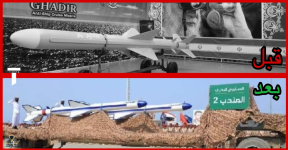
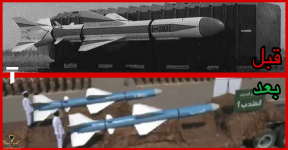
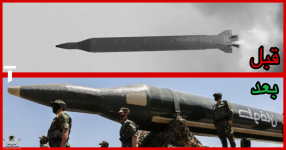
Some of the Houthi lies and fabrications include their claim of launching a locally manufactured missile at Riyadh, Saudi Arabia. However, the truth is that the Houthi Burkan missile is an old Soviet missile, over 70 years old, stolen from Yemeni army depots. It was modified with the help of foreign experts and with components from Iranian missiles smuggled into Yemen. The Mandab 1 missile is a Chinese C-801, an export version intended for other countries. It is an old missile with limited capabilities. It was also developed about 70 years ago, but its production line was later discontinued, and it was retired from service in many countries. The Houthis repainted it, changed its name, and had Iranian components installed on it by foreign experts. The Mandab 2 missile is the same, but with the body modified to resemble the Iranian Noor missile. It is manufactured in Iran and uses a Chinese export engine. It was modified, disassembled, smuggled into Yemen, and reassembled there. The Houthis lack industrial infrastructure, and the designs are identical to those of the Iranian arsenal. Exports from several countries have been proven by technical tests, showing a complete engineering and technical match with Iranian-made missiles, using components supplied by Chinese commercial companies. Now, the Houthi militias have begun using dual-use components and raw chemical materials in smuggling weapons to circumvent the military embargo. Now, the international trend is towards banning these components. What are these materials? Some examples: 1- Iron turning, which has legitimate civilian uses, and which the Houthis use to turn missile parts and components. 2- Inertial navigation systems, which are navigation aids with civilian uses, which the Houthis also use. 3- Heat and flame-resistant materials, which are materials used for insulation in assembling weapons and missile components. How is this? Instead of smuggling weapons directly as complete arms or parts, as was traditionally the case, civilian alternatives are now being transferred organically into Yemen. The Houthis import commercially available civilian goods and technologies, repurchase them within Yemen, or seize them for repurposing in local military manufacturing to circumvent the international arms embargo. These items are known as dual-use materials, as they are used in legitimate civilian industries but can be easily repurposed to assemble drones, ballistic missiles, and cruise missiles with the assistance of foreign experts who guide the Houthis in these stages.
Before and after..