Young people in China are reviving old clothing Hanfu, and maybe nationalism too

Japanese has indeed absorbed a large number of foreign words, which are transliterated into Japanese using katakana and then used in the language. Have you heard of 「Katakana Hell (カタカナ地獄)」? :oops:

In their work and daily lives, Japanese people often complain about the large number of foreign words transliterated into katakana, to the point that even Japanese people themselves have difficulty understanding them.

▼▼▼ The following are all complaints by Japanese people themselves about 「Katakana Hell (カタカナ地獄)」:

◉ カタカナ地獄【NLP】
◉ Katakana Hell【NLP】
https://ameblo.jp/kokoronlp/entry-12415358760.html

◉ 「副業用語で溺れる──カタカナ地獄の住人たちを紹介しよう」
◉ 「Drowning in Side-Business Terminology — Let Me Introduce the Residents of Katakana Hell」
https://note.com/0309_satou/n/n3b17b6128c96

◉ 「カタカナ地獄からの脱出!」
◉ 「Escape from Katakana Hell!」
https://note.com/ovcreer_yukiko/n/na74afcec51ea

◉ ネットバンキング・クレカ明細の「カタカナ地獄」を、AIで読める摘要に整える
◉ Turning the 「Katakana Hell」 of Online Banking and Credit Card Statements into Descriptions That Can Be Read with AI
https://note.com/keiri_hack_/n/ne535eded6f05


And there are indeed many elements of Japanese culture that originated in China or were heavily influenced by China, including various institutions and systems, writing, clothing, architecture, food, and so on.
The influence of China is particularly profound in Japanese writing, since Chinese characters were formally introduced into Japan as early as the 4th–5th centuries AD.

Today, the Japanese writing system contains a huge number of 「kanji」, and kanji are the absolute core of the Japanese writing system.
Only about 92 basic hiragana and katakana are writing forms developed in Japan, but they were also simplified from Chinese characters, so they cannot really be considered creations of the Japanese themselves.

The current 《Table of Commonly Used Kanji (常用漢字表)》, promulgated by the Japanese government, contains a total of 2,136 kanji. It is said that approximately 1,400 of these kanji are identical to Chinese characters.
The remaining kanji are also extremely similar to Chinese characters. We Chinese people can tell at a glance that they are Chinese characters with their strokes slightly modified.

Therefore, Japanese kanji can basically be said to be Chinese characters. If kanji were removed from Japanese, the Japanese writing system would collapse......... :rolleyes:

---------------------------------

▼▼▼ The image below is a screenshot from a Japanese video on YouTube:

The Japanese characters (kanji) marked in red are 100% identical to Chinese characters (Traditional or Simplified).
The Japanese characters (kanji) marked in green have only undergone slight changes to their strokes, but a Chinese person can immediately tell which Chinese character they originated from.
View attachment 217988

View attachment 217989

As if Chinese (or any language) doesn't have foreign word issues?

Microphone becomes 麦克风 (mài-kè-fēng). The literal meaning? "Wheat grams wind".

Bus becomes 巴士 (bā-shì). The literal meaning? "Cling to scholar".

Chocolate becomes 巧克力 (qiǎo-kè-lì). The literal meaning? "Opportunist overcomes strength"

You have to suddenly flip your brain and say "hey what a minute this makes no sense whatsoever and then deduce it must be some wacky way of writing some English spoken word"

Happens all the time in English too.
Chinese people have to finagle a way of writing their first name like "Yexin".

The first time I saw "Yexin" I had no idea what I was looking at...it's not an English word...not even sure how to pronounce it.
 
Last edited:
BTW, Japanese culture is really quite strange. At the coming-of-age ceremony for Prince Hisahito in September 2025, Prince Hisahito wore traditional Japanese clothing, yet traveled in a traditional European-style horse-drawn carriage. Couldn't they have just used an ordinary black car?

034_2-jpg.217990

Well I can't argue with an image of Japanese royalty in an obvious Western carriage.
I even have 2 of those gold colored lanterns outside my front door.

But you guys aren't exactly doing your own thing either
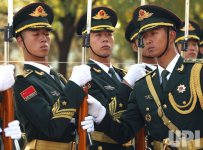
honorGuard.jpg
Not exactly 锦衣卫

honorGuard2.png
 
Last edited:
Well I can't argue with an image of Japanese royalty in an obvious Western carriage.
I even have 2 of those gold colored lanterns outside my front door.

But you guys aren't exactly doing your own thing either
View attachment 218002
Not exactly 锦衣卫

View attachment 218004


▲▲▲ Would you expect Japan's modern Self-Defense Forces to go into battle wearing traditional kimono and wooden sandals?..... :rolleyes:

----------------------

One is a bizarre mix of traditional cultures, while the other is simply the appearance of modern military forces found in many countries. The distinction is very clear, so I don't understand why you are conflating the two.

It is fair to say that almost every country wants to preserve its traditional culture as much as possible in its original form, because that is what shows its uniqueness and gives future generations something to be proud of.

Japan has many cultural elements that its people are proud of, and the institution of the Emperor has an especially strong symbolic connection to Japanese tradition. You could almost say that it is one of the things Japanese people are most proud of, especially considering that this institution has continued for more than a thousand years.

Even if Japan had never had carriages at any point in its history (hypothetically...), with Japan's design capabilities, it would certainly have been possible to redesign a European-style carriage into a Japanese-style carriage for the Japanese Imperial family to use.

Yet we see such an absurd 「Eastern-style + Western-style」 mix, presented on a member of the Japanese Imperial family. That is precisely what I find so absurd.

This inevitably makes one wonder once again just how deeply Japan is obsessed with foreign things, to the point that an element that should not be there is allowed to taint the highest symbol of Japanese traditional culture and leave an obvious blemish, while 120 million Japanese people simply allow this to happen.... :oops:


That's like identifying President Xi with "壮族"

Not exactly 锦衣卫

▲▲▲ BTW, this is only the second time I have seen you use Chinese, so from now on, perhaps I should consider you a Chinese-American.......:rolleyes:
 
Last edited:
Everything in Japan was either copied from China or the west.
Yes, a mix of civilizations, but Japanese often are emotionless and cold in public. Some more cold hearted than the Germans or the French. I wonder how they have developed themselves to that point. That’s the opposite to the Chinese, Vietnamese and Koreans.
 
As if Chinese (or any language) doesn't have foreign word issues?

Microphone becomes 麦克风 (mài-kè-fēng). The literal meaning? "Wheat grams wind".

Bus becomes 巴士 (bā-shì). The literal meaning? "Cling to scholar".

Chocolate becomes 巧克力 (qiǎo-kè-lì). The literal meaning? "Opportunist overcomes strength"

You have to suddenly flip your brain and say "hey what a minute this makes no sense whatsoever and then deduce it must be some wacky way of writing some English spoken word"

Happens all the time in English too.
Chinese people have to finagle a way of writing their first name like "Yexin".

The first time I saw "Yexin" I had no idea what I was looking at...it's not an English word...not even sure how to pronounce it.


Of course, when transliterating a name into a foreign language, it should stay as close as possible to the 「original pronunciation.」 That is simply a matter of respecting your own name and language. I don't think your criticism is reasonable.

---------------

The Oxford English Dictionary includes 「Chinglish」, so loanwords are a phenomenon commonly found in languages around the world.

Moreover, compared with loanwords in Chinese, you cannot deny that people in Japan are clearly much more bothered by loanwords. Otherwise, there would not be so many complaints about loanwords in Japan.

Even ceremonies of the Japanese Imperial family have been tainted by this. The influence of Western culture on Japanese elements is truly astonishing.... :rolleyes:
 
Last edited:
Yes, a mix of civilizations, but Japanese often are emotionless and cold in public. Some more cold hearted than the Germans or the French. I wonder how they have developed themselves to that point. That’s the opposite to the Chinese, Vietnamese and Koreans.

I cannot answer your question, but I can offer you one perspective.

One of the most common ways Taiwanese people have traditionally described the Japanese is 「有禮無體」. This is an old Taiwanese saying used by earlier generations to describe Japanese people as outwardly polite, but lacking traditional decorum in private.

And this expression comes from Taiwanese vernacular, not Mandarin (or Chinese).
So, in political terms, this is not a view originating from Chinese people, but one that originated among Taiwanese people themselves.


This suddenly reminds me of something else. Japanese workplaces have clear hierarchies, and there is even a rather peculiar practice when it comes to stamping documents. Japanese people call it 「お辞儀ハンコ」, which literally means 「bowing stamp」. It involves having a subordinate's stamp appear to bow toward the supervisor's stamp. What a peculiar culture. :oops:

View attachment 218072
 
Last edited:
Well I can't argue with an image of Japanese royalty in an obvious Western carriage.
I even have 2 of those gold colored lanterns outside my front door.

But you guys aren't exactly doing your own thing either
View attachment 218002
Not exactly 锦衣卫

View attachment 218004
The 锦衣卫 represents the spy agency of the feudal dynasty, and it does not align with our values.

But 锦衣卫 fits our clothing aesthetic, so we chose it as folk attire rather than official clothing.
 

Users who are viewing this thread

Back
Top