FHN
Trusted Member


China Unveils New Missile Defence System With Staggering 1000+ Kilometre Range: What is the HQ-19’s Role?
The Chinese People’s Liberation Army has for the first time unveiled a launcher from its HQ-19 anti-ballistic missile system at the Zhuhai Air Show, which is intended to provide a top tier level to t…
China Unveils New Missile Defence System With Staggering 3000 Kilometre Range: What is the HQ-19’s Role?
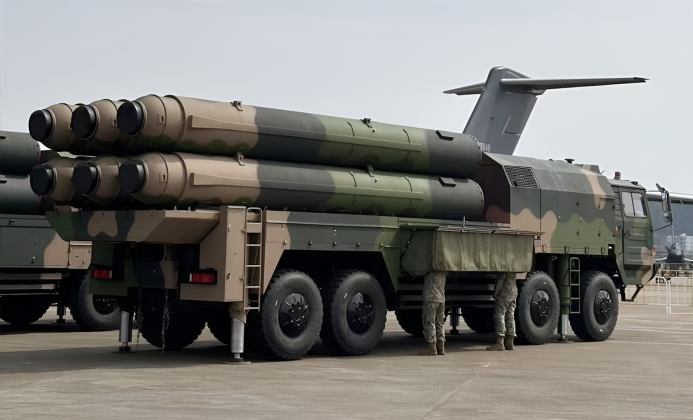
The Chinese People’s Liberation Army has for the first time unveiled a launcher from its HQ-19 anti-ballistic missile system at the Zhuhai Air Show, which is intended to provide a top tier level to the country’s surface to air missile network complementing existing systems such as the HQ-9 and HQ-22. The system has a number of similarities in its function to the American THAAD system and its ship-based counterpart the AEGIS system when integrating SM-3 missiles, and is intended to intercept medium and intermediate range ballistic missiles in their with exo-atmospheric midcourse stages. Like THAAD, the HQ-19 is thought to employ kill vehicles terminal to mid-course interception, with these using thrust vectoring for high speed manoeuvring at extreme altitudes where aerodynamic control is highly difficult to achieve. Such missiles use kinetic kill warheads, which rely on direct impact to neutralise incoming targets rather than on exploding warheads, which requires higher degrees of precision. The HQ-19 is though to use a steep-angle cold launch system to reduces stress on launchers.One of the most notable features of the HQ-19 is its stated range of 3000 kilometres, allowing it to engage incoming missiles well beyond Japan or the Philippines without leaving Chinese territory. While intermediate and medium range ballistic missiles are currently deployed in only very limited numbers by China’s potential adversaries, the deployment of the HQ-19 is likely to become far more important in future as the Western Bloc states and their allies pursue the development of a number of new hypersonic ballistic missile classes - a technology area where China currently retains a strong lead. The development of an advanced ground based exo-atmospheric missile defence system potentially paves the way for derivatives of the same system to be integrated onto destroyers in China’s navy in future, allowing them to intercept missile threats in the far seas and thus mirroring the capability which the SM-3 currently provides the U.S., Japanese and South Korean navies.