China's military robo-wolves unveiled at Airshow China 2024, possessing high mobility and adaptability in complex terrains
By Global Times
Published: Nov 11, 2024 05:40 PM
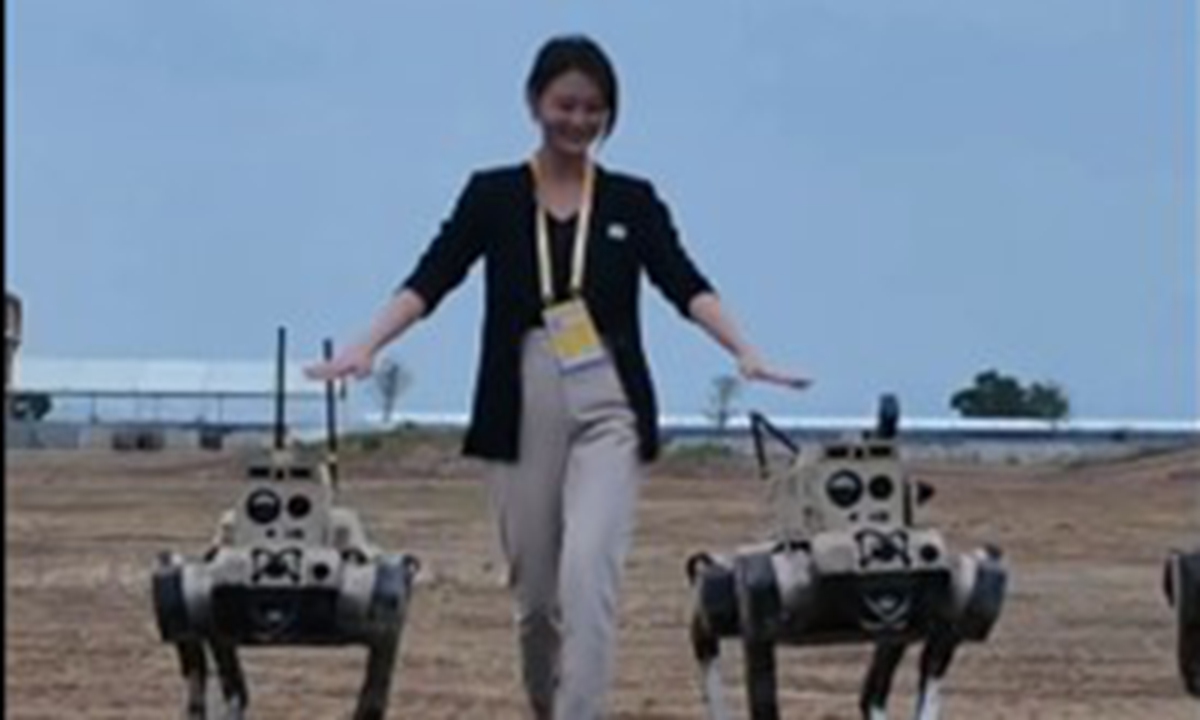
Reporters from the Global Times on Sunday interacted with robo-wolves, or quadrupedal robots at the ground dynamic display area of Airshow China 2024.
An unmanned combat system of robo-wolves, or quadrupedal robots, developed by China South Industries Group Corporation (CSGC), has attracted wide attention with its cutting-edge design and advanced combat concepts at this year's Airshow China being held in Zhuhai, South China's Guangdong Province.
Reporters from the Global Times on Sunday interacted with these quadrupedal robots at the Airshow's ground dynamic display area. After the field vehicle carrying quadrupedal robots was parked, a number of these types of robots got off the vehicle themselves and began interacting with the GT reporters following the commander's instructions.
The Global Times learnt from the CSGC that these robo-wolves are named for their ability to perform in cluster operations like wolves. They are capable of providing integrated cluster combat tactics for special operations detachments and infantry detachments.
These quadrupedal robots, based on a general-purpose platform, feature high mobility and adaptability in complex terrains. They are equipped with capabilities such as walking alongside people, overcoming high obstacles and climbing stairs in complex terrains, and can walk in most terrains.
With a total weight of 70 kilograms, robo-wolves enable applications in multifunctional and various scenarios by equipping various payloads, a staff member from CSGC told the Global Times on Sunday.
The staff member said that they are currently developing a new mode for air-ground collaborative operations in unmanned clusters based on groups of ground-based robo-wolves and airborne drones. The robo-wolves can also carry drones to operate jointly, the staff added.
The cluster system of robo-wolves consists of multiple types of bionic quadrupedal robots, including integrated strike quadrupedal robots, reconnaissance and detection quadrupedal robots, transport quadrupedal robots, and operation and disposal quadrupedal robots, the Global Times learned.
These quadrupedal robots are capable of performing complex clearance tasks in town streets, factories, mines, caves and other scenarios in a coordinated manner.
The system is composed of a carrier or control vehicle, coupled with a number of multi-type quadrupedal robots.
This time, the GT reporter had an opportunity to see a formation formed by two integrated strike-type quadruped robots, one reconnaissance and detection-type quadruped robot, and one transport-type quadruped robot. It supports a combat radius of up to two kilometers, an endurance of up to three hours, and a maximum of 30 self-organizing network nodes.
Using the cluster warfare concept, this system enables interconnectivity, information sharing and dynamic autonomous collaboration among humans, vehicles, and robots. The system also possesses an integrated unmanned combat capabilities in complex environments for investigation, combat, destruction, evaluation and protection.
In addition, the system provides effective solutions to the problems associated with poor communication capability, weak assault capability, limited access, weak cross-layer mobility and weak single-unit combat effectiveness in the complicated environments like urban areas and plateau mountains, which in turn enables the special forces and infantry detachments to be provided with clustered and integrated combat tactics.








 Makkah Defence Alliance: Turkey, Saudi Arabia, and Pakistan, news & updates (18 Viewers)