
Psyko70
Trusted Member

Game title ?A few files that i worked on modifying a game and putting Pakistani units in it.
View attachment 156541
Follow along with the video below to see how to install our site as a web app on your home screen.
Note: This feature may not be available in some browsers.
Game title ?A few files that i worked on modifying a game and putting Pakistani units in it.
View attachment 156541
CnC Zero hour.Game title ?

Just yesterday or day before as per reports India initiated unprovoked firing with small arms in Leepa sector.@Panzerkiel @Oscar @RescueRanger
uptil now we have no reports of ceasefire been broken at LOC up north? we are sure of this? right? nothing has happened? right?

Before we get too worried -India is looking to shift Sir Creek border by around 96kms, which will get important oil reserves and fishing areas into their maritime boundaries. Its not the dead marshes of Sir Creek, but the associated Maritime region in the sea that India wants. The question from India's POV, is that will Pakistan strategic retreat, in order to avoid escalation to nuclear levels, or will Pakistan go all in for a mere 96 Km disputed area (mere is their assumption, of course not ours) ? They are hoping for the former.
India are hoping to:
Though Pakistan can keep going at this for a long time if it wants. That area does not offer any benefits to tactically larger side, so India will still have a very hard time and it will bet very costly, unless one side decides to back out. I guess India has decided they will go all in for this until Pakistan gets tired of defending it. It will be upto our policymakers on what they decide to do eventually.
- Either capture the area, hence getting bragging rights domestically, lose humiliation of May and getting a part of the oil reserves and Fishing Areas
- Or At least come to an agreement where Pakistan vacates, still earning them bragging rights
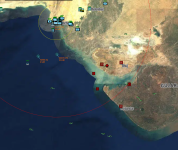
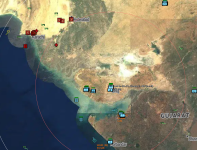
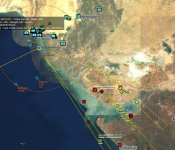
Indian Army will probably have 21 Corps and its formations involved in the exercise.By using FC, drones, limited Airforce and other modern tactics, the Military has shown that it can devatate Taliban. THIS IS A GREAT ACHIEVEMENT since this means that the core of Pakistan Military can take care of India.
2 front or 3 front, India will get destroyed - chance of a nuclear weapons is growing !!
FC is better armed, trained and battle hardened then Sindh or Punjab RangersIt's why Pakistani military has remained vigilant and pointed towards India
And the FC and drones have taken on Afghanistan, going forward it will be the FC taking care of the western front with hopefully better and better equipment
It's time to train the FC at a minimum on par with the Pak Rangers and incorporate all levies into one large FC, which will give us something in the region of 1.5 million men at arms to call upon
They not only lack light mechanize elements but it seems PN Marine force lack Artillery elements as well, which means they are not even equivalent to light infantry battalion as per international standard as light infantry have proper cover of air elements and support of gunships and we know even PA is struggling in gunship domain and PN don't have any gunship elements so it is unlikely that Marine would have that support.IA has BMP-2 IFVs and T-72 tanks with its amphibious formation.
Like which area?There are multiple areas where amphibious operations can be conducted, its not restricted to one area only.
It's an article by Tribune. It was paywalled.IAF seeks 800 medium-range swarm drone systems to hit targets over 350 km
The Armed forces require thousands of drones — both for tactical and strategic employment — as they are cost-effective, force multipliers, and reduce the risk to human life
The Indian Air Force (IAF) has projected a requirement of 800 medium-range swarm unmanned munition systems (SUMS) to meet its requirements for remotely targeting hostile objectives at ranges over 350km.
Each system would have a swarm of at least 20 drones that can be launched in quick succession, loiter over a designated area beyond 350km for at least 30 minutes and autonomously search, detect and identify static or moving targets.
“Swarm drones are effective as they saturate enemy air defence systems, confuse the enemy radars and provide IAF decision makers the option to deploy in a couple of hours against hostile command and control targets,” a request for proposal issued by the Ministry of Defence on October 25 states.
The IAF wants fixed-wing drones with a hybrid jet-engine and battery power pack that can carry a minimum of 30kg of ordnance in addition to its required payload of sensors, electronic counter-measures, communication equipment and navigation aids.
These should be able to operate effectively from altitudes ranging from sea level to 16,000 feet and capable of launch and recovery from unprepared surfaces and the deck of a ship at temperatures varying from minus 20°C to 50°C.
Drones of various types and capabilities have emerged as the centrepiece of the contemporary battle space for attack, surveillance and logistics. The employment of drones in offensive and defensive operations came to the fore during Operation Sindoor.
In the Indian Armed Forces, drones have been integrated virtually into every arm and service for different applications. Lessons learnt during Operation SIndoor, and also inference drawn from conflicts in other parts of the world are being implemented and fine-tuned.
The Armed Forces require thousands of drones — both for tactical as well as strategic employment. Drones, while being cost-effective, are also force multipliers, and also reduce the risk to human life.
While there are numerous projects underway by DRDO, scientific institutions and the industry to design and manufacture drones, the forces are also laying a lot of focus on the in-house development and fabrication of tactical drones and the training of troops in handling such equipment.
mods right ?CnC Zero hour.
Lol. Too late I reckon

Hypersonic?


