Navigation
Install the app
How to install the app on iOS
Follow along with the video below to see how to install our site as a web app on your home screen.
Note: This feature may not be available in some browsers.
More options
Style variation
You are using an out of date browser. It may not display this or other websites correctly.
You should upgrade or use an alternative browser.
You should upgrade or use an alternative browser.
China space program
- Thread starter FHN
- Start date
More options
Who Replied?



RajaBaja
Trusted Member

China launches 8th batch of satellites for 13,000-strong internet megaconstellation (video)
Mike WallThu, August 14, 2025 at 2:00 AM GMT+5·2 min read
When you buy through links on our articles, Future and its syndication partners may earn a commission.

Credit: CCTV
China is ramping up construction of its national satellite-internet megaconstellation.
A Long March 5B rocket lifted off from Wenchang Space Launch Center on the island of Hainan on Wednesday (Aug. 13) at 2:43 a.m. EDT (0643 GMT; 2:43 p.m. local time), carrying a batch of satellites aloft for the Guowang broadband network.
The mission to low Earth orbit (LEO) was a complete success, according to the state-owned China Aerospace Science and Technology Corporation (CASC).

A Chinese Long March 5B rocket launches the eighth batch of satellites for the Guowang internet megaconstellation from Hainan island on Aug. 13, 2025. | Credit: CCTV
Guowang, whose name translates as "national network," will be operated by China Satnet, a state-run company established in 2021. The constellation will eventually consist of about 13,000 satellites, if all goes to plan.
Guowang is a long way from that goal. Wednesday's launch was just the eighth overall for the network, and each mission lofts just eight to 10 spacecraft, apparently because each satellite is quite large.
For comparison, SpaceX launches 24 to 28 satellites on each mission to assemble its Starlink broadband megaconstellation, which currently consists of nearly 8,100 operational spacecraft.
But China is picking up the Guowang pace: Wednesday's liftoff was the fourth for the project in less than three weeks.
Related Stories:
— China launches 1st set of spacecraft for planned 13,000-satellite broadband constellation (photo)
— Starlink satellites: Facts, tracking and impact on astronomy
— A Chinese spacecraft has been checking out US satellites high above Earth
Guowang isn't the only Chinese broadband megaconstellation in the works. Another one, called Qianfan ("Thousand Sails"), began construction last year, like Guowang — and it's envisioned to be just as big.
And the megaconstellation push extends beyond Starlink, Guowang and Qianfan. On Monday (Aug. 11), for example, SpaceX launched a batch of satellites for Project Kuiper, Amazon's planned LEO broadband network, which will eventually feature about 3,200 spacecraft.

China launches 8th batch of satellites for 13,000-strong internet megaconstellation (video)
A Long March 5B rocket launched the eighth batch of satellites for China's Guowang broadband network on Wednesday (Aug. 13). It was the fourth Guowang launch in less than three weeks.
RajaBaja
Trusted Member
This is a massive endeavor. Out of these 13,000 satellites, how many estimated will be military, spy / recon and how many for other purposes? Kindly share opinion and knowledge.
@Beijingwalker @chinasun @Nan Yang @52051
@Beijingwalker @chinasun @Nan Yang @52051

chinasun
Registered Member
This is a massive endeavor. Out of these 13,000 satellites, how many estimated will be military, spy / recon and how many for other purposes? Kindly share opinion and knowledge.
@Beijingwalker @chinasun @Nan Yang @52051
China’s GuoWang constellation plans 12,992 LEO satellites to create a global 6G network, enabling direct-to-handset links, rural broadband, emergency comms, and integrated maritime, aviation, remote-sensing and PNT services. It mirrors SpaceX’s Starlink, which intends to deploy 42,000 satellites; over 5,000 are already in orbit, providing worldwide low-latency internet for commercial users and U.S./allied defense, including battlefield connectivity in Ukraine.
Last edited:
RajaBaja
Trusted Member
China’s GuoWang constellation plans 12,992 LEO satellites to create a global 6G network, enabling direct-to-handset links, rural broadband, emergency comms, and integrated maritime, aviation, remote-sensing and PNT services. It mirrors SpaceX’s Starlink, which intends to deploy 42,000 satellites; over 5,000 are already in orbit, providing worldwide low-latency internet for commercial users and U.S./allied defense, including battlefield connectivity in Ukraine.
That makes sense. What about Radar and SAR? The US is deploying Radar tech on Satellites where they won't need Spy planes anymore like the E-3's or E-7's. All data will be relayed at Fiber Optics speed, faster than light emissions between the satellites to 5th gen and 4.5 gen platforms, ships and subs. Is China deploying a network of satellite constellation on same capability too?
chinasun
Registered Member
China is turning radar satellites into orbital infrastructure. The Xingwang, Qianfan and Honghu constellations have already launched over a hundred C-, X- and Ku-band SAR satellites and will expand to tens of thousands. From hundreds of kilometres up they image and track ships and aircraft day and night, relaying the data at fibre-optic speed via inter-satellite lasers and Q/Ka links to fifth- and 4.5-generation fighters, warships and submarines. When a satellite nears end of life, batches of replacements are launched, letting the system heal itself and provide round-the-clock global coverage.That makes sense. What about Radar and SAR? The US is deploying Radar tech on Satellites where they won't need Spy planes anymore like the E-3's or E-7's. All data will be relayed at Fiber Optics speed, faster than light emissions between the satellites to 5th gen and 4.5 gen platforms, ships and subs. Is China deploying a network of satellite constellation on same capability too?

Beijingwalker
VIP Member
China's Long March-10 carrier rocket succeeds in first static fire test, marking significant milestone in China's manned lunar exploration program
Xinhua2025-08-15 19:58:45
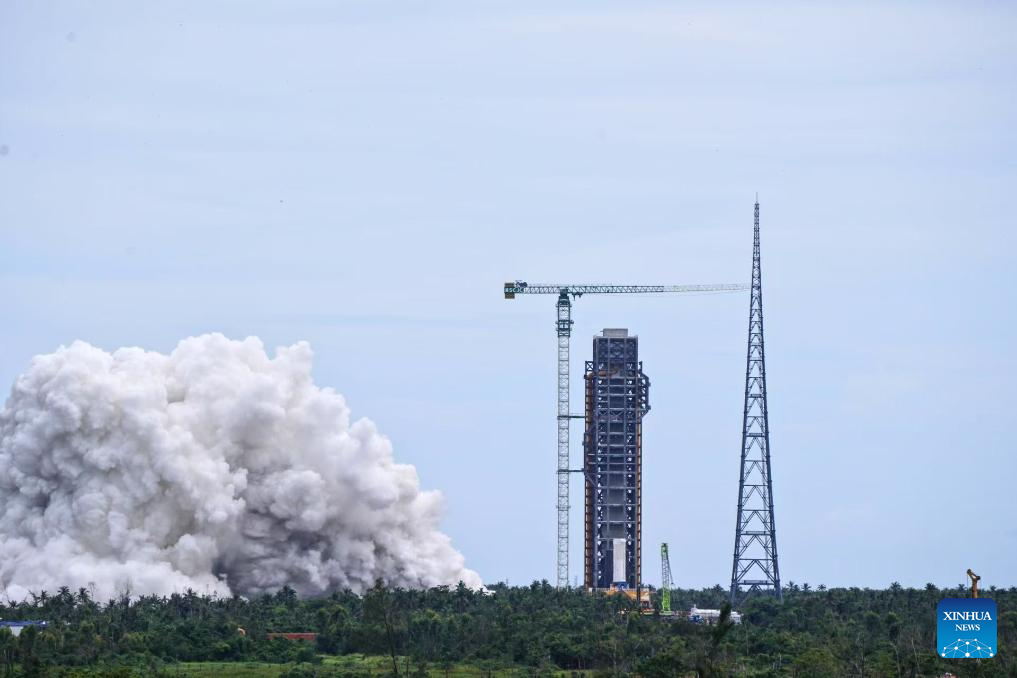
This photo taken on Aug. 15, 2025 shows the static fire test of China's Long March-10 carrier rocket at the Wenchang Spacecraft Launch Site in south China's Hainan Province. China's Long March-10 carrier rocket, the country's new-generation manned launch vehicle, has successfully completed the first static fire test here on Friday, the China Manned Space Agency has announced. (Xinhua/Zhang Bin)
WENCHANG, Hainan, Aug. 15 (Xinhua) -- China's Long March-10 carrier rocket, the country's new-generation manned launch vehicle, has successfully completed the first static fire test on Friday at the Wenchang Spacecraft Launch Site in the southern island province of Hainan, the China Manned Space Agency (CMSA) has announced.
This marks a significant new milestone in China's manned lunar exploration program, following the successful zero-altitude escape flight test of the Mengzhou manned spacecraft and the comprehensive landing and takeoff test of the Lanyue manned lunar lander, according to the CMSA.
At 3:00 p.m. Friday, seven engines of the test product of the rocket's first stage were ignited simultaneously, followed by the completion of multiple scheduled test procedures.
This static fire test evaluated the simultaneous working capacity of the seven parallel engines of the rocket's first stage under standard and high working conditions, as well as obtained complete test data. The test was a complete success, the agency said.
The thrust scale in Friday's test reached nearly 1,000 tonnes, marking the largest such test ever conducted in China.
The Long March-10 carrier rocket series is developed to serve China's manned lunar exploration missions, including two configurations -- the Long March-10 rocket and Long March-10A rocket.
The Long March-10 rocket is a type of three-stage rocket with two boosters. It has a diameter of 5 meters and a maximum height of 92.5 meters. It will undertake the launch missions of the manned spacecraft and the lunar lander.
The Long March-10A is a type of two-stage reusable rocket, with a diameter of 5 meters and a maximum height of 67 meters. Its first stage can be recycled and reused. It will serve the launch missions of the Mengzhou manned spacecraft and Tianzhou cargo craft in the application and development phase of the country's space station.
The success of the static fire test has laid an important technical foundation for the manned lunar exploration mission, the CMSA said.
The agency stated that the Long March-10 series rockets will be fully utilized in the country's manned spaceflight program, working in tandem with the Mengzhou manned spacecraft to achieve the upgrading of China's manned space-Earth round-trip transportation system.
New supporting infrastructure for the country's manned lunar exploration program is under construction at the Wenchang Spacecraft Launch Site, with all work progressing smoothly, the CMSA said. ■
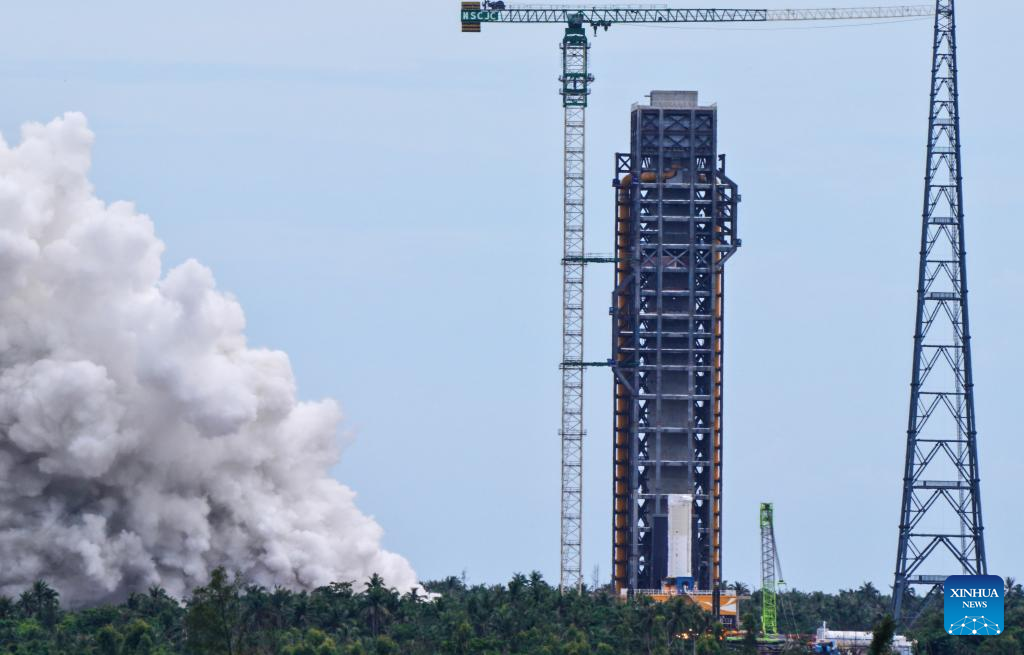
This photo taken on Aug. 15, 2025 shows the static fire test of China's Long March-10 carrier rocket at the Wenchang Spacecraft Launch Site in south China's Hainan Province. China's Long March-10 carrier rocket, the country's new-generation manned launch vehicle, has successfully completed the first static fire test here on Friday, the China Manned Space Agency has announced. (Xinhua/Zhang Bin)
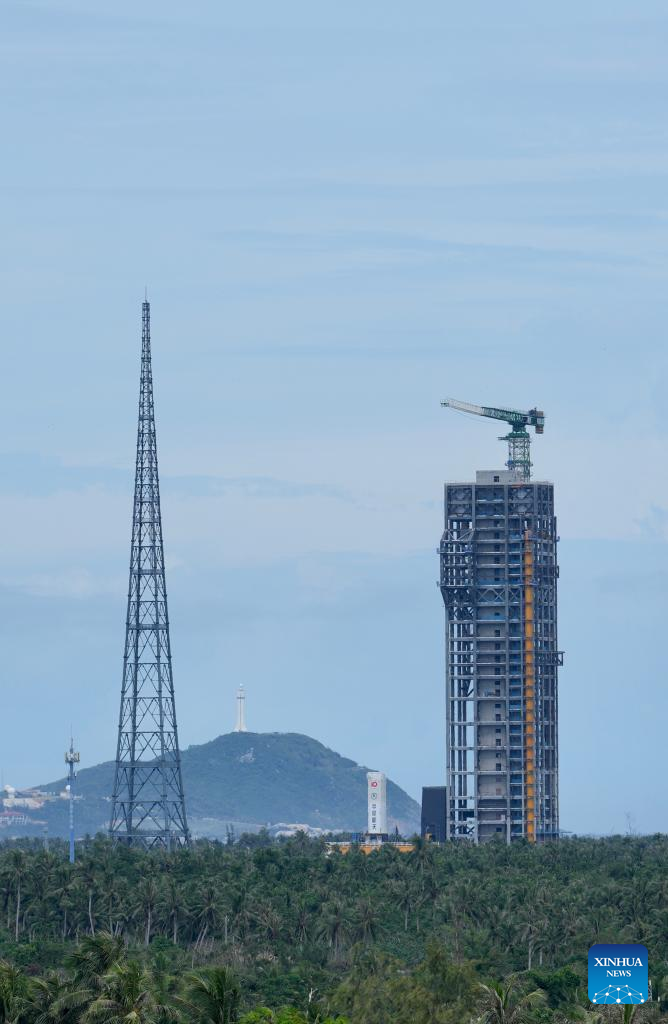
This photo taken on Aug. 15, 2025 shows the static fire test of China's Long March-10 carrier rocket at the Wenchang Spacecraft Launch Site in south China's Hainan Province. China's Long March-10 carrier rocket, the country's new-generation manned launch vehicle, has successfully completed the first static fire test here on Friday, the China Manned Space Agency has announced. (Xinhua/Zhang Bin)

Pakistani Dragon
Elite Member

Welcome back @Beijingwalker .


Beijingwalker
VIP Member
Are China's Spy Satellites A Lifeline For Russia's Struggling Space Intelligence?
October 17, 2025 13:04 CETBy Ray Furlong
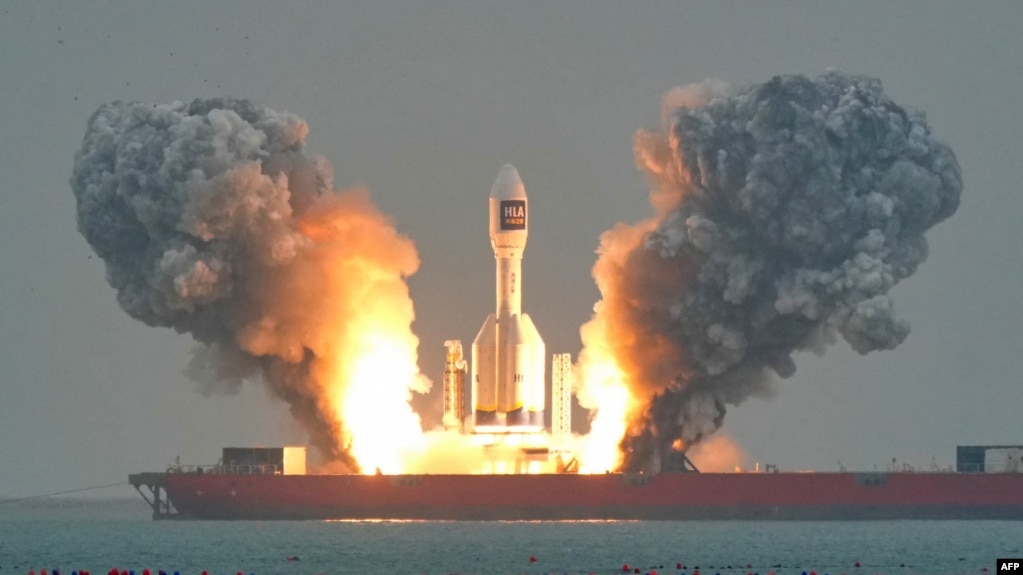
A Chinese Gravity-1 rocket lifts off on October 11 carrying three satellites into orbit
Summary
- Chinese spy satellites reportedly observed Ukraine during Russian missile attacks, raising concerns about potential intelligence sharing with Russia.
- Experts suggest Russia's aging satellite infrastructure and reliance on Western components have created a need for Chinese assistance.
- China's advanced satellite capabilities, including synthetic aperture radar, could provide Russia with higher-quality battlefield intelligence.
The Kremlin has denied that China was providing it with battlefield information, saying it has its own satellites. But experts suggest that, in fact, Russia has a dire need for Chinese assistance.
“Russia's infrastructure is pretty old and creaky,” said Clayton Swope, who spent 14 years in the CIA, mostly in its Directorate of Science and Technology.
“It really seems like a no-brainer that if China is willing to offer either something from a company or from its own government capabilities, Russia will take advantage of that,” Swope, now at the Washington-based Center for Strategic and International Studies (CSIS), told RFE/RL.
China’s Spy-Sat Capabilities
Given the classified nature of such information, it’s hard to say exactly how many spy satellites any nation has.A report published by the US Defense Intelligence Agency in 2022, Challenges to Security in Space, estimated that China had 262 satellites for ISR (intelligence, surveillance, and reconnaissance) compared to Russia’s 32.
“Russia actually started buying commercial satellite imagery on the free commercial market from April 2022,” Juliana Suess, from the German Institute of International and Security Affairs (SWP), told RFE/RL.
“That sort of shows us that Russia realized that actually this is something that they would need. And it also shows that their own sovereign capabilities were simply not enough to plug that gap.”
There is also a quality gap, largely caused by Russia’s ageing satellite fleet. Some of it dates from Soviet times but there have also been more recent launches, including since the start of Russia’s full-scale invasion of Ukraine, over 2022-24.
But even the newest Russian satellites have been affected by wartime Western sanctions.
“This is definitely something they'll be struggling with in terms of where they get their components from and Russian satellites have historically been made of Western components,” said Suess.
In August, the head of Russia’s largest spacecraft manufacturer opened a rare window on the problems facing the country’s space industry, saying “we need to stop lying to ourselves” about the condition it was in.
Igor Maltsev, head of Energia, spoke of chronic underfunding, “ineffective” processes, and lost motivation.
“We've definitely seen Russia build up their capabilities. But on the whole, we can still say that Russia doesn't have particularly good Earth-observation capabilities, and this is also a broader problem that they're having in terms of their space industry lagging behind massively," said Suess.
The quality of the Chinese satellites, particularly in regard to synthetic aperture radar or SAR (which can see through clouds, for instance), is generally reckoned to be much higher than Russia’s -- providing higher resolution imagery and building 3D images.
“In terms of the quantity, diversity, and quality of the data the Chinese can provide, there is no doubt it'll be useful for Russian intelligence and military analysts,” Bleddyn Bowen, who has advised the Pentagon and UK Defense Ministry on space policy, told RFE/RL.
The key advantage, said Bowen, who is an associate professor in astro-politics at Durham University, was better battle damage assessment.
“It could be better tracking of Ukrainian military maneuvers…. If a hill has been evacuated and nobody's there and a satellite can see that, then if you get notice of that an hour after this happened as opposed to after four hours that makes your forces much more responsive,” he said.
So far, this has been an area where Ukraine has enjoyed an advantage over Russia during the war, receiving satellite intelligence from the United States and also European allies. The importance of this data was underlined when Washington briefly stopped supplying it earlier this year.
The week-long move hindered Ukraine’s ability to carry out effective long-range drone strikes and left it blind over the movements of Russian strategic bomber aircraft and ballistic missile launches.
What Does China Want?
But it remains unclear how much data, if any, China is actually sending to Russia. Western officials have refrained from making specific public accusations on the issue.“China is the decisive enabler of Russia’s war in Ukraine. China also provides nearly 80 percent of the dual-use items Russia needs to sustain the war,” an official at the State Department told RFE/RL.
“Continued cooperation between these two countries will only further contribute to global instability and make the United States and other countries less safe,” the official added.
In an interview with RFE/RL’s Current Time, the European Union’s commissioner for defense and space, Andrius Kubilius, was noncommittal.
“What is the Chinese position towards the whole war? We can guess, you know. It looks like that they are, you know, keen to keep this war going on as long as possible, learning also from that war, supporting, you know, Russian side,” he said.
Swope pointed out that little is known about the specific Yaogan satellites that reportedly spied on Ukraine. Three of them, he said, were SAR-equipped.
“I think the big question might be…are they just providing more strategic intelligence and even tactical intelligence about what's happening on the battlefield? Or are these systems somehow tied in to, say, how you would steer a missile?” he said.
Equally, he said, the Chinese satellites could have been gathering information purely for study back in Beijing, “for their own assessment of how conflict is going to be fought in the future.”
Bowen agreed that China’s intentions were unclear.
“It remains to be seen how close, how tactical is that relationship between Russia and China on this,” he said. “Because they're not natural allies, really. China does not want to tip its hand too much to the Russians.”
Another important issue is having sufficient capacity to receive and evaluate incoming information. This is where data-processing becomes decisive, and it is unclear what Russia’s capabilities are in this regard.
“This is something that Western militaries have to contend with as well,” said Suess.
“We talk about a sensor-rich battlefield now, but actually the bottleneck is the processing. This is where AI comes in. This is where the sort of algorithm comes in…filtering through the massive information that you get given,” she added.
liuzhengdong
Registered Member
China is set to launch the Shenzhou-21 crewed spacecraft with three taikonauts on a mission that includes pioneering biological experiments with mice in space. In a significant international collaboration, a Pakistani payload specialist will also join a separate, upcoming spaceflight. The mission will conduct 27 scientific research projects aboard China's Tiangong space station.
Attachments


SABRE
Registered Member
More important question, Pakistan has astronauts? There are reports of training program with China but I haven't heard or seen anything in practical terms yet.Pakistan astronauts are going to the Chinese space station?
Pakistan Defence Latest


Country Watch Latest


Latest Posts
-
-
-

-
-
Many Tibetans move to border defending villages in China-India border regions (17 Viewers)
- Latest: retaxis