Afghan Refugees op/ed by Ambassador Tariq Osman Hyder

Can they get rid of the legal ones too? What about the ones who illegally purchased passports?

When are they going to go door to door in Karachi, Balochistan and FATA?
They are going door to door in Balochistan. Usually those returning at Torkham triple those from chaman for the past couple fo days it has been inverse. Camps in loralai got demolished when they refused to leave. Don't know what's going on in Karachi, somebody local or those keeping an eye on situation there might know.
There aren't many afghan refugees in FATA to speak of, they are mostly in KPK proper. There has been no operation like that in Balochistan here. Nor in Punjab as far as I know, but then again there aren't as many there anyway. Both provinces have chosen to negotiate with camps and facilitate their return rather than coerce their return.

As for those with fake CNICs, only federal govt and FIA can weed them out As they have the database. Local police can't do shit against "citizens" until unless Federal govt proves in court whether someone is illegal citizen or not. That will take time and a lot of effort from a state that prefers quick temporary fixes rather than permanent solutions.


Last but not least, there is shortage of trucks. Hundreds of thousands of Pakistani trucks have been stranded on afghan side after transporting afghans illegals and their households. I don't know who isn't letting them back, us or afghans. This has caused transportation costs for migrants to double and triple. We talking from 50-80k to now 200-300k. Most can't afford that and this is slowing down the rate of voluntary returns. In one or two camp in Balochistan, they were all packed up and ready but with no trucks local DC himself had to arrange transportation for them.
This should be the federal govt job to facilitate repatriation instead just ordering it and then forgetting about it until the deadline.
 
Last edited:
Afghans awaited U.S. resettlement. Pakistan sent them back to the Taliban.

More than 1 million Afghans have been pressured to leave or deported by Pakistan. Many were former U.S. contractors approved for U.S. resettlement, now on hold under Trump.

For Mursal, the nightmares began in late January.

That’s when the 28-year-0ld Afghan woman learned that President Donald Trump, in one of his first acts back in office, had suspended all refugee arrivals to the United States.

The former economics student’s father had worked for U.S.-funded media projects during the 20-year war in Afghanistan. After the Taliban toppled the U.S.-backed government in Kabul in 2021, the Biden administration promised them safe haven in America.

They sold their belongings, moved to Pakistan and awaited what they and tens of thousands of refugees believed to be imminent resettlement in the U.S. Now she feared she would be deported back to Afghanistan under the Taliban’s repressive rule.

The nightmare came true in July. With their U.S. resettlement cases still pending, Mursal and her family joined the more than 1 million Afghans pressured to leave or be forcibly deported by Pakistani officials in the past 2½ years, the U.N. estimates.

Now, they’re hiding in Afghanistan not only from the Taliban, which have imposed increasingly harsh restrictions on Afghan females, but also from family and friends.

“Everyone knows we worked with the U.S.,” Mursal told The Washington Post via a secure messaging app. “We fear what will happen if someone informs the Taliban’s intelligence unit.” Like other Afghans in this report, she spoke on the condition her full name be withheld out of concern for her safety.

When Pakistan began deporting Afghans en masse in fall 2023, the Biden administration gave letters of protection to Mursal and others who were waiting for U.S. resettlement. For almost two years, Pakistani authorities largely complied with U.S. requests to shield those who had supported the U.S. war effort in Afghanistan or were otherwise eligible for resettlement.

But that has changed in recent months. Pakistani officials appear to no longer believe the U.S. is serious about resettling the Afghans who have been left behind, according to interviews with seven Afghans who have recently been deported from the country.

“Trump has created this chaos,” said Taimor, a 36-year-old former contractor for the U.S. Army Corps of Engineers. He fled Afghanistan, he said, after the Taliban detained and tortured him for his work in 2022. He was deported back to the country in July.

The Pakistani Interior Ministry did not respond to a request for comment. A senior Foreign Ministry official, speaking on the condition of anonymity because he was not authorized to speak publicly, acknowledged “missteps at the operational level by law enforcement.”

But he disputed that Afghans awaiting resettlement in the U.S. have been deported in large numbers. “Individuals who were mistakenly deported have later been facilitated to return,” he said.

The White House did not comment and the State Department did not respond to a request for comment.

“We’re not hearing a lot from government anymore,” said Shawn VanDiver, the Navy veteran who leads AfghanEvac, which helps Afghans flee the country. “They just frankly don’t seem to care."

Taliban officials say returnees have nothing to fear. They cite a general amnesty for all members of the U.S.-backed Afghan administration the regime declared in August 2021.

But the U.N. warned in July that some are still subjected to “serious human rights violations” including “torture and ill-treatment, arbitrary arrest and detention, and threats to personal security.” Women, former employees of the previous government, media workers and members of civil society are at particularly high risk, the U.N. said.

Some refugees say Trump has appeared more eager in recent months to regain control of Afghanistan’s Bagram air base than with their plight.

“If the U.S. is serious about wanting to return to Bagram, the Taliban will take it out on us,” Taimor said. “They take this very seriously.”

‘There is no mercy’

Many recent deportees could have applied to resettle in Europe or elsewhere. But several told The Post they wanted to go to the U.S., and trusted the government would keep its word.

The Biden administration resettled about 200,000 Afghans after the fall of Kabul. Around 20,000 cases were still being processed when Trump suspended resettlements, according to Pakistani officials. Thousands, having depleted their savings, are stuck.

“In all these years, we haven’t received a penny from the U.S.,” said a 34-year old civil rights activist. He had just been told his resettlement was imminent when Trump suspended the program, he said, but has since been deported to Afghanistan.

Many of the refugees are paying for their own accommodations in Pakistan. Some have been flushed out of their hideouts in recent months as Pakistani officials threaten to fine landlords found to be hosting migrants with expired visas.

The civil rights activist’s landlord brought police to evict him in April. He showed the officers the protection letter confirming that his U.S. resettlement case was being processed, he said, but “they tore it apart and threw it into my face.”

Pakistan’s crackdown appears to have grown more severe. When Pakistani officers detained Taimor in the past, he said, they would find his name among a list of people under U.S. protection and let him go.

“But in July,” he said, “they came back, arrested us, and this time they didn’t listen.”

Only one of the seven deportees interviewed by The Post has been able to return to Pakistan, and only on a short-term visa. (He needed help from relatives to buy the expensive document.)

Two refugees interviewed by The Post said they were beaten by Pakistani officers. “There is no mercy,” said Frotan, a 33-year-old former Afghan Air Force captain. He was detained, he said, alongside a former judge. Both fell under categories particularly vulnerable to Taliban retribution, according to the U.N.

When he arrived at a deportation camp, he said, police demanded a $600 bribe to release him. Unable to pay, he said, he was locked in an overcrowded prison cell, together with elderly people, babies, and a woman who said she had no relatives left in Afghanistan.

“They laughed and played an Afghan song, telling her to enjoy it,” he said.

A 22-year-old man described being imprisoned in a hot, mass holding cell with a door that was opened only three times a day. When a woman passed out, he said, detainees banged on the door for half an hour before Pakistani officers responded.

Mursal’s mother was separated from the family, she said, and detained in one of the camps.

“She’s still traumatized,” she said. “Our family is going through a very difficult time.”

Returnees fear being recognized

As Mursal and her sister crossed the Pakistani border into Afghanistan, they held each other’s hands tightly. Her sister had wanted to become a midwife; Mursal wanted to resume her economic studies. They’re unlikely careers for women under the Taliban.

The Taliban border guards questioned them.

“They wanted to know: Why are you alone?” Mursal recalled. “Thankfully, our father was waiting on the other side of the border.” Traveling without a male relative would have violated the regime’s restrictions on women’s movement.

Others feared immediate arrest for their U.S. ties. “I was shaking,” Taimor said. But the Taliban, which have seen more than 2 million Afghans return this year from Iran and Pakistan, appeared too overwhelmed to search phones or to question most returnees, he said.

For many, the greater fear is being recognized by former neighbors in tight-knit communities where not only the Taliban but local elders keep close watch.

None of the deportees who spoke to The Post felt safe returning to their old neighborhoods. Nearly all said they were relying on close relatives for housing and financial support.

To avoid being recognized, Taimor said, “we only go outside during the night.”

To avoid being recognized, Taimor said, “we only go outside during the night.”

Many fear it’s only a matter of time until the Taliban finds them. Matiullah, a 34-year-old former Afghan air force pilot, has so far avoided deportation from Pakistan but has had several close calls with police.

“When the Taliban took Kabul, they had no information,” he said. But the regime’s apparatus has become more professional in the four years since, “and now they know my name, my position, everything.”

Formoly, a 39-year-old Afghan who spent 15 years working with U.S.-backed organizations, said the Taliban appear increasingly paranoid about potential spies. When the Taliban detained and questioned a relative’s friend who had once applied to the U.S. military in a translator role, he said, they wanted to know two things: Was he still in touch with the Americans — and were they planning to reinvade?

When Formoly was deported to Afghanistan last month, he sent urgent messages to his U.S. contacts pleading for help.

“All I’ve received are automated replies, thanking me for my emails,” he said.

 
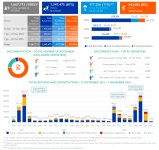
Update as of November 1, 2025.

1,667,713 (1.67 million) Afghan illegal settlers have been repatriated back to Afghanistan since illegal foreigners repatriation plan began in 2023 under Kakar caretaker government.

The IFRP was on hold during 2024 and early 2025. But since April, more settlers have been repatriated in 2025 than 2023 and 2024 put together, around 861,722. Which comes around ~4100 per day since April 1.

There are still anywhere between 1.8 to 2.4 million pre 2023 afghans occupying Pakistani territories. At the 2025 rate of deportations, it will take around 15 to 20 months to get rid of them all assuming Pakistan doesn't pull another Islami baradar mulk like in 2024.

The deportation rate this week has been around ~14k per day since there was a backlog caused by border war. This will climb back down by the end of the month.

Undocumented make up 75% of the repatriations.
IMG_20251108_060050.jpg
 
Update as of November 1, 2025.

1,667,713 (1.67 million) Afghan illegal settlers have been repatriated back to Afghanistan since illegal foreigners repatriation plan began in 2023 under Kakar caretaker government.

The IFRP was on hold during 2024 and early 2025. But since April, more settlers have been repatriated in 2025 than 2023 and 2024 put together, around 861,722. Which comes around ~4100 per day since April 1.

There are still anywhere between 1.8 to 2.4 million pre 2023 afghans occupying Pakistani territories. At the 2025 rate of deportations, it will take around 15 to 20 months to get rid of them all assuming Pakistan doesn't pull another Islami baradar mulk like in 2024.

The deportation rate this week has been around ~14k per day since there was a backlog caused by border war. This will climb back down by the end of the month.

Undocumented make up 75% of the repatriations.
View attachment 158190
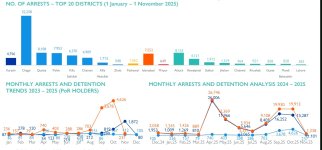
Disturbing figure.

32k Afghan illegals were arrested this year in Chagai district of Balochistan. Actual population of illegals there much higher in the district.

To put it in perspective, the Biggest town there is Nok kundi with a total population of 30k.

Only the arrested illegals made up around 11% of the entire district population of 270k. Real percentage could be 3x as high.

And we haven't even gone into fake CNICs yet..

This is a settler colonial project that Kakar shall be remembered fondling for reversing.

IMG_20251108_070316.jpg
 
Disturbing figure.

32k Afghan illegals were arrested this year in Chagai district of Balochistan. Actual population of illegals there much higher in the district.

To put it in perspective, the Biggest town there is Nok kundi with a total population of 30k.

Only the arrested illegals made up around 11% of the entire district population of 270k. Real percentage could be 3x as high.

And we haven't even gone into fake CNICs yet..

This is a settler colonial project that Kakar shall be remembered fondling for reversing.

View attachment 158195

We can safely 3-5x the 250k fake cnic figure. Its just the tip of the iceberg.
 
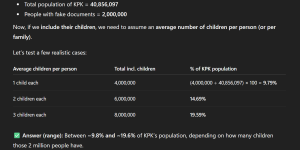
If we consider there are 2 million in Pakistan with fake CNICs between 1990s and 2000s and they have blended into KPK. This is the outcome. This is very alarming!

1762865597917.png
 
If we consider there are 2 million in Pakistan with fake CNICs between 1990s and 2000s and they have blended into KPK. This is the outcome. This is very alarming!

View attachment 158996
Lots of assumptions here but starting with, from where did you get 2 million CNICs figures? Nadra has identified 250k, not all afghans either. But even if we assume all to be afghans, that's still 8x your 2 million figure. That percentage tha drops down to 1.2-2.5%.

Since 70% afghans migrants are in KP, the percentage further drops down to 0.85% to 1.75%. which is more realistic.

Again, where how did your come to 2 million CNICs starting number especially for 1990s?
 
Nine in 10 families in Afghanistan are going hungry or falling into debt as millions of new returnees stretch resources in poverty-stricken areas in the east and north, according to the United Nations.

Taliban-controlled Afghanistan – battered by aid cuts, sanctions and repeated natural disasters, including a deadly quake in August – is struggling to absorb 4.5 million people who have returned since 2023. About 1.5 million were forced back this year from Pakistan and Iran, which have intensified efforts to expel Afghan refugees.


A UN Development Programme (UNDP) report released on Wednesday said returning Afghans are reeling from severe economic insecurity. More than half of returnee households are skipping medical care to afford food while more than 90 percent have taken on debt, the report said.

Their debts range from $373 to $900 when the average monthly income is $100, according to the report, whose findings were based on a survey of more than 48,000 households.

Returnees are also struggling to find decent housing as rent prices have tripled. More than half report lacking sufficient space or bedding while 18 percent report having been displaced for a second time in the past year. In western Afghanistan’s Injil and Guzara districts, “most returnees live in tents or degraded structures,” the report says.

The UNDP called for urgent support to strengthen Afghans’ livelihoods and services in high-return areas.

“Area-based recovery works,” said Stephen Rodriques, UNDP resident representative in Afghanistan. “By linking income opportunities, basic services, housing and social cohesion, it is possible to ease pressure on high-return districts and reduce the risk of secondary displacement.”

Advertisement

Aid for Afghanistan, still reeling from the impact of decades of war before the United States’s withdrawal in 2021, has plummeted, and donor countries have failed to meet the $3.1bn the UN sought for Afghanistan this year.

The Taliban government appealed for international humanitarian assistance after this year’s earthquake, and it has formally protested against Pakistan’s mass expulsion of Afghan nationals, saying it is “deeply concerned” about their treatment.
e UNDP also warned that limited economic opportunities for women in Afghanistan are exacerbating the plight of returnees, who more frequently rely on female breadwinners.

Get instant alerts and updates based on your interests. Be the first to know when big stories happen.
Yes, keep me updated
Participation by women in Afghanistan’s labour force has fallen to 6 percent, one of the lowest globally, and restrictions on their movement have made it nearly impossible for women who head households to access jobs, education or healthcare, the agency said.

“Afghanistan’s returnee and host communities are under immense strain,” said Kanni Wignaraja, UN assistant secretary-general and UNDP regional director for Asia and the Pacific. “In some provinces, one in four households depend on women as the main breadwinner, so when women are prevented from working, families, communities, the country lose out.”

“Cutting women out of the front-line teams means cutting off vital services for those who need them most, including returnees and victims of natural disasters,” she added.
 
If your ultimate goal in life is to blow yourself up wheh your balls drop, one meal a day is sufficient.

You just need to be able to carry a few kg. Obviously, you don't need to go to school either.
 
This is the ultimate tragedy of the situation. Pakistan has gone out of its way to help Afghans and specially the Taliban, earning itself the enmity of the entire West/ISAF yet the payback is nothing but blood of innocent Pakistanis. We have destroyed our social fabric for Afghanistan and it has been all for naught.

As I have always maintained, Afghans are good people and they don't deserve this. But the actions of their Taliban leaders, who we unfortunately helped impose on them and who now stay on for reasons that I documented here, have no considerations or care for the suffering of these people. Their goal is the take over of Pakistan and then push their takfiri ideology out to Iran etc. Like ISIS, the Taliban will never take on India or any other external enemies. Their task is to impose their interpretation on the rest of us who they consider "murtad".

What compounds this tragedy is the sheer anger against the Taliban and Afghanistan which is at a level never seen before in Pakistan. I think it is the reverse of what we used to hear for years about Afghans hating Pakistan. People in Pakistan are asking "what have we done to Afghanistan to see this mass blood letting at their hands?"

On top of this, the clueless in KP and their OIC resolution like jirgas yield nothing. See this: https://www.dawn.com/news/1954653

How tone-deaf can they be? Some of the demands of the jirga are as follows:

- Hold talks with Afghanistan.
That we have done this innumerable times is lost on them and each time the outcome has been worse than the time before. Not saying talks should be abandoned but this has been a one-way street.
- Peace in Pakistan cannot happen unless there is peace in Afghanistan. Last I checked, there has been peace in Afghanistan. No bombings, no suicide attacks, no attacks on military camps, on schools, on courts etc. etc. All of the violence is happening in Pakistan as such there must be some special kind of hashish being smoked at the jirga and in the KP government.
- Open all trade routes to Afghanistan. What safety and security does Pakistan get from such a move? Jirga has no clue.
- One former CM quipped rhetorically, what good did the past Jirgas result in? Answer: Crickets chirping.

The reality is that KP has no clue how to manage this conflict that is being waged on Pakistan from outside of Pakistan. I wish there was better alignment between the centre and the province and the NAP gets implemented fully.
 
The north korea strategy.

People can't rebel, if they're starving and rely completely on you for survival.
 

Users who are viewing this thread

Latest Posts

Back
Top