SMASH SLBM Testing - Nov 2025

Good to see Pakistan finally has the confidence to design, build and deploy its home grown systems to defend Pakistan now.

The days of "begging" the Americans for weapons only to be denied, or sanctioned after payment has been taken are well and truly over.

What Pakistan cannot build for itself, it can now get from China and Türkiye.
 
Exactly in the first test you can see the missile impact in a single frame I've tried slowing the vid down but nothing, definitely something high supersonic if not hypersonic
@JamD

To view this content we will need your consent to set third party cookies.
For more detailed information, see our cookies page.

One thing is for sure angle of attack is 90 degrees, I think this they tested with warhead separation just as Asad Kamal CEO of gids said regarding F2, I think you remember that, Angle of attack seems different compared to last time if not speed.


Put the camera angle like this and you’d get the same effect:
View attachment 161801

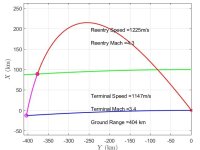
So I did this a while back when had dimensions and specifications from the Bunyan-al-Marsoos event. Take this with a pinch of salt - I used a ballistic simulator that I made with all the numbers I could get and then assumed some ballistic coefficient and burn time numbers that agreed with tests that we saw. I am basically assuming F2=SMASH. I have faith in this but you don't have to.


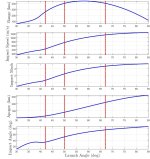
Ok so pure ballistic launches - no maneuvering. I swept through various launch angles. Three vertical red lines where first line corresponds to impact mach of 1.3 - like in the video we saw (first or second test) and the remaining two are 400 km range solutions both of which are >2 impact Mach
1.jpg

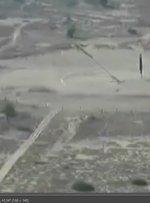
Also measured the impact angle on the F2 test...42 deg
2.jpg

Notice the impact angle on my plot 38 deg maybe? for the first 1.3 Mach impact
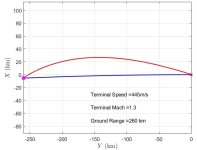
so very likely they tested F2 at 250 km range, but it validates all of the aero and controls.
5.jpg

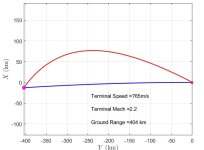
It is capable of M>2 at two trajectories:
274 seconds. The second vertical line in the previous plot. Depressed trajectory I guess. Doesn't even go to space (above 100 km)
3.jpg


448 seconds. The third vertical line in the previous plot. Lofted trajectory. Goes to space. Comes back at a steeper angle and higher speed
4.jpg

The main point of all this is to show that you can do this test:
5.jpg
and this will essentially verify all of your numbers for you. Now you know with some certainty you can use this missile on the 400km trajectories. Obviously, you wouldn't start with the 400km tests because its difficult to get targeting and set up exclusion zones. But you can verify your model, which is what is done.
 
So I did this a while back when had dimensions and specifications from the Bunyan-al-Marsoos event. Take this with a pinch of salt - I used a ballistic simulator that I made with all the numbers I could get and then assumed some ballistic coefficient and burn time numbers that agreed with tests that we saw. I am basically assuming F2=SMASH. I have faith in this but you don't have to.


Ok so pure ballistic launches - no maneuvering. I swept through various launch angles. Three vertical red lines where first line corresponds to impact mach of 1.3 - like in the video we saw (first or second test) and the remaining two are 400 km range solutions both of which are >2 impact Mach
View attachment 161816

Also measured the impact angle on the F2 test...42 deg
View attachment 161815

Notice the impact angle on my plot 38 deg maybe? for the first 1.3 Mach impact
so very likely they tested F2 at 250 km range, but it validates all of the aero and controls.
View attachment 161817

It is capable of M>2 at two trajectories:
274 seconds. The second vertical line in the previous plot. Depressed trajectory I guess. Doesn't even go to space (above 100 km)
View attachment 161814


448 seconds. The third vertical line in the previous plot. Lofted trajectory. Goes to space. Comes back at a steeper angle and higher speed
View attachment 161813

The main point of all this is to show that you can do this test:
View attachment 161817
and this will essentially verify all of your numbers for you. Now you know with some certainty you can use this missile on the 400km trajectories. Obviously, you wouldn't start with the 400km tests because its difficult to get targeting and set up exclusion zones. But you can verify your model, which is what is done.
This beautifully matches the observed frame analysis you did for the first test which came in at shallow depressed angle and official figure of >2M impact velocity.
 
Seriously suggest we make an air launched scaled down variant of this missile to match brahmos tri service launch capability with more potent system. Would be a great export competitor to rampage and lora as well
 
Seriously suggest we make an air launched scaled down variant of this missile to match brahmos tri service launch capability with more potent system. Would be a great export competitor to rampage and lora as well
Only CM-400 tot would make sense
 
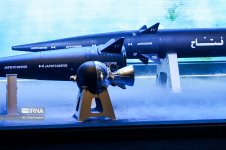
I wonder if they could do some dual pulse or terminal stage power like Iranian Fatah and get it to do higher velocity in depressed trajectory. For very low reaction time for the counter systems…
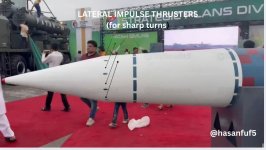
I would expect terminal maneuvering to be present with those painted on thrusters on the mockup. However, I don't think this is big enough for a powered terminal stage - as in it is not big enough to fit a big enough motor, and it is not big enough to be staged.
 
So I did this a while back when had dimensions and specifications from the Bunyan-al-Marsoos event. Take this with a pinch of salt - I used a ballistic simulator that I made with all the numbers I could get and then assumed some ballistic coefficient and burn time numbers that agreed with tests that we saw. I am basically assuming F2=SMASH. I have faith in this but you don't have to.


Ok so pure ballistic launches - no maneuvering. I swept through various launch angles. Three vertical red lines where first line corresponds to impact mach of 1.3 - like in the video we saw (first or second test) and the remaining two are 400 km range solutions both of which are >2 impact Mach
View attachment 161816

Also measured the impact angle on the F2 test...42 deg
View attachment 161815

Notice the impact angle on my plot 38 deg maybe? for the first 1.3 Mach impact
so very likely they tested F2 at 250 km range, but it validates all of the aero and controls.
View attachment 161817

It is capable of M>2 at two trajectories:
274 seconds. The second vertical line in the previous plot. Depressed trajectory I guess. Doesn't even go to space (above 100 km)
View attachment 161814


448 seconds. The third vertical line in the previous plot. Lofted trajectory. Goes to space. Comes back at a steeper angle and higher speed
View attachment 161813

The main point of all this is to show that you can do this test:
View attachment 161817
and this will essentially verify all of your numbers for you. Now you know with some certainty you can use this missile on the 400km trajectories. Obviously, you wouldn't start with the 400km tests because its difficult to get targeting and set up exclusion zones. But you can verify your model, which is what is done.
1764093965040.png
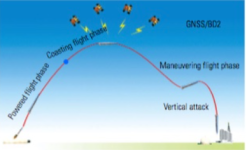
How badly would a maneuvering trajectory such as this affect the impact mach?
 
I would expect terminal maneuvering to be present with those painted on thrusters on the mockup. However, I don't think this is big enough for a powered terminal stage - as in it is not big enough to fit a big enough motor, and it is not big enough to be staged.
Yes, I meant if they bolt on a powered MARV thingy onto it (hypothetically), would it be feasible, would it provide high(er) terminal velocity and longer range at depressed trajectory.

Nothing huge, something like this (or solid rocket) for the last stretch:
IMG_5354.jpeg
 
View attachment 161828
How badly would a maneuvering trajectory such as this affect the impact mach?
I have tried maneuvering trajectories and for things that fly ballisticly they don't look too different from purely ballistic trajectories and thus have limited use for changing their trajectory too much. The picture you have shown is an exaggerated graphic, valid for maybe HGVs. For things like SMASH it is quite enough to maneuver terminally using thrusters.

A related rant:
When you want to change direction using fins, you move the fine, this causes angle-of-attack, this causes pitch-rate, this causes the pitch angle to change, this causes the missile to move off path. This is a slow process but it can provide relatively large movements.
On the other hand, if you have a thruster, you fire it and your missile moves off its path. It is VERY rapid but is limited in terms of magnitude of movements.
This basically has to do with F = ma and how quickly you can generate a. With fins it is a long process and with thrusters it is immediate.

Yes, I meant if they bolt on a powered MARV thingy onto it (hypothetically), would it be feasible, would it provide high(er) terminal velocity and longer range at depressed trajectory.
Adding thrust terminally always makes you go faster terminally (obviously) but I doubt it makes practical sense for something this small to have stages and thus any kind of MARV. We've seen in the video that the entire missile hits the target so it is not staged.
 
Yes, I meant if they bolt on a powered MARV thingy onto it (hypothetically), would it be feasible, would it provide high(er) terminal velocity and longer range at depressed trajectory.

Nothing huge, something like this (or solid rocket) for the last stretch:
View attachment 161829
Still can't believe Iran has developed such a master piece despite too many restrictions and embargos.
 
Adding thrust terminally always makes you go faster terminally (obviously) but I doubt it makes practical sense for something this small to have stages and thus any kind of MARV. We've seen in the video that the entire missile hits the target so it is not staged.
So using this platform and developing it into having a MARV/glider/powered glider is not feasible.
 

Pakistan Navy successfully tests indigenously-developed anti-ship ballistic missile: ISPR

News Desk Published November 25, 2025 Updated 9 minutes ago

The Pakistan Navy successfully tests a ship-launched ballistic missile <to bolster A2/AD deterrent.>

The Pakistan Navy on Tuesday conducted a successful test of an indigenously developed ship-launched ballistic missile, according to the military’s media affairs wing.

According to the Inter-Services Public Relations (ISPR), the weapon system is capable of engaging targets both at sea and on land “with high precision”.

“The system is equipped with state-of-the-art guidance and advanced maneuverability features,” the ISPR said in a statement.

“The flight test was witnessed by Admiral Naveed Ashraf, Chief of the Naval Staff, senior scientists and engineers.”

The ISPR deemed the successful test launch “a testimony to Pakistan’s technological prowess and Pakistan Navy’s unwavering commitment to safeguard national interests”.

According to the statement, President Asif Ali Zardari, Prime Minister Shehbaz Sharif, Chief of Army Staff Field Marshal Asim Munir, Chairman of the Joint Chiefs of Staff Committee General Shamshad Mirza and service chiefs congratulated the participating units and scientists on the test.

On September 30 this year, the Pakistan Army successfully conducted a training launch of a newly inducted, indigenously-produced Fatah-4 cruise missile at a range of 750 kilometres, the military’s media wing said.

“Equipped with advanced avionics and state-of-the-art navigational aids, this weapon system is capable of evading [the] enemy’s missile defence system due to terrain-hugging features and engaging targets with high precision,” the Inter-Services Public Relations (ISPR) said in a statement.

Video from an earlier test on Nov 4, 2024:
To view this content we will need your consent to set third party cookies.
For more detailed information, see our cookies page.

MashAllah, great news! R&D doing its magic.
What's the range please?
 

Users who are viewing this thread

Pakistan Defence Latest

Country Watch Latest

Latest Posts

Back
Top