Operation Ghazab Lil Haq (Pakistan - Afghanistan War)

Eagle Eye
@zarrar_11PK
Monitoring:

🔴 Taliban Regime has pardoned more than 3,200 hard-line detainees (Terrorists).

🔴 These were not ordinary inmates but individuals convicted in high-profile terrorism cases.

🔴 The released group includes operatives linked to suicide-bombing networks.

🔴 Immediately after their pardon, coordinated movements toward Pakistan began.

🔴 Sentences of an additional 4,300 prisoners have been reduced.

🔴 This next batch is widely assessed to be ready for induction into the TTP.

🔴 Many of those released are now free and capable of conducting operations inside Pakistan.

🔴 The internal situation in Afghanistan continues to deteriorate rapidly.

🔴 Extremist groups are swiftly filling the security vacuum.

🔴 Reports indicate that many released operatives are close to joining 1S- **KP.

🔴 The region faces a serious risk of a renewed wave of terrorism.

🔴 Pakistan’s security agencies remain on high alert.

🔴 The international community is urged to acknowledge the grave consequences of Kabul’s decisions.
Simple
Call for conference and arm the Northern alliance..its not that hard
 
This is not an isolated case.
From Bajaur to Khyber, from Parachinar to Peshawar, the majority of TTP attackers, suicide bombers, and planners who strike Pakistan are either Afghan nationals or operate from safe havens inside Afghanistan with full logistical and leadership support.

Pakistan has handed over mountains of evidence, names, locations, satellite imagery, intercepted communications to Kabul, yet TTP leaders roam freely, fundraise, recruit, and issue orders from Afghan cities.

Until Afghanistan dismantles these TTP sanctuaries and hands over the wanted terrorists, Pakistan has every right to treat those areas as legitimate targets for self-defense.

The blood of our people will no longer be answered with diplomatic notes, it will be answered with action.
Insanity is doing the same thing over and over again and expecting different results

Its clear that taliban wont or cant deal with TTP.
 
Simple
Call for conference and arm the Northern alliance..its not that hard
Northern Alliance has disbanded. The new entity is National Resistance Front for Afghanistan. Pakistan did have a role to play in getting the NA out of Afghanistan btw.

But anyways rhe NRF don't have any substantial presence inside Afghanistan's border. A couple hundred/thousand members outside the nation afaik.

I dunno how arming them will help. Looks like a political entity in name.
 
Last edited:
Northern Alliance has disbanded. The new entity is National Resistance Front for Afghanistan. Pakistan did have a role to play in getting the NA out of Afghanistan btw.

But anyways rhe NRF don't have any substantial presence inside Afghanistan's border. A couple hundred/thousand members outside the nation afaik.

I dunno how arming them will help. Looks like a political entity in name.

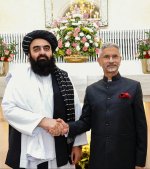
Not so long ago you Indians were cheerleading for the last few NA fighters in the Panjshir Valley, the Taliban were all bad and Afghan women were being oppressed. What happened?

1764403198244.jpeg

Your leaders are now shaking hands with the bad Taliban and inviting them over for dinner.

Why has the NA become irrelevant and bad?
 
@Dalit bro

Not so long ago you Indians were cheerleading for the last few NA fighters in the Panjshir Valley, the Taliban were all bad and Afghan women were being oppressed. What happened?

The same as what happened to you, only in the reverse direction.

Regards
 
@Dalit bro

Not so long ago you Indians were cheerleading for the last few NA fighters in the Panjshir Valley, the Taliban were all bad and Afghan women were being oppressed. What happened?

The same as what happened to you, only in the reverse direction.

Regards

1764405032070.jpeg


"Saaaar, kaale he to kya, dilwale he. Long live Taliban!"
 
Not so long ago you Indians were cheerleading for the last few NA fighters in the Panjshir Valley, the Taliban were all bad and Afghan women were being oppressed. What happened?
And Pakistan was cheerleading and providing intel to Taliban to weed out NA. People here were celebrating how Taliban would totally kick India out of Afghanistan.

Geopolitics is fickle or do you see the world one dimensionally?
 
And Pakistan was cheerleading and providing intel to Taliban to weed out NA. People here were celebrating how Taliban would totally kick India out of Afghanistan.

Geopolitics is fickle or do you see the world one dimensionally?

1764405683887.jpeg

"Saaaaar, Le jaynge, le janyge, Taliban ko utha ke le jaynge!"

Happy honeymoon between India and Taliban!
 
To view this content we will need your consent to set third party cookies.
For more detailed information, see our cookies page.

ISPR says that fences are not effective. The DG language was not inclusive. He kept saying that "aap ko (public) pay karna ha". The number of IBOs is too high, and it's debatable, but the already strained provincial government pays the price, which causes friction.
 

Afghanistan dilemma

Touqir Hussain

ACCORDING to Pakistan’s defence minister, “Peaceful relations with our neighbour are only possible if all support for the TTP is completely ended”. It is difficult, he said, to trust the Afghan side without firm guarantees against cross-border attacks. The truth is, the Afghan Taliban did not give ironclad guarantees to America in the Doha Agreement, and are not likely to give them to Islamabad either. I hold no brief for the Taliban but would still like to understand their policies.

Pakistan and Afghanistan have a shared but contentious history, overlapping identities, a border dispute, and bifurcated tribes. The two have been dependent on external powers, subordinate to their security and strategic interests and victims of their wars. All this provided them with an opportunity to interfere in the other’s affairs.

It all began with Kabul’s open interference in Pakistan with its ‘Pakhtunistan’ claims. Pakistan successfully blunted the Afghan overreach but allowed itself to be drawn into Afghanistan’s political process. First, it attempted to undermine the Saur Revolution of April 1978, with the help of Afghanistan’s Islamist parties. Later, it let the Afghans find shelter in our tribal areas and beyond as refugees, the Mujahideen and finally as the Taliban.
 
Dealing with the Taliban is a complex task.
Both the Afghan people, who were let down first by the Mujahideen and later by a corrupt ruling elite tied to America’s wars, and Pakistan, where the state’s security apparatus was convinced it alone knew what was best for the country, have lost the Afghanistan we once knew.

The Taliban are no liberators. Their treatment of women alone is a crime against humanity. And they are also a menace to Pakistan, with their strengths and weaknesses both.

A factionalised Taliban preside over a divided population, an unravelling economy and a worsening humanitarian crisis. And the space given by the Taliban to many jihadist, separatist and terrorist groups with whom they have formed links over the years creates ungoverned spaces, which compromise Afghanistan’s own security.

In this fragile security situation, the Taliban lack both the political will and capacity to act against the TTP with whom they have ideological links. The Taliban treat the TTP and other terrorist groups operating on Afghanistan soil as allies to meet potential aggression from IS-K and the National Resistance Front, or from any external effort at regime change. These groups are also seen as a leverage to obtain concessions — recognition, commercial ties, etc — from regional states.

That makes the task of dealing with the Taliban, especially asking them to do something that compromises their security, a complex one. Islamabad needs to convince them that their survival depends on good relations with Pakistan.

If military action becomes necessary to convey this message it should carefully reflect Pakistan’s capacity, not the intent, to destabilise the Taliban. A threatened Taliban will cling to the TTP. And a destabilised Afghanistan would be an unmanageable challenge.
 
Basically, we are stuck with the Taliban, having to ‘protect’ them and ‘protect’ ourselves from them. Pakistan needs patience and negotiations mixed with varying degrees of pressure relating to border control, refugees, and trade. There is no military solution to Pak-Afghan problems unless we’re prepared for a blowback.

Rather than overreact to the Taliban’s outreach to India, Pakistan needs to assure Kabul that they have a sovereign right to have ties with India, but that along with that right is the obligation to behave like a sovereign government and disallow its territory from being used by the TTP and Baloch insurgents.

Simultaneously, Pakistan must degrade these outfits at home, incentivising the Taliban to act against weakened, less useful proxies. The Taliban alone cannot solve this problem for Pakistan, even if they wanted to. The bottom line is: Afghanistan is not a military challenge; it is a political challenge with a military dimension.

The writer, a former ambassador, is adjunct professor at Georgetown University.
 

Users who are viewing this thread

Pakistan Defence Latest

Country Watch Latest

Back
Top