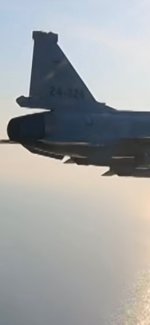
JF-17 - Updates, News & Discussion

Wow, so many questions 😅 I don't have the exact details obviously but CPD JF-17 is now DCAS- PFX and here is my personal deduction from some other things too which I recently observed... I think they are working on a design in collaboration with China and Turkieye and this can be called as the new Azm project for indigenous 5th gen... now, as it is not easy and I think we will need a lot of help for engine and RAM coating, so it will definitely come after operationalization of J-35, maybe with some basic ToT...
Lastly, I think JF-17 block 1 will be replaced by an improved block 3 with semi-stealth features with name of block 4 or Alpha etc.
PS: This is just my opinion that we are working on both projects with 5th gen on backburner until J-35 helps us to better understand stealth.
sir is there any way to tell is it grippen e like upgrade i mean increase in size ai sensor fusion etc
 
Thank your for your input. Forgive my ignorance, but what is meant by CPD and DCAS? I think this raises so many more questions! 😂 So for the roadmap we have PFX, project Azm in collaboration with Turkey and China, both as clean sheet designs, as well as a Block 4 JF17. Please correct me of I've misinterpreted. If we're also inducting J35, I guess that doesn't leave any scope for TFX in PAF colours?
Chief Project Director was the post in PAF, held by a 2 or 3 star air officer... DCAS is Deputy Chief of Air Staff for operations, admin, support etc.
So, a DCAS post for PFX project means it is in full swing with all available resources... you can think of it as evolution of Azm, though I don't know about those specifications you mentioned like directed energy weapons... I think it is a project like KAAN and KF-21 but I want to see our own engine for it...
And yes, may be the name is not block-4 but I think we are working on a better JF variant to be used as a stepping stone to jump on to 5th gen technology... again, I will be more interested in the results of jet engine project but we may see some more clarity in a year or so...
Lastly, J-35 will be inducted and after we get the hang of stealth ecosystem with the sensor fusion and all that, we may induct KAAN or indigenous Low Observability jet, depending upon the progress of the project... engine will be the main issue in my opinion and with US engine in KAAN, there will be so many strings attached with its export.
 
Pakistan and China has strong friendship due to common interests but Pakistan and Turkey is more closer because of religion and history. People like Turkish culture, food, Dramas and historical series. How many people watch Chinese dramas or movies?

Don’t be jealous of Turkey. what if Pakistan started co-producing defense systems with Bangladesh?
You keep using the jealous word and I don't know why brother.

All I am saying is that today as we speak, Pakistan is busy importing and integrating military hardware from China. These imports make up around 83%.

Only 17% is coming from elsewhere. Why? It's simply because either other don't have what Pakistan needs or they don't want to sell it to Pakistan (unless Pakistan does backflips and rolls over the ground to please them first), therefore, China is the only option.

Pakistan-Turkiye, Pakistan-Turkiye-Bangladesh, Pakistan-Iran, Pakistan-Iran-Turkiye, Pakistan-Saudi Arabia and Pakistan-Saudi Arabia-Turkiye can collaborate as much as they like, but Pakistan is in the middle of a very hostile two-front neighbourhood. Pakistan's needs are immediate. It needs everything readily and available right now and only China can provide that.

Everyone else can provide diplomatic support to Pakistan in time of need but they can't provide material support, except maybe some symbolic gesture.

Can Turkiye, Saudi Arabia and anyone else keep up with the speed of development and production that China is making in military sphere? I don't think so. Even the Americans are now asking the Chinese for "balance of power" in Asia-Pacific instead of "domination" in Asia-Pacific like they tried in the last two decades.
 
sir is there any way to tell is it grippen e like upgrade i mean increase in size ai sensor fusion etc
Great question but again I can only make an educated guess... I think you are right as it will focus on some stealth features, AI and fusion of data/sensors to further complement the Multi-Domain Operations... however, we may not see any noticeable increase in size like 25% more in Super Hornet than Legacy Hornet...
I think you are right in giving example of Gripen E where the size increase wasn't huge...
In my opinion, a drastic increase in size poses many aerodynamic and design issues e.g. 3.5 degrees outward canted pylons of super Hornet to cater for inlets. So it is better to keep the size increase marginal if possible.
 
Chief Project Director was the post in PAF, held by a 2 or 3 star air officer... DCAS is Deputy Chief of Air Staff for operations, admin, support etc.
So, a DCAS post for PFX project means it is in full swing with all available resources... you can think of it as evolution of Azm, though I don't know about those specifications you mentioned like directed energy weapons... I think it is a project like KAAN and KF-21 but I want to see our own engine for it...
And yes, may be the name is not block-4 but I think we are working on a better JF variant to be used as a stepping stone to jump on to 5th gen technology... again, I will be more interested in the results of jet engine project but we may see some more clarity in a year or so...
Lastly, J-35 will be inducted and after we get the hang of stealth ecosystem with the sensor fusion and all that, we may induct KAAN or indigenous Low Observability jet, depending upon the progress of the project... engine will be the main issue in my opinion and with US engine in KAAN, there will be so many strings attached with its export.
Thanks for clarifying. I think in the original press releases when project Azm was announced way back in 2017, if my memory serves me correctly, they mentioned a number of next gen tech, such as all aspect low observability and directed energy weapons. I don't know if that was the official objective or not, but maybe things have been scaled back since then. As I understand it, PFX is effectively what project Azm has evolved into, and there's likely to be a further enhanced block version of JF17, in addition to the J35. And it seems that the TFX is a hedge against the risk of developing PFX, depending on how that progresses. So over the next 5-10 years we could be looking at at least two new platforms in the PAF (PFX and J35), in addition to an advanced block version of JF17, with legacy Block 2/3 JF17s.

I think for most objective observers of project AZM, it seemed quite ambitious for a country like Pakistan. In my humble opinion, what may be needed is a decoupling of the platform from the tech, rather like how the late and great ACM Mushaf Ali Mir did with the JF17, allowing the platform to develop and mature, and adopting an open architecture platform that would allow future avionics and weapons to be integrated as and when they were ready. And we saw this in the development of the JF17, where initially it was intended to adopt largely French avionics and weapons like a Sagem radar and the Mica missile, but by the time the enhanced prototype was developed (with DSI, extended LERX, and redesigned tail fin), Chinese avionics and weapons were mature enough to replace the French options.

This could be acutely important to developing an indigenous engine production capability. In my opinion, it may be a stretch to expect a completely novel designed next gen combat jet engine from Pakistan, especially given that we don't even have any history of licence production of any jet engine from raw materials, there's simply no ecosystem in Pakistan for that. What we could be looking at is licensed production of either a Turkish or Chinese powerplant in my view, especially given that the future of the PAF will largely be integrated into the ecosystems of these two sources.

And on the topic of ecosystems, where does that leave the Viper fleet of the PAF in your view? :) upgrades for the Block52s and legacy fleet? More used/new airframes?
 
And on the topic of ecosystems, where does that leave the Viper fleet of the PAF in your view? :) upgrades for the Block52s and legacy fleet? More used/new airframes?
Azm was an ambitious project and as I said before, we need stepping stones to reach that level. Moreover, with the current focus on drones, the integration among all assets should be the primary goal and designing a new platform a secondary one.
About F-16s, I think we may see a deal for V-kits to upgrade blk 52 to 70 standard, including new weapons too... however, if the price is inhibiting, then it doesn't make sense because even with all the upgrades, Link-16 can't be integrated in our network centric warfare.
 
If you are trying to gain an advantage in business negotiations with China, you should carefully study Sun Tzu's Art of War.

Your current approach is unlikely to be effective. It could even produce the opposite result.
China is the main source for weapon systems for Pakistan. Both countries have deep understanding and, as a result, China specially allows some advanced systems for transfer to Pakistan that it wouldn't allow to another country. Similarly Pakistan also gets related technology, to varying levels, for many of these Chinese systems.

Pakistan also gets some technology from western sources (including Türkiye) and integrates it in some of the Chinese weapon systems that were imported from China.

I think the goal is to offer some western options if and when these 'westernized' Chinese weapons systems are partially or completely produced in Pakistan. These system then might be offered for export to friendly countries who may prefer some western flavor in those systems.

All of this is probably done with complete understanding between the concerned Pakistani and Chinese quarters. Using negotiations with Turkish companies as the bargaining chip with China does no make sense to me.
 
You keep using the jealous word and I don't know why brother.

All I am saying is that today as we speak, Pakistan is busy importing and integrating military hardware from China. These imports make up around 83%.

Only 17% is coming from elsewhere. Why? It's simply because either other don't have what Pakistan needs or they don't want to sell it to Pakistan (unless Pakistan does backflips and rolls over the ground to please them first), therefore, China is the only option.

Pakistan-Turkiye, Pakistan-Turkiye-Bangladesh, Pakistan-Iran, Pakistan-Iran-Turkiye, Pakistan-Saudi Arabia and Pakistan-Saudi Arabia-Turkiye can collaborate as much as they like, but Pakistan is in the middle of a very hostile two-front neighbourhood. Pakistan's needs are immediate. It needs everything readily and available right now and only China can provide that.

Everyone else can provide diplomatic support to Pakistan in time of need but they can't provide material support, except maybe some symbolic gesture.

Can Turkiye, Saudi Arabia and anyone else keep up with the speed of development and production that China is making in military sphere? I don't think so. Even the Americans are now asking the Chinese for "balance of power" in Asia-Pacific instead of "domination" in Asia-Pacific like they tried in the last two decades.

Bhai, not everything can be openly discussed in public forums sometimes you have to read between the lines and connect the dots yourself. The way you’re approaching this issue feels like running in circles without acknowledging the bigger picture.

Yes, everyone knows that China is Pakistan’s primary defense supplier. The reason is obvious: Chinese military equipment is generally more affordable compared to Western systems, and it comes without the heavy political strings or restrictions that Western countries often impose. But relying too heavily on one source creates vulnerabilities. Strategic autonomy demands diversity.

Now that Pakistan has a choice, Pakistan can’t afford to limit itself to a single partner. That’s why cooperation with countries like Turkey, Romania, Brazil, South Africa, and Thailand matters. Each brings unique strengths, technologies, and opportunities for joint development.

Turkey is already playing a crucial role in strengthening Pakistan’s defense industry. From UAVs (like Bayraktar drones) to naval modernization and joint ventures in armored vehicles, Turkish collaboration provides Pakistan with advanced systems tailored to its needs.

Other partners like Brazil (aerospace), South Africa (missile and artillery systems), and Romania/Thailand (industrial cooperation) expand Pakistan’s options, reduce dependency, and open doors for technology transfer.

Why Diversification is Critical ?

• Strategic Independence: Over reliance on one supplier makes Pakistan vulnerable to shifts in foreign policy or supply chain disruptions.
• Technology Transfer: Working with multiple partners increases chances of coproduction, joint R&D, and indigenous capability building.
• Diplomatic Balance: Defense cooperation strengthens political ties, ensuring Pakistan isn’t seen as aligned with only one bloc.
• Industrial Growth: Partnerships like those with Turkey help Pakistan’s own defense industry mature, creating jobs, expertise, and export potential.
• Operational Flexibility: Access to varied platforms and technologies ensures Pakistan’s armed forces can adapt to different scenarios without being locked into one ecosystem.

While China remains a cornerstone of Pakistan’s defense procurement, broadening cooperation especially with Turkey is not just desirable, it’s essential. It strengthens Pakistan’s defense industry, enhances resilience, and ensures long term strategic autonomy.
 
Last edited:
Bhai, not everything can be openly discussed in public forums sometimes you have to read between the lines and connect the dots yourself. The way you’re approaching this issue feels like running in circles without acknowledging the bigger picture.

Yes, everyone knows that China is Pakistan’s primary defense supplier. The reason is obvious: Chinese military equipment is generally more affordable compared to Western systems, and it comes without the heavy political strings or restrictions that Western countries often impose. But relying too heavily on one source creates vulnerabilities. Strategic autonomy demands diversity.

Now that Pakistan has a choice, we Pakistan can’t afford to limit itself to a single partner. That’s why cooperation with countries like Turkey, Romania, Brazil, South Africa, and Thailand matters. Each brings unique strengths, technologies, and opportunities for joint development.

Turkey is already playing a crucial role in strengthening Pakistan’s defense industry. From UAVs (like Bayraktar drones) to naval modernization and joint ventures in armored vehicles, Turkish collaboration provides Pakistan with advanced systems tailored to its needs.

Other partners like Brazil (aerospace), South Africa (missile and artillery systems), and Romania/Thailand (industrial cooperation) expand Pakistan’s options, reduce dependency, and open doors for technology transfer.

Why Diversification is Critical ?

• Strategic Independence: Over-reliance on one supplier makes Pakistan vulnerable to shifts in foreign policy or supply chain disruptions.
• Technology Transfer: Working with multiple partners increases chances of co-production, joint R&D, and indigenous capability building.
• Diplomatic Balance: Defense cooperation strengthens political ties, ensuring Pakistan isn’t seen as aligned with only one bloc.
• Industrial Growth: Partnerships like those with Turkey help Pakistan’s own defense industry mature, creating jobs, expertise, and export potential.
• Operational Flexibility: Access to varied platforms and technologies ensures Pakistan’s armed forces can adapt to different scenarios without being locked into one ecosystem.

Iwhile China remains a cornerstone of Pakistan’s defense procurement, broadening cooperation especially with Turkey is not just desirable, it’s essential. It strengthens Pakistan’s defense industry, enhances resilience, and ensures long-term strategic autonomy.
also, turkish industry is in its infancy, the turks are alot more willing to work on your terms and do more to secure a contract than china is at the moment,
 
we have already, and will continue to.

the turks practically begged us to join tfx in its infancy.
Also Atak-2, just listen to 16:40 🥲
To view this content we will need your consent to set third party cookies.
For more detailed information, see our cookies page.
 
Azm was an ambitious project and as I said before, we need stepping stones to reach that level. Moreover, with the current focus on drones, the integration among all assets should be the primary goal and designing a new platform a secondary one.
About F-16s, I think we may see a deal for V-kits to upgrade blk 52 to 70 standard, including new weapons too... however, if the price is inhibiting, then it doesn't make sense because even with all the upgrades, Link-16 can't be integrated in our network centric warfare.
Isnt Link 16 already Talking to Link 17 through translation vis ground stations?
 

Users who are viewing this thread

Country Watch Latest

Back
Top