Pakistan External Debt

Kuch Aysa Scene hai

This little tiny "rise" is called performance
If your economy tanks 20-30%, and then you rise 0.5% for every 4 month , on paper it looks like progress

But you are still down 29%


The Massive "Dip" from 2018 to 2025 is ignored but the tiny rise up is applauded by Tout media

View attachment 151830
Sherlock Sahib, kuchh aisa hi scene huwa tha.

2013-2018: Pakistan's Nominal GDP expands by $98 billion over 60 months.

2018-2022: Pakistan's Nominal GDP expands by just $26 billion over 45 months.
 
Pakistan’s provincial system has become an expensive, outdated layer of governance that no longer serves the public effectively. With nearly $33 billion spent annually on just four provinces much of it tied up in bureaucracy and political overhead. it’s time to rethink the structure.

The solution? Dismantle the provincial tier and empower Pakistan’s 32 divisions and local bodies directly. These divisions are closer to the ground, more responsive to local needs, and better positioned to deliver real impact. By reallocating funds to divisions, Pakistan could not only streamline governance but also afford universal education and healthcare without increasing the budget.

This isn’t just reform. It’s a reset. Provinces have outlived their usefulness. The future lies in local empowerment, not centralized provincial control.

.Expecting the army to fix the economy is like asking a car mechanic to perform heart surgery, it’s simply not their domain. Their expertise lies in political maneuvering, not economic management. If economic reform were truly within their grasp, we’d have seen meaningful change by now. Sadly, that may not be possible in our lifetime.
 
Last edited:
Corruption and incompetence of the present and past governments. PPP and MLN has have been extremely corrupt governments.
 
Source GROK AI

Understanding the Hybrid Government System in PakistanThe term "hybrid government" or "hybrid regime" in Pakistan refers to a political arrangement where civilian leaders (typically from parties like PML-N or PPP) hold formal power, but the military establishment exerts significant behind-the-scenes influence over key decisions, including foreign policy, security, and even economic priorities. This model intensified after the ouster of Prime Minister Imran Khan via a no-confidence vote on April 10, 2022, which many analysts attribute to the military's withdrawal of support from Khan's PTI government. The subsequent coalition government under Shehbaz Sharif (PDM from 2022–2023, followed by the 2024-elected PML-N-led coalition) has been widely described as a "hybrid" setup, with the military's role formalized through bodies like the Special Investment Facilitation Council (SIFC), which blends civilian and military oversight on economic projects.Critics, including PTI supporters and independent analysts, argue this system prioritizes short-term political survival and elite interests over long-term reforms, leading to policy paralysis, corruption, and investor flight. While some sources credit the hybrid setup with stabilizing IMF negotiations, the overall economic trajectory since 2022 shows contraction, stagnation, and vulnerability. Below, I outline the key mechanisms through which this system has exacerbated Pakistan's economic woes, supported by data up to mid-2025.Key Economic Impacts and Mechanisms of DestructionThe hybrid system's flaws—chronic instability, military-civilian friction, and ad-hoc policymaking—have amplified pre-existing issues like high debt and low exports. Here's a breakdown:

  1. Political Instability and Policy Inconsistency:
    • The post-Khan era has been marked by protests, arrests (e.g., Khan's ongoing detention), and rigged election allegations in 2024, eroding investor confidence. This instability delayed IMF bailouts (e.g., a $1.1 billion tranche stalled from November 2022 to mid-2023) and deterred foreign direct investment (FDI), which dropped over 20% from 2022 levels.
    • Hybrid dynamics lead to fragmented decision-making: Civilian governments push populist subsidies (e.g., fuel price freezes in 2022), while military priorities (e.g., security spending) divert resources. Result: No cohesive reforms, with the economy stuck in a cycle of IMF dependencies.
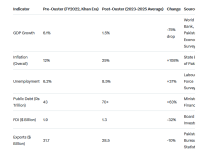
    • Public debt surged from Rs 43 trillion (April 2022) to over Rs 70 trillion by 2025, with interest payments consuming 50–60% of federal revenue. The hybrid regime accumulated $200 billion in new debt since 2022, while GDP grew by just $33 billion—pushing debt-to-GDP above 70%.
    • Circular debt in the energy sector ballooned from Rs 2.5 trillion (2022) to Rs 3.5 trillion (2025), fueled by delayed reforms and subsidies. Military-linked projects (e.g., CPEC extensions) added opaque borrowing without productivity gains.

1759927341273.png


Broader Systemic Failures

  • Military Overreach in Economy: The SIFC (launched 2023) aimed to attract $25 billion in investments but delivered under $5 billion by 2025, prioritizing military-linked ventures (e.g., mining exports without local value-add). This crowds out private sector growth and fosters corruption, with tax-to-GDP at a dismal 9.2%.
  • Erosion of Institutions: Censorship (e.g., internet blackouts targeting PTI), judicial interference (26th Amendment, 2024), and media harassment stifle innovation. IT exports, a bright spot under Khan, stagnated due to outages.
  • Social Fallout: 2022 floods exposed hybrid governance flaws—slow response and elite capture of aid—worsening food insecurity. Youth exodus and rising terrorism (diverting security budgets) compound the crisis.
Counterarguments and NuancesSome sources (e.g., PML-N officials) argue the hybrid system averted default via IMF deals (e.g., $3 billion SBA in 2023, extended 2024) and stabilized reserves to $9–10 billion by 2025. Credit ratings improved slightly (Caa2 Positive, Moody's 2025). However, these are bandaids: Growth remains volatile, and without addressing hybrid-induced instability, experts warn of another crisis by 2026. Khan's era (2018–2022) saw 6% peak growth and FATF grey-list exit, but inherited deficits; the post-2022 decline is steeper due to regime change fallout.In summary, the hybrid system has "destroyed" the economy by entrenching instability and elite capture, turning a fragile recovery into a debt-fueled stagnation. True revival demands civilian-led reforms, reduced military meddling, and export-focused policies—steps blocked by the current setup. As of October 2025, green shoots (e.g., stock market gains) mask deeper rot, with poverty and emigration signaling a humanitarian edge.
 
If you are really concerned about Pakistan’s financial situation, why don’t you do the analysis from post General Zia?

1 USD was equal to 17 PKR.
Here's my analysis:
Sanctions, military coupé, war, war, war.

But now, some good news.

What is Pakistan achieving in 2025 under PM Shehbaz Sharif?

Date
Event

01/01/2025​
Pakistan begins 2-year term as non-permanent UNSC member.

01/01/2025​
Pakistan Stock Exchange (PSX) breaks new record for the 72nd time, closing at 117,008.08.

01/01/2025​
Pakistan breaks ground on $1.2B Chashma Nuclear Plant Unit 5.

02/01/2025​
Pakistan Stock Exchange (PSX) breaks new record for the 73rd time, closing at 117,119.66.

02/01/2025​
3 Pakistan Navy ships visited Iran’s Port Bandar Abbas during their overseas deployment to the Arabian Gulf.

03/01/2025​
Pakistan Stock Exchange (PSX) breaks new record for the 74th time, closing at 117,805.06.

03/01/2025​
Mashreq Pakistan becomes first bank to launch pilot operations as digital retail bank.

05/01/2024​
Saudi Arabia’s budget airline Flyadeal granted permission to start operations from 2 February 2025.

05/01/2025​
Government decides to setup 2 passport offices at 2 NADRA mega centres.

05/01/2025​
Uzbekistan Ambassador to Pakistan announced direct flights from Uzbekistan to Karachi.

06/01/2025​
West Indies cricket team arrives in Pakistan for Test series after 18 years

10/01/2025​
PIA restarts direct flights to France/EU after a 4-year flight ban is lifted.

11/01/2025​
Bangladesh simplifies visa process for Pakistanis.

20/01/2025​
New Gwadar International Airport starts operations with landing of first PIA flight from Islamabad.

20/01/2025​
Fast track passport facility now available in 26 more cities

23/01/2025​
The World Bank launched a $20 billion Country Partnership Framework (CPF) program for Pakistan in Islamabad.

25/01/2025​
PIA starts international flights from the new Gwadar International Airport.

28/01/2025​
The State Bank of Pakistan awarded its first digital retail banking license to easypaisa digital bank.

04/02/2025​
First cargo ship docks at the Gwadar Port under the Afghan Transit Trade corridor.

06/02/2025​
Pakistan’s first-ever ‘Made in Pakistan’ expo opens in Saudi Arabia.

06/02/2025​
Pakistan's Chawla Group officially brings Dongfeng EVs to Pakistan

12/02/2025​
President of Turkiye Recep Tayyip Erdogan arrives in Pakistan on a two-day visit.

14/02/2025​
Pakistan’s first ever Purchasing Managers’ Index (PMI) launched.

28/02/2025​
Pakistan-China sign agreement to train and send first Pakistani astronaut into space and stay research at the Tiangong space Station.

27/03/2025​
Pakistani, Sri Lankan and Bangladeshi Stock Markets sign ‘landmark’ agreement to strengthen capital market cooperation

29/03/2025​
For the first time, Pakistan starts exporting cars to Japan.

31/03/2025​
Pakistan received record breaking $4.1 billion in remittances for the month of March 2025.

03/04/2025​
Inflation drops to 59-year low at 0.7% in March 2025. Lowest since December 1965.

03/04/2025​
Punjab has become the first province in the country to implement round-the-clock satellite-based thermal imaging surveillance.

10/04/2025​
'First-of-its-kind' trade deal between Scotland and Pakistan.

17/04/2025​
Pakistan and Bangladesh resume Foreign Office consultative meetings after 15 years.

20/04/2025​
PIA starts direct flights from Lahore to Baku, Azerbaijan.

23/04/2025​
Pakistan Navy forces Indian aircraft carrier INS Vikrant to retreat in Arabian Sea.

07/05/2025​
Pakistan shot down 6 Indian fighter aircraft after unprovoked Indian aggression.

10/05/2025​
Pakistan launched Operation Bunyan-um-Marsoos against India, avenging deaths of civilians martyed by Indian military on 7 May 2025. 34 Indian bases attacked.

16/05/2025​
Pakistan launches Rs30 billion Green Sukuk

16/05/2025​
UAE’s flydubai airline starts inaugural flights to Peshawar's Bacha Khan International Airport.

25/05/2025​
Pakistan allocates 2,000 MW to Bitcoin mining, AI data centers in bold digital economy push.

30/05/2025​
Pakistan joins China's new global mediation body: International Organisation for Mediation

06/06/2025​
Pakistan sold 40 JF-17 Thunder multirole fighters to Azerbaijan in a $4.6 billion deal.

19/06/2025​
Pakistan launches National Electric Vehicle Policy 2025-30.

20/06/2025​
China, Pakistan and Bangladesh hold their first ever trilateral summit in China to deepen ties.

21/06/2025​
Pakistan introduces a one-year multiple entry visa for Afghan drivers.

26/06/2025​
Pakistan’s first AI data centre launched in Karachi.

01/07/2025​
Pakistan Navy acquired 3 Royal Navy Hovercrafts from the UK.

07/07/2025​
FBR introduces Pakistan’s first AI-powered customs clearance system.

09/07/2025​
Pakistan’s first National Dredging and Marine Services (NDMS) company has been formed

16/07/2025​
UK lifts bank on Pakistani airlines imposed in July 2020.

30/07/2025​
Pakistan approves it's National Artificial Intelligence (AI) Policy 2025).

31/07/2025​
Pakistan and the US sign an historic trade deal with Washington reducing tariffs to 19% and finalising investments in Pakistan’s oil reserves.

02/08/2025​
Pakistan officially inducted the first batch of three Z-10 ME attack helicopters purchased from China.

02/08/2025​
Iran’s President Dr Masoud Pezeshkian visits Pakistan on an official visit.

08/08/2025​
Iran Air launches direct flights between Quetta and Zahedan.

12/08/2025​
Pakistan unveils the new Fatah-4 missile.

13/08/2025​
Prime Minister announces the creation of the Army Rocket Force Command (ARFC).

15/08/2025​
Pakistan Navy launches third Hangor-class submarine in China.

23/08/2025​
Pakistan’s foreign minister arrived in Bangladesh after a 13-year gap.

26/08/2025​
PM launches Pakistan’s New Energy Vehicle (NEV) Policy 2025-30.

04/09/2025​
CPEC 2.0 officially launched during the Second Pakistan-China B2B Investment Conference held in Beijing.

18/09/2025​
Pakistan and Saudi Arabia sign a landmark Joint Mutual Defence Pact that says an attack on one country will be considered an aggres
sion against both countries.

02/10/2025​
Pakistan delivers its first batch of enriched rare earth elements and critical minerals to US Strategic Metals (USSM) in the United States.
 
State Bank of Pakistan (SBP) Governor Jameel Ahmad said on Wednesday the country’s external debt to GDP (gross domestic product) ratio had dropped to 26% in the fiscal year 2025 (FY25) compared to 31% a couple of years ago, reducing the nation’s reliance on foreign financing in the wake of a jump in the inflows of workers’ remittances.

In absolute numbers, “Pakistan’s foreign debt has remained stagnant for the past three year at June 2022 level [against assumption of a surge],” the central bank chief said while talking to media on sideline of its celebration of ’Pakistan Women Entrepreneurship Day 2025”.


The foreign financing that Pakistan availed between FY22 and FY25 had been fully utilised to repay the old foreign debt obligations instead for building up foreign exchange reserves, he said.

Earlier, the external financing rose by on an average $6.4 billion an year from FY15 to FY22, he compared.

To recall, the size of the domestic economy has risen to $407.10 billion in FY25 compared to $375 billion in FY22, it was learnt.

The jump in inflows of workers’ remittances in the past three years has reduced the nation’s reliance on foreign funding.

The inflows of workers’ remittances surged to record $38.3 billion in FY25 compared to $30.3 billion in FY24 – rising by 27% year-on-year basis, he mentioned, projecting the remittances would surpass $40 billion mark in the ongoing fiscal year 2025-26.

Responding to a question, Ahmad acknowledged Pakistan’s imports were on the rise, settling at $5.2 billion in November 2025. He, however, dismissed the notion the current account deficit would cross the projected level of upto 1% of GDP.

“The current account deficit would remain at the July 2025 projected level of 0-1% of GDP,” he said.

He said the bank financing to small and medium-sized enterprises (SME) had increased by Rs150 billion over the past one year to Rs700 billion, showing the growth in the financing remain higher than the targeted one.

Pakistan had targeted to double SME financing to Rs1.1 trillion in five years compared Rs550 billion last year, he recalled.
 
Source GROK AI

Understanding the Hybrid Government System in PakistanThe term "hybrid government" or "hybrid regime" in Pakistan refers to a political arrangement where civilian leaders (typically from parties like PML-N or PPP) hold formal power, but the military establishment exerts significant behind-the-scenes influence over key decisions, including foreign policy, security, and even economic priorities. This model intensified after the ouster of Prime Minister Imran Khan via a no-confidence vote on April 10, 2022, which many analysts attribute to the military's withdrawal of support from Khan's PTI government. The subsequent coalition government under Shehbaz Sharif (PDM from 2022–2023, followed by the 2024-elected PML-N-led coalition) has been widely described as a "hybrid" setup, with the military's role formalized through bodies like the Special Investment Facilitation Council (SIFC), which blends civilian and military oversight on economic projects.Critics, including PTI supporters and independent analysts, argue this system prioritizes short-term political survival and elite interests over long-term reforms, leading to policy paralysis, corruption, and investor flight. While some sources credit the hybrid setup with stabilizing IMF negotiations, the overall economic trajectory since 2022 shows contraction, stagnation, and vulnerability. Below, I outline the key mechanisms through which this system has exacerbated Pakistan's economic woes, supported by data up to mid-2025.Key Economic Impacts and Mechanisms of DestructionThe hybrid system's flaws—chronic instability, military-civilian friction, and ad-hoc policymaking—have amplified pre-existing issues like high debt and low exports. Here's a breakdown:

  1. Political Instability and Policy Inconsistency:
    • The post-Khan era has been marked by protests, arrests (e.g., Khan's ongoing detention), and rigged election allegations in 2024, eroding investor confidence. This instability delayed IMF bailouts (e.g., a $1.1 billion tranche stalled from November 2022 to mid-2023) and deterred foreign direct investment (FDI), which dropped over 20% from 2022 levels.
    • Hybrid dynamics lead to fragmented decision-making: Civilian governments push populist subsidies (e.g., fuel price freezes in 2022), while military priorities (e.g., security spending) divert resources. Result: No cohesive reforms, with the economy stuck in a cycle of IMF dependencies.
    • Public debt surged from Rs 43 trillion (April 2022) to over Rs 70 trillion by 2025, with interest payments consuming 50–60% of federal revenue. The hybrid regime accumulated $200 billion in new debt since 2022, while GDP grew by just $33 billion—pushing debt-to-GDP above 70%.
    • Circular debt in the energy sector ballooned from Rs 2.5 trillion (2022) to Rs 3.5 trillion (2025), fueled by delayed reforms and subsidies. Military-linked projects (e.g., CPEC extensions) added opaque borrowing without productivity gains.

View attachment 152376


Broader Systemic Failures

  • Military Overreach in Economy: The SIFC (launched 2023) aimed to attract $25 billion in investments but delivered under $5 billion by 2025, prioritizing military-linked ventures (e.g., mining exports without local value-add). This crowds out private sector growth and fosters corruption, with tax-to-GDP at a dismal 9.2%.
  • Erosion of Institutions: Censorship (e.g., internet blackouts targeting PTI), judicial interference (26th Amendment, 2024), and media harassment stifle innovation. IT exports, a bright spot under Khan, stagnated due to outages.
  • Social Fallout: 2022 floods exposed hybrid governance flaws—slow response and elite capture of aid—worsening food insecurity. Youth exodus and rising terrorism (diverting security budgets) compound the crisis.
Counterarguments and NuancesSome sources (e.g., PML-N officials) argue the hybrid system averted default via IMF deals (e.g., $3 billion SBA in 2023, extended 2024) and stabilized reserves to $9–10 billion by 2025. Credit ratings improved slightly (Caa2 Positive, Moody's 2025). However, these are bandaids: Growth remains volatile, and without addressing hybrid-induced instability, experts warn of another crisis by 2026. Khan's era (2018–2022) saw 6% peak growth and FATF grey-list exit, but inherited deficits; the post-2022 decline is steeper due to regime change fallout.In summary, the hybrid system has "destroyed" the economy by entrenching instability and elite capture, turning a fragile recovery into a debt-fueled stagnation. True revival demands civilian-led reforms, reduced military meddling, and export-focused policies—steps blocked by the current setup. As of October 2025, green shoots (e.g., stock market gains) mask deeper rot, with poverty and emigration signaling a humanitarian edge.
The entire argument rests on a false assumption: that Pakistan suddenly became a hybrid state after 2022. Pakistan has been a civil military blend since 1958. Every government, including PTI, operated in the same system. Calling it “hybrid” only now is just political framing, not analysis.

PTI itself was brought to power through the same establishment structure. It benefited from the same interference. It worked with the same generals. It used the same back channels. That means you cannot blame the system only when your preferred party is out of power.

The economic collapse did not start in 2022. The hard numbers show the real damage happened between 2020 and early 2022. Record borrowing, historic current account deficits, import addiction, and zero structural reforms created the conditions that forced Pakistan back into the IMF. When global commodity prices spiked, Pakistan’s weak fundamentals collapsed. This was baked in long before Shehbaz arrived.

Debt rising from 43 to 70 trillion is not because of “hybrid rule.” It is because half the federal budget is interest payments due to bad fiscal management over decades, including PTI’s massive borrowing. Pakistan added more debt from 2018 to 2022 than in any previous four year period. PTI locked Pakistan into expensive LNG contracts and raised circular debt from 1.1 trillion to over 2.5 trillion before leaving office. The mess did not begin in 2022.

SIFC did not “destroy private sector growth.” The private sector in Pakistan has been stagnant for 30 years due to low productivity, low skills and zero value addition. No government has fixed this. PTI talked about exports but delivered no reforms. No tariff restructuring, no tech upgrades, no industrial upscaling. That is why exports remain stuck. Blaming SIFC is an excuse to avoid discussing long term structural failures.

Investor flight was not caused by “hybrid politics.” It was caused by instability created by PTI itself after 2022. Investors run from chaos, not from institutions. No one invests in a country where the largest political party launches street agitation, burns property, attacks the state and refuses to accept elections. That is political destabilization, not economic sabotage by the establishmnt.

IT exports stagnated due to global slowdown and fintech tightening, not “internet shutdowns.” India, Bangladesh and the Philippines also saw drops. This happened worldwide.

Flood response criticism is political marketing. Every government in South Asia struggled, including India during COVID and Bangladesh during cyclones. Natural disasters overwhelm weak states, not because of “hybrid rule” but because of decades of underdevelopment .

Finally, blaming the system while exempting PTI from responsibility is dishonest. If hybrid governance destroys economies, then PTI’s entire tenure must be judged under the same lens, because it governed in the same structure. You cannot praise the same system when it helps your party and condemn it when it doesnt .

The problem is not “hybrid.” The problm is 75 years of weak institutions, zero reforms, political ego and constant instability. Pakistan will recover when reforms matter more than narratives, not when every crisis is conveniently blamed on whoever is in power at the moment.
 
2018
  • Imran Khan's government took office in August 2018, inheriting economic challenges including a widening current account deficit (4.4% of GDP in H1 FY2017-18) and falling foreign reserves (~$9.6 billion). The fiscal deficit increased to 5.5% of GDP by July 2018.
This figure is incorrect. This is one of the things I like to pointing out repeatedly.

This is how data was and still is manipulated (luckily much less now):

Foreign Reserves
  • PML-N: Only the Foreign Reserves figure is pointed out.
  • PTI: Both Foreign and Liquid Reserves figures are added together to show a higher amount.
Exports
  • PML-N: Only figures for goods exports are pointed out.
  • PTI: Both goods and services figures are added together to show a higher amount.
Imports
  • PML-N: Both goods and services figures are added together to show a higher figure.
  • PTI: Only goods figure is shown to point out a lower amount.
Debt
  • PML-N: Total external debt amount is pointed out.
  • PTI: Only Government held external debt is shown.

And, so on.

It's only when you do your own research from official sources from both the PML-N and PTI eras, and crunch numbers together you see a more truer picture.
 
The problem is not “hybrid.” The problm is 75 years of weak institutions, zero reforms, political ego and constant instability. Pakistan will recover when reforms matter more than narratives, not when every crisis is conveniently blamed on whoever is in power at the moment.

What really matters is IMF support. As long as those crutches remain available, Pakistan's economy will limp along. By design.

All these numbers are not to be trusted, nor their conclusions, in favor of one side or another, no matter who.
 
This figure is incorrect. This is one of the things I like to pointing out repeatedly.

This is how data was and still is manipulated (luckily much less now):

Foreign Reserves
  • PML-N: Only the Foreign Reserves figure is pointed out.
  • PTI: Both Foreign and Liquid Reserves figures are added together to show a higher amount.
Exports
  • PML-N: Only figures for goods exports are pointed out.
  • PTI: Both goods and services figures are added together to show a higher amount.
Imports
  • PML-N: Both goods and services figures are added together to show a higher figure.
  • PTI: Only goods figure is shown to point out a lower amount.
Debt
  • PML-N: Total external debt amount is pointed out.
  • PTI: Only Government held external debt is shown.

And, so on.

It's only when you do your own research from official sources from both the PML-N and PTI eras, and crunch numbers together you see a more truer picture.
You’re claiming the numbers are “incorrect” but you haven’t produced a single alternative figure from the State Bank, the Finance Ministry, or any credible dataset. Official data show a very large current account deficit in FY2017‑18, SBP reserves in the single‑digit billions by mid‑2018, and a fiscal deficit in the mid‑5%‑of‑GDP range, all of which are consistent with the figures quoted. Pointing out that politicians sometimes cherry‑pick between SBP vs total reserves, goods vs goods‑plus‑services, or total vs government external debt is fine, but that does not magically make these specific numbers false; it just shows you’re dodging the question instead of engaging with the actual data.
 
You’re claiming the numbers are “incorrect” but you haven’t produced a single alternative figure from the State Bank, the Finance Ministry, or any credible dataset. Official data show a very large current account deficit in FY2017‑18, SBP reserves in the single‑digit billions by mid‑2018, and a fiscal deficit in the mid‑5%‑of‑GDP range, all of which are consistent with the figures quoted. Pointing out that politicians sometimes cherry‑pick between SBP vs total reserves, goods vs goods‑plus‑services, or total vs government external debt is fine, but that does not magically make these specific numbers false; it just shows you’re dodging the question instead of engaging with the actual data.


Usually, I found this user incapable of abstraction or of understanding epistemic truth, and any engagement with him beyond data and number crunching undermined his ability to develop scientific understanding.
 

Users who are viewing this thread

Back
Top