Below is what "Google-Image Translation" states about the image:
The
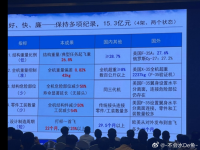
macro-context of this slide reflects an internal aviation industry or military-technical symposium in China showcasing the breakthrough industrial achievements of the
J-35 series (including the J-35A Air Force variant and the carrier-based naval variant). [
1,
2]
The presentation acts as an "efficiency and lean manufacturing report card," specifically detailing how China managed to break away from traditional aviation manufacturing bottlenecks to produce a stealth fighter cheaper and faster than Western standards. [
1]

Extracted Deep Technical Context
1. The Core Philosophy: "Good, Fast, and Cheap" (好、快、廉)
The slide's header states:
"Good, Fast, Cheap — Maintaining multiple records, 1.53 billion RMB (4 aircraft, two states)."
- The "Two States" (两个状态): This refers to the concurrent development of the land-based J-35A and the carrier-borne J-35 variant.
- The Budget Miracle: Developing 4 advanced test airframes across two highly distinct configurations for just 1.53 billion RMB (approx. $215 million USD) is incredibly inexpensive. By comparison, Western 5th-generation prototypes cost several billion dollars to develop. [1, 2]
2. Mastering the "Weight Curse" via 3D Printing
In aerospace engineering, aircraft almost always get progressively heavier during development, which degrades range and maneuverability.
- The U.S. F-35 Lesson: The slide references the American X-35 demonstrator exceeding its weight target by 2,237 kg (nearly 5,000 lbs), which historically forced Lockheed Martin into a massive, multi-billion dollar redesign project to strip weight. [1]
- The Chinese Solution: China managed a near-perfect weight control deviation of just 0.82% (43 kg). This was achieved by pioneering integrated 3D-printed titanium structures. Instead of riveting dozens of small parts together, massive components are printed as a single, flawless block of metal.
3. Eradicating Structural Fatigue ("No Connectors")
Traditionally, joining the wings to the fuselage requires massive bolts, rivets, and heavy connecting joints. These areas endure the highest stress and are prone to micro-fractures over time. [
1]
- F-35 Vulnerability: The slide explicitly points out that the F-35 relies on split-surface connections between the fuselage and wings, leaving structural fatiguing risks at the connection points. [1]
- J-35 Innovation: By leveraging advanced large-scale isobaric manufacturing and monolithic 3D-printing, China successfully printed the wing-root and main fuselage components as unified pieces. Removing separate connectors allowed them to cut critical fatigue zones by 50%, drastically extending the operational lifespan of the airframe.
4. Radical Supply Chain Optimization
- 54% Less Tooling: Traditional fighter manufacturing requires thousands of specialized molds, jigs, and distinct assembly line tools (tooling). By printing massive, single-piece components, China eliminated the need for individual part molds. [1]
- Resulting Velocity: Eliminating over half the required components allowed them to cut the timeline from prototype to maiden flight down to 22 months, a feat that usually takes Western or older domestic programs 4 to 5 years. [1]

The Big Picture: Industrial Rivalry
This slide is tangible evidence of a paradigm shift in military aerospace. Historically, the U.S. dominated fifth-generation aviation through decades of R&D refinement. However, this presentation outlines how China has caught up not merely by mimicking aerodynamics, but by
out-manufacturing the West at a fraction of the cost. [
1,
2,
3,
4]
By mastering monolithic titanium 3D printing, China has bypassed expensive sub-assembly manufacturing pipelines. This allows them to scale up production of the J-35 rapidly, fulfilling domestic Air Force and Navy quotas while simultaneously pitching it as a highly cost-competitive
stealth export fighter to global markets. [
1,
2,
3]
If you would like to explore further, I can provide more details on
China's large-scale titanium 3D printing factories or how the
performance capabilities of the production J-35 stack up against the F-35. [
1]