(CDF / COAS)'s Desk

Nothing is written in stone. In the future a PAF/PN officer could also lead the charge.
yeah hope it is a short term like 3 years and it rotates between the chiefs , just like how centcom does it .
 
According to analysis of this retired fauji, land is most important and army controls the land hence CDF should control everything! Case closed.


The Marke-e-Haq has been a turning point in Pakistan’s military history. The Pakistan Armed Forces delivered on the commitment made to the people of Pakistan in accordance with their oath. The Pakistan Army used Fatah-1 and Fatah-2 missiles and long-range artillery, while the Air Force employed precision munitions, loitering munitions, and integrated space, cyber, and electronic warfare, targeting 26 objectives in IIOJK and mainland India. On the LoC, the ground forces targeted the Indian Army’s forward headquarters, logistic installations, and forward positions and posts until the opposing side raised white flags. The Marke-e-Haq was an example of coordination and synergy between the Army, the Air Force, and other elements of national power. After Marke-e-Haq, Pakistan’s geostrategic profile has risen, and it has emerged as a net security stabiliser in the region. The world now views Pakistan as a peer competitor to India, and the conflict has significantly altered perceptions of Pakistan. In a historic decision, the Government of Pakistan elevated COAS General Asim Munir to the rank of Field Marshal. The decision was made to convey national gratitude for his strategic leadership in defending Pakistan’s sovereignty and territorial integrity. He led the Pakistan Army with courage and determination and coordinated the operations with the PAF and PN during Marke-e-Haq and Bunyan Un Marsous.
The 27th Amendment abolished the post of Chairman Joint Chiefs of Staff Committee (CJCSC) and replaced it with the newly created position of Commander of the National Strategic Command. The President approved the Pakistan Army Act, Pakistan Air Force Act, and Pakistan Navy Ordinance amendment bills 2025, passed by Parliament. Under the revised Act, the Army Chief will concurrently hold the office of Chief of Defence Forces for a period of five years. The most important question is why it is essential for an Army Chief to serve as the Chief of Defence Forces. The Pakistan Army is the largest force, most involved in national security and defence, with strategic decisions primarily made by its leadership. Pakistan’s geography naturally necessitates a land-oriented defensive posture. Consequently, Pakistan’s defence planning is primarily land-centric, focusing on the major threat from the East (India). Pakistan shares a long 3,133-kilometre border with India, which includes 700 kilometres of the Line of Control (LoC), 193 kilometres of the Working Boundary, and 2,240 kilometres of the International Border. The major wars of 1948, 1965, 1971, Siachen, and Kargil were primarily land operations.
The threat from the western borders remains significant, as Pakistan shares a 2,641-kilometre land border with Afghanistan. The western border is frequently the site of ground attacks, counterterrorism operations, and ongoing border security challenges. Therefore, both the eastern and western borders involve land-based threats that have been the largest and most persistent since 1947. The Army has the largest personnel, intelligence, and logistic networks; therefore, it handles the majority of operational responsibilities. Joint operations always revolve around land-based planning
. Historically, the Soviet Red Army became the core of Soviet strategy as the Navy and Air Force played a supportive role on the Eastern Front. Nazi Germany’s strategy was based on panzer offensives and rapid territorial conquest to keep pressure on the enemy. During the Vietnam War, the US had overwhelming air and naval superiority; however, the strategic focus remained on securing territory and ground-based operations. During the Soviet invasion of Afghanistan, despite overwhelming air superiority, the control of valleys and dominating mountains was decisive. Moreover, the Mujahideen insurgency was a land-based challenge. Pakistan’s defence planning is indeed land-centric due to geography and history. That is why Army leadership dominates and why many agree that the CDF should come from the Army. The appointment of the CDF is of great significance. He will be responsible for overseeing multi-domain operations with strategic authority. Command and control will be streamlined as decision-making will be faster during crises. There will be better coordination between the Army, Navy, and Air Force. When the same person controls both the Army and other services during operations, it will facilitate long-term defence planning and military modernisation. A person serving as both Army Chief and Chief of Defence Forces is considered important because it will improve coordination across all services, enhance strategic planning, and facilitate single-point military advice.

The writer is a retired brigadier and freelance columnist. He tweets @MasudAKhan6.
 
Last edited:
Most people don’t realize this, but most of the decision making, especially pertaining to security matters comes after a full consultation with China. You can be damn sure this was done in full coordination with them, and was given the green light by China. As we are heavily dependent on Chinese hardware and intelligence, it would not come as a surprise if the Chinese suggested making these changes. The Chinese clearly seem to have a lot of faith in Asim Munir, we should leave our personal grievances aside, and from a Pakistan perspective, hope that he delivers in his new role.
 
Some knowledgeable Pakistani analysts I listened to had this view on this CDF post :

The conflicts of the future will be about air, naval, cyber, covert action, economic coersion, autonomous machines , information and space. The army boots will play less and less of a role and pitched land battles will be rare. This means that funding and attention will gradually shift to these services from the army and the army will lose prominence.

Hence the creation of this CDF post in Pakistan and re-organization of armed forces , putting the army always on top. It's for the purpose of army brass maintaining its hold on the armed forces in a future where the army itself will be less and less relevant.
No arm/service will be "less relevant" in a future war. Clearly these analysts have not looked at warfare in the past 5 years (let alone the last 20 years).

Look at the war in Ukraine. Brutal slog on the ground with both Russia and Ukraine fighting it out to hold ground. No amount of air/naval activity takes anything away from the role their ground forces have to play. Take the Azerbaijan-Armenia war. Yet another conflict where the ground forces played an instrumental role. Look at Israeli occupation of Gaza. It was a brutal slog on the ground despite Israelis using their air power indiscriminately, yet having no choice but to put over a hundred thousand troops on the ground to battle and try to take the land from Hamas.

People may be taking the wrong conclusions from the May conflict between Pak-India. In this case, the situation simply did not escalate to the next step which was to mobilize ground forces to hold and deter the other side. If the conflict had continued, the ground forces would have been involved in a major way.

This is because in order to hold ground, you need land forces. In the context of Pakistan-India, the land forces cannot/will not become redundant.

In my mind, the planning of operations, even by individual services, with "Joint" considerations is a pro. It means that resources will be allocated without a lot of redundancy. As an example, our CDF office may finally lead to establishing a joint Special Forces Command (I see this as an eventuality) inshallah. It would also lead to a more "unselfish" approach to acquisitions. All 3 services would look at joint plans and address the gaps based on this joint planning instead of only catering to their own service needs and plans.
 
According to analysis of this retired fauji, land is most important and army controls the land hence CDF should control everything! Case closed.


The Marke-e-Haq has been a turning point in Pakistan’s military history. The Pakistan Armed Forces delivered on the commitment made to the people of Pakistan in accordance with their oath. The Pakistan Army used Fatah-1 and Fatah-2 missiles and long-range artillery, while the Air Force employed precision munitions, loitering munitions, and integrated space, cyber, and electronic warfare, targeting 26 objectives in IIOJK and mainland India. On the LoC, the ground forces targeted the Indian Army’s forward headquarters, logistic installations, and forward positions and posts until the opposing side raised white flags. The Marke-e-Haq was an example of coordination and synergy between the Army, the Air Force, and other elements of national power. After Marke-e-Haq, Pakistan’s geostrategic profile has risen, and it has emerged as a net security stabiliser in the region. The world now views Pakistan as a peer competitor to India, and the conflict has significantly altered perceptions of Pakistan. In a historic decision, the Government of Pakistan elevated COAS General Asim Munir to the rank of Field Marshal. The decision was made to convey national gratitude for his strategic leadership in defending Pakistan’s sovereignty and territorial integrity. He led the Pakistan Army with courage and determination and coordinated the operations with the PAF and PN during Marke-e-Haq and Bunyan Un Marsous.
The 27th Amendment abolished the post of Chairman Joint Chiefs of Staff Committee (CJCSC) and replaced it with the newly created position of Commander of the National Strategic Command. The President approved the Pakistan Army Act, Pakistan Air Force Act, and Pakistan Navy Ordinance amendment bills 2025, passed by Parliament. Under the revised Act, the Army Chief will concurrently hold the office of Chief of Defence Forces for a period of five years. The most important question is why it is essential for an Army Chief to serve as the Chief of Defence Forces. The Pakistan Army is the largest force, most involved in national security and defence, with strategic decisions primarily made by its leadership. Pakistan’s geography naturally necessitates a land-oriented defensive posture. Consequently, Pakistan’s defence planning is primarily land-centric, focusing on the major threat from the East (India). Pakistan shares a long 3,133-kilometre border with India, which includes 700 kilometres of the Line of Control (LoC), 193 kilometres of the Working Boundary, and 2,240 kilometres of the International Border. The major wars of 1948, 1965, 1971, Siachen, and Kargil were primarily land operations.
The threat from the western borders remains significant, as Pakistan shares a 2,641-kilometre land border with Afghanistan. The western border is frequently the site of ground attacks, counterterrorism operations, and ongoing border security challenges. Therefore, both the eastern and western borders involve land-based threats that have been the largest and most persistent since 1947. The Army has the largest personnel, intelligence, and logistic networks; therefore, it handles the majority of operational responsibilities. Joint operations always revolve around land-based planning
. Historically, the Soviet Red Army became the core of Soviet strategy as the Navy and Air Force played a supportive role on the Eastern Front. Nazi Germany’s strategy was based on panzer offensives and rapid territorial conquest to keep pressure on the enemy. During the Vietnam War, the US had overwhelming air and naval superiority; however, the strategic focus remained on securing territory and ground-based operations. During the Soviet invasion of Afghanistan, despite overwhelming air superiority, the control of valleys and dominating mountains was decisive. Moreover, the Mujahideen insurgency was a land-based challenge. Pakistan’s defence planning is indeed land-centric due to geography and history. That is why Army leadership dominates and why many agree that the CDF should come from the Army. The appointment of the CDF is of great significance. He will be responsible for overseeing multi-domain operations with strategic authority. Command and control will be streamlined as decision-making will be faster during crises. There will be better coordination between the Army, Navy, and Air Force. When the same person controls both the Army and other services during operations, it will facilitate long-term defence planning and military modernisation. A person serving as both Army Chief and Chief of Defence Forces is considered important because it will improve coordination across all services, enhance strategic planning, and facilitate single-point military advice.

The writer is a retired brigadier and freelance columnist. He tweets @MasudAKhan6.
He is stating the facts. For Pakistan, not being an expeditionary state, with territorial/land disputes with immediate neighbors, boots on the ground is central to our military planning and strategy.

This illogical self-flagellation about the role of CDF runs counter to the basics of management. As an example, in any corporation, the CEO runs all the divisions to attain the outcomes/strategy set for the corporation. You cannot have each division/organization, and its leaders, within the corporation running and implementing their own strategy. These orgs have to run things synergistically and with a shared set of resources expended based on core priorities.

An HDO is no different in this regard.
 
Some knowledgeable Pakistani analysts I listened to had this view on this CDF post :

The conflicts of the future will be about air, naval, cyber, covert action, economic coersion, autonomous machines , information and space. The army boots will play less and less of a role and pitched land battles will be rare. This means that funding and attention will gradually shift to these services from the army and the army will lose prominence.

Hence the creation of this CDF post in Pakistan and re-organization of armed forces , putting the army always on top. It's for the purpose of army brass maintaining its hold on the armed forces in a future where the army itself will be less and less relevant.
Nonsense.

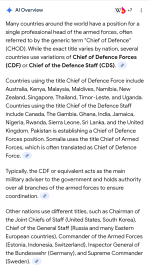
Around 70 countries currently have the CDF position as part of their military structure.

Pakistani military is finally adapting to the new international norm.

Screenshot_20251208-195828.Chrome.png

India established it's first Chief of Defence Staff (CDS) in 2020. No Indian moaned and whined about it.
 
Last edited:
First of all, watch your tone. Just bcz you support military blindly, you don't have privilege to insult anybody.
Then, please improve your comprehension. I stated that if Army's apolitical claims cannot be taken seriously, then these shouldn't too.
Take care
I completely agree with your request to keep things civil. As to your point about doubts about the equity between the services on account of the army's apolitical claims, that is your prerogative but that does not make your critique factual.

CDF is an essential need for a modern military. The same design could have been applied to CJCSC and it may have worked. However, the key is the change being affected which is what matters and that is to have combatant commands under a single, unified leadership.

For those suggesting that PAF, PN would suffer, you have to look at how CDF staff shapes the "Jointness". In Pakistan, this would mean officers at the Brig/Air Cdre/Cdre and higher ranks being brought into the joint staff together to look at the needs of services operating synergistically. The requirements/constraints of the PAF/PN would be discussed in this joint setting and appropriate plans put in place to cater to these issues. "Jointness" is being tried out through rudimentary measures even for early in career officers under training with PMA running its first "Joint Course" to start assimilating officers from across the services to work together.

Currently, a higher level of "jointness" in the works only done for SPD for "plans" and not operations, and also for limited procurement within the office of CJCSC. With CDF, members of the combatant commands will be pulled together. Real operational plans/strategy/tactics will be discussed at a much more granular level than the CJCSC office was ever able to.

Don't let your political baggage and dislike for a person cloud your understanding of the efficacy of the office of CDF. This is much more than a name change and it will bode well for Pakistan's security inshallah.
 
Last edited:
My own feeling is that this was a needed change. It became controversial given the person it involves and the surrounding politics. From a military perspective, this is needed and timely.

Your professional assessment is duly noted, and respected.

There is a certain section on PDF that is currently hellbent on pushing one and one agenda only - that of proving FM AM is the devil incarnate himself who can do nothing but evil - regardless of the merits or demerits of anything.

This is itself a direct legacy of the heady days when nearly all of PDF was giddy in its excitement at promoting IK no matter what, and a this certain section still cannot fathom the immensity of the changes arising out of his disastrous political failure, which was always inevitable..

Given all of the above, it is nearly futile to assess the particular topic of this thread with any level of fairness, compounded by the fact that most of us simply do not have the military knowledge necessary to be able to even form any opinion as to how to best organize multiple branches of the armed forces to maximize their unique abilities in a synergistic way if they are to continue to meet the challenges in the years and decades ahead.
 
Last edited:
What does “culturally futuristic” mean in this context?

Cyberpunk Corpo Morality? 😂

If I have to take a guess (in good faith) - the culturally futuristic term may imply the "organizational culture" of the Armed Forces, and marrying that with "integration" it could point to a culture where the hierarchy is maintained but the internal bureaucracy is minimized - with further distribution and delegation of operational/tactical decision making power/authority all the way down the hierarchy to relevant operational commanders (whether theatre, team, or field).

This is however, a guess in good faith. It could be the other way around too (which would be counterproductive to any betterment envisioned under CDF HQ)
 
"According to the CDF, all three services of the armed forces would maintain their “internal autonomy and organisational structure”"

I_OSQG.gif


To view this content we will need your consent to set third party cookies.
For more detailed information, see our cookies page.
 
Last edited:

Users who are viewing this thread

  • Hq9
Back
Top