
hasssanali8998
Elite Member

yeah hope it is a short term like 3 years and it rotates between the chiefs , just like how centcom does it .Nothing is written in stone. In the future a PAF/PN officer could also lead the charge.
Follow along with the video below to see how to install our site as a web app on your home screen.
Note: This feature may not be available in some browsers.
yeah hope it is a short term like 3 years and it rotates between the chiefs , just like how centcom does it .Nothing is written in stone. In the future a PAF/PN officer could also lead the charge.


 www.nation.com.pk
No arm/service will be "less relevant" in a future war. Clearly these analysts have not looked at warfare in the past 5 years (let alone the last 20 years).Some knowledgeable Pakistani analysts I listened to had this view on this CDF post :
The conflicts of the future will be about air, naval, cyber, covert action, economic coersion, autonomous machines , information and space. The army boots will play less and less of a role and pitched land battles will be rare. This means that funding and attention will gradually shift to these services from the army and the army will lose prominence.
Hence the creation of this CDF post in Pakistan and re-organization of armed forces , putting the army always on top. It's for the purpose of army brass maintaining its hold on the armed forces in a future where the army itself will be less and less relevant.
He is stating the facts. For Pakistan, not being an expeditionary state, with territorial/land disputes with immediate neighbors, boots on the ground is central to our military planning and strategy.According to analysis of this retired fauji, land is most important and army controls the land hence CDF should control everything! Case closed.
The Ideal CDF
The Marke-e-Haq has been a turning point in Pakistan’s military history. The Pakistan Armed Forces delivered on the commitment made to the people of
The Marke-e-Haq has been a turning point in Pakistan’s military history. The Pakistan Armed Forces delivered on the commitment made to the people of Pakistan in accordance with their oath. The Pakistan Army used Fatah-1 and Fatah-2 missiles and long-range artillery, while the Air Force employed precision munitions, loitering munitions, and integrated space, cyber, and electronic warfare, targeting 26 objectives in IIOJK and mainland India. On the LoC, the ground forces targeted the Indian Army’s forward headquarters, logistic installations, and forward positions and posts until the opposing side raised white flags. The Marke-e-Haq was an example of coordination and synergy between the Army, the Air Force, and other elements of national power. After Marke-e-Haq, Pakistan’s geostrategic profile has risen, and it has emerged as a net security stabiliser in the region. The world now views Pakistan as a peer competitor to India, and the conflict has significantly altered perceptions of Pakistan. In a historic decision, the Government of Pakistan elevated COAS General Asim Munir to the rank of Field Marshal. The decision was made to convey national gratitude for his strategic leadership in defending Pakistan’s sovereignty and territorial integrity. He led the Pakistan Army with courage and determination and coordinated the operations with the PAF and PN during Marke-e-Haq and Bunyan Un Marsous.
The 27th Amendment abolished the post of Chairman Joint Chiefs of Staff Committee (CJCSC) and replaced it with the newly created position of Commander of the National Strategic Command. The President approved the Pakistan Army Act, Pakistan Air Force Act, and Pakistan Navy Ordinance amendment bills 2025, passed by Parliament. Under the revised Act, the Army Chief will concurrently hold the office of Chief of Defence Forces for a period of five years. The most important question is why it is essential for an Army Chief to serve as the Chief of Defence Forces. The Pakistan Army is the largest force, most involved in national security and defence, with strategic decisions primarily made by its leadership. Pakistan’s geography naturally necessitates a land-oriented defensive posture. Consequently, Pakistan’s defence planning is primarily land-centric, focusing on the major threat from the East (India). Pakistan shares a long 3,133-kilometre border with India, which includes 700 kilometres of the Line of Control (LoC), 193 kilometres of the Working Boundary, and 2,240 kilometres of the International Border. The major wars of 1948, 1965, 1971, Siachen, and Kargil were primarily land operations.
The threat from the western borders remains significant, as Pakistan shares a 2,641-kilometre land border with Afghanistan. The western border is frequently the site of ground attacks, counterterrorism operations, and ongoing border security challenges. Therefore, both the eastern and western borders involve land-based threats that have been the largest and most persistent since 1947. The Army has the largest personnel, intelligence, and logistic networks; therefore, it handles the majority of operational responsibilities. Joint operations always revolve around land-based planning. Historically, the Soviet Red Army became the core of Soviet strategy as the Navy and Air Force played a supportive role on the Eastern Front. Nazi Germany’s strategy was based on panzer offensives and rapid territorial conquest to keep pressure on the enemy. During the Vietnam War, the US had overwhelming air and naval superiority; however, the strategic focus remained on securing territory and ground-based operations. During the Soviet invasion of Afghanistan, despite overwhelming air superiority, the control of valleys and dominating mountains was decisive. Moreover, the Mujahideen insurgency was a land-based challenge. Pakistan’s defence planning is indeed land-centric due to geography and history. That is why Army leadership dominates and why many agree that the CDF should come from the Army. The appointment of the CDF is of great significance. He will be responsible for overseeing multi-domain operations with strategic authority. Command and control will be streamlined as decision-making will be faster during crises. There will be better coordination between the Army, Navy, and Air Force. When the same person controls both the Army and other services during operations, it will facilitate long-term defence planning and military modernisation. A person serving as both Army Chief and Chief of Defence Forces is considered important because it will improve coordination across all services, enhance strategic planning, and facilitate single-point military advice.
The writer is a retired brigadier and freelance columnist. He tweets @MasudAKhan6.

Nonsense.Some knowledgeable Pakistani analysts I listened to had this view on this CDF post :
The conflicts of the future will be about air, naval, cyber, covert action, economic coersion, autonomous machines , information and space. The army boots will play less and less of a role and pitched land battles will be rare. This means that funding and attention will gradually shift to these services from the army and the army will lose prominence.
Hence the creation of this CDF post in Pakistan and re-organization of armed forces , putting the army always on top. It's for the purpose of army brass maintaining its hold on the armed forces in a future where the army itself will be less and less relevant.
I completely agree with your request to keep things civil. As to your point about doubts about the equity between the services on account of the army's apolitical claims, that is your prerogative but that does not make your critique factual.First of all, watch your tone. Just bcz you support military blindly, you don't have privilege to insult anybody.
Then, please improve your comprehension. I stated that if Army's apolitical claims cannot be taken seriously, then these shouldn't too.
Take care

yeah hope it is a short term like 3 years and it rotates between the chiefs , just like how centcom does it .

My own feeling is that this was a needed change. It became controversial given the person it involves and the surrounding politics. From a military perspective, this is needed and timely.

Prepping for Season 2 ahead of time instead of vibing it basically

Female and male servicemen will share same barracks?What does “culturally futuristic” mean in this context?
What does “culturally futuristic” mean in this context?


I think Chief of Defence (CHOD) will be a suitable name for this postNonsense.
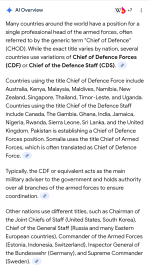
Around 70 countries currently have the CDF position as part of their military structure.
Pakistani military is finally adapting to the new international norm.
View attachment 164366
India established it's first Chief of Defence Staff (CDS) in 2020. No Indian moaned and whined about it.


lol and if we want to say..Chief OF Defence Office????I think Chief of Defence (CHOD) will be a suitable name for this post


