Venezuela - US Conflict: News, Updates

1766341117462.jpeg

Screenshot_20251221-121640.png


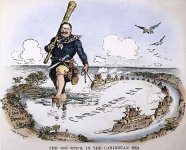
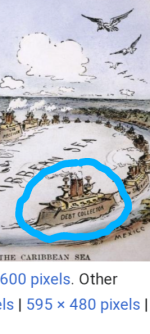
The Roosevelt Corollary was articulated in the aftermath of the Venezuelan crisis of 1902–1903. In late 1902, Britain, Germany, and Italy imposed a naval blockade of several months against Venezuela after President Cipriano Castro refused to pay foreign debts and damages suffered by Europeans in a recent civil war.[3] The dispute was referred to the International Court of Arbitration at The Hague, which concluded on 22 February 1904 that the blockading powers involved in the Venezuela crisis were entitled to preferential treatment in the payment of their claims.[3][4] This left other countries which did not take military action, including the United States, with no recourse. The U.S. disagreed with the outcome in principle, and Roosevelt saw the need to take action politically. The corollary went towards ensuring that U.S. interests abroad were protected from, in future, European powers using this ruling at The Hague as justification for military action and/or occupation in Central and Latin America.[3][4]
 
Last edited:

May 2019​

“Mortgaged to the hilt”​

US President Donald Trump, himself a veteran of multiple bankruptcies, points to Russia and China as significant contributors to Venezuela’s financial debacle. On May 1, he told Fox Business: “The advantage (Venezuela has) is they have oil. It’s mortgaged out to the hilt between China and Russia.They just sucked money out of everybody. (Venezuela) has mortgaged their oil almost to the maximum. … When you think about it, what has to be done, essentially, it’s called a country foreclosure.”

Overall, Venezuela could owe China more than $55 billion and Russia at least $17 billion, estimates Moises Rendon, a former Venezuelan bank analyst who is now Associate Director of the Americas program at the Center for Strategic & International Studies in Washington, D.C.

China has loaned more than $60 billion to Venezuela since 2007, most in exchange for promises of repayment in oil. Russia too has made significant loans to Venezuela as well selling arms on credit. Both countries already are slowly reducing their debts by taking oil deliveries.

 
Last edited:
View attachment 166315

View attachment 166314


The Roosevelt Corollary was articulated in the aftermath of the Venezuelan crisis of 1902–1903. In late 1902, Britain, Germany, and Italy imposed a naval blockade of several months against Venezuela after President Cipriano Castro refused to pay foreign debts and damages suffered by Europeans in a recent civil war.[3] The dispute was referred to the International Court of Arbitration at The Hague, which concluded on 22 February 1904 that the blockading powers involved in the Venezuela crisis were entitled to preferential treatment in the payment of their claims.[3][4] This left other countries which did not take military action, including the United States, with no recourse. The U.S. disagreed with the outcome in principle, and Roosevelt saw the need to take action politically. The corollary went towards ensuring that U.S. interests abroad were protected from, in future, European powers using this ruling at The Hague as justification for military action and/or occupation in Central and Latin America.[3][4]
Note:

The dispute was referred to the International Court of Arbitration at The Hague, which concluded on 22 February 1904 that the blockading powers involved in the Venezuela crisis were entitled to preferential treatment in the payment of their claims.[3][4]


Maass, Matthias (2009), Catalyst for the Roosevelt Corollary: Arbitrating the 1902–1903 Venezuela Crisis and Its Impact on the Development of the Roosevelt Corollary to the Monroe Doctrine, Diplomacy & Statecraft, Vol. 20, Iss. 3, pp. 383–402


Mitchener, Kris James; Weidenmier, Marc (2005). "Empire, Public Goods, and the Roosevelt Corollary". The Journal of Economic History. 65 (3): 658–692. doi:10.1017/S0022050705000240. ISSN 0022-0507. JSTOR 3875013. S2CID 153712841.
 
"We're not going to be letting anybody going through who shouldn't be going through,” Mr. Trump told reporters of his call for a blockade. “You remember they took all of our energy rights. They took all of our oil not that long ago. And we want it back. They took it — they illegally took it.”

WAR IS A RACKET

Why don’t those damned oil companies fly their own flags on
their personal property—maybe a flag with a gas pump on it.

—Brigadier General Smedley D. Butler, 1937
 
1766343786167.jpeg

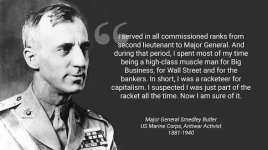
I spent 33 years and four months in active military service and during that period I spent most of my time as a high class muscle man for Big Business, for Wall Street and the bankers. In short, I was a racketeer, a gangster for capitalism. I helped make Mexico and especially Tampico safe for American oil interests in 1914. I helped make Haiti and Cuba a decent place for the National City Bank boys to collect revenues in. I helped in the raping of half a dozen Central American republics for the benefit of Wall Street. I helped purify Nicaragua for the International Banking House of Brown Brothers in 1902-1912. I brought light to the Dominican Republic for the American sugar interests in 1916. I helped make Honduras right for the American fruit companies in 1903. In China in 1927 I helped see to it that Standard Oil went on its way unmolested. Looking back on it, I might have given Al Capone a few hints. The best he could do was to operate his racket in three districts. I operated on three continents.
Smedley D. Butler, War Is a Racket
 
It’s a pressure strategy to oust the narcoterrorist Maduro and his regime. The vast majority of Venezuelans and people of South America want him gone.

The U.S is sinking lower and lower, constant wars, conflict for the Jews, always involved everywhere in everyone's business and now actual goddam piracy and regime change attempts to create chaos
 
Have you guys noticed how both Russia and China have abandoned Venezuela?
Well Russia is the OG zionist state and Chinese are merchants who want to continue trading with zionist enslaved West
 
ISTANBUL

China on Monday slammed the US for “arbitrarily seizing” vessels of other nations amid escalating tensions in the Caribbean.

“The US practice of arbitrarily seizing other countries’ vessels grossly violates international law,” Foreign Ministry spokesman Lin Jian told reporters in Beijing.

“China opposes unilateral, illicit sanctions that have no basis in international law or have no authorization of the United Nations Security Council,” said Lin.

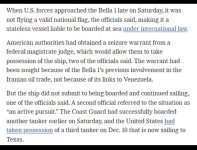
The statement from Beijing came as the US forces were pursuing another Venezuelan oil tanker in the Caribbean, and if seized, it will be the third ship intercepted since Dec. 10.

The US Coast Guard "operation" targets the Bella 1 tanker, a Panamanian-flagged vessel sanctioned by the US, which is en route to Venezuela to load oil, Bloomberg reported Sunday.

The incident follows the boarding of the Centuries supertanker on Saturday and the Skipper on Dec. 10.

The development comes amid heightened tensions between Washington and Caracas.

US President Donald Trump declared a "total and complete blockade" of sanctioned oil tankers entering or leaving Venezuela.

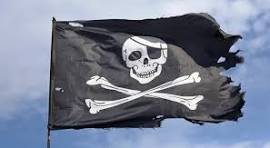
Venezuela condemns US actions as "international piracy."

Washington has said the measures aim to combat corruption and drug trafficking, while Caracas accuses the US of using anti-narcotics efforts as a pretext to remove President Nicolas Maduro from power and gain control over Venezuela's oil resources.

“We stand against any move that violates the purposes of the UN Charter and infringes upon other countries’ sovereignty and security and all acts of unilateralism and bullying,” the Chinese Foreign Ministry spokesman said.

“Venezuela has the right to independently develop mutually beneficial cooperation with other countries, and we believe that the international community can understand and support Venezuela’s stance of defending its own rights,” he added.

 
LIVE
1 hour ago

Q: How Did Chevron Become Venezuela’s Largest Foreign Investor?​


1766395446900.jpeg

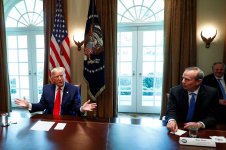
Donald Trump, during his first term as president, with Chevron CEO Mike Wirth at the White House on April 3, 2020. Tom Brenner/Reuters


In November 2025, Wirth attended a red carpet dinner at the White House for Saudi Crown Prince Mohammed bin Salman. Bin Salman, invited by President Donald Trump, was making his first visit to the United States since 2018.[11]


Key Owners of Chevron:

  • Vanguard Group: One of the largest shareholders, managing significant portions of Chevron's stock.
  • BlackRock Inc.: A major asset manager with a substantial stake.
  • State Street Corporation: Another leading institutional holder.
  • Berkshire Hathaway Inc.: Warren Buffett's company also holds a notable position.
Ownership Structure:
  • Institutional Investors: Own the majority (around 65-78%) of Chevron's shares, influencing decisions.
  • Retail/Individual Investors: Own a substantial portion, nearly one-third, of the shares.
 
Last edited:
Mr. Trump told reporters on Monday that the United States intended to keep the 1.9 million barrels of oil that were on the first tanker that was seized. “We’re keeping it,” Mr. Trump said. “We’re keeping the ships also.”

María Corina Machado, Venezuela’s de facto opposition leader and winner of this year’s Nobel Peace Prize, told CBS News in an interview earlier this month that she supports the seizures and has been “asking for this for years.”

Mr. Maduro, in a letter to the United Nations on Monday, said the “blockade and acts of piracy” would harm global energy supply, market stability and individual economies. The U.N. Security Council has scheduled an emergency meeting on Tuesday to discuss Venezuela.


Users who are viewing this thread

Pakistan Defence Latest

Back
Top