Desprado123
SpeedLimited

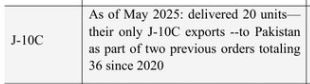
Pentagon says that Pak has 36 j 10C
Follow along with the video below to see how to install our site as a web app on your home screen.
Note: This feature may not be available in some browsers.

Pentagon says that Pak has 36 j 10C
Total 36 since 2020 and as a part of previous order.read that sentence again man , both u and the sibal have the comprehension of 2 year old
Total 36 since 2020 and as a part of previous order.

Valid point...agreed. However, I for one only see PAF trying to ensure all parts and components of JFT are made in Pakistan and a new engine is introduced with minimal redesign of engine bay (If possible).
The military industry is a branch of the industrial system, and it follows the most fundamental logic of industrial development.The only way this will happen is if there's an alloys and composites production base within Pakistan that can output at scale (as we'll need subassemblies for fighters, drones, and munitions).
Pentagon says that Pak has 36 j 10C

Point taken. What you do not know and are not privy to is the fact the Defence Production Division of Pakistan has been reaching out to private sector groups to venture into various manufacture and supply opportunities for private sector from light weight Kevlar vests to manufacture of critical electronic systems and other high tech components. Various visits meetings have been done and assurances of long term contracts and joint investments have been made to encourage the private sector to come into. This was never done before where engagement with large group of private sector investors were called in to discuss areas of opportunities and long term commitments.The military industry is a branch of the industrial system, and it follows the most fundamental logic of industrial development.
PAC is striving to develop localized manufacturing of the JF-17, increasing the proportion of domestically produced components. However, aiming for 100% localized manufacturing is clearly not something PAC can achieve, nor is it something PAC can decide on its own.
Overemphasizing nationalism will kill the entire industry. You need to respect the laws of scientific and technological development, and you also need to respect the laws of industrial development.
=======================================
Here's a real-world case study from China:
China is the world's largest producer and consumer of ballpoint pens. However, the special steel used for the ballpoint pen tips was 100% reliant on imports (mainly from Japan) for a long time.
A national leader, during a meeting, angrily criticized, "Why can't we produce this small thing ourselves?" Consequently, under the strong influence of the state apparatus, Taiyuan Iron and Steel Group developed this type of steel and dedicated one production line to its manufacture. We achieved the goal of domestic production.
However, this is a very niche market. One batch of this steel produced by Taiyuan Iron and Steel Group is enough for a year's supply. For the rest of the time, the production line is severely underutilized. Meanwhile, due to Chinese dumping, several related Japanese companies went bankrupt. The Taiyuan Iron and Steel Group's production line also suffered huge losses.
Ultimately, the relevant companies reached a settlement. They agreed to cooperate and benefit mutually.
=======================================
Whether it's alloys or composite materials, their entire production chain is closely linked to the overall industrial supply chain. Introducing these production chains is pointless if you don't have sufficient market demand to absorb the resulting capacity.
Regarding the JF-17's engine, the only alternative currently available is the WS-21 engine. Replacing the RD-93 engine with the WS-21 is relatively easy from a technical standpoint. While Liyang Company's current WS-21 engine production line capacity is not high, it is more than sufficient to meet PAC's needs.
The problem lies in Pakistan's overall considerations regarding other aspects.

The quantity and backup doesn't depend on numbers only but also the quality of aircraft. A single J-10C sqn held off all the packages of IAF on 7th, so we don't need Mirages and PGs in combat role now.If true than it means we have around 300s of fighter jets. PAF is also not replacing old jets with jf 17 than how we suppose to compete with IAF in terms of quantity and back up?

What is the minimum number of squadron that PAF will maintain or will keep maintaining it? Another issue is number of pilots, if we retired all 3rd gen Aircrafts, then we will have trouble maintaining a good pilot per aircraft ratio?The quantity and backup doesn't depend on numbers only but also the quality of aircraft. A single J-10C sqn held off all the packages of IAF on 7th, so we don't need Mirages and PGs in combat role now.
We have 400 aircraft if we count the 3rd gen too but practically they can’t be deployed in the initial phase of any conflict against India. Another J-10C sqn will give us more capability than 3 air superiority squadrons of PG. They will be in training role only and then retired in a few years. By that time, we may see J-35 in service too. Let's see what is the situation a year from now.
The core element in winning that air battle was an advanced air combat system; the J-10CE was merely one node in this system.The quantity and backup doesn't depend on numbers only but also the quality of aircraft. A single J-10C sqn held off all the packages of IAF on 7th, so we don't need Mirages and PGs in combat role now.

That’s exactly the right way to frame it. The decisive factor wasn’t the J-10CE as a standalone platform, but the system-of-systems it was embedded in. In a modern air battle, outcomes are driven by how well sensors, datalinks, shooters, AEW&C, and ground-based IADS are integrated into a single decision loop.The core element in winning that air battle was an advanced air combat system; the J-10CE was merely one node in this system.
If we were to use some technical means to integrate the Rafale fighter jet into this system—that is, a PAF Rafale fighter jet against an IAF J-10CE—the result would be very interesting. (Of course, such a scenario is impossible in reality.)
What truly gives the PAF an advantage over the IAF is not its fighter jets, but this entire system.
When the IAF's Rafale fighter pilots were still relying on visual observation and public radio channels for communication, their defeat was already inevitable. Even if they were flying 5th-generation fighters like the F-22/F-35, they would not have been able to compete with the PAF.

On PAF's lack of modern SOW:
It is reality and what we saw in May 2025 conflict was the outcome of PAF's historic blunder of turning itself into a completely defensive force with focus on "Defending" the skies only and not preparing for "Punishing Back" the enemy.
I have been saying it since ages that fundamental flaw in PAF's strategic mindset that led to this situation is it being a purely defense oritened force. Look at its fighter fleet in terms of weapon carrying capacities and ranges and then compare it to IAF's 10-Squadron strong fleet of SU-30MKI where each can carry nearly 8 tons of ordinance. Its bigger size allows it to carry weapons like Brahmos for which PAF has very little to no defense. (as we saw in May 2025 conflict). PAF has always told us because Pakistan does not has geopolitical ambitions hence it is contended with its light Multirole fighters like F-16s and JF-17s. No real strike platform. ROSE project itself was a desperate attempt to have some kind of SOW capability after pressler amendments. First time PAF suffered from lack of this capability was Kargil and that was in 1999. Now why do I say it is flawed mindset. Apart from IAF's strength in A2G capabilities, we will also have to take into account the geographical strength of India. It has massive land mass and in Indian Ocean it has even bigger space to manuvear and lure Pakistani single engine light to medium weight multirole fighters deep into its territory in a Kill-Box of S-400 and other advanced long range SAMs. In absense of a true long range, heavy weight bomber fighter (J-16 type), PAF will never be able to neutralize deep embedded IACCS nodes, SAM sites, IAF bases, C2 nodes etc. Leave all those aside, PAF will not even be able to neutralize all those massive ammuniton dumps and Earth Covered Magazines (ECMs) there. Look at this image, this facility is just one of dozens more like this...
View attachment 166432
How much aerial firepower required to deal with all those ECMs in this single ammunition dump near Ambala? PAF always required heavy bombers with powerful long range A2G weapons (ideally with Penetrator warheads). Look at Israel. A tiny state and still operating more than 160 F-15s. Why? Because it is not about the size of Israel but the size of its adversaries. All Arab nations. How Pakistan's situation is different? We are also upagainst an adversary that has massive land advantage. Only way to overcome this is to have something that can provide both range and firepower. Lastly, for those who still have doubts, think why China is developing H-20 despite having various types of Flankers, J-20, and J-10Cs. It's never about your size or ambitions ... it is always about the capability of your adversary which must dictate your war prepardness.
Thanks for reading.
Unfortunately, the F-16 is not related to this system. Neither China nor the United States would allow something like this to happen.This is also why the PAF's F-16 upgrades matter. They don’t change the character of the system; they add nodes, density, and redundancy to it. More shooters and passive participants inside the same NC architecture deepen the engagement envelope and complicate adversary planning.
I agree absolutely but the point was regarding J-10C in comparison to PAF Mirages and F-7PGs. Those aircraft can't be integrated in PAF's Multi-Domain Operations and so their numbers are immaterial.The core element in winning that air battle was an advanced air combat system; the J-10CE was merely one node in this system.
If we were to use some technical means to integrate the Rafale fighter jet into this system—that is, a PAF Rafale fighter jet against an IAF J-10CE—the result would be very interesting. (Of course, such a scenario is impossible in reality.)
What truly gives the PAF an advantage over the IAF is not its fighter jets, but this entire system.
When the IAF's Rafale fighter pilots were still relying on visual observation and public radio channels for communication, their defeat was already inevitable. Even if they were flying 5th-generation fighters like the F-22/F-35, they would not have been able to compete with the PAF.
I cannot comment on the Mirages.I agree absolutely but the point was regarding J-10C in comparison to PAF Mirages and F-7PGs. Those aircraft can't be integrated in PAF's Multi-Domain Operations and so their numbers are immaterial.


