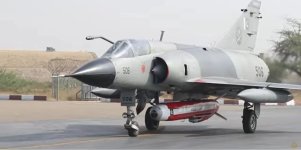
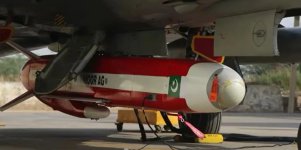
PAF Conducts Successful Test Launch of Taimoor ALCM

But Khobsorat Larkiyan tu phir bhi AF wale hi le jate hai...the rest goes to military, and remaining navy wale, left overs are for Civilians. (Mazak hai bhai serious na ho jana)

I think we are going off topic.

But just to clear this point as well - yes, there may be certain fascination factor found among the females for being a military wife. But things are changing my brother. Real life is getting tougher.

There is simply no money to afford the usual perks like good old times. No new constructions for accommodations being done at bases. That means the you'll have to wait 3-4 years to get an official accommodation for a family. Guest rooms are used on ad-hoc basis but they charge so much you have 60-70 K per month amounting to mess bill.

Professional life has become more and more hectic. So many new systems being inducted while the service is focused on rationalization of manpower at the same time.

Very little family time and sports time - nothing like good old times. Less leaves - no more C130 sorties for travelling - they even revising the policies for end service benefits as well to ensure least burden on service - The good times are gone as far as this job is concerned, too.

So you'll see this fascination factor soon fading away.

Anyway - let's get back to the topic.
 
Suparco is an interesting case, at least amongst the organization's that I am aware off. another example is Suparco offshot i.e. Stingray. Anyone who had a taya, chacha and mama stayed on Suparco and everyone else (including some brilliant minds) moved to a new company with a contract on lower financial terms or unclear path ahead. Needless to say, loss for suparco or defence production or ultimately the nation.
This is an endemic problem as the same has happened at other places with a big name and expectations associated with it.
PCSIR and PITAC established by Field Marshall Ayub khan. Both organizations did wonders in research of industrial and manufacturing processes. Helped in lowering manufacturing costs while increasing efficiency. Skoda Pakistan joint car manufacturing, as SKOPAK, and much more happened in the 50s , 60s and 70s.
We then went into reverse gear, and still going.
 
When it comes to ground launched offensive weapons, no one seems to be talking about TELs. Pakistan could be producing thousands of H1/2/4, Babur, etc but if there's no way to deploy them and use them, they may as well be useless. Does anyone know if we at least produce our own TELs or do we have to import them? How many regiments of Babur, H1, H2, do we actually have? Have we seen any increased orders for TELs? That would be a sure way to see if we've actually ramped up production of these weapons.
There is some unverified information:
The heavy TEL used by Pakistan and North Korea mainly originate from China. However, there are significant differences between the two.
The TEL exported by China to Pakistan are military versions, while those exported to North Korea are civilian versions (although it sounds ridiculous, there are indeed civilian versions).

For Pakistan, there are no serious technical obstacles to independently producing TEL.
The difficulty lies in Pakistan's lack of a sufficiently supportive industrial system – specifically, a lack of adequate supply chains.
This is essentially a common problem for Pakistan's entire military-industrial complex.
 
There is some unverified information:
The heavy TEL used by Pakistan and North Korea mainly originate from China. However, there are significant differences between the two.
The TEL exported by China to Pakistan are military versions, while those exported to North Korea are civilian versions (although it sounds ridiculous, there are indeed civilian versions).

For Pakistan, there are no serious technical obstacles to independently producing TEL.
The difficulty lies in Pakistan's lack of a sufficiently supportive industrial system – specifically, a lack of adequate supply chains.
This is essentially a common problem for Pakistan's entire military-industrial complex.
I feel the Pakistani government should establish worker cooperatives in such industries, providing them with capital and granting membership to skilled workers and management. The pay gap should be limited, with top management earning no more than 10–15 times the average salary. These co-ops could draw on the experience of successful co-op giants like Mondragon to structure themselves through the direct participation of these giant co-ops initially (which I believe they are happy to provide), while the government gradually shields the domestic market from foreign competitors through higher import tariffs. Members should not be allowed to sell equity, and dividends should be distributed very sparingly, with most profits reinvested into R&D and expansion. This model would prevent capital flight and the diversion of funds to unproductive sectors. The cooperatives would remain entirely privately owned by their members and governed by co-op bylaws, with no government control.


Some may call this naive, but I think it is at least as naive to believe that Pakistani capitalists can industrialise the country. They are parasites.

@JamD @Oscar Penny for your thoughts?
 
@Corax Our TELs come mostly from china or Belarusian firms. They are most probably assembled at NDC complexes in fateh jangh or at tirwana( all of this open source info)

Regarding the amounts of TELs we have is very difficult but satellite imagery says we have TELs in some or enough amount ,you get the idea.

We have seen US constantly putting bans on NDC and the belarusians cuz they are providing us with TELs etc...we do get them from china also mainly the TELs of FATAH are chinese looking.

At the end of the day making TELs for us would not be a problem anymore cuz we have been building them for a long time(Hopium from my side)
 
👌 I agree, we have to look at the root cause without any prejudice. If we identify it wrongly due to whatever reason, the solution will be useless.
Military will be more than happy if civilians run the state efficiently . Military intervenes out of necessity not choice.... military has become a scapegoat for all the nation's blunder ...blame everything on the military and claim innocence.....in an attempt to look balanced and objective people, unnecessarily, delve into unjustified criticism of military.... that's my gripe.
 
There is some unverified information:
The heavy TEL used by Pakistan and North Korea mainly originate from China. However, there are significant differences between the two.
The TEL exported by China to Pakistan are military versions, while those exported to North Korea are civilian versions (although it sounds ridiculous, there are indeed civilian versions).

For Pakistan, there are no serious technical obstacles to independently producing TEL.
The difficulty lies in Pakistan's lack of a sufficiently supportive industrial system – specifically, a lack of adequate supply chains.
This is essentially a common problem for Pakistan's entire military-industrial complex.
Most of the TEL are built in Pakistan on engine/ chassis bought from the west.
 
What capabilities does the Taimoor ALCM bring to Pakistan in an India–Pakistan war scenario?

The recent successful test of the Taimoor Air-Launched Cruise Missile (ALCM) on January 3, 2026, marks a pivotal shift in the Pakistan Air Force’s (PAF) offensive doctrine. As a high-precision, indigenous weapon system, the Taimoor is designed to provide Pakistan with a sophisticated "stand-off" strike capability, allowing it to hit high-value targets while keeping its aircraft safe from advanced enemy air defenses.
In a potential India-Pakistan war scenario, the Taimoor ALCM introduces several strategic and tactical advantages:

Penetration of Layered Air Defenses
One of the most significant challenges for the PAF is India’s increasingly dense air defense network, including the S-400 Triumf and the indigenous MRSAM systems.

  • Low-Altitude Flight: Taimoor is engineered for "terrain-hugging" and "sea-skimming" flight profiles. By flying at extremely low altitudes, it can exploit radar gaps and terrain masking to remain undetected until the final moments of impact.
  • Stealth Characteristics: Its airframe features low-observability (stealth) characteristics, specifically designed to reduce its radar cross-section, making it a "hard kill" for interceptor missiles.
Deep Standoff Range (600 km)
With a confirmed range of 600 kilometers, the Taimoor allows the PAF to engage targets deep within Indian territory without crossing the Border or Line of Control (LoC).

  • Safety of Platforms: PAF strike packages, such as the JF-17 Thunder Block III and Mirage-V, can launch the missile from well within protected Pakistani airspace.
  • Targeting High-Value Assets: This range puts critical infrastructure—including command and control centers, airbases, and logistics hubs—under direct threat from the very onset of hostilities.
Maritime Strike and Anti-Access/Area Denial (A2/AD)
The Taimoor is a multi-role weapon, capable of engaging both land and sea targets.

  • Naval Deterrence: In a conflict, the Taimoor serves as a potent anti-ship missile. Its ability to strike warships at distances up to 290–600 km complicates Indian naval maneuvers in the Arabian Sea.
  • Threat to Capital Ships: By holding aircraft carriers and destroyers at risk from the air, Pakistan can enforce a "no-go zone" for the Indian Navy’s surface fleet near its coastline.
Narrowing the Escalation Ladder
The Taimoor is primarily projected as a conventional precision-strike weapon.

  • Conventional Deterrence: By providing a highly accurate non-nuclear option to strike strategic targets, Pakistan gains a way to respond to conventional Indian incursions (such as "Cold Start" doctrine maneuvers) without immediately resorting to the nuclear threshold.
  • High Precision: Equipped with an Imaging Infrared (IIR) seeker and advanced GNSS/INS navigation, it offers high terminal accuracy, ensuring that military objectives are met with minimal collateral damage.
Indigenous Sustainability
Because the Taimoor is developed by Pakistan's Air Weapons Complex (AWC) and marketed by GIDS, it offers strategic autonomy.

  • Resilience to Sanctions: Unlike imported systems (like the SCALP or Storm Shadow), Pakistan’s ability to manufacture and iterate on the Taimoor locally ensures that its strike capabilities remain unaffected by international arms embargoes or supply chain disruptions during a prolonged war.


Summary of Technical Specifications


Feature

Detail

Range

600 km (373 miles)

Speed

Subsonic (Mach 0.7 – 0.8)

Guidance

INS/GNSS + Imaging Infrared (IIR) Seeker

Warhead

Conventional (Blast-fragmentation / Penetration)

Launch Platforms

JF-17 Thunder, Mirage III/V

The Taimoor ALCM acts as a force multiplier that compensates for numerical inferiority through qualitative precision. It ensures that in any future conflict, the PAF retains the ability to project power deep into contested spaces while preserving its most valuable aerial assets.


Taimoor vs. Indian Air Defense Systems
The Taimoor is designed specifically to exploit the "blind spots" of a multi-layered Integrated Air Defense System (IADS) like India's.
Neutralizing the S-400 Triumf
The S-400 is a "high-altitude gatekeeper." While it can track targets at 400km, it faces the "radar horizon" problem against low-flying missiles.

  • Terrain Masking: Taimoor flies at altitudes as low as 50–100 meters. By hugging the terrain, it remains hidden behind hills or the Earth's curvature, significantly reducing the S-400's effective detection range.
  • Saturation Attacks: Because the Taimoor is indigenous and relatively low-cost, it can be launched in "swarms." Even if an S-400 battery detects them, the sheer number of incoming low-RCS (Radar Cross Section) targets can deplete the battery's limited interceptor missiles.
Overcoming the MRSAM and Akash
For medium-range systems like the MRSAM (Barak-8) and Akash, the Taimoor uses advanced terminal guidance:

  • IIR Seeker: Unlike older missiles that use radar (which can be jammed), Taimoor’s Imaging Infrared (IIR) seeker "sees" the heat signature of the target. This makes it immune to electronic warfare (jamming) aimed at its guidance system.
  • Stealth Shaping: Its box-shaped fuselage and X-type tail are designed to scatter radar waves, making it appear much smaller than it is, delaying the "lock-on" time for systems like the Akash.


Technical Comparison: Taimoor vs. BrahMos vs. Nirbhay
The following table highlights the radical differences in philosophy between Pakistan's newest ALCM and India’s primary cruise missiles.


Feature

Taimoor (Pakistan)

BrahMos (India)

Nirbhay / ITCM (India)

Type

Stealth ALCM

Supersonic Cruise

Long-Range Subsonic

Range

600 km

290–500 km (Air-launched)

800–1,000 km

Speed

Subsonic (Mach 0.8)

Supersonic (Mach 3.0)

Subsonic (Mach 0.7)

Key Advantage

Survivability & Stealth

Kinetic Energy & Speed

Extreme Range

Guidance

INS/GNSS + IIR Seeker

Active Radar Seeker

INS/GPS + RF Seeker

Launch Platform

JF-17, Mirage III/V

Su-30MKI (Heavy)

Land-based / Ships


The "Stealth vs. Speed" Debate

Taimoor vs. BrahMos

  • Philosophy: BrahMos relies on speed to overwhelm defenses—it hits so fast that the enemy has seconds to react. Taimoor relies on stealth—the enemy doesn't know it's there until it hits.
  • Versatility: BrahMos is very heavy (2.5 tons for air-launch), meaning only the heavy Su-30MKI can carry it. Taimoor is lightweight (<1,200 kg), allowing Pakistan to equip its entire JF-17 Thunder fleet with long-range precision strike capabilities.
Taimoor vs. Nirbhay

  • Mission Profile: Nirbhay is a "loitering" missile designed for very long distances (1,000 km), essentially a "Tomahawk" equivalent. Taimoor is a tactical "Standoff" weapon.
  • Technology: Taimoor is considered more advanced in terms of seeker technology (IIR), which allows for "surgical" accuracy against specific buildings or moving warships, whereas Nirbhay has historically faced more developmental hurdles in its guidance systems.


Conclusion
In a war scenario, the Taimoor doesn't need to "outrun" the S-400; it just needs to "out-hide" it. By providing a 600km range on a stealthy, low-flying airframe, Pakistan has effectively neutralized the "safe zone" Indian air defenses previously provided for deep-seated military assets.
 
I am sorry that I couldn't give detailed explanations on each point you raised. I simply do not have enough free time to do that on a forum that doesn't pay me money lol. However, keep in mind you also didn't refute any of the specifics in my post and started discussing technologies present on the systems. However, I believe @Ak01 and @puttputt may have satisfied some of your questions. Again, I am sorry for not being more descriptive in my reply to you.

Just FYI I disagree vehemently that Pakistan's defense industry is on par with the Turkish. I have actually worked in Turkish defense industry and Pakistan's so I am quite well placed to judge this. Again, I've discussed this on this forum many times before in detail and cannot spend time repeating very long posts.
Hello sir,

I understand your point. You have more intel and technical idea of systems. However, I am talking about perception in each sector of defence related to Pakistan by Pakistani's. We are here to learn if you are think tank we want views of think tank so that we are properly educated. Obviously detailed data is stupid to ask as its confidential but upper level based on you is weak as compared to turkey. Could be could be not but as you are better ill consider that.

Dear members I want to add something for last time in this thread until im asked to reply.

Truth is Pakistan excels in:
  1. Software sovereignty
  2. Systems integration
  3. Electronic warfare
  4. Operational software
  5. Multi-vendor interoperability
  6. Combat-driven design choices
I am not saying this with blindness as I have known people who are really good. Turkey is behind Pakistan in some of these sectors. Turkey is new in ballistic and cruise missile family.
Pakistan fields:
  • Land-attack cruise missiles
  • Air-launched cruise missiles
  • Sea-based (sub-surface) cruise missiles
Key advantages:
  • Terrain-following navigation
  • Multi-platform launch flexibility
  • Nuclear + conventional roles
  • Operational testing across environments

Turkey’s cruise missile efforts:
  • SOM family
  • Mostly:
    • Air-launched
    • Conventional
    • Short- to medium-range
  • Strong guidance and seeker tech
  • Limited emphasis on:
    • Sea-based deterrence
    • Strategic range classes
Turkey excels at precision, not strategic reach
Most Pakistan’s cruise missiles are not export products, so they are:
  • Less visible
  • Less advertised
  • More classified
Everything is not about accuracy. Its also about strategic depth, Survivability and launch flexibility. With limited data putting emphasis turkey is better is pure ignorance.

Turkey in my opinion excels in
UAV, Naval ships, armored vehicles.

Pakistan lacks in production capacity and stockpiles if it comes to cruise missiles.
 
Last edited:
What capabilities does the Taimoor ALCM bring to Pakistan in an India–Pakistan war scenario?

The recent successful test of the Taimoor Air-Launched Cruise Missile (ALCM) on January 3, 2026, marks a pivotal shift in the Pakistan Air Force’s (PAF) offensive doctrine. As a high-precision, indigenous weapon system, the Taimoor is designed to provide Pakistan with a sophisticated "stand-off" strike capability, allowing it to hit high-value targets while keeping its aircraft safe from advanced enemy air defenses.
In a potential India-Pakistan war scenario, the Taimoor ALCM introduces several strategic and tactical advantages:

Penetration of Layered Air Defenses
One of the most significant challenges for the PAF is India’s increasingly dense air defense network, including the S-400 Triumf and the indigenous MRSAM systems.

  • Low-Altitude Flight: Taimoor is engineered for "terrain-hugging" and "sea-skimming" flight profiles. By flying at extremely low altitudes, it can exploit radar gaps and terrain masking to remain undetected until the final moments of impact.
  • Stealth Characteristics: Its airframe features low-observability (stealth) characteristics, specifically designed to reduce its radar cross-section, making it a "hard kill" for interceptor missiles.
Deep Standoff Range (600 km)
With a confirmed range of 600 kilometers, the Taimoor allows the PAF to engage targets deep within Indian territory without crossing the Border or Line of Control (LoC).

  • Safety of Platforms: PAF strike packages, such as the JF-17 Thunder Block III and Mirage-V, can launch the missile from well within protected Pakistani airspace.
  • Targeting High-Value Assets: This range puts critical infrastructure—including command and control centers, airbases, and logistics hubs—under direct threat from the very onset of hostilities.
Maritime Strike and Anti-Access/Area Denial (A2/AD)
The Taimoor is a multi-role weapon, capable of engaging both land and sea targets.

  • Naval Deterrence: In a conflict, the Taimoor serves as a potent anti-ship missile. Its ability to strike warships at distances up to 290–600 km complicates Indian naval maneuvers in the Arabian Sea.
  • Threat to Capital Ships: By holding aircraft carriers and destroyers at risk from the air, Pakistan can enforce a "no-go zone" for the Indian Navy’s surface fleet near its coastline.
Narrowing the Escalation Ladder
The Taimoor is primarily projected as a conventional precision-strike weapon.

  • Conventional Deterrence: By providing a highly accurate non-nuclear option to strike strategic targets, Pakistan gains a way to respond to conventional Indian incursions (such as "Cold Start" doctrine maneuvers) without immediately resorting to the nuclear threshold.
  • High Precision: Equipped with an Imaging Infrared (IIR) seeker and advanced GNSS/INS navigation, it offers high terminal accuracy, ensuring that military objectives are met with minimal collateral damage.
Indigenous Sustainability
Because the Taimoor is developed by Pakistan's Air Weapons Complex (AWC) and marketed by GIDS, it offers strategic autonomy.

  • Resilience to Sanctions: Unlike imported systems (like the SCALP or Storm Shadow), Pakistan’s ability to manufacture and iterate on the Taimoor locally ensures that its strike capabilities remain unaffected by international arms embargoes or supply chain disruptions during a prolonged war.


Summary of Technical Specifications


Feature

Detail

Range

600 km (373 miles)

Speed

Subsonic (Mach 0.7 – 0.8)

Guidance

INS/GNSS + Imaging Infrared (IIR) Seeker

Warhead

Conventional (Blast-fragmentation / Penetration)

Launch Platforms

JF-17 Thunder, Mirage III/V

The Taimoor ALCM acts as a force multiplier that compensates for numerical inferiority through qualitative precision. It ensures that in any future conflict, the PAF retains the ability to project power deep into contested spaces while preserving its most valuable aerial assets.


Taimoor vs. Indian Air Defense Systems
The Taimoor is designed specifically to exploit the "blind spots" of a multi-layered Integrated Air Defense System (IADS) like India's.
Neutralizing the S-400 Triumf
The S-400 is a "high-altitude gatekeeper." While it can track targets at 400km, it faces the "radar horizon" problem against low-flying missiles.

  • Terrain Masking: Taimoor flies at altitudes as low as 50–100 meters. By hugging the terrain, it remains hidden behind hills or the Earth's curvature, significantly reducing the S-400's effective detection range.
  • Saturation Attacks: Because the Taimoor is indigenous and relatively low-cost, it can be launched in "swarms." Even if an S-400 battery detects them, the sheer number of incoming low-RCS (Radar Cross Section) targets can deplete the battery's limited interceptor missiles.
Overcoming the MRSAM and Akash
For medium-range systems like the MRSAM (Barak-8) and Akash, the Taimoor uses advanced terminal guidance:

  • IIR Seeker: Unlike older missiles that use radar (which can be jammed), Taimoor’s Imaging Infrared (IIR) seeker "sees" the heat signature of the target. This makes it immune to electronic warfare (jamming) aimed at its guidance system.
  • Stealth Shaping: Its box-shaped fuselage and X-type tail are designed to scatter radar waves, making it appear much smaller than it is, delaying the "lock-on" time for systems like the Akash.


Technical Comparison: Taimoor vs. BrahMos vs. Nirbhay
The following table highlights the radical differences in philosophy between Pakistan's newest ALCM and India’s primary cruise missiles.


Feature

Taimoor (Pakistan)

BrahMos (India)

Nirbhay / ITCM (India)

Type

Stealth ALCM

Supersonic Cruise

Long-Range Subsonic

Range

600 km

290–500 km (Air-launched)

800–1,000 km

Speed

Subsonic (Mach 0.8)

Supersonic (Mach 3.0)

Subsonic (Mach 0.7)

Key Advantage

Survivability & Stealth

Kinetic Energy & Speed

Extreme Range

Guidance

INS/GNSS + IIR Seeker

Active Radar Seeker

INS/GPS + RF Seeker

Launch Platform

JF-17, Mirage III/V

Su-30MKI (Heavy)

Land-based / Ships


The "Stealth vs. Speed" Debate

Taimoor vs. BrahMos

  • Philosophy: BrahMos relies on speed to overwhelm defenses—it hits so fast that the enemy has seconds to react. Taimoor relies on stealth—the enemy doesn't know it's there until it hits.
  • Versatility: BrahMos is very heavy (2.5 tons for air-launch), meaning only the heavy Su-30MKI can carry it. Taimoor is lightweight (<1,200 kg), allowing Pakistan to equip its entire JF-17 Thunder fleet with long-range precision strike capabilities.
Taimoor vs. Nirbhay

  • Mission Profile: Nirbhay is a "loitering" missile designed for very long distances (1,000 km), essentially a "Tomahawk" equivalent. Taimoor is a tactical "Standoff" weapon.
  • Technology: Taimoor is considered more advanced in terms of seeker technology (IIR), which allows for "surgical" accuracy against specific buildings or moving warships, whereas Nirbhay has historically faced more developmental hurdles in its guidance systems.


Conclusion
In a war scenario, the Taimoor doesn't need to "outrun" the S-400; it just needs to "out-hide" it. By providing a 600km range on a stealthy, low-flying airframe, Pakistan has effectively neutralized the "safe zone" Indian air defenses previously provided for deep-seated military assets.


I like what you have described here, but, still I dont think Taimoor missile has all the answers.

meanwhile, our antagonist is busy developing missiles like Pralay which are meant to replace Prithvi (shorter range missiles)

Pralay is a sophisticated missile, it is supposed to evade AD network (at least on the paper)

in other words, we have less varied missiles types than our adversary to kill the AD networks

this is not going to be enough, bec. our AD is weaker
 
I like what you have described here, but, still I dont think Taimoor missile has all the answers.

meanwhile, our antagonist is busy developing missiles like Pralay which are meant to replace Prithvi (shorter range missiles)

Pralay is a sophisticated missile, it is supposed to evade AD network (at least on the paper)

in other words, we have less varied missiles types than our adversary to kill the AD networks

this is not going to be enough, bec. our AD is weaker

Agreed dear, Since I am not an expert in this field, my writing is naturally superficial and based on limited, publicly available information. While my points may be incorrect, I believe that discussing them will help us all reach a deeper understanding.
 
I like what you have described here, but, still I dont think Taimoor missile has all the answers.

meanwhile, our antagonist is busy developing missiles like Pralay which are meant to replace Prithvi (shorter range missiles)

Pralay is a sophisticated missile, it is supposed to evade AD network (at least on the paper)

in other words, we have less varied missiles types than our adversary to kill the AD networks

this is not going to be enough, bec. our AD is weaker
Hello sir,

You are one of my favorite members. Always show respect and consider others view. That is why im compel to ask you that why you think AD is weaker than Indian ? if s400 couldn't do much against s400 with cm 400 AKG. Then in my opinion Ground Based AD systems are just not that effective in Indo Pak scenario. With drones, missiles and guided rockets its already a challenge for even US to counter them easily.

Between I think even Pakistan military never said Taimoor has all the answers. Its just alternate delivery system of conventional and nuclear strike. which is strategic depth.

Pakistan has HQ9, Spada 2000 (Aspide), LY 80 which has been tested against cruise missiles vastly in testing by china before even inducting. The Chinese tested subsonic and supersonic missiles against it and it had greater than 50% probability in single shot so in reality even if its not single shot but destroying the missile on the way with multiple launches increases the efficiency if not single shot I repeat.

Truth is Pakistan only lacks in quantity of AD systems causing blind spots.

We had perfect victory against Indian airforce shows that our doctrine just focused on Air force to airforce fights and on 2nd tier anticipated missile attacks.

However there are reports of indian missiles kill by soft kill and hard kill. having soft kill capability against supersonic cruise missile is marvel itself as very rarely it is reported in Ukraine war. its either hard kill or miss. Pakistan did both ways.

We lack in supersonic cruise missiles but our subsonic systems are hardened to pierce through Indian AD's undetected.

Personal opinion: Fatah is more of my choice then cruise missiles.
 

Users who are viewing this thread

Back
Top