PAF J-10CE News, Updates and Discussion

Status
Not open for further replies.
If it is for PAF use, then replacing JF-17b3 with WS-19 is a good idea. The WS-19 not only provides greater thrust, but also simplifies the logistical versatility of the J-35. If it is export-oriented, then it is not a good idea. WS-19 will increase the procurement cost of JF-17b3 by approximately $10 million, and there will also be an increase in later costs. This may not be a happy choice for the target users of JF-17b3.
But ws-19 is export ban as per @Michael

My question was that michael said JF17B3 has reached its limit, so i wanted to know if we install high thrust, more electric power engine, can we make it more advance like better radar and irst sensor etc?
 
But ws-19 is export ban as per @Michael

My question was that michael said JF17B3 has reached its limit, so i wanted to know if we install high thrust, more electric power engine, can we make it more advance like better radar and irst sensor etc?

If WS-19 is prohibited from export, why does it appear on FC-31?


WS-19 is on the export control list issued by the Chinese Ministry of Commerce, Chinese Customs, and the Central Military Commission, rather than on the export ban list.

It can be exported as long as the application is approved.
 
Last edited:
If WS-19 is prohibited from export, how can PAF obtain J-35?

WS-19 is on the export control list issued by the Chinese Ministry of Commerce, Chinese Customs, and the Central Military Commission, rather than on the export ban list.

It can be exported as long as the application is approved.
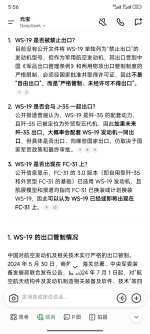
1. The J-35 series fighter jet uses both WS-21 and WS-19 engines, and both have successfully passed testing.
As of now:
All PLA Navy versions of the J-35 use WS-21 engines.
All officially procured PLAAF J-35A versions use WS-19 engines. Additionally, several J-35s (with WS-21 engines) owned by SAC are temporarily on loan to the PLAAF for training purposes.
The export version of the FC-31/J-35 is planned to use WS-21 engines.

2. Currently, there are no public laws prohibiting this. This is because the official announcement regarding these two engines has not yet been made. To date, "WS-21/WS-19" remains an unofficial designation.

3. Regardless of whether China allows the export of the WS-19 engine, considering the maintenance system and maturity of the engine itself, Pakistan is not suitable for introducing the WS-19 engine in the next few years. The technical risks exceed Pakistan's capacity to handle them.
 
Last edited:
1. The J-35 series fighter jet uses both WS-21 and WS-19 engines, and both have successfully passed testing.
As of now:
All PLA Navy versions of the J-35 use WS-21 engines.
All officially procured PLAAF J-35A versions use WS-19 engines. Additionally, several J-35s (with WS-21 engines) owned by SAC are temporarily on loan to the PLAAF for training purposes.
The export version of the FC-31/J-35 is planned to use WS-21 engines.

2. Currently, there are no public laws prohibiting this. This is because the official announcement regarding these two engines has not yet been made. To date, "WS-21/WS-19" remains an unofficial designation.

3. Regardless of whether China allows the export of the WS-19 engine, considering the maintenance system and maturity of the engine itself, Pakistan is not suitable for introducing the WS-19 engine in the next few years. The technical risks exceed Pakistan's capacity to handle them.

Screenshot_2026-01-12-17-56-25-517_com.tencent.hunyuan.app.chat.jpg

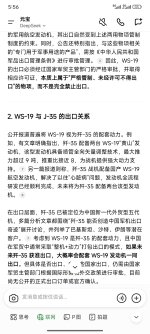
Screenshot_2026-01-12-17-56-49-320_com.tencent.hunyuan.app.chat.jpg
 
You're asking an AI for this kind of information ???
I don't know how to answer this kind of question.

I suggest you read the main thread about the J-35 series fighter jet first.
I use AI screenshots just for the convenience of gathering information and answering.

I know many people believe that J-35 will use WS-21 export. The reason is probably because WS-13 is very mature, so WS-21 is very suitable for export and the like.

I believe that J-35 exports will use WS-19, firstly because the FC-31 at the 2023 Dubai Airshow was use WS-19, and secondly because customers who purchase 5G fighter jets will definitely pursue higher end performance.
 
Last edited:
I kept this position that at least 1 more sq of J-10CE makes a lot more sense than J-35's in 2026, I mean China needs time to build and do whatever testing is required, plus the platform itself needs time to mature, plus we saw J-10CE hold IAF off including shooting down Rafale so it make complete sense that they order 20ish more units. I just thought some member who keep a close eye on new jets via its serial numbers might have some idea but no issues, hopefully in 2026 we at least get 1 more sq.

PAF has right now the IAF fully covered with its fleet as of now esp when you consider that they have lost 4 of their Rafales, some other Rafales are potentially damaged/written off that we don't know about. There is also the new news of a "own kill" which is also unknown. The JF17 fleet can take of every fighter in the IAF as of now in a BVR fight and the F16s will get an upgrade with new Link-16 terminals which will make them more potent.

In short, the IAF is not in position to take another dance with the PAF right now.

So, rather than a new J10CE squadron, PAF may want to take a "risk" with an early version of the J-35 in 2027 and not wait for it too fully mature. I think that is potentially the reason for the pause in procurements of both J10CE and JF17C's. PAF is saving aggressively for J-35AE's.

(imho).
 
Last edited:
I believe that J-35 exports will use WS-19, firstly because the FC-31 at the 2023 Dubai Airshow was use WS-19, and secondly because customers who purchase 5G fighter jets will definitely pursue higher end performance.
1. There is no evidence to support this viewpoint "the FC-31 at the 2023 Dubai Airshow was use WS-19". As of 2023, the development of the WS-19 engine was not yet complete. The maiden flight of the WS-19 took place in 2024.

2. At least under current circumstances, the view that the WS-19 engine is more powerful than the WS-21 engine is inappropriate. They are products of two different technological development paths.
The WS-21 is more focused on providing better maneuverability and payload capacity for fighter jets; the WS-19 is more focused on providing better avionics performance for fighter jets.
In gaming terms, one focuses on "red buff", and the other focuses on "blue buff".
In Chinese military terminology: the WS-21 is the pinnacle of third-generation engines; the WS-19 is the pioneering engine of the fourth generation.
To fully utilize the performance of a fourth-generation engine, an extremely powerful and advanced military system is required. This is a capability that all countries that need to purchase fighter jets from abroad completely lack. If they possessed such a support system, they wouldn't need to buy fighter jets from other countries.
 
If it is for PAF use, then replacing JF-17b3 with WS-19 is a good idea. The WS-19 not only provides greater thrust, but also simplifies the logistical versatility of the J-35. If it is export-oriented, then it is not a good idea. WS-19 will increase the procurement cost of JF-17b3 by approximately $10 million, and there will also be an increase in later costs. This may not be a happy choice for the target users of JF-17b3.

A single unit of WS-19 is currently more expensive than an entire JF-17 block 3 without the engine.

Production rate for WS-19 is still in the process of scaling up. Also the engine may not be suitable for JF-17 aerodynamics and FCS. It is more than 30% more powerful compared to WS-13. There is speculation that WS-19 is up to 120KN wet thrust, making it roughly 40% more powerful if true.

JF-17's purpose is to be quick, easy, affordable and replaceable. WS-13 and RD-93 are readily available and matured products. Makes no sense to put a Ferrari engine into a VW Golf.
 
1. There is no evidence to support this viewpoint "the FC-31 at the 2023 Dubai Airshow was use WS-19". As of 2023, the development of the WS-19 engine was not yet complete. The maiden flight of the WS-19 took place in 2024.

2. At least under current circumstances, the view that the WS-19 engine is more powerful than the WS-21 engine is inappropriate. They are products of two different technological development paths.
The WS-21 is more focused on providing better maneuverability and payload capacity for fighter jets; the WS-19 is more focused on providing better avionics performance for fighter jets.
In gaming terms, one focuses on "red buff", and the other focuses on "blue buff".
In Chinese military terminology: the WS-21 is the pinnacle of third-generation engines; the WS-19 is the pioneering engine of the fourth generation.
To fully utilize the performance of a fourth-generation engine, an extremely powerful and advanced military system is required. This is a capability that all countries that need to purchase fighter jets from abroad completely lack. If they possessed such a support system, they wouldn't need to buy fighter jets from other countries.

Although it was two years ago, I still remember the FC-31 at the 2023 Dubai Airshow having a noticeable bulge at the rear. The result of everyone's discussion at that time was WS-19.

How could WS-19 and WS-21 be the same lv. WS-19 is an excellent 4G medium thrust engine, like F414. Customers who purchase 5G fighter jets will certainly choose WS-19.
 
Last edited:
A single unit of WS-19 is currently more expensive than an entire JF-17 block 3 without the engine.

Production rate for WS-19 is still in the process of scaling up. Also the engine may not be suitable for JF-17 aerodynamics and FCS. It is more than 30% more powerful compared to WS-13. There is speculation that WS-19 is up to 120KN wet thrust, making it roughly 40% more powerful if true.

JF-17's purpose is to be quick, easy, affordable and replaceable. WS-13 and RD-93 are readily available and matured products. Makes no sense to put a Ferrari engine into a VW Golf.
Yes. We are well aware that the JF-17 is positioned as a cost-effective 4G fighter jet. It is meaningless to forcibly upgrade it with high cost technology, and it may even destroy its commercial value.
 
A single unit of WS-19 is currently more expensive than an entire JF-17 block 3 without the engine.

Production rate for WS-19 is still in the process of scaling up. Also the engine may not be suitable for JF-17 aerodynamics and FCS. It is more than 30% more powerful compared to WS-13. There is speculation that WS-19 is up to 120KN wet thrust, making it roughly 40% more powerful if true.

JF-17's purpose is to be quick, easy, affordable and replaceable. WS-13 and RD-93 are readily available and matured products. Makes no sense to put a Ferrari engine into a VW Golf.

PAF will never go for the WS-13 unless Russia turns around and stops the sale of PD-93. The WS-13 is an unproven engine that is not operationally deployed at all and the risk is very high with that engine. RD-93 is proven.
 
PAF has right now the IAF fully covered with its fleet as of now esp when you consider that they have lost 4 of their Rafales, some other Rafales are potentially damaged/written off that we don't know about. There is also the new news of a "own kill" which is also unknown. The JF17 fleet can take of every fighter in the IAF as of now in a BVR fight and the F16s will get an upgrade with new Link-16 terminals which will make the more potent.

In short, the IAF is not in position to take another dance with the PAF right now.

So, rather than a new J10CE squadron, PAF may want to take a "risk" with an early version of the J-35 in 2027 and not wait for it too fully mature. I think that is potentially the reason for the pause in procurements of both J10CE and JF17C's. PAF is saving aggressively for J-35AE's.

(imho).

100% This. IAF seems obsessed with fighting the last war and things will play out like last time. PAF seems to be focused on what the future will look like.

After Feb 2019 we did not sit on our laurels and think the APG-68/AMRAAM combo will win again next time. We moved on to AESA/PL-15, networks and C-400.

Now after May 2025 we know next time we cannot rely on J-10C 5 years from now, hence the urgency to always be one step ahead...
 
How could WS-19 and WS-21 be the same lv. WS-19 is an excellent 4G medium thrust engine, like F414. Customers who purchase 5G fighter jets will certainly choose WS-19.
I'll use an analogy that's not entirely accurate, but quite close:

One is the pinnacle of the internal combustion engine era. The other is a pioneering work in the era of smart electric vehicles.

We all know that smart electric vehicles are the future trend. However, they require an environment with sufficient charging infrastructure, as well as supporting systems such as communication systems and navigation systems. Without sufficiently developed supporting systems, smart electric vehicles would be meaningless.

In China today, the supporting systems for smart electric vehicles are very well-developed; therefore, buying a smart electric vehicle is a very reasonable choice.

But what if you were using it in a region of Africa where the local supporting systems are not sufficiently developed? How would you choose then?

This is the fundamental difference between the WS-21 engine and the WS-19 engine.

The improved capabilities of the WS-19 engine do not lie in enhancing the fighter jet's maneuverability or payload capacity, but rather in providing a more powerful power supply for advanced avionics systems. These advanced avionics systems are more dependent on advanced air combat support systems. If the user does not possess a more advanced air combat support system, these advanced avionics systems will be useless. Therefore, the surplus power supply would be meaningless. ------ What's the point of a household with a total power load of no more than 3KW installing a 10 square millimeter main power line?
 
PAF will never go for the WS-13 unless Russia turns around and stops the sale of PD-93. The WS-13 is an unproven engine that is not operationally deployed at all and the risk is very high with that engine. RD-93 is proven.
WS-13 is very mature.

It has not only been in service for 15 years, but also applied on many platforms. For example, FBC-1,GJ-11, Xianglong high-altitude unmanned reconnaissance aircraft, etc. It is rare to find engines like the WS-13 that serve multiple platforms such as fighter jets, fighter bombers, stealth drones, and high-altitude drones.

And the lifespan of WS-13 has been extended to 3000 hours. RD-93 only has 2200 hours. If the hot end components are not replaced, the lifespan of F414 is only 2000 hours.
 
Status
Not open for further replies.

Users who are viewing this thread

Country Watch Latest

Latest Posts

Back
Top