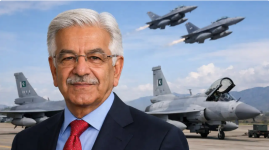
India has a role in saving Pakistan's economy, suggests Khawaja Asif as he brags about JF-17 fighter jet sales

Beijingwalker

VIP Member
Joined
Nov 4, 2011
Messages
93,660
Reaction score
113,945
Reputation
1,959.0
Country of Origin
Country of Residence

India has a role in saving Pakistan's economy, suggests Khawaja Asif as he brags about JF-17 fighter jet sales​

Pakistan's Defence Minister, Khawaja Asif, has claimed that international sales of the JF-17 Thunder fighter jet could eliminate the country's need for future IMF bailout

Updated: January 12, 2026 21:15 IST

搜狗截图20260113234009.png
Amid media reports that Bangladesh is planning to procure JF-17 Thunder fighter jets from Pakistan, and Pakistan and Saudi Arabia are in talks to convert about $2 billion of Saudi loans into a JF-17 fighter jet deal, Pakistan's defence minister, Khawaja Asif, has made a tall claim.

According to the defence minister, Pakistan may no longer have to depend on International Monetary Fund (IMF) bailouts if countries continue to showcase interest in the single-engine lightweight combat jet, developed jointly by the Chengdu Aircraft Corporation (CAC) of China and the Pakistan Aeronautical Complex (PAC), and end up procuring them.

He credited this interest that various countries are showing in the aircraft to the India-Pakistan conflict in May. The conflict, according to him, showcased to the world Pakistan's resolve and military capabilities.

"Our aircraft have been tested, and we are receiving so many orders that Pakistan may not need the International Monetary Fund in six months," he said during an interview with Geo News.

According to a Reuters report, Aamir Masood, a retired Air Marshal and defence analyst, claimed that Pakistan was either in talks or had finalised deals for providing defence equipment, including JF-17s, with as many as six countries. He said the marketability of the fighter jet increased as it was "tested and has been used in combat."

Pakistan has been attempting to expand its arms export in the past few months. Islamabad had struck a deal with the Libyan National Army for the sale of JF-17 fighter jets and training aircraft.

A Reuters report, on Monday, said Indonesia's defence minister met Pakistan's air force chief in Islamabad, and the two, while discussing areas of defence cooperation, also discussed the sale of JF-17 jets.
 

'So Many Orders, IMF No Longer Needed': Drowning In Debt, Pakistan's Khawaja Asif Claims Jet Sales 'Surging' After India Conflict​

Pakistan's Defence Minister Khawaja Asif claimed the country might not require an IMF bailout anymore, citing a surge in defense orders following a recent military clash with India.​

Cash-strapped Pakistan has made a tall claim that it may no longer need an International Monetary Fund (IMF) bailout, saying that its aircraft were selling like hotcakes after last year's military clash with India. In an interview with Karachi-based Geo TV, Pakistan's Defence Minister Khawaja Asif claimed that defence orders have "surged" following the four-day mini-war with India in May 2025, to the extent that Islamabad could soon not need IMF loans altogether.

"Our aircraft have been tested, and we are receiving so many orders that Pakistan may not need the IMF in six months," Asif, who's known for making exaggerating claims said, arguing that the world has taken notice of Pakistan's military capabilities.

Reuters also reported that Pakistan and Saudi Arabia are in talks to convert about $2 billion of Saudi loans into a JF-17 fighter jet deal. Aamir Masood, a retired Air Marshal and analyst, said Pakistan was in talks about or had finalised deals with six countries to provide equipment, including JF-17s and electronic systems and weapons systems for the jets.

The JF-17s marketability has been increased because "it is tested and has been used ‍in combat," he told Reuters, adding that it's also cost effective. ‍Pakistan has said the aircraft was deployed during its conflict with India in May last year, the heaviest fighting between the neighbours in decades.


India has a role in saving Pakistan's economy, suggests Khawaja Asif as he brags about JF-17 fighter jet sales​

Pakistan's Defence Minister, Khawaja Asif, has claimed that international sales of the JF-17 Thunder fighter jet could eliminate the country's need for future IMF bailout

Updated: January 12, 2026 21:15 IST

View attachment 171998
Amid media reports that Bangladesh is planning to procure JF-17 Thunder fighter jets from Pakistan, and Pakistan and Saudi Arabia are in talks to convert about $2 billion of Saudi loans into a JF-17 fighter jet deal, Pakistan's defence minister, Khawaja Asif, has made a tall claim.

According to the defence minister, Pakistan may no longer have to depend on International Monetary Fund (IMF) bailouts if countries continue to showcase interest in the single-engine lightweight combat jet, developed jointly by the Chengdu Aircraft Corporation (CAC) of China and the Pakistan Aeronautical Complex (PAC), and end up procuring them.

He credited this interest that various countries are showing in the aircraft to the India-Pakistan conflict in May. The conflict, according to him, showcased to the world Pakistan's resolve and military capabilities.

"Our aircraft have been tested, and we are receiving so many orders that Pakistan may not need the International Monetary Fund in six months," he said during an interview with Geo News.

According to a Reuters report, Aamir Masood, a retired Air Marshal and defence analyst, claimed that Pakistan was either in talks or had finalised deals for providing defence equipment, including JF-17s, with as many as six countries. He said the marketability of the fighter jet increased as it was "tested and has been used in combat."

Pakistan has been attempting to expand its arms export in the past few months. Islamabad had struck a deal with the Libyan National Army for the sale of JF-17 fighter jets and training aircraft.

A Reuters report, on Monday, said Indonesia's defence minister met Pakistan's air force chief in Islamabad, and the two, while discussing areas of defence cooperation, also discussed the sale of JF-17 jets.
If we use simple logic, the trolling around this issue doesn’t make much sense.

Most of the aircraft parts come from China. Realistically, more than 80% of the total cost/value goes to China because China is supplying the majority of components, technology, and manufacturing.

Even if we generously leave 20% for discussion, Pakistan’s share would still be limited.

At best, Pakistan might receive around 10–20%, and even that seems optimistic. So how can claims of Pakistan getting the major profit be true?

That would only be possible if Pakistan were manufacturing more than 80% of the parts locally. Without large-scale local manufacturing and ownership of key technologies, higher profit margins are simply not realistic
 
If we use simple logic, the trolling around this issue doesn’t make much sense.

Most of the aircraft parts come from China. Realistically, more than 80% of the total cost/value goes to China because China is supplying the majority of components, technology, and manufacturing.

Even if we generously leave 20% for discussion, Pakistan’s share would still be limited.

At best, Pakistan might receive around 10–20%, and even that seems optimistic. So how can claims of Pakistan getting the major profit be true?

That would only be possible if Pakistan were manufacturing more than 80% of the parts locally. Without large-scale local manufacturing and ownership of key technologies, higher profit margins are simply not realistic


Those are large no. of words we didn't need. More power to Khawaja Asif, the "google it" guy. I suppose when Pakistan has done it all, we will know, won't we?
 
Most of the aircraft parts come from China. Realistically, more than 80% of the total cost/value goes to China because China is supplying the majority of components, technology, and manufacturing.
Even if we generously leave 20% for discussion, Pakistan’s share would still be limited.
At best, Pakistan might receive around 10–20%, and even that seems optimistic. So how can claims of Pakistan getting the major profit be true?

I posted a video of Dr. Farrukh Salim in another thread today. He is a credible analyst; per him, about '35-40%' from the sale of JF-17 would go to other countries while the rest will be for Pakistan. Regardless of how many Pakistan sells, it is still some extra money--hard cash but on top of that, the 'hype', the technology gains/industrial grade scaling, diplomatic gains etc have their own benefits. At the least, India's Tejas is being denied the opportunity to shine.
"The only bad publicity is no publicity" (singer Madonna in the 80s).
 
Those are large no. of words we didn't need. More power to Khawaja Asif, the "google it" guy. I suppose when Pakistan has done it all, we will know, won't we?
He is typical south asian political leader - even similar found in india, they only talk and claims, with no any evidence and reality.
 
If we use simple logic, the trolling around this issue doesn’t make much sense.

Most of the aircraft parts come from China. Realistically, more than 80% of the total cost/value goes to China because China is supplying the majority of components, technology, and manufacturing.

Even if we generously leave 20% for discussion, Pakistan’s share would still be limited.

At best, Pakistan might receive around 10–20%, and even that seems optimistic. So how can claims of Pakistan getting the major profit be true?

That would only be possible if Pakistan were manufacturing more than 80% of the parts locally. Without large-scale local manufacturing and ownership of key technologies, higher profit margins are simply not realistic
seriously, where do you get that
 
I posted a video of Dr. Farrukh Salim in another thread today. He is a credible analyst; per him, about '35-40%' from the sale of JF-17 would go to other countries while the rest will be for Pakistan. Regardless of how many Pakistan sells, it is still some extra money--hard cash but on top of that, the 'hype', the technology gains/industrial grade scaling, diplomatic gains etc have their own benefits. At the least, India's Tejas is being denied the opportunity to shine.
"The only bad publicity is no publicity" (singer Madonna in the 80s).
How can this be true? Do we even understand the major cost-driving parts of an aircraft? Has Pakistan produced or replaced any of them?

The real benefits come from owning and manufacturing the high-value systems. For example, if India replaces the engine, radar, seeker, guidance system, mission computer, and launcher with indigenous systems and then exports the product, India will capture most of the profit.

But if the product is exported largely with Russian-made engines, seekers, propulsion, and core technology, then most of the economic benefit will go to Russia, even if India holds 51% ownership. Ownership alone does not determine profit.

This is a basic logic:
 
If we use simple logic, the trolling around this issue doesn’t make much sense.

Most of the aircraft parts come from China. Realistically, more than 80% of the total cost/value goes to China because China is supplying the majority of components, technology, and manufacturing.

Even if we generously leave 20% for discussion, Pakistan’s share would still be limited.

At best, Pakistan might receive around 10–20%, and even that seems optimistic. So how can claims of Pakistan getting the major profit be true?

That would only be possible if Pakistan were manufacturing more than 80% of the parts locally. Without large-scale local manufacturing and ownership of key technologies, higher profit margins are simply not realistic
paint jobs are expensive these days. What can you say? I went into the wrong profession :-)
 
'35-40%' from the sale of JF-17 would go to other countries while the rest will be for Pakistan.
Doesn’t sound correct. The cost of engine itself is about 12-15% of the total cost. Many critical components still come from China in finished condition. Then comes specialty materials that aren’t produced in Pakistan. These are all higher components in terms of value. Even if work share is 60:40, the cost share ratio is likely to be different. Don’t know the exact numbers and wouldn’t hazard a guess either.
 
The real benefits come from owning and manufacturing the high-value systems. For example, if India replaces the engine, radar, seeker, guidance system, mission computer, and launcher with indigenous systems and then exports the product, India will capture most of the profit.

I don't know how Dr. Farrukh Salim came to the '35-40%' number as I am not a hardware person but he is credible.
Regardless of whether 40% or 90% of the sale amount goes out of Pakistan, it is still some extra money coming to Pakistan. Certainly, better than India's Tejas not being sold ;)
 
I don't know how Dr. Farrukh Salim came to the '35-40%' number as I am not a hardware person but he is credible.
Regardless of whether 40% or 90% of the sale amount goes out of Pakistan, it is still some extra money coming to Pakistan. Certainly, better than India's Tejas not being sold ;)
As I already said - pakistan might will get between 10-20%.

Manufacturer always get some benefits of share - for an example - india is exporting apple phones, india does get it's share of manufacturing but again largely amount goes to OEM - Apple & original parts suppliers.

India gets between - 8-10% only
 
Last edited:

Users who are viewing this thread

Pakistan Defence Latest

Latest Posts

Back
Top