Navigation
Install the app
How to install the app on iOS
Follow along with the video below to see how to install our site as a web app on your home screen.
Note: This feature may not be available in some browsers.
More options
Style variation
You are using an out of date browser. It may not display this or other websites correctly.
You should upgrade or use an alternative browser.
You should upgrade or use an alternative browser.
Chinese Economy: General News, Updates and Discussions
- Thread starter Beijingwalker
- Start date
More options
Who Replied?


CallSignMaverick
Banned

The competition was between India-men and Kazakh-men, the video is edited.
 www.uaeswatchallenge.com
Even the grifter @BRICSNews deleted it after being community noted
Results | Final Standing
View the official rankings and results at the end of the competition
Even the grifter @BRICSNews deleted it after being community noted

Thinking_Hard
Registered Member
The competition was between India-men and Kazakh-men, the video is edited.
Results | Final Standing
View the official rankings and results at the end of the competition
Even the grifter @BRICSNews deleted it after being community noted
You have discovered recreational activity of many. Even if you layout the fact, most wouldn't care.

Goenitz
Elite Member

time matters.. was that edited too?The competition was between India-men and Kazakh-men, the video is edited.
Results | Final Standing
View the official rankings and results at the end of the competition
Even the grifter @BRICSNews deleted it after being community noted

Yasser76
Elite Member
You have discovered recreational activity of many. Even if you layout the fact, most wouldn't care.
Biggest centre for fake news? Which country? Remind me again?

Malcolm Reynolds
Banned
Oh look here...a "Malcolm Reynolds" says it's fake just bcuz it doesn't suit his narrative...
...let's come back to reality...start by changing ur name to Mukesh Raghav or something first bcuz there's no way u r a Malcom Reynolds.
it's fake cause it's fake.
shoot the messenger much ?
Cookie Monster
Trusted Member

U r not the messenger...it's fake cause it's fake.
shoot the messenger much ?
...what u r making is a claim Mukesh with no evidence to back it up. A claim will be questioned especially when it is being pulled from ur behind and stinking up this whole thread. All it shows is ur desperation and attempts to save face.
wangdefa
Registered Member

China's true peaceful personality has been often been interpreted as cowardice by many people around the world.
All politics in this world are not simply 'black or white.' From another perspective, we should let everyone underestimate us; this is not a bad thing. We don't care about these comments. I believe we have many plans to accomplish, rather than constantly getting caught in the traps of public opinion and wasting our energy. We have plenty of time to continue developing, and the benefits brought by technological progress are just beginning. It's like watching a movie—if we fast forward to the ending, the China twenty years from now is what we are striving for. Everything else, I don't care about.
We still need to go through four "five-year plans," and I looked at this plan carefully, and I compared it to my previous version, and it seems that we are pushing and implementing some incredible plans.
Malcolm Reynolds
Banned
U r not the messenger...
...what u r making is a claim Mukesh with no evidence to back it up. A claim will be questioned especially when it is being pulled from ur behind and stinking up this whole thread. All it shows is ur desperation and attempts to save face.
I just stated a fact. That its fake. it really is not my job to disprove every ham handed effort to make India look bad. Let the retards enjoy, we shouldn't be cruel.
Faithfulguy
Elite Member

How can India have any type of history before British created India. India was like Africa, a geographical expression.india has no martial history only history of being colonised by muslims, turks, mongols, brits etc

Beijingwalker
VIP Member
- Thread starter
- #1,286
Beijingwalker
VIP Member
- Thread starter
- #1,287
CIA releases new video in attempt to lure Chinese military officers to spy for US
Feb 13, 2026
The CIA has released a new Chinese-language video aimed at recruiting spies within China’s military, expanding its campaign to attract informants and drawing likely anger from Beijing.The video, posted on the agency’s YouTube channel, depicts a fictional mid-level officer in the People’s Liberation Army disillusioned by alleged corruption among senior leaders. It shows him at work and later at home with his family before deciding to reach out to the CIA.
In the clip, the officer says, "Each day that goes by, it becomes clearer the only thing our party leaders are interested in defending is their own pockets." He adds, "They built their careers on a foundation of lies. But those walls are slowly crumbling away, and we are left to clean up their mess."
In another scene, he reflects on his family, saying, "I could not let their madness be a part of my daughter's future."The video also includes an appeal in Chinese text asking: "Do you have information about high-ranking Chinese leaders? Are you a military officer or have dealings with the military? Do you work in intelligence, diplomacy, economics, science, or advanced technology fields, or deal with people working in these fields?""Please contact us. We want to understand the truth," the text says, adding that the CIA can be contacted "securely through our Tor hidden service."
Feb 13, 2026
The CIA has released a new Chinese-language video aimed at recruiting spies within China’s military, expanding its campaign to attract informants and drawing likely anger from Beijing.The video, posted on the agency’s YouTube channel, depicts a fictional mid-level officer in the People’s Liberation Army disillusioned by alleged corruption among senior leaders. It shows him at work and later at home with his family before deciding to reach out to the CIA.
In the clip, the officer says, "Each day that goes by, it becomes clearer the only thing our party leaders are interested in defending is their own pockets." He adds, "They built their careers on a foundation of lies. But those walls are slowly crumbling away, and we are left to clean up their mess."
In another scene, he reflects on his family, saying, "I could not let their madness be a part of my daughter's future."The video also includes an appeal in Chinese text asking: "Do you have information about high-ranking Chinese leaders? Are you a military officer or have dealings with the military? Do you work in intelligence, diplomacy, economics, science, or advanced technology fields, or deal with people working in these fields?""Please contact us. We want to understand the truth," the text says, adding that the CIA can be contacted "securely through our Tor hidden service."
Beijingwalker
VIP Member
- Thread starter
- #1,288
Beijingwalker
VIP Member
- Thread starter
- #1,289
China Records Historic US$734 Billion Current Account Surplus In 2025
February 18, 2026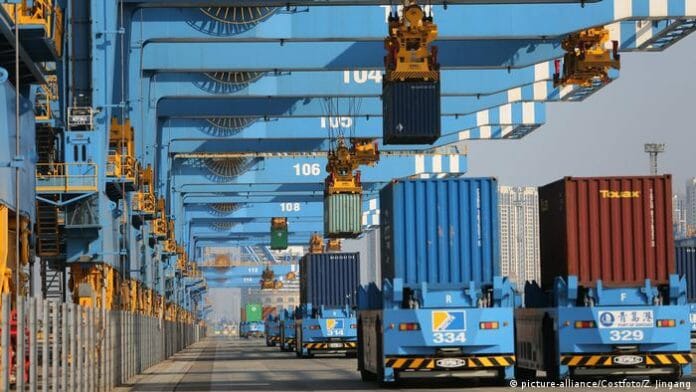
China’s current account surplus reached a staggering $734.9 billion in 2025, according to preliminary data released today by the State Administration of Foreign Exchange (SAFE). The record-breaking figure underscores China’s solidified position as the world’s primary export engine, even as global trade tensions and shifting capital flows reshape the second-largest economy.
While the current account soared, the capital and financial accounts—which track the movement of investment in and out of the country—recorded a deficit of $760.2 billion. This figure includes “net errors and omissions” for the fourth quarter, highlighting a significant “balancing act” in China’s international payments.
The massive surplus was primarily driven by a robust trade in goods, which surpassed the $1 trillion mark for the first time in history. This surge occurred despite aggressive tariff policies from Western nations, as Chinese manufacturers successfully pivoted toward the “Global South.”
China Records Historic US$734 Billion Current Account Surplus In 2025
China’s current account surplus reached a staggering $734.9 billion in 2025, according to preliminary data released today by the State Administration of Foreign Exchange
 www.businesstoday.com.my
Beijingwalker
VIP Member
- Thread starter
- #1,290
China must surrender know-how for EU access, says critical mineral CEO
“We are no longer the professor," Umicore chief Bart Sap tells Euractiv. "We are the student"Economy
Nikolaus J. Kurmayer/Thomas Moller-NielsenEuractiv
Feb 18, 2026 - 06:00

(Photo credit should read CFOTO/Future Publishing via Getty Images)
Chinese companies should relinquish control of cutting-edge technologies and form joint ventures with EU firms to access the bloc’s single market, according to the head of a leading European critical minerals processor.
Bart Sap, CEO of Umicore, told Euractiv that introducing conditions on Chinese firms’ ability to sell to the EU’s 450 million consumers – which would mirror restrictions that Beijing has long imposed on foreign investment into China – is necessary to “rebalance” relations between the EU and the world’s second-largest economy.
“The reality is, we are behind the curve,” said Sap, whose Brussels-headquartered firm refines 17 minerals, including cobalt, nickel, and antimony, that the EU has designated as strategically critical.
China accounts for roughly 70% of global critical mineral processing, giving Beijing an effective chokehold over elements used in the production of numerous high-tech civilian and military technologies, including fighter planes, radars, and computer chips.
“We have to make sure that we onshore these technologies here; that when we spend public funds, that actually we bring those companies and technologies in joint ventures into Europe,” Sap added. “And therefore, a strong local content requirement is needed.”
Facing ‘reality’
Sap’s comments come as China’s yawning trade surplus and growing dominance in a wide range of modern technologies, from electric vehicle production to mineral refining, are straining ties between Brussels and Beijing at a time when high energy prices and US tariffs are already eroding Europe’s industrial base.
They also come after Beijing imposed stringent export controls on rare earths – a critical mineral subgroup – in retaliation against US President Donald Trump’s sweeping levies last April. The move alarmed European officials and business leaders and accelerated Brussels’ efforts to reduce its strategic dependence on Beijing and Washington through ‘Made in Europe’ industrial policies.
The bloc’s protectionist push, which is strongly backed by France’s Emmanuel Macron but viewed more cautiously by Germany and many other countries, was debated at an informal EU summit last week and will also be discussed by leaders in Brussels next month.
The European Commission’s ‘Industrial Accelerator Act’, set to be unveiled next week, is also expected to contain tough local content requirements for subsidies and public tenders in a range of areas, including electric vehicles, batteries, and aluminium, according to a draft proposal seen by Euractiv.
Sap, whose company is the only European refiner of germanium, a critical mineral recently weaponised by Beijing, said demanding preferential treatment for EU firms will require Brussels to face the “reality” of China’s technological dominance.
“We have to recognise that we are no longer the professor, we are the student,” he said. “And if you’re a student, you take a different approach, and you want to learn.”
‘China cannot live without the EU’
Sap added that pursuing this approach will require EU leaders to be “brave enough” to stand up to China, which is the bloc’s second-largest trading partner for goods after the US.
“If some commissioners or leaders in the EU would say [a] local content requirement is coming, investments will come into Europe,” Sap said. “Because in the end, China cannot live without the EU. Because with whom are they going to trade?”
He also pushed back against the suggestion that such policies would be aimed “against” China, arguing instead that they are better viewed as an attempt to “collaborate” with Beijing.
Washington’s efforts to cut China out of American supply chains – and its attempt to pressure the EU to follow suit – have also provided an “opportunity” for Europe to strengthen its industrial competitiveness, he said.
“We can fight it, or we can collaborate,” Sap said. “And I think we have an opportunity, because the US has chosen to fight it. Let us collaborate.”
Users who are viewing this thread
Total: 2 (members: 0, guests: 2)


