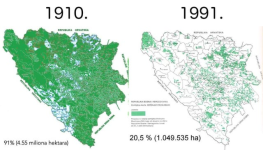
View attachment 178870
Bosniak owned land 1910 vs 1991
From Deepseek:
Yes, the Kingdom of Yugoslavia did implement land reforms that resulted in the large-scale expropriation of land from Bosnian Muslims. While the reform was officially presented as a social measure to dismantle the last remnants of a feudal-like system, its implementation was heavily ethnically charged and specifically targeted the Muslim landowning class .
The process was far from a simple administrative procedure; it involved violence, ethnic tension, and had long-lasting consequences for the Muslim population in Bosnia and Herzegovina.
The land reform began with the Interim Decree on the Preparation of the Agrarian Reform of 25 February 1919. Its proclaimed goal was "the land belongs to those who till it," aiming to break up large estates and feudal remnants to create a class of small peasant proprietors .
However, in Bosnia and Herzegovina, this policy had a distinct ethnic dimension. Key impacts on Bosnian Muslims included:
· Disproportionate Targeting: Approximately two-thirds of all land expropriated during the interwar land reform was located in Bosnia and Herzegovina. A total of 1,175,305 hectares—representing 23% of the total territory of Bosnia and Herzegovina—was seized from its owners for redistribution .
· The Landowning Class: The reform targeted the Muslim landowning class, which was often inaccurately described as "feudal" to justify the confiscation. In reality, many were not large estate owners but rather small landholders who lived off rents from sharecroppers. Around 60,000 families were deprived of their property and income, leading to widespread poverty and social decline .
· Widespread Violence: The implementation was accompanied by widespread violence, particularly in 1919. Bosnian Serb peasants and armed groups attacked Muslim farmers and landowners. By mid-1919, it is estimated that about 2,000 Muslims were killed, more than 4,000 families were driven from their homes, and 400,000 hectares of land were seized by force .
· Ethnic Engineering: The reform was also used as a tool for "internal colonisation." Expropriated land was awarded to colonists, primarily Royal Serbian Army volunteers and landless Serb peasants from other regions. The Yugoslav authorities used this process to strengthen the position of the Christian (predominantly Serb) population in Bosnia and Herzegovina .

Was Compensation Paid?
The law promised compensation to former landowners, with a total amount of 255 million dinars to be paid with interest over 40 years. However, payments only began in 1936 and stopped completely in 1941 with the invasion of Yugoslavia in World War II. Ultimately, only 10% of the expected amount was ever paid, leaving the dispossessed Muslim families with nothing .

Political Reaction
The land reform was a defining issue for Bosnian Muslims in the interwar period. The Yugoslav Muslim Organization (JMO) was formed in February 1919 precisely to act as the political representative of these "devastated people." A central part of their platform was to fight for compensation for the landowners and to protect Muslim interests in the new state .