Chinese Economy: General News, Updates and Discussions

China should give them a finger. These hypocrites want cutting edge Chinese tech for free and trying to bully China ? Why didn't they before share with China their gasoline auto engines and other engines tech for example, lol ?
 
Wow, EU is now demanding of China the same thing that China demanded of foreign investors for last 50 years. You want to do business here ? Setup a JV and do a tech transfer to it. It's Chinese managed to extract all the technology from West.
 
Since when students calling professors to surrender?
 
Wow, EU is now demanding of China the same thing that China demanded of foreign investors for last 50 years. You want to do business here ? Setup a JV and do a tech transfer to it. It's Chinese managed to extract all the technology from West.

China doesn't earn a lot of profit by exporting the refined rare earths, simply not to disrupting the world supply chain as it is indispensable to the modern technological industry.

China has no obligation to share this chokehold technology with any one, nor the west was willing to share their high end tech in the past.

They only want China to stay perpetually in the low end manufacturing sector.
 
Wow, EU is now demanding of China the same thing that China demanded of foreign investors for last 50 years. You want to do business here ? Setup a JV and do a tech transfer to it. It's Chinese managed to extract all the technology from West.
why invest in Europe.

without such materials, Europe factory will shut down

let Europe pay high price to import from China
 
Fair deal. China played the same game for market access in China
 
Europe can try to find alternatives, but good luck.

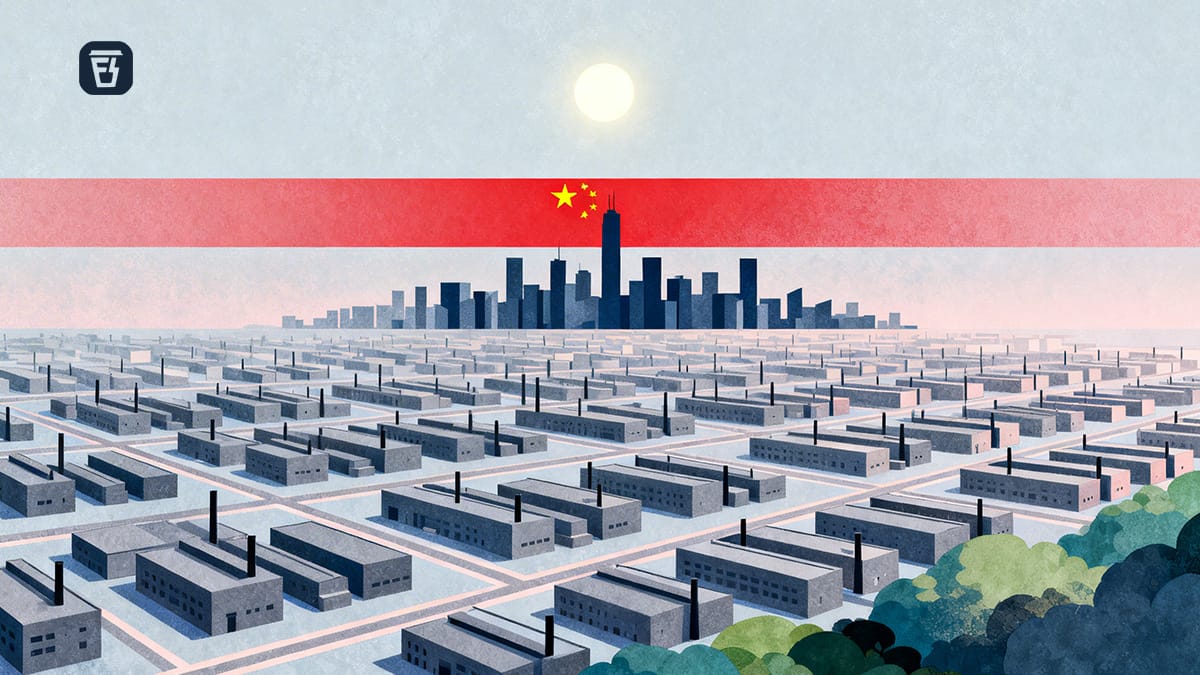
Why can’t the world replace China?​

Why can’t the world replace China?

In today’s Finshots, we explain how China’s manufacturing playbook is different and why it’s so hard to replace.

20 February 2026

The Story

Imagine you’re building a new gadget. The funding is secured, the trademarks are filed, and the paperwork is clean. That’s just the red tape. Now comes the tricky part ― manufacturing.

You need 10,000 microchips, custom screws, a battery casing, a display panel, and a printed circuit board prototype by tomorrow morning. In most countries, that means weeks of emails, minimum order quantities, and international shipping.

But in one country, it just means walking across the street.

We’re talking about China.

In fact, that’s how we see China, right? We define it in terms of cheap labour, mass manufacturing, and an obsession with export.

But here’s the thing and also the part we rarely talk about. China, like India and most other Asian countries in the 20th century relied mostly on one industry: agriculture.

It was only in 1978 under Deng Xiaoping, a former high-ranking Chinese Communist Party official, that the country started moving away from its agriculture economy and opening itself to other markets. Special Economic Zones (SEZs) were carved out as experiments. Foreign capital flowed in. And factories replaced farms.

By the time China joined the World Trade Organization in 2001, it had plugged itself directly into global supply chains. The world got cheaper goods. China got scale. And that’s how the “factory of the world” was born.

Now this explanation looks comforting, but it’s also incomplete because the outside world always thought the edge that Chinese manufacturing had was cheap labour. But if that was true, rising wages should have weakened it. And if last year was any indication, tariffs should have crippled it.

Instead, something stranger happened. China didn’t just keep manufacturing. It got better at it.

For 15 years straight, China has remained the world’s largest manufacturer. It produces nearly a third of the world’s manufactured goods. Companies may diversify to other countries. Supply chains may shift at the edges. But the centre of gravity remains intact.

Manufacturing today is not just about assembling goods. That’s what it was in the past, but now it’s more than that. It’s about proximity. When you have suppliers, workshops and component traders all working so closely together, something unusual happens.

In fact, there’s a very interesting theory that economists came up with. When companies cluster together geographically, they tend to become more productive — not just individually, but collectively. Suppliers specialise. Workers circulate. Knowledge spreads informally over coffee breaks and factory floors. The location itself becomes more efficient than the sum of its firms.

In the 1990s, Nobel laureate Paul Krugman formalised this idea, calling it agglomeration or the tendency of industries to cluster and generate increasing returns.

And nowhere in the modern world is agglomeration more visible than in one city ― Shenzhen.

Remember that shift in 1978? The decision to carve out a few experimental capitalist enclaves inside a socialist economy?

One of those experiments was a fishing town bordering Hong Kong. Yup, Shenzhen was just a small town back then. It was supposed to be a policy trial, designated as one of China’s first Special Economic Zones in 1980, and had a population of around 30,000.

Today, it’s something else entirely. Shenzhen is home to around 17 million people and generates a GDP larger than many countries.

But the skyline is not the story. The supply chain is. At the heart of Shenzhen is Huaqiangbei, often described as the world’s largest electronics market. This isn’t a mall or shopping complex. It’s a vertical system.

One building may house hundreds of component traders. One specialises in microcontrollers. Another in lithium batteries. Another in display drivers. Need a niche chip discontinued five years ago? Someone likely has old inventory. Need 5,000 units by Friday? A call is made.

In most countries, supply chains stretch across continents.

But in Shenzhen, they stretch across blocks.

This density compresses time.

A design flaw discovered in the morning can be corrected by night. A supplier underperforming can be replaced within hours. Engineers move between firms, carrying tacit know-how that never appears in formal manuals. This is what agglomeration looks like in practice.

As of 2025, the Shenzhen-Hong Kong-Guangzhou cluster is ranked first among the most innovative regions in the world by the World Intellectual Property Organization (WIPO). In simple terms, it had the most number of patents filed in 2025 than any other region in the world.

Shenzhen didn’t remain a low-cost industry hub. Over time, it upgraded and now global giants like Huawei, Tencent and BYD call it home.

And here’s the part that makes Shenzhen difficult to replicate.

Once suppliers cluster together, they lower costs for each other. Once costs fall, more firms arrive. Once more firms arrive, specialisation deepens. And once specialisation deepens, productivity rises. The ecosystem simply begins to feed itself.

So yeah, it’s no longer about labour cost.

At some point the cluster becomes so dense that companies don’t choose it for convenience. Rather they choose it because leaving would slow them down.

But Shenzhen is not unique.

Across China, entire cities specialise in entire product lines. China hosts more than two dozen large-scale industrial clusters around specific sectors. Dongguan specialises in footwear and manufacturing. Entire towns specialise in soles, stitching, foam moulding, and packaging. A brand can coordinate thousands of suppliers within a short radius.

Suzhou is known for electronics, semiconductors, and precision components, anchored by the Suzhou Industrial Park.

Now all this would make you wonder, if this model is so powerful, why hasn’t the world replicated it? Why haven’t subsidies and industrial parks elsewhere created the same density?

Well let’s start with time. Shenzhen did not wake up one morning as the world’s hardware capital. It compounded over four decades. Every supplier that arrived reduced friction for the next one. And every engineer trained another.

Another reason is because today, you can’t import supplier webs. Sure, governments can attract investments and provide tax breaks. They can even subsidise the land. But what they can’t recreate is a web of thousands of small suppliers sitting within a 10 kilometre radius.

When one strand is removed, the system adjusts. But try building that web from scratch and you only discover the missing strands when something breaks.

At some point, an ecosystem stops being a collection of firms and starts becoming economic infrastructure. It becomes the invisible system that makes speed normal and friction rare.

Recreating something like this is easier said than done. But it reminds us of one thing: manufacturing is not a short-term boost. It is a long-term bet.

In this year’s Economic Survey, the case was made for manufacturing-led exports as a way to stabilise currencies, lower borrowing costs, and bring discipline to the broader economy. The lesson from Shenzhen adds another layer: manufacturing is not just about output, but about building ecosystems that endure.

Because the countries that build dense ecosystems don’t just compete. They tilt the playing field quietly, structurally, and for decades.

 
No thx but we can assist EU in importing 10mil more Africans for their success and development :)
 
  • Haha
Reactions: ety

China’s beauty brands shine online as foreign rivals falter​

20 Feb 2026

China’s beauty upstarts are seizing the spotlight as foreign brands stumble in a fiercely competitive market. With digital savvy, localisation strategies and “self-developed” formulas, they are rewriting the rules of China’s cosmetics game. Will China’s cosmetics market become a battlefield foreign brands can no longer win?

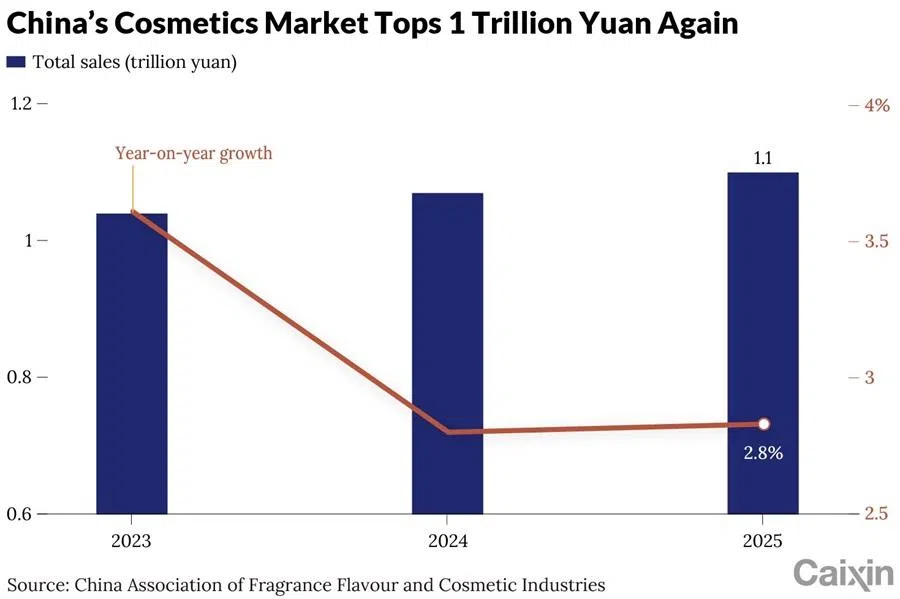
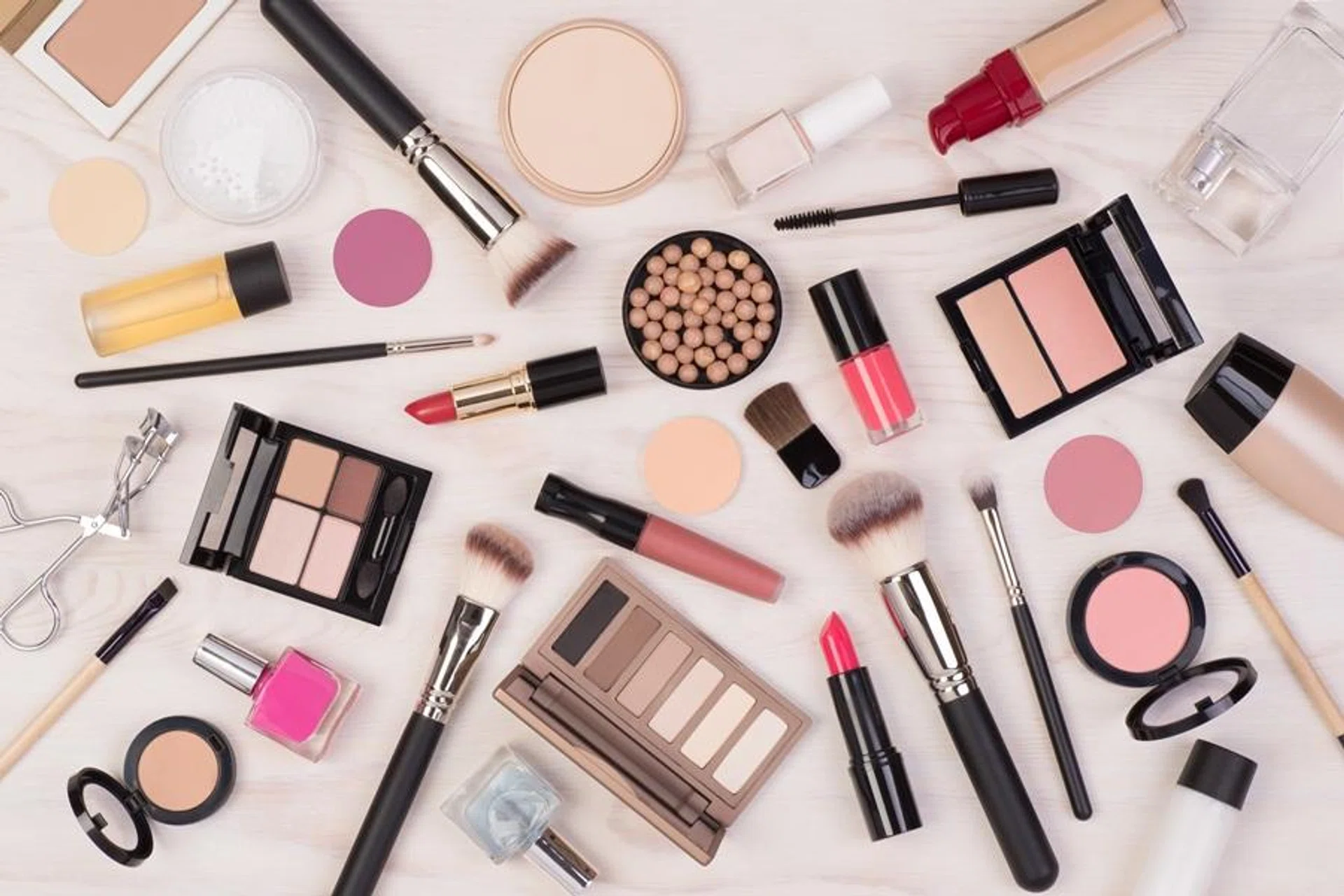
China’s beauty market has exceeded the 1 trillion RMB mark. (iStock)


Foreign beauty brands have long dominated China’s cosmetics market. European luxury labels filled department store counters, South Korean imports set trends and multinational companies controlled the science behind skincare. But that landscape has shifted.

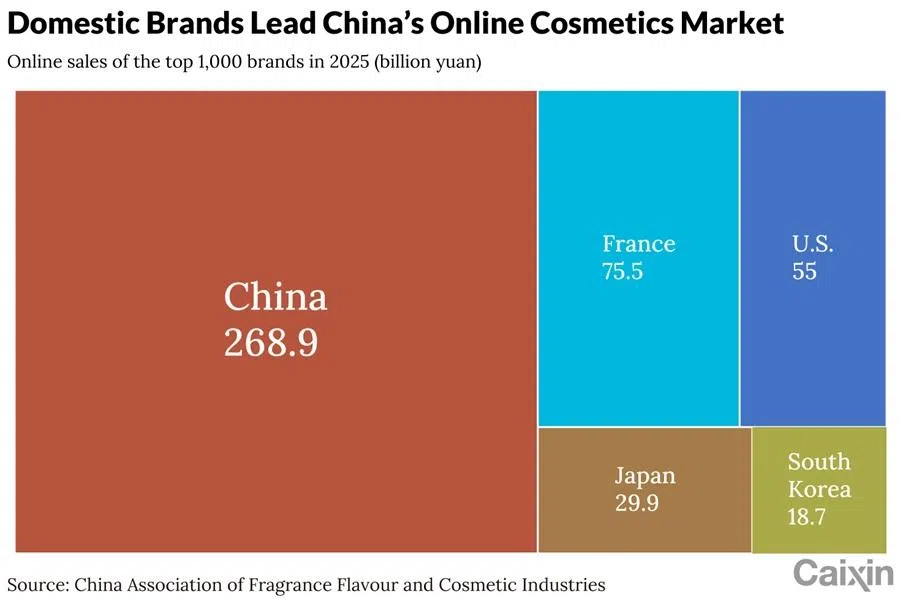
In 2025, China’s cosmetics market grew 2.8% to more than 1.1 trillion RMB (US$159 billion) in sales, according to the China Association of Fragrance Flavour and Cosmetic Industries (CAFFCI). Domestic brands accounted for 57.4% of the market, outpacing foreign competitors for the fourth straight year.

The momentum has extended to the capital markets. Since 2024, the cosmetics industry has seen a rise in IPO activity as domestic players fund their expansions. Mao Geping Cosmetics Co. Ltd. kicked off the wave with a Hong Kong IPO in late 2024, followed by Shanghai Forest Cabin Cosmetics Group Co. Ltd. last year. Others, including Chando Group Corp., Proya Cosmetics Co. Ltd., Guangdong Marubi Biotechnology Co. Ltd. and Shenzhen HBN Technology (Group) Co. Ltd., are pursuing primary or secondary listings. In 2025 alone, more than 40 Chinese beauty firms set IPOs in motion, with Hong Kong overtaking Chinese mainland exchanges as the preferred venue, CAFFCI data showed.

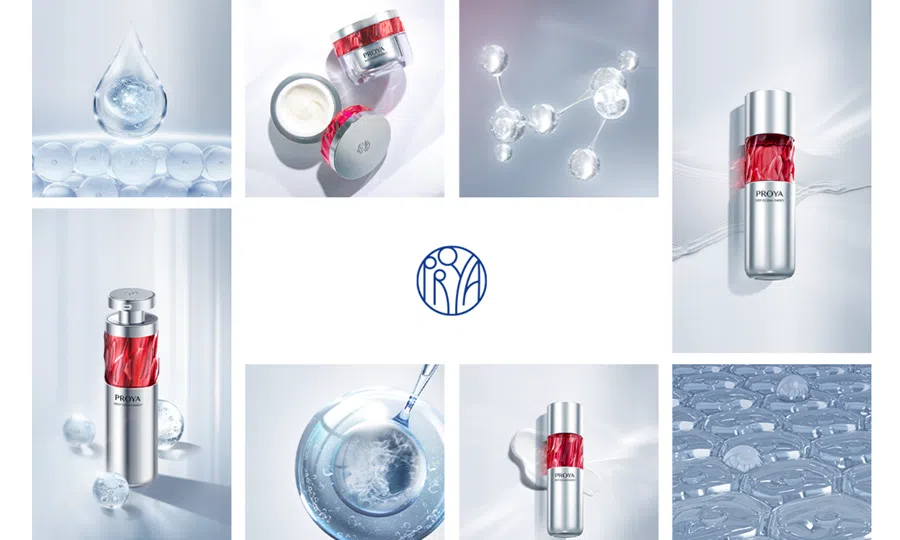
 (Screenshot of Proya Cosmetics official website)

(Screenshot of Proya Cosmetics official website)

Behind the rise of domestic firms is a playbook built on dominating online channels, keen insight into local trends, and rapid decision-making and product development. Foreign rivals have been forced to adapt, scaling back in China or investing in local startups to stay relevant. Some analysts expect larger homegrown players to further consolidate their lead as the industry undergoes rapid reshuffling.
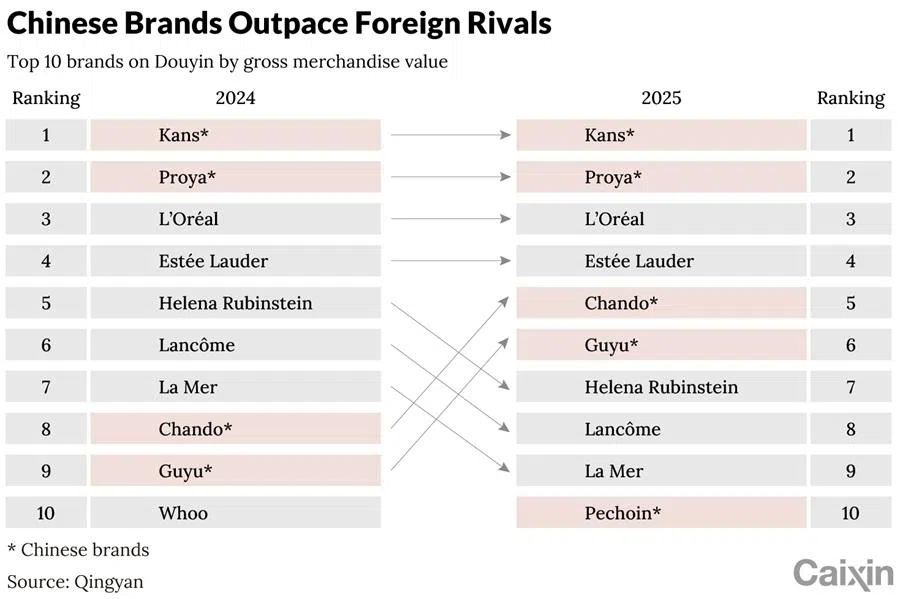
Domestic brands held half of the top ten spots in Douyin’s cosmetics gross merchandise value (GMV) ranking in 2025, according to Qingyan, a market data provider.

Digital dominance​

Unlike foreign brands that focus on prime placement in high-end department stores, domestic contenders have prioritised digital storefronts — a shift that became evident during the Covid-19 pandemic. In 2022, China’s online cosmetics sales surpassed offline sales for the first time, according to consulting firm Frost & Sullivan Inc. In 2025, online sales of domestic cosmetics approached 721.8 billion RMB, accounting for 65.4% of the overall market, according to CAFFCI.

“The online playbook of Chinese brands resembles that of internet companies,” said an employee at a foreign cosmetics company. “They move fast, face fewer internal constraints and make decisions quickly. Employees at foreign beauty companies might still be busy writing emails and going through approval processes.”

The Chinese companies use proprietary apps to collect first-hand consumer data, allowing them to develop products targeting unmet needs and deliver them precisely to specific audiences on Douyin... foreign competitors... cannot replicate this model.
 (Graphic: Caixin)

(Graphic: Caixin)
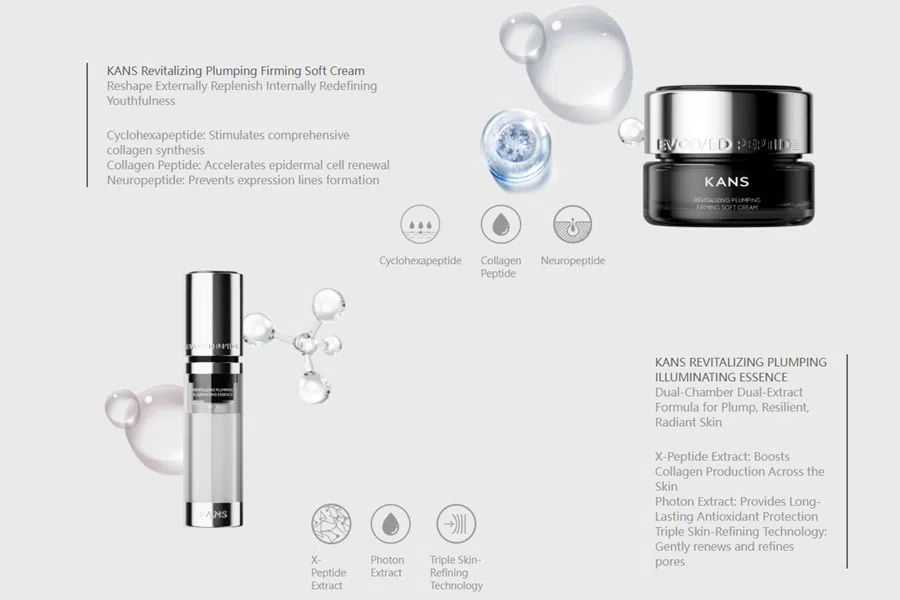
E-commerce platforms such as ByteDance Ltd.’s Douyin and Alibaba Group Holding Ltd.’s Tmall have emerged as the main battleground. Domestic brands held half of the top ten spots in Douyin’s cosmetics gross merchandise value (GMV) ranking in 2025, according to Qingyan, a market data provider. Leading the list was Kans, owned by Hong Kong-listed Shanghai Chicmax Cosmetic Co. Ltd., with GMV exceeding 8 billion RMB. Proya ranked second with more than 3 billion RMB, followed by global giants L’Oréal and Estée Lauder.

A report by research firm Bernstein noted that leading Chinese cosmetics companies derive about 70% of their sales from Douyin — TikTok’s Chinese cousin — compared with just 40% for their foreign rivals.

The Chinese companies use proprietary apps to collect first-hand consumer data, allowing them to develop products targeting unmet needs and deliver them precisely to specific audiences on Douyin, the report said, adding that foreign competitors, constrained by global brand guidelines and slower creative cycles, cannot replicate this model.

Proya topped Tmall skincare sales in 2025 with more than 4 billion RMB in revenue, surpassing foreign brands including L’Oréal, Lancôme and Estée Lauder. Its success was fuelled by the viral “morning C, night A” skincare trend — a regimen combining vitamin C for daytime “brightening” and vitamin A for nighttime “anti-ageing”.

In 2021, Proya packaged its two serums into a dedicated “morning C, night A” set and raised prices shortly after. According to Minsheng Securities Co. Ltd., the firm’s average prices on Tmall doubled from 2017 levels, driving a 76% jump in sales that year. In 2024, Proya became the first domestic cosmetics company to surpass 10 billion RMB in annual revenue.
 (Screenshot of Kans official website)

(Screenshot of Kans official website)

Kans took a different approach. In 2023, it promoted an anti-ageing kit through a 15-episode short drama on Douyin, featuring the products throughout. The series drew over 200 million views in three weeks. By March 2024, Kans had backed 22 short dramas that received 7 billion views in total. The strategy paid off: Kans’s revenue jumped 143.8% in 2023, while parent Shanghai Chicmax’s revenue grew 56.6%.

Bet on ingredients​

A deeper shift is underway in how Chinese consumers evaluate skincare products.
Consumers increasingly scrutinise ingredient lists, research key components such as niacinamide and hyaluronic acid, and prioritise efficacy over brand heritage. A 2024 survey by consulting firm iResearch found that 58.8% of consumers ranked ingredients as their top consideration when buying skincare products.

Domestic brands have leaned into this trend, promoting proprietary research and “self-developed” formulas. Average research and development (R&D) spending among China’s listed beauty-related companies rose from 2.4% of revenue in 2020 to 3.2% in the first half of 2025, CAFFCI data showed.
“Now, they care about whether key ingredients have patents, exclusive supply and stories that can create blockbuster products.” — a worker at a midsize cosmetics factory
Hong Kong-listed Shanghai Forest Cabin promotes camellia oil and the concept of “nourishing skin with oil”, while IPO-hopeful Shenzhen HBN Technology centres its branding on retinol, claiming its proprietary compound enhances DNA repair and collagen production.

The shift has rippled through supply chains. Before 2021, brands mainly wanted basic moisturising products, said a worker at a midsize cosmetics factory. “Now, they care about whether key ingredients have patents, exclusive supply and stories that can create blockbuster products.”

 (Graphic: Caixin)

(Graphic: Caixin)

But ingredient trends can turn quickly. Bloomage Biotechnology Corp. Ltd. saw skincare revenue fall more than 30% in both 2024 and the first half of 2025 after interest in hyaluronic acid waned. Meanwhile, Hong Kong-listed rival Giant Biogene Holding Co. Ltd. grew its revenue from 1.55 billion RMB in 2021 to 5.54 billion RMB in 2024 due largely to its focus on recombinant collagen.

A capital market analyst noted the fickleness of consumer trends: “Whether it’s hyaluronic acid or recombinant collagen, investors worry about preference shifts. Recombinant collagen has been hot for nearly four years. We can clearly sense concerns about its growth and competition intensifying since 2024.”

Bloomage Biotechnology and Giant Biogene clashed over the ingredients in a public spat last year. The former accused brokerages of unfairly promoting recombinant collagen and backed a beauty blogger who questioned the authenticity of one of Giant Biogene’s flagship products. Giant Biogene defended its product and denounced Bloomage’s claims as “malicious allegations”. The dispute dragged down both companies’ share prices.

Foreign strategies​

In January, Filorga, a French skincare brand owned by Colgate-Palmolive Co., and Hince, a makeup brand owned by South Korea’s LG H&H Co. Ltd., shut down their Tmall stores. The pair follow 25 other foreign beauty brands that either scaled back operations in China or exited the market entirely last year, according to Chinese outlet Cosmetic Newspaper.

Meanwhile, others are fighting back with heavy discounts. Estée Lauder Companies Inc.’s sales on the mainland rose 13% year-on-year in the fourth quarter of 2025, up from 9% in the previous three months, driven in part by strong performance during the annual “Double 11” online shopping festival around 11 November.

Some global groups are also looking to learn from Chinese upstarts. In November, L’Oréal SA’s venture capital fund took a minority stake in Chinese skincare brand Lan — its first investment in a local skincare startup.

“One reason foreign giants invest in Chinese companies is to learn from startups and feed that experience back into their own organisations, sharpening their decision-making and market instincts,” said the employee at a foreign cosmetics company.

But local brands are often short-lived. Some 27,000 domestic cosmetics brands exited the market in 2025, accounting for more than 40% of local marques, while 17,000 were launched, CAFFCI data showed.

 (Graphic: Caixin)

(Graphic: Caixin)

Industry analysts said newcomers face an uphill battle. In such a crowded market, there is little room for new cosmetics brands to scale, the capital market analyst said. The analyst also expected market share to continue shifting toward domestic players, with the larger homegrown firms further consolidating their lead.

Goldman Sachs said in a report that “branding will become the most effective strategy in 2026” for consumer engagement or new product and ingredient launches. Companies with products featuring high repurchase rates and cost-efficient, multiple-channel sales strategies are better positioned, according to the report.

This article was first published by Caixin Global as “In Depth: China’s Beauty Brands Shine Online as Foreign Rivals Falter”. Caixin Global is one of the most respected sources for macroeconomic, financial and business news and information about China.

 
Fair deal. China played the same game for market access in China
China can do the same to ban EU products too. They have made enough money in Chinese markets without transferring any meaningful advanced tech in the past decades. Most Chinese products exported to EU are everyday essential products while EU products are not, so who need whom more.
 
Last edited:
China can do the same to ban EU products too. They have made enough money in Chinese markets without transferring any meaningful advanced tech in the past decades. Most Chinese products exported to EU are everyday essential products while EU products are not, so who need whom more.
Do it. Instead of making endless arguments about what you CAN do. Because you always comes short when it comes to actually doing something.
 
  • Haha
Reactions: ety
Do it. Instead of making endless arguments about what you CAN do. Because you always comes short when it comes to actually doing something.
Says someone from some country best known for talking and bragging advising doer China to take actions, :LOL:.
 

Users who are viewing this thread

Pakistan Defence Latest

Country Watch Latest

Latest Posts

Back
Top