Pakistan Air Force (PAF) : PFX Fighter Project
[This information is available in public domain; I have consolidated it]
Consolidated Design & Requirements
1. Program Overview
- Name: Pakistan Fighter Experimental (PFX)
- Role: 4.5-generation to 5th-generation multirole fighter (officially “4.5-generation ++”)
- Strategic Need: Replace ~100 aging aircraft:
- F-7, Mirage III/V (retiring now)
- Older JF-17 Block I/II
- Eventually older F-16s
- Timeline: Development through the 2020s, entry into service in the 2030s
- Primary Partner: China (Chengdu Aircraft Corporation – CAC)
- We already know that Pakistan can't do this alone.
2. Two Conceptual Design Streams
The PFX exists in two parallel concepts. One was shown officially, the other emerged from detailed analysis.
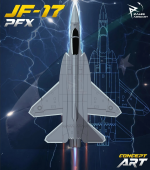
Stream A – Official IDEAS 2024 Model (Heavyweight)
- Configuration: Twin-engine, with canards
- Philosophy: Direct evolution of JF-17 → stretched fuselage, increased size
- Dimensions (estimated):
- Length: ~20.4 m
- Wingspan: ~13.5 m
- Height: ~4.5 m
- Weights:
- Empty: ~19,000 kg
- Max Takeoff: ~37,000 kg
- Propulsion: Two WS-19 class engines (~110–130 kN each)
- Stealth: Reduced RCS using composites & RAM, but canards increase signature
- Internal Weapons Bay: Yes (smaller than dedicated 5th-gen)
- Supercruise: Yes (modest)
- Role: Air dominance / heavy multirole
Stream B – Medium-Weight Alternative
- Configuration: Twin-engine, no canards (cleaner stealth shaping)
- Philosophy: Compact, carrier-capable option, similar to J-35
- Dimensions (estimated):
- Length: 16.5 – 17.5 m
- Wingspan: 11 – 12 m
- Height: 4 – 4.2 m
- Weights:
- Empty: 12,000 – 14,000 kg
- Max Takeoff: 24,000 – 28,000 kg
- Propulsion: Two smaller engines (still 110–130 kN class each – scaled down)
- Intakes: Diverterless supersonic inlet (DSI), compact
- Stealth: Better than canard design – angular faceting, no large control surfaces forward
- Internal Weapons Bay: 4–6 AAMs or mixed load
- Supercruise: Yes, but less than J-20
- Combat Radius: 900 – 1,200 km
- Max Speed: Mach 1.8 – 2.0
- Role: Multirole (air-to-air + strike), carrier-capable variant possible
3. Common Design Features (Both Streams)
These elements appear in both concepts:
| Feature | Specification |
| Engines | Twin-engine, Chinese WS-19 or WS-13 derivative |
| Radar | AESA (locally produced under Chinese license) |
| Missiles (primary) | PL-15 (long-range BVR), PL-10 (short-range) |
| Cockpit | Glass cockpit with Wide Area Display (WAD) |
| Stealth | Composite materials, radar-absorbent coatings |
| Intakes | Diverterless supersonic inlet (DSI) |
| IRST | Yes (integrated) |
| EW Suite | Advanced electronic warfare, sensor fusion |
4. Performance Expectations (Medium-Weight Stream B)
| Parameter | Value |
| Max Speed | Mach 1.8 – 2.0 |
| Combat Radius | 900 – 1,200 km |
| Service Ceiling | ~16,000 m |
| Supercruise | Yes (Mach 1.4–1.6 possible) |
| Internal Payload | 4–6 AAMs or 2,000 kg of bombs |
| External Payload | Optional (but compromises stealth) |
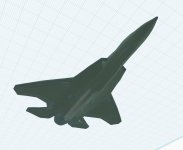
5. Visual Description (Medium-Weight Concept)
Overall silhouette:
- Looks like a smaller, canardless J-20 or a land‑based J-35.
- Angular, stealthy faceting.
- Shorter nose and tighter fuselage than the heavy IDEAS model.
- Compact wing‑body blend.
Key angles & details:
- Front: DSI intakes flush with fuselage, no canards, faceted chin for IRST.
- Side: Stepped canopy, sharp leading edge, twin canted vertical tails (outward angled).
- Top: Cranked delta wing (possibly), blended fuselage, no horizontal stabilizers (elevons only).
- Rear: Two engine nozzles (likely serrated for stealth), deep tail stinger between engines.
- Weapons bay doors: Visible on underside – two side‑by‑side bays or one long bay.
Comparison dimensions :
| Real Aircraft | Length | Wingspan |
| JF-17 | 14.0 m | 9.4 m |
| J-35 | ~17.3 m | ~11.5 m |
| F-35A | 15.7 m | 10.7 m |
| PFX (Medium) | 16.5 – 17.5 m | 11 – 12 m |
6. Chinese Assistance needed (Pakistan can't do it alone)
| Area | Specific Help |
| Design & Engineering | CAC co‑development, J‑20 derived aerodynamics & composites |
| Engines | WS-19 supply or co‑production |
| Radar & Avionics | AESA, EW suite, sensor fusion, IRST |
| Weapons | PL-15, PL-10 integration |
| Production | PAC Kamra facility expansion, local component manufacturing |
| Training | Pilot and maintenance training for 5th-gen operations |
7. Dual-Track Development Strategy (PAF Plan)
- PFX‑Alpha: Immediate risk reduction, modified JF-17 testbed for AESA/EW/sensor fusion.
- PFX Final: Full new airframe (heavy or medium) entering service in 2030s.
- Parallel high‑end option: Potential J‑35E purchase (40 aircraft reported) as interim 5th‑gen capability.