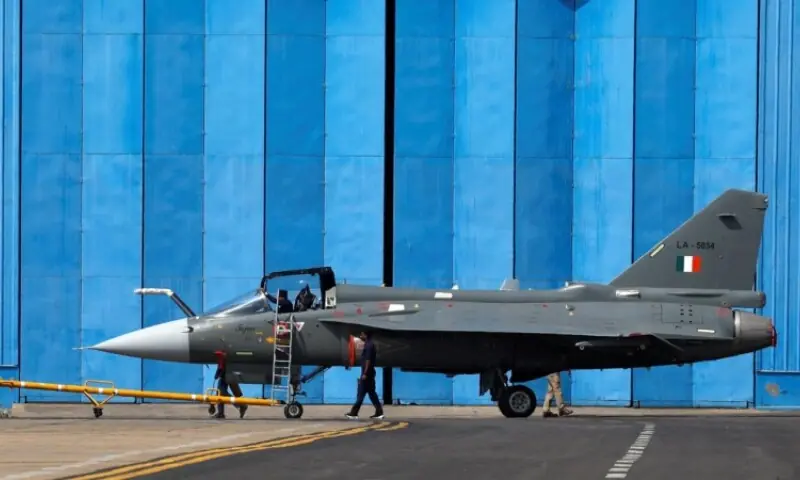
Logically, right now, the IAF is better of cutting their losses on the Tejas, and re-orienting their focus on the AMCA, and chalk up the entire Tejas programme as a "learning experience".
They should focus on trying to make sure the AMCA programme goes smoothly now.
The IAF has a serious problem as it does not have a single engine light platform for the backbone of its fleet to do the bulk of commodity operations. India's options are limited in this space.
I bet India is kicking herself that she did not purchase the Mirage 2000 production line right about now. That would have solved their problems for sure. A Mirage 2000-9 is still a quite effective platform now.
The options are the Gripen-E(excellent platform), F16(F-21), F-35(= NO!) KAI F-50 etc. Su75 would make an excellent co-development project with the benefits of a single engine platform though it will take some time to mature.
They can try and bulk up on more new build Su-30MKI(or upgraded variants) to maintain squadron strength(Su57 will take time to spin up) but the Su-30MKI has proven to be very very ineffective against the PAF with 2 shot down over 2 military confrontations of 2019, and 2025.
Lets see what India does decide to do. Force planning is a real problem for the IAF right now.
India cannot create the AMCA to the requirement they desire which is a proper 5th generation fighter. This is about as challenging as asking me and my friends with mechanical engineering backgrounds to build a hypercar that is the equal performance as a Bugatti Chiron. We may have some of the fundamental knowledge and know the buzzwords but we can't really completely design the thing from ground up. We certainly cannot
make it into a reality even if we know how to design and engineer it.
Making things is much,
much harder than designing and engineering. Making is the level of superhuman level engineering, above mere design engineering because the calculations, estimations, modelling, testing, restarting and iteration processes are even more complex than theoretical design phase.
People put so much prestige to design engineering when it is the easiest part. The physics is hard, the manufacturing is hard. Putting the known maths and physics applied to design engineering is easy. Everything is known. The hard work at design engineering stage has already been done by the maths and physics people who theorised, created, tested and verified all the laws, formulae, rules, processes, logic the design engineer need only apply. It's a step by step with minimal critical thinking and challenging intellectual demand. The discovery and mastery of the physics and maths is hard (India hasn't got these academic levels that US and China have in spades, nor does India have the infrastructure, institutions, labs, test facilities, equipments and so on... no advanced wind tunnels, no advanced supercomputing and much more precision tooling missing). The manufacturing is hard, just like the physics that establish its foundation. The design is piss easy and possibly the only part me and my mechanical engineering friends
can actually do in this make a hypercar challenge. Even if we can get handed the physics because hypercar physics is low level public university knowledge compared to black art of fighter aircrafts, and suppose we can design it and CATIA/Solidworks it all up, how can we loom up the carbon fibre? how can be materialise the engine block?
India has the same capability of building AMCA to the combat performance level of even 2017 J-20 as me and my group of friends has on building a Chiron rivalling hypercar. We'll need billions in investment, we'll need to build warehouses of test facilities, spend 2 decades in R&D, spend another decade testing and iterating and improving. India's HAL, academic institutions, industrial institutions simply do not have what it takes to even design, engineer, manufacture a computer from scratch and all on its own even if it reverse engineers. It doesn't have the tools even if it has the brainpower!