Turkish Air Force | News & Discussions

What is the actual status of Kaan ?
We saw a first flight (not so potent : undercarriage down, flight straight) and no more news since.
- The current situation can be explained as follows: Things are going well for the Kaan project in terms of the fuselage, avionics, and radar. The P1 is expected to begin flying by June 2026 at the latest. F110 engines have been supplied for 5-6 prototypes and are currently in storage.

- Regarding the fuselage, the investment made to produce the F-35's mid-fuselage is paying off in Kaan. Also, we've been working on stealth coatings for almost 20 years; we didn't just start that task.

- In terms of avionics, radar, and sensor integration, the experience gained from UAVs has been immensely beneficial. The avionics and the Murad AESA radar were already tested on Akıncı and Kızılelma before Kaan. We struggled considerably with the radar, but we've moved into mass production there as well. We were already good at optical-based sensors.

- The Achilles' heel of the Kaan project, just like the Altay project, is the engine. There's a double dilemma here. First, will the USA sell us F-110s for Block 10 Kaan's? Block 10 Kaan's require around 90-96 F-110 engines. Secondly, will the TF35000 engine development project be successful and ready by around 2032-2033? Work alone isn't enough; it also needs to be completed without delay!

- Lastly, don't pay much attention to Kaan, the first to fly. They actually flew P0, which shouldn't have flown at all, for PR purposes. They needed to calm the public.
 
Last edited:
Aerodynamics is truly fascinating. To this day, humanity has not yet fully grasped its fundamental formulas, so we can only accumulate real data through repeated wind tunnel tests.

What determines a fighter jet’s true flight performance is not computer simulations or designed theoretical data, but countless wind tunnel tests—real experimental results.

I wonder what the actual wind tunnel test data of the KAAN fighter jet is. As far as I know, Turkey and Europe currently do not have high-speed wind tunnels suitable for fifth-generation fighter jets.
 
I wonder if it happened like this ?
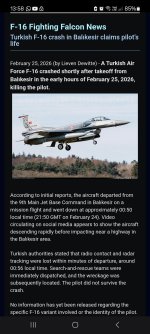
The experienced major Pilot could have ejected. Probably due to a technical malfunction after takeoff , our heroic Pilot wanted to land the F-16 on the Istanbul-Izmir highway, but He couldn't because of the traffic

View attachment 180792
To view this content we will need your consent to set third party cookies.
For more detailed information, see our cookies page.


May ALLAH have mercy on our martyred Pilot
and Our condolences and prayers for strength to his Family ... so sad


On the same day, F-16s crashed during night flights in both Turkiye and South Korea.

An F-16C Fighter Jet crashed during a night training flight in South Korea.

The pilot ejected and survived.
To view this content we will need your consent to set third party cookies.
For more detailed information, see our cookies page.


Our Turkish Pilots risk their lives to save the F-16, and they lose their lives in the process.
 
The Achilles' heel of the Kaan project, just like the Altay project, is the engine.

This is the Achilles heel of every single project. lol

to date, the only platform that is free of this is the TB2 and TB3 and some land vehicles due to BMC Power's investment in powerpacks. Every other platform is dependent.

With the Altay Tank Engine and Transmission, it will liberate essentially every Land platform as Tank engines are the pinnacle of land powerpacks, and once you can build that, smaller engines and less sophisticated engines are easier.

TS1400 once we see it in production gokbeys being delivered to customers, especially export customers, then we will know its finished.

After the TF35000 is done all air aspects should be ready, then all that will be left is Marine turbine propulsion and Submarine propulsion.

I think Turkey should look to secure a license production deal for the LM2500, and them build an indigenous dropin replacement for it. In this scope we are behind Japan, Italy and even India, which recently secured license production agreements.

The Submarine propulsion question is tricky and up in the air, will Turkey bother to actually build a diesel engine, or go straight to Nuclear submarines. Thats something that probably needs to be discussed.
 
I think Turkey should look to secure a license production deal for the LM2500, and them build an indigenous dropin replacement for it. In this scope we are behind Japan, Italy and even India, which recently secured license production agreements.

The Submarine propulsion question is tricky and up in the air, will Turkey bother to actually build a diesel engine, or go straight to Nuclear submarines. Thats something that probably needs to be discussed.
If solid-state battery technology continues to advance at this rate, turbines will be unnecessary in 10 years. Ships could then perform just as well with a diesel+battery combination. If there are problems with solid-state batteries, and if LM2500 supply from the USA cannot be guaranteed, we will use a cheaper version of the TF35000 at sea.

I am also curious to see what will happen with submarines. We'll wait and see.
 
If solid-state battery technology continues to advance at this rate, turbines will be unnecessary in 10 years. Ships could then perform just as well with a diesel+battery combination. If there are problems with solid-state batteries, and if LM2500 supply from the USA cannot be guaranteed, we will use a cheaper version of the TF35000 at sea.

I am also curious to see what will happen with submarines. We'll wait and see.

The power to weight idk if it can be solved with solid state batteries. Turbines provide a lot of power.

With regards to supply, I don't think its too much of an issue, ships are the one area where things are more flexible and alternative Turbines can be used, whether from RollsRoyce, Ukraine, Russia or China. The weight doesn't matter as its a ship.

The License production of the LM2500 is what Turkey needs, b/c if it is license produced, then a dropin replacement with Turkish parts can be used as well.
 
I wonder what the actual wind tunnel test data of the KAAN fighter jet is. As far as I know, Turkey and Europe currently do not have high-speed wind tunnels suitable for fifth-generation fighter jets.
I'm not saying they'll do it exactly like that, but high-speed tunnels may not be necessary. They might be planning to collect the necessary data with a scaled-down supersonic drone.

On the other hand, a supersonic tunnel might already be under construction, and these won't be needed. We'll wait and see.
 
I'm not saying they'll do it exactly like that, but high-speed tunnels may not be necessary. They might be planning to collect the necessary data with a scaled-down supersonic drone.

On the other hand, a supersonic tunnel might already be under construction, and these won't be needed. We'll wait and see.

@MMM-E was mentioning a facility was being built in Turkey.

Not sure if BAE has a facility in the UK, but they might have assisted with wind tunnel tests in the UK.
 
- China has established an absolute leading position in the field of ultra-high-speed wind tunnels, possessing the world’s only comprehensive testing capability covering Mach 5–30, with large-scale flow fields and long-duration testing.

- Although the United States has multiple facilities, it has obvious shortcomings in key performance indicators such as test duration, flow field size, and data accuracy, resulting in insufficient high-end capabilities.

- Russia has inherited part of the Soviet Union’s technological legacy but has fallen behind in equipment upgrading and system integrity.

- Japan and Europe are currently only capable of conducting basic research at medium and low Mach numbers, with a generational gap in ultra-high-speed technologies compared with China, the United States and Russia

A truly excellent aircraft can only be developed through countless wind tunnel tests, which continuously refine the airframe design, strengthen structural materials, and upgrade the flight control system. Otherwise, such an aircraft will forever be nothing more than a flying coffin—incapable of high speed and high maneuverability, and prone to disintegration in mid‑air.
 
Last edited:
A truly excellent aircraft can only be developed through countless wind tunnel tests, which continuously refine the airframe design, strengthen structural materials, and upgrade the flight control system. Otherwise, such an aircraft will forever be nothing more than a flying coffin—incapable of high speed and high maneuverability, and prone to disintegration in mid‑air.
You're right. But you shouldn't think that using a high-speed tunnel is the only way, given technological advancements. Similar results can be achieved with scaled-down drones.

For example, a 2/3 scale drone using a Ukrainian afterburner engine could easily achieve satisfactory results, even under real atmospheric conditions. Given our experience with drones, it's very likely we'll try this approach.

It's also said that a high-speed tunnel is under construction. Tests have just begun. We'll wait and see what happens.
 
You're right. But you shouldn't think that using a high-speed tunnel is the only way, given technological advancements. Similar results can be achieved with scaled-down drones.

For example, a 2/3 scale drone using a Ukrainian afterburner engine could easily achieve satisfactory results, even under real atmospheric conditions. Given our experience with drones, it's very likely we'll try this approach.

It's also said that a high-speed tunnel is under construction. Tests have just begun. We'll wait and see what happens.
Any change in shape, size, proportion or weight will produce different effects.
It seems you haven't really understood what aerodynamics is.
 
To view this content we will need your consent to set third party cookies.
For more detailed information, see our cookies page.
 

Users who are viewing this thread

Pakistan Defence Latest

Country Watch Latest

Back
Top