Chengdu J-20 5th Generation Aircraft News & Discussions

Gallium Nitride on Silicon Carbide.

China has been revolutionising airborne AESA technology for over 10 years.

China caught up to US in radar technology around 2010. People still have wool over their eyes and have no clue just how far ahead China is today in 2026. It's 2 generations ahead. It's simply running much faster and left the US in the dust in mid 2010s with completion of GaN technology while US was still learning it. 2020s GaN on SiC became the standard for J-20S, J-20A and now J-35 and all the new heavy CCAs.

GaN on SiC is something science fiction to USA today. US is struggling to finish GaN radar for F-35 even though it has GaN technology but it is struggling to get it up to even production level let alone mass production.

Sorry but right now China is already experimenting with the replacement for GaN on SiC which is already 2-3 years old, something the US might be able to produce in 2030s but they might just spy on China. The tide's turned a lot in China's favour without the rest of the world really knowing or accepting.
 
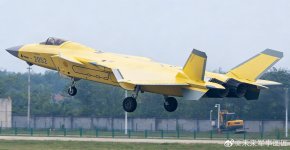
I know, 未来军事画匠 is mostly known for his PS & AI-manipulated images and so most likely this one showing the J-20A prototype no. 2052 with WS-15 is also not 100% legit! But maybe it is since it looks almost taken a moment before the one we know already?

J-20A no. 2052 +  WS-15 - 未来军事画匠 xs.jpg
 
Gallium Nitride on Silicon Carbide.

China has been revolutionising airborne AESA technology for over 10 years.

China caught up to US in radar technology around 2010. People still have wool over their eyes and have no clue just how far ahead China is today in 2026. It's 2 generations ahead. It's simply running much faster and left the US in the dust in mid 2010s with completion of GaN technology while US was still learning it. 2020s GaN on SiC became the standard for J-20S, J-20A and now J-35 and all the new heavy CCAs.

GaN on SiC is something science fiction to USA today. US is struggling to finish GaN radar for F-35 even though it has GaN technology but it is struggling to get it up to even production level let alone mass production.

Sorry but right now China is already experimenting with the replacement for GaN on SiC which is already 2-3 years old, something the US might be able to produce in 2030s but they might just spy on China. The tide's turned a lot in China's favour without the rest of the world really knowing or accepting.
Indeed. China is working on next generation GaN-on-diamond/Ga2O3-on-diamond radars.
 
I know, 未来军事画匠 is mostly known for his PS & AI-manipulated images and so most likely this one showing the J-20A prototype no. 2052 with WS-15 is also not 100% legit! But maybe it is since it looks almost taken a moment before the one we know already?

View attachment 180566
whats interesting is the amount of arrays here, the j35 otoh looks far lihter on them
 
What advantages of GaN on SIC compared to ordinary GAN? Does this mean Chinese J-20s can detect a US F-22, F-35 or B-2 much farther before their USAF's GAN radars detect J-20s?
 
Gallium Nitride on Silicon Carbide.

China has been revolutionising airborne AESA technology for over 10 years.

China caught up to US in radar technology around 2010. People still have wool over their eyes and have no clue just how far ahead China is today in 2026. It's 2 generations ahead. It's simply running much faster and left the US in the dust in mid 2010s with completion of GaN technology while US was still learning it. 2020s GaN on SiC became the standard for J-20S, J-20A and now J-35 and all the new heavy CCAs.

GaN on SiC is something science fiction to USA today. US is struggling to finish GaN radar for F-35 even though it has GaN technology but it is struggling to get it up to even production level let alone mass production.

Sorry but right now China is already experimenting with the replacement for GaN on SiC which is already 2-3 years old, something the US might be able to produce in 2030s but they might just spy on China. The tide's turned a lot in China's favour without the rest of the world really knowing or accepting.

What are you smoking? Lol.
 
What advantages of GaN on SIC compared to ordinary GAN? Does this mean Chinese J-20s can detect a US F-22, F-35 or B-2 much farther before their USAF's GAN radars detect J-20s?

Apart from F-15EX of which there are only like a few dozen at most, USAF fighters don't even have GaN.

F-35 flight 4 mod is trying to update to GaN.

US is approximately 5 years away from GaN on SiC and 10 years away from GaN on diamond if they ever even get there.
 
Last edited:
Lol. Reytheon and DARPA has developed GaN on diamond before Chinese even put their first AESA on a jet.


Not to mention all new gen U.S. radars in service (SPY-6, LTAMDS and APG-79 V4) are equipped with GaN on SiC technology.
I think the topic is US dont have them in production and producing at scale yet and it is not about capabilities to make it.
 
I think the topic is US dont have them in production and producing at scale yet and it is not about capabilities to make it.
Analyzing and evaluating radar capabilities primarily involves three aspects:

1. Hardware Layer (RF & Aperture Hardware Capability): This layer refers to the hardware performance of the GaN/SiC/GaAs T/R modules you mentioned, as well as other related hardware-level metrics.
This layer determines: the theoretical detection range of the radar.

2. Software Layer (Signal Processing & Radar Resource Management Layer): This layer includes detection capabilities, tracking capabilities, waveform and resource management, ECCM, etc.
This layer determines: whether the radar can still detect targets in complex environments.

3. Database (Signature & Mission Data Layer): This layer includes a database of various target features.
This layer determines: whether the radar can tell you what it is seeing.

Starting with fifth-generation fighter jets, an additional analysis and evaluation metric has been added: the Network-Centric Integration Layer. This refers to the radar's system-wide collaborative capabilities.

Simply using the hardware layer to evaluate radar performance is meaningless.

This is a simplistic analytical method, not a true military evaluation method. Military radar evaluation methods analyze from an application perspective.

========================================

Based on currently available information:

At the hardware level, China does indeed have a slight lead over the United States. This is thanks to China's rare earth strategy.

At the software level, neither China nor the US has any confirmed information, making it impossible to assess.

At the database level, the United States is absolutely ahead; this is beyond dispute.
 
Last edited:

Users who are viewing this thread

Pakistan Defence Latest

Country Watch Latest

Back
Top