I think the plan of using Kurdish terrorists, oh excuse me freedom fighters, to harass the Iranian state is still in motion. American foreign policy's first preference is always to use proxies.
The U.S. and Israel are arming Kurdish groups to stage an incursion. What could go wrong?

www.theatlantic.com
The Coming Invasion of Iran
The U.S. and Israel are arming Kurdish groups to stage an incursion. What could go wrong?
Days after the United States and Israel killed Iran’s leader, the war is set to enter a dramatic new phase. Thousands of Iranian Kurdish militants are gathering in Iraqi Kurdistan, set to receive American and Israeli financial and military support to launch a major attack on Iranian territory, according to several people with close knowledge of the plan
. Other armed militants, such as the Mojahedin-e-Khalq (MEK), an exiled opposition group that has long carried out violent operations inside Iran, and Baloch militias that operate on Iran’s southeastern border with Pakistan, are also rumored to be involved.
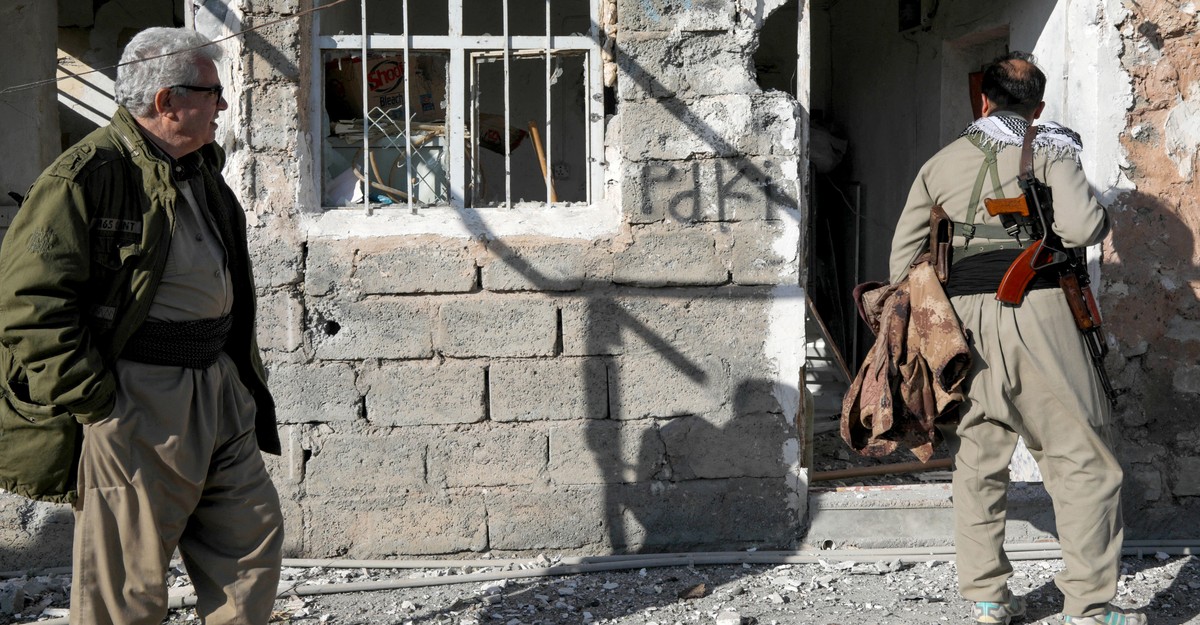
Last month, five Kurdish Iranian political parties came together to form the Coalition of Political Forces of Iranian Kurdistan, signaling their desire for joint political action. The five parties, all of which have military wings, have gathered thousands of their members in Iraq’s autonomous Kurdistan Region, a leader of an Iranian opposition group who has been privy to the plans told me. (He requested anonymity, like others I spoke with for this story, because of the sensitivity of the operation.)
According to this person, the operation is to be led by the Democratic Party of Iranian Kurdistan (known by its Kurdish initials PDKI), whose leader, Mustafa Hijri, spoke by phone with Donald Trump yesterday. The PDKI has deep roots among Iran’s Kurds. It’s the oldest Kurdish party and a consultative member of the Socialist International. According to the opposition leader who spoke with me, as well as the leader of one of the Kurdish groups aware of but not included in the plan, the U.S. and Israel have set aside significant funds for arms and logistical support to the five Iranian Kurdish groups. (A spokesperson for the Israel Defense Forces said the organization had “no comment on this matter.” The Pentagon did not immediately respond to a request for comment.) The Komala Party of Iranian Kurdistan, also a consultative member of the Socialist International but more left-leaning than the PDKI, joined the coalition today, becoming its sixth member party. The party had already received arms and financial support separately, my opposition source told me. Khalid Azizi, PDKI’s spokesperson, declined to comment when I reached him by phone.
I spoke with a Kurdish Iranian analyst who is normally based in the United States but has close ties to the Kurdish forces. He was about to leave for Iraq to embed with them. He told me that, to his knowledge, the militants taking part in the operation are Iranian citizens and mostly Kurds. The question of whether the MEK or the Communist Party of Iran (which has roots in Iranian Kurdistan but doesn’t have a military wing) are directly involved was not one I could settle at the time of writing; this source suggested that the Communists were but the MEK was not, but the information could not be confirmed.
Iranian Kurdish forces have long awaited such an opportunity, Shukriya Bradost, a Kurdish Iranian security analyst based in Washington, D.C., told me. “Kurdish parties want to protect the interests of their people,” Bradost said. “They have sought to do so peacefully but, when they get no results, they try other means.”
The operation is likely to face fierce opposition from many non-Kurdish Iranians. That will be especially true if the plan involves the MEK, which was once designated by the State Department as a terrorist organization before it was delisted in 2012. The group is seen by many Iranians as a cult whose eclectic ideology, which mixes Islam and Marxism, is easily as unpalatable as the Islamic Republic’s. As for the Kurdish parties, they have substantial support in Iran’s Kurdish-majority areas, but many other Iranians fear that empowering groups whose agendas may be sectarian will lead to civil war and state collapse.
Other ethnicity-based parties may raise even more concerns. The main Baloch militia, Army of Justice (Jaish al-Adl), is jihadist and alleged to have roots in al-Qaeda. (The Balochs, like the Kurds, are mostly Sunni, making both communities part of a religious minority within a nation that is 90 percent Shiite.) The militia formed a political group called the Popular Fighters Front in December, perhaps choosing a secular-sounding name to allay outside worries. But jihadists still make up the backbone of its forces.
The fear among many Iranians and other observers is that the agendas of the ethnic militias are territorial and separatist and could lead Iran to disintegration or civil war. “Fostering an armed ethnic insurgency in Iran would be the mother of all strategic, moral, and political mistakes,” Behnam Ben Taleblu, a senior fellow at the Foundation for Defense of Democracies, told me. “This is almost guaranteed to end in a failed state.”
Anticipating such objections, Bradost claimed that the Kurdish parties “saw their future in a democratic Iran, not separation from Iran.” And most Iranian Kurdish parties indeed advocate federalism rather than independence. The Kurdistan Freedom Party (known by its Kurdish acronym, PAK) is an exception and openly seeks an independent Republic of Kurdistan. But the PAK has agreed to commit to the program set forth by the coalition, which doesn’t include separatism, Bradost told me.
Taleblu, an expert on Kurdish politics, cautioned that the appeal of these parties is “limited to their own ethnic constituencies.” But Bradost said that the Kurdish parties were open to working with most Iranian political forces—just not the Islamic Republic, which is now too weakened to be a partner, or Reza Pahlavi, the son of the late shah of Iran, who has been
publicly hostile to the Kurdish parties. The Kurdish attitude toward Pahlavi will change only if the U.S. and Israel successfully pressure him to switch his position, she added.
Suspicion of a Kurdish insurgency, however, might not be so easily quelled, not only among Pahlavi’s supporters but across Iran’s political spectrum. Amir Hossein Ganjbakhsh, a pro-democracy political activist based in the United States, told me that the U.S. and Israel would “commit their biggest mistake” if they pursue this plan. “This would unite many Iranians who cherish Iran’s territorial integrity above all. It would be a recipe for civil war.” In response to the threat to Iran’s sovereignty, he said, “a large coalition of Iranians, whether they are monarchist or republican, whether they are religious or secular, would unite against these parties.”
Nesan Nodinian, the head of the Kurdistan Committee of the Worker-Communist Party of Iran, said that his party won’t oppose the others if they “liberate Kurdistan from the Islamic Republic by driving out the regime’s armed forces.” But his party has called on Kurdish civil society to “self-organize” and hopes to take part in local elections that the Kurdish parties have promised to stage if they seize Iranian territory. He also said that his party doesn’t share the hostility of much of the Iranian opposition to the MEK. “We are neither worried about them, nor optimistic, but they lack a social base,” he said. He told me he did not think Iran would descend into civil war, but rather that anti-regime Iranians would rally to the Kurds in a united struggle against the Islamic Republic.
That scenario may be far too optimistic. Many cities in western Iran are inhabited not just by Kurds but also by other ethnic groups, such as Azeri Turks, who could be mobilized against the Kurds, producing the sort of internecine conflict that is all too familiar in the Middle East. Brushing off such worries, Bradost claimed that Kurds and Azeris would unite over their shared non-Persian identity. But defining coalitions in terms of ethnic contrast will not inspire confidence in many other Iranians.
At the moment, the regime itself remains a formidable opponent to all of these plans. “Iran can muster up to 1 million people in military uniform,” Ganjbakhsh noted. Ali Larijani, Iran’s national security adviser, has repeatedly warned against ethnic insurgency in recent days. Iraqi Kurdish authorities, who have often collaborated with Tehran, had previously agreed to restrict Iranian Kurdish parties’ access to arms. But these restrictions were recently lifted, Nodinian told me, and yesterday, the Islamic Revolutionary Guard Corps staged attacks on bases in Iraqi Kurdistan. Today a top Iraqi Kurdish
official declared that his region will “completely keep its neutrality” in the war.
Taleblu warned that the regime has “played ethnic minorities against each other for quite some time” and said that it was well equipped to “take on a local armed insurgency.”
Finally, the American president remains a wild card. Even as forces in the Iranian opposition compete for Trump’s support and attention, he periodically signals that he might yet change tack and work with remnants of the regime, as he did in Venezuela. That would presumably pull the plug on the Kurdish operation.
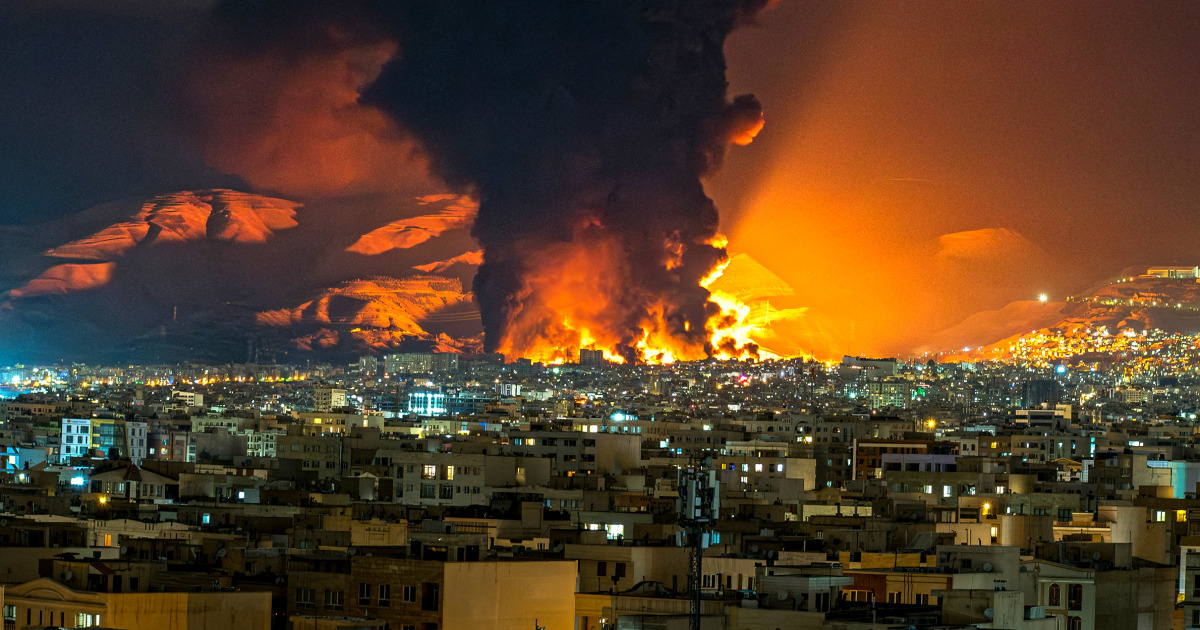
But the battle seems to be already on. This morning, the regime asked residents to evacuate Marivan, a Kurdish-majority city with a population of 200,000. IRGC forces dispatched 230 attack drones against targets in Iraqi Kurdistan “to fight off terrorist and separatist grouplets,” a media channel close to the force reported.
For many years, as they fought off the brutal dictatorship ruling over them, Iranians have worried that their struggle might lead to civil war and chaos. That scenario now seems closer than ever.