Aftermath of the Iran-US war and its effects on proximities

@RescueRanger @Mr X
As we can't reply in 'Truth in digital age...', I was wondering if our comments, smileys, etc., will be used by AI software like those used in the Iran war.
Therefore, can things like VPN etc save us from future political or some anti-state prosecution, or even coercive sabotage, etc?
 
@RescueRanger @Mr X
As we can't reply in 'Truth in digital age...', I was wondering if our comments, smileys, etc., will be used by AI software like those used in the Iran war.
Therefore, can things like VPN etc save us from future political or some anti-state prosecution, or even coercive sabotage, etc?
That thread is locked because it is a reference thread - I locked it because people tend to just post random off topic content and spoil the purpose of an informative thread.

As for the above question, I am sorry, but I don't get your meaning, can you elaborate.
 
That thread is locked because it is a reference thread - I locked it because people tend to just post random off topic content and spoil the purpose of an informative thread.

As for the above question, I am sorry, but I don't get your meaning, can you elaborate.

He wants to know if having a VPN will save his booty hole from persecution if he goes back to the fatherland, after posting anti-state rhetoric.
 
As for the above question, I am sorry, but I don't get your meaning, can you elaborate.
I mean, Israel and the US are using AI software for targeting acquisitions.
Now, the software uses all kinds of data like pictures, videos, smileys, etc and keeps tracking if the user has participated in pro-Palestinians or pro-Iranian protests, for instance.
I was just wondering if, in the future, this data will be brought up for job screening, visa approval, etc. Perhaps, I can't explain it as it is not my domain as such but watch just this excerpt of the video (time-stepped).

AI drone targets based on an algorithm if a person is too political to challenge the government. However, a human can judge that students at this age are somewhat political, so not a threat.

To view this content we will need your consent to set third party cookies.
For more detailed information, see our cookies page.


So, I was asking as a future projection how these data-driven companies will use AI to keep an eye on Muslims in the West, and if VPNs can save us. A far-right government would love to do that.

He wants to know if having a VPN will save his booty hole from persecution if he goes back to the fatherland, after posting anti-state rhetoric.
No, bro. I don't expect them to catch me. For them, I am still safe.
 
I mean, Israel and the US are using AI software for targeting acquisitions.
Now, the software uses all kinds of data like pictures, videos, smileys, etc and keeps tracking if the user has participated in pro-Palestinians or pro-Iranian protests, for instance.
I was just wondering if, in the future, this data will be brought up for job screening, visa approval, etc. Perhaps, I can't explain it as it is not my domain as such but watch just this excerpt of the video (time-stepped).

AI drone targets based on an algorithm if a person is too political to challenge the government. However, a human can judge that students at this age are somewhat political.

To view this content we will need your consent to set third party cookies.
For more detailed information, see our cookies page.


So, I was asking as a future projection how these data-driven companies will use AI to keep an eye on Muslims in the West, and if VPNs can save us. A far-right government would love to do that.


No, bro. I don't expect them to catch me. For them, I am still safe.

Sir this is not relevant to this thread - if you make a new thread about this, we can discuss this as digital literacy and digital safety is a personal interest for me. So, create a thread and add me, would love to talk more about it there.
 
The new GHQ idea is still there for E-8 because if there is something faujis love its plots and “اے تھلے بجری ڈال “


But the funds and priorities have been so far sensibly overruled by security concerns
E-10 to be exact
 
Pakistani statement on the war at UNSC

To view this content we will need your consent to set third party cookies.
For more detailed information, see our cookies page.
 
Israeli airport 😂😂😂

To view this content we will need your consent to set third party cookies.
For more detailed information, see our cookies page.

Fake news. That is a movie cinema and the footage is from 2025.
1773368649844.png
Here is the original tweet:
To view this content we will need your consent to set third party cookies.
For more detailed information, see our cookies page.
 
Fake news. That is a movie cinema and the footage is from 2025.
View attachment 185420
Here is the original tweet:
To view this content we will need your consent to set third party cookies.
For more detailed information, see our cookies page.

Shocker. The proliferation of fake news continues and they eagerly lap it up as fact.
 

The Other Global Crisis Stemming From the Strait of Hormuz’s Blockage​

Even if the Iran war stops, restarting production and transport for fertilizers and their components could take weeks—at a crucial moment for planting.

By Noah Gordon and Lucy Corthell
Published on Mar 12, 2026

The war in Iran has already claimed many direct victims, from the more than 100 children killed in a U.S. strike on an Iranian elementary school, to the Iranians inhaling toxic substances released by Israeli strikes on oil facilities in and around Tehran, to those soldiers and civilians killed and wounded across the region by the conflict. And no matter how quickly the fighting ends—wars often resist one protagonist’s desire to end them—its indirect victims could include billions of people hoping for good harvests and affordable meals in the coming year.

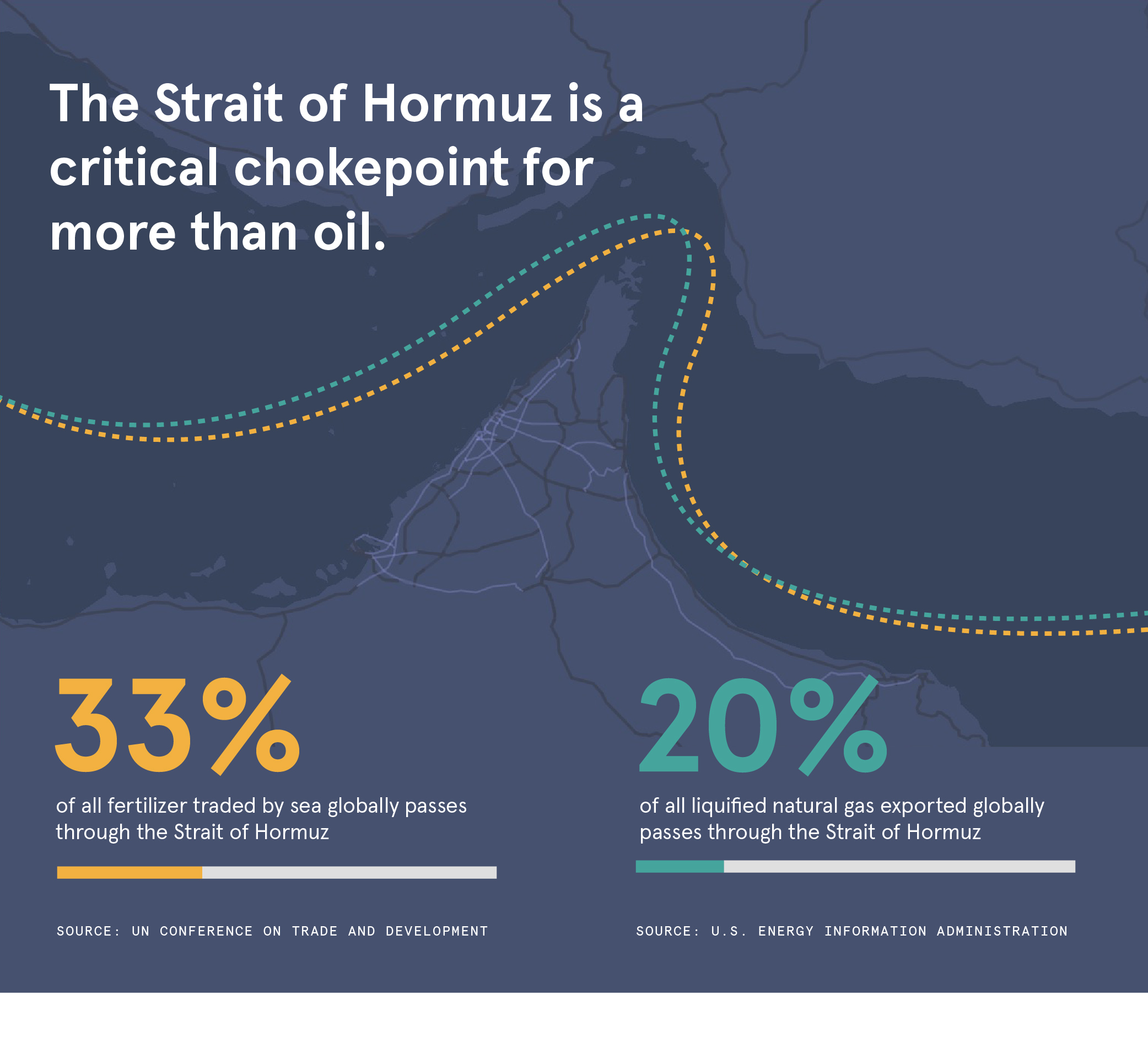
The Gulf region is a key producer not only of liquified natural gas (LNG) and oil products but also of fertilizer. About one-third of global seaborne trade in fertilizers typically passes through the Strait of Hormuz, which has been nearly entirely closed since the United States and Israel attacked Iran on February 28. In particular, Gulf countries are important producers of nitrogen fertilizers, which depend primarily on natural gas burned at high pressure in the presence of hydrogen to synthesize ammonia. (The hydrogen usually comes from natural gas as well.)

But it’s not just that Gulf fertilizer can’t make it to export markets such as Sudan, Brazil, or Sri Lanka. It’s also that fertilizer producers elsewhere lack key ingredients. This is where the second-order effects of a supply chain crisis appear, just as they did during Russia’s invasion of Ukraine in 2022, which sent fertilizer prices soaring.

Deprived of their natural gas supplies from Qatar, fertilizer firms in India, Bangladesh, and Pakistan have had to shut down production. Egypt, another important producer, has lost its gas imports from Israel and must turn to the ever-pricier LNG market. The benchmark price of urea, the most widely traded fertilizer, is up about 30 percent in the last month.

eyJrZXkiOiJpbWFnZXMvSG9ybXV6LmpwZyJ9

The damage extends beyond nitrogen to another key crop nutrient, phosphorus. Gulf countries produce around 20 percent of phosphate fertilizers, and as well as a quarter of global sulfur, which is largely an oil and gas byproduct. Fertilizer producers need sulfur (sulfuric acid, to be precise) to turn phosphate rock into a liquid that plants can absorb.

Because fertilizer has less value than oil and gas, political and business leaders expend fewer resources to make sure it keeps flowing. A ship captain bold enough to brave drone strikes and dash through the Strait of Hormuz would prefer to carry oil than fertilizer, a preference that would be shared by any potential navy escort, which the United States is in any case not yet able to provide. G7 countries don’t maintain strategic fertilizer reserves to match their oil stockpiles. The pipeline that Saudi Arabia built to enable exports through the Red Sea rather than the Strait of Hormuz is for oil, not ammonia products.

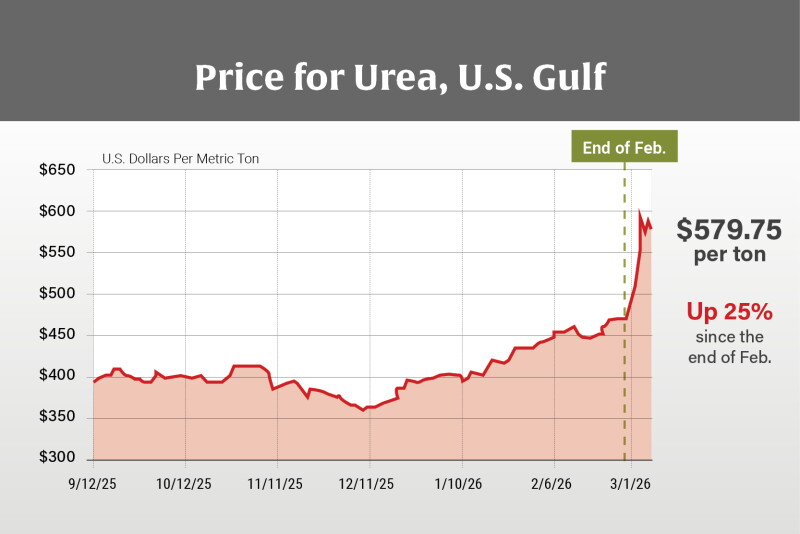
To be clear, about half of fertilizer is not traded internationally at all. The United States, a land of abundant natural gas, produces about three-quarters of the fertilizer it consumes, while China is even more self-sufficient. But because these are globally traded commodities, problems in one place ripple throughout the global economy. Even before the war in Iran, China was restricting fertilizer exports to protect its own farmers—but it needs Brazil, which is highly dependent on Middle Eastern urea, to be able to grow soybeans to feed to the pigs and cows in both countries. U.S. importers have seen the price of urea at the port in New Orleans rise more than 25 percent since the end of February, pushing the president of the American Farm Bureau Federation to write a plaintive letter to President Donald Trump warning that this “production shock” threatens national security. The price of urea as a ratio of the price of corn is approaching record levels.

This bad news comes at a bad time, just before spring planting season in the Northern Hemisphere. Farmers typically order fertilizer in March to apply in April or May. Now, the president of the South Carolina Farm Bureau is worried “farmers are not going to be able to finance planting their crop” while economists and fertilizer analysts expect “inflation going through the roof” over coming months as crops planted today are supposed to be arriving in supermarkets. Like anyone else with a fossil-fueled vehicle, U.S. farmers are also paying more for fuel since the war started, diesel fuel being the relevant one for agriculture.

As in the 2022 crisis, poorer countries will suffer the most. As Carnegie nonresident scholar Adam Tooze noted, the countries whose fertilizer use (and yields) fell most in 2022 included Côte d’Ivoire, Kenya, Nigeria, and South Africa. The fertilizer shortage of 2022, caused by the loss of many Russian and Belarusian products and a spike in gas prices, was one reason for a stark rise in global food prices in that year. The most dramatic example came from Sri Lanka, whose president had made the baffling decision to ban synthetic fertilizer such as urea and ammonia in 2021. Local agriculture collapsed, as did his government, and he had to flee the country. (Without synthetic fertilizers, some scholars argue, the global population would only be half as large as it is.) In 2022 countries such as Sri Lanka could at least count on foreign aid to help fill gaps. With the U.S. Agency for International Development now shuttered, that safety net may no longer be available.

The fertilizer crisis will cast a spotlight on the inefficiencies in the tremendously productive food system. About 20 percent of food designed for human consumption is wasted and never consumed. Almost 40 percent of cropland is used to grow animal feed at a huge efficiency cost: A cow requires 50 calories of feed to produce one calorie of beef. A third of U.S. corn is used to produce ethanol transport fuels for dubious environmental benefits.

Even if the Strait of Hormuz does open soon, restarting production and transport for fertilizers and their components could take weeks—weeks that Northern Hemisphere farmers do not have. Consumers around the world are already beginning to see higher prices for their gasoline and plane tickets. The more worrisome costs for the most vulnerable—those at the grocery store—are yet to come.

About the Authors​

Noah Gordon
Fellow, Sustainability, Climate, and Geopolitics Program and Fellow, Europe Program
Noah J. Gordon is a fellow in the Sustainability, Climate, and Geopolitics Program at the Carnegie Endowment for International Peace in Washington, DC.

Lucy Corthell
James C. Gaither Junior Fellow, Sustainability, Climate and Geopolitics Program
Lucy Corthell is a James C. Gaither Junior Fellow in the Carnegie Sustainability, Climate and Geopolitics Program.
 

The Other Global Crisis Stemming From the Strait of Hormuz’s Blockage​

Even if the Iran war stops, restarting production and transport for fertilizers and their components could take weeks—at a crucial moment for planting.

By Noah Gordon and Lucy Corthell
Published on Mar 12, 2026

The war in Iran has already claimed many direct victims, from the more than 100 children killed in a U.S. strike on an Iranian elementary school, to the Iranians inhaling toxic substances released by Israeli strikes on oil facilities in and around Tehran, to those soldiers and civilians killed and wounded across the region by the conflict. And no matter how quickly the fighting ends—wars often resist one protagonist’s desire to end them—its indirect victims could include billions of people hoping for good harvests and affordable meals in the coming year.

The Gulf region is a key producer not only of liquified natural gas (LNG) and oil products but also of fertilizer. About one-third of global seaborne trade in fertilizers typically passes through the Strait of Hormuz, which has been nearly entirely closed since the United States and Israel attacked Iran on February 28. In particular, Gulf countries are important producers of nitrogen fertilizers, which depend primarily on natural gas burned at high pressure in the presence of hydrogen to synthesize ammonia. (The hydrogen usually comes from natural gas as well.)

But it’s not just that Gulf fertilizer can’t make it to export markets such as Sudan, Brazil, or Sri Lanka. It’s also that fertilizer producers elsewhere lack key ingredients. This is where the second-order effects of a supply chain crisis appear, just as they did during Russia’s invasion of Ukraine in 2022, which sent fertilizer prices soaring.

Deprived of their natural gas supplies from Qatar, fertilizer firms in India, Bangladesh, and Pakistan have had to shut down production. Egypt, another important producer, has lost its gas imports from Israel and must turn to the ever-pricier LNG market. The benchmark price of urea, the most widely traded fertilizer, is up about 30 percent in the last month.

eyJrZXkiOiJpbWFnZXMvSG9ybXV6LmpwZyJ9

The damage extends beyond nitrogen to another key crop nutrient, phosphorus. Gulf countries produce around 20 percent of phosphate fertilizers, and as well as a quarter of global sulfur, which is largely an oil and gas byproduct. Fertilizer producers need sulfur (sulfuric acid, to be precise) to turn phosphate rock into a liquid that plants can absorb.

Because fertilizer has less value than oil and gas, political and business leaders expend fewer resources to make sure it keeps flowing. A ship captain bold enough to brave drone strikes and dash through the Strait of Hormuz would prefer to carry oil than fertilizer, a preference that would be shared by any potential navy escort, which the United States is in any case not yet able to provide. G7 countries don’t maintain strategic fertilizer reserves to match their oil stockpiles. The pipeline that Saudi Arabia built to enable exports through the Red Sea rather than the Strait of Hormuz is for oil, not ammonia products.

To be clear, about half of fertilizer is not traded internationally at all. The United States, a land of abundant natural gas, produces about three-quarters of the fertilizer it consumes, while China is even more self-sufficient. But because these are globally traded commodities, problems in one place ripple throughout the global economy. Even before the war in Iran, China was restricting fertilizer exports to protect its own farmers—but it needs Brazil, which is highly dependent on Middle Eastern urea, to be able to grow soybeans to feed to the pigs and cows in both countries. U.S. importers have seen the price of urea at the port in New Orleans rise more than 25 percent since the end of February, pushing the president of the American Farm Bureau Federation to write a plaintive letter to President Donald Trump warning that this “production shock” threatens national security. The price of urea as a ratio of the price of corn is approaching record levels.

This bad news comes at a bad time, just before spring planting season in the Northern Hemisphere. Farmers typically order fertilizer in March to apply in April or May. Now, the president of the South Carolina Farm Bureau is worried “farmers are not going to be able to finance planting their crop” while economists and fertilizer analysts expect “inflation going through the roof” over coming months as crops planted today are supposed to be arriving in supermarkets. Like anyone else with a fossil-fueled vehicle, U.S. farmers are also paying more for fuel since the war started, diesel fuel being the relevant one for agriculture.

As in the 2022 crisis, poorer countries will suffer the most. As Carnegie nonresident scholar Adam Tooze noted, the countries whose fertilizer use (and yields) fell most in 2022 included Côte d’Ivoire, Kenya, Nigeria, and South Africa. The fertilizer shortage of 2022, caused by the loss of many Russian and Belarusian products and a spike in gas prices, was one reason for a stark rise in global food prices in that year. The most dramatic example came from Sri Lanka, whose president had made the baffling decision to ban synthetic fertilizer such as urea and ammonia in 2021. Local agriculture collapsed, as did his government, and he had to flee the country. (Without synthetic fertilizers, some scholars argue, the global population would only be half as large as it is.) In 2022 countries such as Sri Lanka could at least count on foreign aid to help fill gaps. With the U.S. Agency for International Development now shuttered, that safety net may no longer be available.

The fertilizer crisis will cast a spotlight on the inefficiencies in the tremendously productive food system. About 20 percent of food designed for human consumption is wasted and never consumed. Almost 40 percent of cropland is used to grow animal feed at a huge efficiency cost: A cow requires 50 calories of feed to produce one calorie of beef. A third of U.S. corn is used to produce ethanol transport fuels for dubious environmental benefits.

Even if the Strait of Hormuz does open soon, restarting production and transport for fertilizers and their components could take weeks—weeks that Northern Hemisphere farmers do not have. Consumers around the world are already beginning to see higher prices for their gasoline and plane tickets. The more worrisome costs for the most vulnerable—those at the grocery store—are yet to come.

About the Authors​

Noah Gordon
Fellow, Sustainability, Climate, and Geopolitics Program and Fellow, Europe Program
Noah J. Gordon is a fellow in the Sustainability, Climate, and Geopolitics Program at the Carnegie Endowment for International Peace in Washington, DC.

Lucy Corthell
James C. Gaither Junior Fellow, Sustainability, Climate and Geopolitics Program
Lucy Corthell is a James C. Gaither Junior Fellow in the Carnegie Sustainability, Climate and Geopolitics Program.
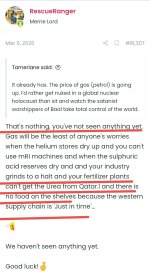
Well would you look at that seems old grumpy doom and gloom resuceranger was right again:
1000008531.jpg

But that's okay, keep clapping for cigars and blasts in a fight we have no dog in (for now). All that will change, and the cacophony of this crescendo will echo in your streets and houses.

"You all haven't seen anything yet".

🫡
 

How War in Iran Could Remake the Global Energy Landscape

The oil crisis in the Middle East could spur countries to invest in wind, solar and otherrenewables. It could also spike reliance on coal, a cheap and polluting fossil fuel.

By Brad Plumer and Lisa Friedman
Reporting from Washington

Published March 11, 2026Updated March 12, 2026

The war in Iran is choking off oil and gas supplies and spiking energy prices across the globe. And for many environmentalists, that’s a powerful argument for countries to curb their use of fossil fuels and shift to wind, solar and other renewable sources.

But as the chaos forces nations to rethink their energy policies, the results could be messy — and cleaner options may not always be the winner.

Some countries in Europe and Asia may try to install more wind turbines, solar panels and batteries to buffer themselves against surges in the price of natural gas, as many did after Russia invaded Ukraine in 2022. If oil prices stay elevated, electric cars could become a more economical option for drivers from Brazil to the United States.

“This newest upheaval shows yet again that fossil fuel dependence leaves economies, businesses, markets and people at the mercy of each new conflict,” said Simon Stiell, the United Nations climate chief. Investing in renewable energy, he said, is “the obvious pathway to energy security.”

Yet other countries could respond to the supply crunch by burning more coal — a highly polluting fossil fuel, but cheap and readily available — or embracing American natural gas. And if the Iran conflict causes interest rates to rise, that could make new renewable energy systems more expensive, analysts said.

The Trump administration, for its part, has been urging nations to use more oil and gas and is pitching the United States as a stable supplier of fossil fuels in a dangerous geopolitical era.

“It’s like an inkblot test,” said David Victor, a professor of public policy at the University of California, San Diego. “The war has reminded everybody of the powerful importance of energy security. And with that reminder, you have radically different responses.”

The war also underscores a notable shift in the global energy landscape. For years, many world leaders declared tackling global warming a top priority and called for a shift to cleaner energy sources that didn’t heat the planet. But recently, rising geopolitical and trade risks have spurred countries to look for homegrown sources of any kind of energy. That could include solar or nuclear power but also coal or gas.

A scramble for energy​

The fighting in the Middle East has already exposed vulnerabilities in global energy markets. Roughly 20 percent of the world’s oil and much of its natural gas normally travels by ship through the Strait of Hormuz, a narrow waterway off the southern coast of Iran.

Since the war began, Iran has been attacking tankers in the strait and traffic has slowed to a crawl, cutting off critical energy supplies. International oil prices rose by as much as one-third before dropping somewhat over the past few days.

The shock waves have been profound.

Qatar, which supplies one-fifth of the world’s liquefied natural gas, has halted gas production, leading to price spikes and factory shutdowns in faraway countries that rely on the fuel, including India, South Korea and Taiwan. In Vietnam, “sold out” signs are appearing at gasoline stations. In Pakistan, officials have urged four-day workweeks to save energy. Hungary and Croatia have imposed price controls on domestic fuels.

In the short term, many countries are racing to secure energy supplies wherever they can. That often means scrambling for oil, gas and coal, which together still provide 80 percent of the world’s energy needs.

In Thailand, which typically imports much of its natural gas from Qatar, officials have ordered domestic coal plants to run at full capacity and the national oil and gas company to maximize local production to make up the shortfall. In Taiwan, officials have broached the possibility of restarting a shuttered coal plant.

In Europe, where natural gas prices have spiked more than 75 percent since the war began, nations are buying more U.S. liquefied natural gas, outbidding poorer countries like Pakistan and Bangladesh.

“In the short term, countries will get energy wherever they can find it,” said Kevin Book, managing director of ClearView Energy Partners, a research firm. “But in the long run, there’s room for a rethink.”

Rethinking oil and gas imports​

Depending on the length and severity of the Iran conflict, some nations could seek to reduce their reliance on oil and gas imports from the Middle East in the coming years, experts said.

That could be a boon for U.S. gas exporters who can offer an alternative to gas shipped through the Strait of Hormuz. Over the past decade, thanks to advances in fracking technology, the United States has become by far the world’s biggest supplier of liquefied natural gas, a form of gas that has been cooled for shipment. U.S. companies are expected to double export capacity by 2031.

“The security argument for Qatari gas has really been undermined, and this is going to bolster the case for a lot of new L.N.G. projects out there,” said Ira Joseph, a scholar at Columbia University’s Center on Global Energy Policy.

Some countries in Southeast Asia and elsewhere could also turn to domestic sources of coal, the dirtiest of the fossil fuels but also widely available in many parts of the world. In recent years, nations like India, Indonesia, Bangladesh and Pakistan have all been developing new coal plants, and global coal consumption has reached record highs.

“If your goal is domestically produced energy and you’re South Africa or Indonesia or China, coal looks pretty good from energy security standpoint,” said Jason Bordoff, the founding director of the Center on Global Energy Policy.

A far less polluting option would be for countries to invest in renewable energy sources like wind and solar power, which do not require fuel and could help insulate them from volatile swings in gas and oil markets.

After Russia invaded Ukraine in 2022 and cut off gas supplies, Europe stepped up its investment in solar power, with installations surging from roughly 40 gigawatts per year to nearly 65 gigawatts per year. (One gigawatt produces roughly enough electricity at peak output to power 300,000 homes.)

Last year, nations spent more than $780 billion on renewable energy, according to the International Energy Agency, more than they invested in oil infrastructure.

“My expectation, if post-Ukraine energy development is any indicator, is that it will accelerate further in countries that do not have access to fossil fuels,” said Ani Dasgupta, head of the World Resources Institute, an environmental group.

A recent analysis from BloombergNEF, a research firm, suggested that the Iran conflict could give a boost to solar power and batteries, both of which have been rapidly falling in cost. Still, there are some obstacles that markets like Europe and India will need to overcome, including grid congestion, land constraints and regulatory bottlenecks.

Nuclear power is another option. In Japan, which is highly dependent on imported natural gas, officials have been gradually restarting nuclear plants that were closed in 2011 after a reactor meltdown at Fukushima. Those efforts could take on a new urgency, since each nuclear plant generally displaces gas power.

Because clean energy and fossil fuels could both benefit, it is unclear what the shifting energy landscape would mean for greenhouse gas emissions.

A case in point is China, which over the last 20 years has pushed hard to reduce its reliance on imported oil and gas — seemingly motivated far more by concern about energy security than climate change.

China has fostered a cutting-edge electric vehicle industry, installed more wind and solar power than the rest of the world combined and is constructing dozens of nuclear power plants. But the country has also built hundreds of coal-burning power plants and — despite the heavy focus on renewables — has quickly become the world’s biggest emitter of planet-warming greenhouse gases, helping to push global temperatures to new highs.

“While China is bearing some pain today, this crisis is in some ways a validation of their energy security strategy over the past 20 years,” said Mr. Bordoff. “In a world where energy is increasingly weaponized and energy security is more at risk, you would expect to see more countries try to reduce their dependence on imports.”

The electric car calculus​

The situation is somewhat different in the United States.

Because natural gas markets are highly regional, America’s record gas production has kept the nation relatively protected from price shocks there. Natural gas is the biggest source of electricity in the United States, and the fact that it remains cheap means that other sources like wind, solar or nuclear power are unlikely to get any particular boost from the Iran conflict.

Yet the price of oil, which is traded globally, has been rising, which in turn has made gasoline more expensive for drivers in the United States. That could make electric vehicles more competitive, according to a separate analysis by BloombergNEF.

Today, U.S. gasoline prices are averaging around $3.50 per gallon. If prices were to climb to around $4.00 per gallon, the total cost of owning an electric car like the Tesla Model Y would be roughly similar to the total cost of owning a gasoline-burning Toyota RAV 4, because of the lower fuel costs, the analysis found.

Still, there are plenty of complications, said Ethan Zindler, head of country and policy research at BloombergNEF.

“Consumers would need to believe that prices are going to stay where they are,” he said.

The United States, Canada and Europe have also put tariffs and other trade barriers on Chinese electric vehicles, which are some of the cheapest on the market today. Some experts wonder whether those dynamics could change if prices stay high for long enough.

“The question is when does this crisis go on long enough that it starts to change people’s longer term thinking about energy policy and energy strategy,” said Mr. Zindler. “The higher that prices go, the bigger the shifts we could see.”

Brad Plumer is a Times reporter who covers technology and policy efforts to address global warming.
Lisa Friedman is a Times reporter who writes about how governments are addressing climate change and the effects of those policies on communities.
 
Well would you look at that seems old grumpy doom and gloom resuceranger was right again:
View attachment 185435

But that's okay, keep clapping for cigars and blasts in a fight we have no dog in (for now). All that will change, and the cacophony of this crescendo will echo in your streets and houses.

"You all haven't seen anything yet".

🫡

The Iran War Is Sending Fertilizer Prices Soaring at the Worst Time for Farmers​

Fertilizer prices were already elevated, but they’re now surging just weeks before spring planting. What can be done to ease costs in the short term as well as fix the problem for good?​

Tyne Morgan

By Tyne Morgan

March 10, 2026 01:42 PM
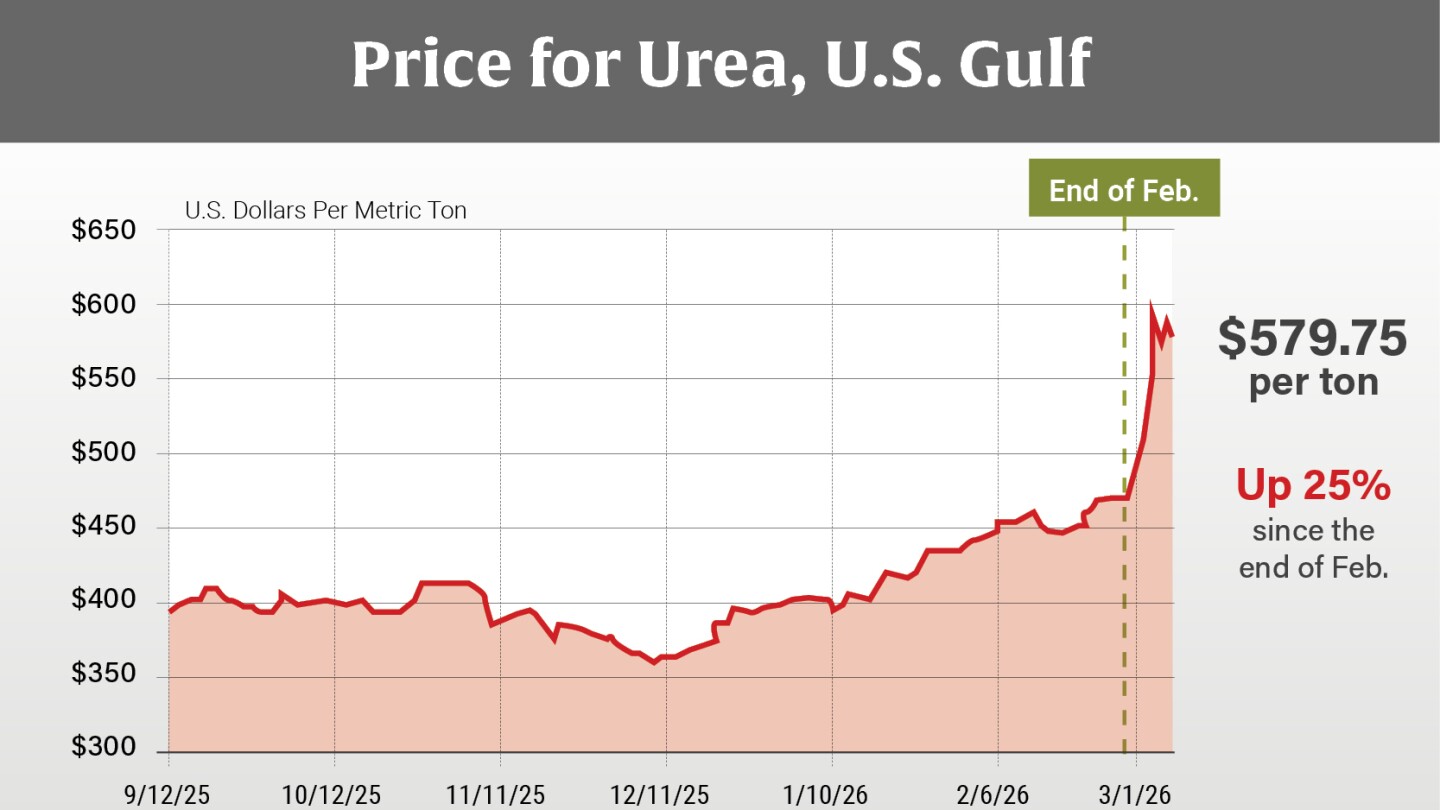
Price for Urea, U.S. Gulf.jpg

New analysis from Farm Bureau’s MarketIntel team underscores why fertilizer markets are particularly vulnerable to geopolitical instability involving Iran and neighboring countries in the Persian Gulf.
(Lori Hayes/ Source: AFBF)
The American Farm Bureau Federation (AFBF) is urging the Trump administration to take immediate action to stabilize fertilizer supply chains as geopolitical tensions in the Middle East send shockwaves through global input markets just as U.S. farmers begin spring planting. But with farmers already dealing with high fertilizer prices, even before the conflict in Iran, farmers are searching for a longer-term solution. Fertilizer market analysts warn while there are several options longer-term, there is no single fix for high fertilizer prices, only a mix of short-term policy responses and long-term investments that could gradually stabilize supply.

But today, the sticker shock is hitting farmers hard, especially for those who waited to book fertilizer for spring. Fertilizer prices have shot up in just a week. Typically, retailers may receive updated pricing once or twice a month. But with the ongoing uncertainty in Iran and the impact on the Strait of Hormuz is having on fertilizer shipments, some retailers say they are getting several pricing updates a day.

The price shock is real for farmers. One local Missouri retailer told AgWeb that in just a two-week period:

  • Urea is up $140 per ton
  • NH3 has risen $100 per ton
  • UAN is also up $100 per ton


The Iran War Is Sending Fertilizer Prices Soaring at the Worst Time for Farmers​

Fertilizer prices were already elevated, but they’re now surging just weeks before spring planting. What can be done to ease costs in the short term as well as fix the problem for good?​

Tyne Morgan

By Tyne Morgan

March 10, 2026 01:42 PM
Price for Urea, U.S. Gulf.jpg

New analysis from Farm Bureau’s MarketIntel team underscores why fertilizer markets are particularly vulnerable to geopolitical instability involving Iran and neighboring countries in the Persian Gulf.
(Lori Hayes/ Source: AFBF)
The American Farm Bureau Federation (AFBF) is urging the Trump administration to take immediate action to stabilize fertilizer supply chains as geopolitical tensions in the Middle East send shockwaves through global input markets just as U.S. farmers begin spring planting. But with farmers already dealing with high fertilizer prices, even before the conflict in Iran, farmers are searching for a longer-term solution. Fertilizer market analysts warn while there are several options longer-term, there is no single fix for high fertilizer prices, only a mix of short-term policy responses and long-term investments that could gradually stabilize supply.

But today, the sticker shock is hitting farmers hard, especially for those who waited to book fertilizer for spring. Fertilizer prices have shot up in just a week. Typically, retailers may receive updated pricing once or twice a month. But with the ongoing uncertainty in Iran and the impact on the Strait of Hormuz is having on fertilizer shipments, some retailers say they are getting several pricing updates a day.

The price shock is real for farmers. One local Missouri retailer told AgWeb that in just a two-week period:

  • Urea is up $140 per ton
  • NH3 has risen $100 per ton
  • UAN is also up $100 per ton

arewehavingfunyet.gif
 

Users who are viewing this thread

Pakistan Defence Latest

Latest Posts

Back
Top