Its just a theory from my side but could it be that the other 4 made here will have the TAS?? or maybe the ASW role is being given to the sea sultans so the switch??? or maybe yours is correct that SWATS will be made for this role? but still the IN sub threat is big...
It would be a strange way of doing things, because then any downtime would seriously kill ASW abilities of the PN.
Submarines are far better for ASW than aircraft/surface ships, for many reasons, but the simplest are that aircraft are limited, station time, the types of sensors, also very vunerable to interception etc.
Surface ships are noisy, operate above the theromcline, the noise floor is also greater and you get tons of interference. This is why proper ASW vessels carry towed arrays which can operate at varied depths, negating some of these issues. But also, surface ships are very, very vulnerable. Remember, IRIS dena was probably targeted within 20 miles. With TWO torpedos, one missed, one hit, so they didnt even get a warning of the first torpedo, nor did they know the sub was there. This just shows you how difficult ASW really is.
I think, at the end of the day, the PN knows the Yuan isnt a particularly optimal submarine for our environment, but really, it had no choice. Theres a very good USNI article on it, and i will paste the relevant bits:
"Designing a submarine to operate in very shallow water has other problems beyond just maneuvering. Holst correctly points out that the acoustic environment in coastal areas is chaotic and difficult, making it challenging for an antisubmarine platform to find a Yuan ensconced in such waters. But what is good for the gander is also good for the goose.
Radiated noise from shipping is far louder, and even with multiple bounces off the bottom and sea surface, a lot of the acoustic energy will still reach a submerged submarine’s sonar. With shipping, biologic, and wave noise coming in from both near and far, a Yuan would be hard pressed to detect, track, and identify a target of interest; particularly as surface combatants tend to be quieter than civilian merchants. In other words, it will be very difficult to find and obtain an accurate fire control solution on a desired target without using a periscope to sort out the tactical picture. Doing so, however, would increase the submarine’s chances of being detected by radar or electro-optical sensors. Therefore, a submarine hugging the bottom in shallow coastal waters will be vexed by the same problem that an ASW ship has to deal with in looking for the submarine. But what is even more curious—if Chinese designers had intended from the very beginning for the Yuan-class to be a shallow water boat—why was a passive low frequency flank array put on these submarines?"
"The H/SQG-207 is a line of individual hydrophones mounted to the hull, and is designed to provide long-range detection against noisy ships—low frequency noise suffers lower absorption losses and travels further in water. The problem is this kind of array is most effective in deeper water where interference with the bottom is limited. Such an array would be severely degraded in very shallow water, offering little, if any benefit, beyond the capabilities of the medium frequency bow array. The fact that the H/SQG-207 array is on the Yuan-class argues strongly that its design operating areas are in deeper waters where this passive sonar can serve as the primary sensor."
"The sonar suite of the Yuan is tailored more for deep water where it can use the low frequency flank array to make long-range detections against noisy ships. The lack of a vertical launch system means the Yuan, and Song-class, are limited by the number of torpedo tubes that can be allocated to ASCMs; making it very hard to saturate a ship’s air defenses with only four, or at most five, missile salvos. And given the current short-ranged YJ-82 ASCM, a Type 039A/B Yuan-class submarine is better off attempting to close inside 15 kilometers and engaging the target with YU-6 torpedoes. But even after the introduction of the YJ-18, the restrictive factors of the torpedo room’s capacity and the small number of torpedo tubes remains. The PLAN appears to appreciate this constraint, as the discussion of future nuclear submarine designs having as many as 16 vertical launch tubes suggests.
The design aspects of the Type 039A/B Yuan-class submarine point toward deep-water operating areas in the near seas, to include the approaches to Taiwan, where their improved sonar and AIP capabilities will aid the submarine in detecting, tracking, and engaging targets of interest. And while a Type 039A/B Yuan could soon be loaded with a more effective, long-range ASCM, the submarine’s design limitations will continue to rely heavily on the torpedo."
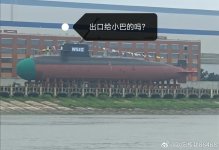
I dont think this photo has been uploaded here , found it on a chinese defence forum..
The 3rd Hangor class (PNS MANGRO) for Pakistan on the slipway.
View attachment 186032
The pic from the navy ceremony :
View attachment 186036
The PN repeatedly refers to its ships as 039B (upgraded). One difference you might spot is that in the photo above, pre launch, you can see that the flank array sonar is shorter than the PLAN's domestic version.
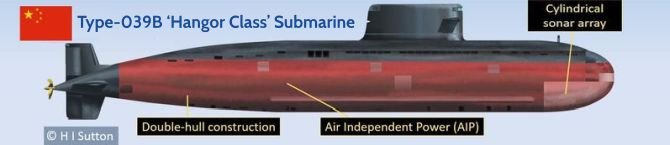
As you can see here, it starts rather close to the cylindrical array, whereas the one on the PN's boat starts a little further back, and ends short of the PLAN's one too.
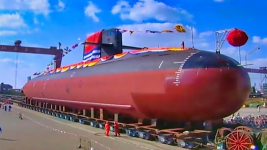
Its clear that the original configuration would be unsuitable for our coastal waters. Perhaps part of the 'upgrades' were the substitution of the unsuitable sonar equiptment for something better in our warmer, shallower waters.
But i still think these boats arent going to be used anywhere near our waters. They are HUGE. I see these as attack subs, designed to go out into deeper waters and strike, both indian coasts and also indian vessels further afield. I think this is why the PN has placed such an importance on SWATs. Shallow water ATTACK subs- hence why my thought that perhaps SWATs will look after the ASW work for us