Iran - Israel/US War: Israel-US declare war on Iran, Iran responds

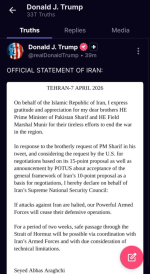
Pakistanis role was not negotiate a perfect deal for Iran. It was to get parties around the table to iron out the differences. You can walk away on Saturday if the ceasefire is not perfect.
There is no such thing as "Perfect Deal" or any draft that can make everyone happy, every party has to make concessions and sacrifices, some do more and others do less. Its all about who is in the strong position, and now despite what we read on PDF from Pro Iranian sources about how good Iran is doing, or from Pro American sources on how Awesome Americans are winning, the reality is known to people on ground and those who are involved in negotiations, they understand the dire situation on ground on both sides hence messages are sent for initiating talks.
 
The lengths to which Israel has gone to destroy Iranian nuclear program. What is mind-boggling is how Iran has allowed the Israeli network to remain operational inside of Iran learning who the key people are, including doctoral candidates in their universities working on nuclear disciplines.

This is not an Israel problem. They are the enemy who will do what they can to destroy Iran's nuclear problem, what is unbelievable is the space that the Iranian government, military, security forces have allowed to the Israelis and their agents to gather intelligence which is now being used to destroy, murder Iranians perceived close to the nuclear program.


Before winding down the war, US and Israel are determined to wipe out Iran’s nuclear expertise​


Mostafa Salem, Tal Shalev, CNN
Tue, April 7, 2026 at 12:01 AM EDT


FILE - This satellite image provided by Vantor shows the Natanz nuclear complex in Iran on March 7, 2026, with no new damage seen at the facility or the tunnels. (Satellite image ©2026 Vantor via AP, file) - Vantor/AP

FILE - This satellite image provided by Vantor shows the Natanz nuclear complex in Iran on March 7, 2026, with no new damage seen at the facility or the tunnels. (Satellite image ©2026 Vantor via AP, file) - Vantor/AP
As rain poured on the northern provinces of Iran in late March, a somber crowd snaked through the mountain ranges of Asara carrying the coffin of Mohammad Reza Kia. The city of just a few thousand people was draped in banners now hailing the young nuclear scientist as a “martyr of the imposed war.”

Piecing together information on Kia and the circumstance of his obscure death is difficult, but two weeks ago his mother said in a short clip that he was killed in an attack.

Beyond a few research papers attributed to him and an inactive social media page bearing his name, the only information available is that he was a doctoral candidate in the Department of Nuclear Engineering at Amirkabir University of Technology from 2010 to 2017.


Kia’s killing, and those of countless Iranian scientists in all parts of the country, demonstrates the lengths to which Israel and the United States are willing to go to ensure that Tehran’s ability to weaponize its nuclear program is significantly curtailed after the war ends.

Last week, US President Donald Trump said the US was on track to achieve its objectives in the Iran war – including preventing Tehran from developing a nuclear weapon – and suggested the conflict could last two to three more weeks. But Iran still retains hundreds of kilograms of the core component needed to build a bomb, as well as decades of expertise. As the US and Israel look to wind down the war, they are determined to target that expertise in a bid to cripple the nuclear program.

Hit list​

Over the past decades, Iran built an extensive knowledge ecosystem around its nuclear program - university departments, specialized machinery, and a robust system that included domestic uranium mining, processing, enrichment using advanced centrifuges, and storage in stockpiles. Experts say that even if Iran’s program is peaceful, Tehran has the architecture to weaponize it should it choose to.

An Israeli security source said all of those are on its hit list.

A few days after Kia’s funeral, another strike hit a building 300 miles away, killing nine people - including Ali Fouladvand, a scientist in charge of research at a leading organization long accused by Western powers and Israel of serving as a front for acquiring the knowledge needed to weaponize Iran’s nuclear program.

The founder of the organization, known by its Persian acronym SPND, was Mohsen Fakhrizadeh, a leading nuclear scientist widely believed to have been assassinated by Israel six years ago. The organization’s current chairman, Jabal Amelian, was killed in the initial wave of Israeli-US strikes in late February, while other leading figures have been systematically targeted by Israel since last year.

“Every link in the nuclear production chain is a target – from the knowledge base to the production floor. The goal is to cut off all the roots,” an Israeli security source told CNN. “From the people working in laboratories to the factories that produce components for those labs.”

When the United States and Israel launched a war on Iran last month, the Islamic Republic’s Supreme Leader Ayatollah Ali Khamenei and his top military and intelligence officials were killed in a targeted operation designed to eliminate the regime’s leading figures.


Israel appears to have taken the lead on assassinating even low-level figures linked to Iran’s nuclear program while systematically degrading the knowledge centers that could prove useful in the future.

Two Iranian women stand next to a banner featuring a portrait of Iranian nuclear scientist Mohammad Mehdi Tehranchi, who was killed in Israeli attacks. - Morteza Nikoubazl/NurPhoto/Getty Images

Two Iranian women stand next to a banner featuring a portrait of Iranian nuclear scientist Mohammad Mehdi Tehranchi, who was killed in Israeli attacks. - Morteza Nikoubazl/NurPhoto/Getty Images
Israel’s strategy expanded in June 2025. It killed the top figures in the Revolutionary Guards’ aerospace force – the commanders responsible for Iran’s missile capabilities, which could aid in developing a nuclear warhead – while also targeting more than a dozen of the country’s top nuclear professors and scholars, including Mohammad Mehdi Tehranchi, one of Iran’s most notable physicists.


“Israel is striking every stage of the production process – including iron and steel plants that are not directly part of the military industry but could eventually contribute to rebuilding the production process,” the source said.

It is also hitting specific departments at universities while also attempting to significantly degrade the complex supply chain needed to maintain Iran’s nuclear program.

“In terms of knowledge – scientists, libraries, archives, chemical labs, the people working in all these places - and also the ranks that could replace them” are all targets, the source told CNN.

Potential weaponization​

Even as Iran insisted that its nuclear program was entirely peaceful, Western nations have long suspected it of using front companies to circumvent international monitoring and develop dual-use technologies that could be rapidly repurposed to weaponize the program if the decision were made.

Nicole Grajewski, an assistant professor at the Center for International Studies at Sciences Po in Paris, noted that nuclear experts believe Iran had conducted diagnostic tests, nuclear effects modeling, and detonation simulations, all signs that Tehran was acquiring the knowledge needed to weaponize its program when desired.

US intelligence assessments have said there is no evidence Iran was trying to weaponize its nuclear program, but experts say Iran used its status as a nuclear threshold state – one that retains the ability to build a bomb – as a source of leverage in talks with the West.

This Jan. 15, 2011 file photo shows the heavy water nuclear facility near Arak, 150 miles (250 kilometers) southwest of the capital Tehran, Iran. - Hamid Foroutan/ISNA/AP

This Jan. 15, 2011 file photo shows the heavy water nuclear facility near Arak, 150 miles (250 kilometers) southwest of the capital Tehran, Iran. - Hamid Foroutan/ISNA/AP
Iranian officials at the heavily sanctioned SPND had built a network of subordinate organizations designed to develop expertise and acquire dual-usetechnologies that the United States says are intended to gather the knowledge needed for nuclear weaponization.

“Iran is the only country in the world without nuclear weapons that is producing uranium enriched to 60 percent and it continues to use front companies and procurement agents to obscure its efforts to acquire dual-use items from foreign suppliers,” US Secretary of State Marco Rubio said in a statement announcing the sanctioning of SPND last year.

A key component for a nuclear bomb​

After Trump withdrew from the Iran nuclear deal struck by the Obama administration in 2015, Tehran began installing advanced centrifuges to accelerate its uranium enrichment. It succeeded in amassing a significant stockpile of highly enriched uranium – enough to build a nuclear weapon.

More than 400 kilograms of highly enriched uranium had been stockpiled in Iran, raising serious concerns among international agencies, which questioned why the Islamic Republic would need such a large quantity if its nuclear program was truly peaceful. The level of enrichment needed for nuclear power is under 4%, but Iran began enriching uranium as much as 60% after Trump pulled out of the nuclear deal in 2018.

When Israel and the United States struck Iran’s heavily fortified nuclear facilities last year, the fate of the highly enriched uranium became increasingly unclear. The head of the United Nations nuclear watchdog, Rafael Grossi, told PBS in an interview published Friday that the material is believed to be in Isfahan and could possibly be moved.

“The nuclear sites that we obliterated… have been hit so hard that it would take months to get near the nuclear dust,” Trump said in an address last week. In a Reuters interview on April 1, he added that the enriched material is “so far underground, I don’t care about that.”

Before that comment, the Wall Street Journal cited US officials as saying Trump was weighing a military operation to extract the uranium, though no decision had been made.

ISFAHAN, IRAN -- JUNE 14, 2025: 08  Maxar satellite overview shows widespread damage to the Isfahan enrichment facility after reported airstrikes. Please use: Satellite image (c) 2025 Maxar Technologies. - Maxar/Getty Images

ISFAHAN, IRAN -- JUNE 14, 2025: 08 Maxar satellite overview shows widespread damage to the Isfahan enrichment facility after reported airstrikes. Please use: Satellite image (c) 2025 Maxar Technologies. - Maxar/Getty Images
More
Iran has been intentionally vague regarding its access to the material, but it offered to dilute it during negotiations with the US before the war began in February.

“That was a big offer, a big concession in order to prove that Iran has never wanted nuclear weapons and would never want them,” Iran’s Foreign Minister Abbas Araghchi told CBS last month.

Despite Israel targeting key facilities to degrade Iran’s nuclear program, Grajewski said that Iran’s uranium stockpiles and years of accumulated technical knowledge would suffice to build a simplified, gun-type bomb should the country decide to shift its posture.

“Iran can still create a nuclear weapon, it’s just a matter of political will,” Grajewski said. “If the war stops, Iran could theoretically embark on a rapid effort for weaponization within one to two years.”

For more CNN news and newsletters create an account at
 
My “anger” is at users here who are washing their hands of their own PM’s explicit comments. Everyone was quick to celebrate being the mediator then now want to take no responsibility for the problems. They want only recognition of the good.

If Pakistan is going to mediate, it must be done accurately. That is all. That’s not obsession, that’s logical. Making statements that weren’t true means that next time the enemy won’t take Pakistan’s role seriously.

This is why Oman wasn’t chosen this time to mediate because they went on American news channels in February and said a good deal is there and good progress is happening and in the next 48 hours 3000 bombs were dropped on Iran. That was the second time they claimed everything was going well before US attacked.

The point here is if Pakistan cannot get the two warring sides to even accept the basic terms of ceasefire then why are Iran and U.S. even using a mediator (wether Pakistan or anyone else)?

This whole thing looks like a way for Trump to exit the conflict and walk away while the Middle East continues to burn.

Your FM highlighted Pakistani PM tweet where it explicitly mentioned Lebanon. Its clear that it came from Iranian side and was agreed by ALL. Pakistani PM didn't put it on his own whims and wishes.

What you want Pakistan to do?
 
First of all, as a Muslim nation and as a mediator, Pakistan has made a significant contribution to this temporary ceasefire. As an ally of Saudi Arabia, Pakistan has chosen to rationally handle the dispute between the two countries instead of joining the battlefield. In this regard, Pakistan has done an excellent job.

Israel, as a bridgehead for the United States in the Middle East, will continue to sabotage any peace agreement in the Middle East, and in the next two weeks, he will try to persuade the United States to restart the war.

Iran's actions and retaliatory capabilities have exceeded everyone's expectations. It can be said that the future strategies of other countries in the world opposing U.S. hegemony can take Iran's case as a reference. At the same time, it also exposed the strength of the United States. A world power and a regional country are evenly matched. Although Iran suffered heavy losses, the United States did not achieve its expected goals.
 
Energy prices still rise just as the did in the US. I am paying over $1 more than I did before this war started despite the US being a major oil producer.

It is Iranian officials saying it not Trump.

If I am wrong then I will admit it, we will see during negotiations. If I end up being wrong then I am grateful for Pakistan's and China's efforts.

The impact of Iran's blockade of the strait on China is very small.

Firstly, Iran did not intercept Chinese ships, and Chinese ships were able to operate normally.

Secondly, China and Russia have very well-developed oil pipelines. The transportation volume of pipelines between the two countries is limited by the policy of the National Development and Reform Commission of China (which prohibits the import of oil from a single country exceeding 20% of the total oil imports) and does not operate at high speed. If the National Development and Reform Commission lifts policy restrictions, the China Russia oil pipeline alone can meet all of China's oil demand.

Thirdly, China itself is one of the top ten oil producing countries in terms of proven oil reserves. In the 1990s, China was the largest oil exporting country in Asia. China is now reducing oil extraction and importing a large amount of oil to balance its huge trade surplus, not because China has no oil.

Fourthly, China has the world's largest proven coal reserves and mature coal refining technology. If the oil price exceeds $100, capital will quickly enter the coal refining market.

Fifth, now the Chinese government has banned oil exports, and international oil prices will not affect domestic prices in China.


The reason why you think China is pressuring Iran over oil prices is illogical. In fact, this war is very beneficial for China. If China really intervened and mediated this war, then it must have been for Iran's interests.
 
Last edited:
To view this content we will need your consent to set third party cookies.
For more detailed information, see our cookies page.


The genocide continues while Iran sits and watches and tweets fake threats. They did the same thing as HZ was decapitated in 2025.

Iran has thrown all its proxies under the bus to satisfy its own goals. That is why this time the Houthi’s barely lifted a finger for Iran.
 
The impact of Iran's blockade of the strait on China is very small.

Firstly, Iran did not intercept Chinese ships, and Chinese ships were able to operate normally.

Secondly, China and Russia have very well-developed oil pipelines. The transportation volume of pipelines between the two countries is limited by the policy of the National Development and Reform Commission of China (which prohibits the import of oil from a single country exceeding 20% of the total oil imports) and does not operate at high speed. If the National Development and Reform Commission lifts policy restrictions, the China Russia oil pipeline alone can meet all of China's oil demand.

Thirdly, China itself is one of the top ten oil producing countries in terms of proven oil reserves. In the 1990s, China was the largest oil exporting country in Asia. China is now reducing oil extraction and importing a large amount of oil to balance its huge trade surplus, not because China has no oil.

Fourthly, China has the world's largest proven coal reserves and mature coal refining technology. If the oil price exceeds $100, capital will quickly enter the coal refining market.

Fifth, the Chinese government has long banned oil exports, and international oil prices will not affect domestic prices in China.


The reason why you think China is pressuring Iran over oil prices is illogical. In fact, this war is very beneficial for China. If China really intervened and mediated this war, then it must have been for Iran's interests.
I asked AI if your claims are true it laughed uncontrollably and then terminated error 404 not found.
 
My “anger” is at users here who are washing their hands of their own PM’s explicit comments. Everyone was quick to celebrate being the mediator then now want to take no responsibility for the problems. They want only recognition of the good.

If Pakistan is going to mediate, it must be done accurately. That is all. That’s not obsession, that’s logical. Making statements that weren’t true means that next time the enemy won’t take Pakistan’s role seriously.

This is why Oman wasn’t chosen this time to mediate because they went on American news channels in February and said a good deal is there and good progress is happening and in the next 48 hours 3000 bombs were dropped on Iran. That was the second time they claimed everything was going well before US attacked.

The point here is if Pakistan cannot get the two warring sides to even accept the basic terms of ceasefire then why are Iran and U.S. even using a mediator (wether Pakistan or anyone else)?

This whole thing looks like a way for Trump to exit the conflict and walk away while the Middle East continues to burn.
With posts like above, as a Pakistani, all I can tell you is that kindly tell your government to not use the good offices of Pakistan for peacemaking. Go talk to the Americans directly.

Clearly, for some Iranians here, no matter what Pakistan does, it won't pass muster.

We stand by our PM's comments. He isn't the one bombing Beirut and he isn't the one who started this war. He tried to help in earnest which you clearly have no appreciation for.

Please go ahead and talk directly with Trump et-al and get terms.
 
Last edited:
Iran FM cannot endorse Pak's effort without aye of IRGS, Khamnaei, etc.
Pak is the observer or facilitator in this process. A guarantee can come only from the Security Council.
To view this content we will need your consent to set third party cookies.
For more detailed information, see our cookies page.
 
So, tell me which part is not true?


While some of these claims contain kernels of truth regarding China's energy infrastructure, the overall conclusion that the impact of a blockade is "very small" is largely inaccurate. As of April 2026, the ongoing blockade of the Strait of Hormuz has significantly disrupted Chinese energy imports and forced the government to intervene in domestic pricing.
UN Trade and Development (UNCTAD) +1

1. Iranian Policy Toward Chinese Ships
  • The Claim: Iran did not intercept Chinese ships.
  • The Reality: While Iran has specifically targeted vessels linked to the U.S., Israel, and their allies, the broader blockade has paralyzed traffic for everyone. By March 2026, daily transits dropped from over 120 to just a handful, with many ships anchoring outside the strait to avoid the general risk of military escalation.
    farmdoc daily +2

2. Russia-China Pipeline Capacity
  • The Claim: The Russia-China pipeline can meet all of China's oil demand if NDRC restrictions are lifted.
  • The Reality: This is mathematically incorrect.
    • Current Capacity: Overland pipelines from Russia and Central Asia can supply roughly 50 million tons of oil annually, which is only about 10–15% of China’s total crude imports.
    • Total Demand: China imported approximately 11.55 million barrels per day (mbpd) in 2025. Even if Russia's 2.2 mbpd total exports to China were all piped (which they aren't), it would not cover the ~5.4 mbpd China typically imports through the Strait.
    • Policy: There is no official "20% limit" policy from the NDRC that, if removed, would allow pipelines to suddenly replace maritime flows; the limit is physical infrastructure.
      CGEP +3

3. China's Domestic Oil Reserves
  • The Claim: China is a top producer and was a net exporter in the 1990s.
  • The Reality: While China is a top producer (typically 4th or 5th globally), its consumption has skyrocketed.
    • Import Dependency: Over 70% of China's oil consumption is met by imports.
    • Strategic Reserves: China has built massive reserves, reaching approximately 1.2 billion barrels by late 2025, but this only covers about 100 days of consumption. It is a buffer, not a permanent solution to a blockade.
      War on the Rocks +4

4. Coal Refining (Coal-to-Liquids)
  • The Claim: High oil prices will trigger a massive shift to coal refining.
  • The Reality: China does have the world's most advanced Coal-to-Liquids (CTL) technology, but it cannot scale quickly enough to replace million-barrel-per-day shortfalls. CTL is capital-intensive and environmentally taxing, serving more as a niche strategic supplement than a primary oil source.
    CNBC

5. International vs. Domestic Prices
  • The Claim: International oil prices do not affect domestic prices due to export bans.
  • The Reality: This is false.
    • Price Linkage: China’s domestic refined oil pricing mechanism is directly linked to a basket of international crude prices (like Brent and Dubai).
    • 2026 Intervention: Because global prices surged past $100 per barrel in early 2026, the National Development and Reform Commission (NDRC) had to impose temporary "price caps" (RMB 1,160 per ton for gasoline) to protect consumers from the extreme volatility caused by the blockade.
 
While some of these claims contain kernels of truth regarding China's energy infrastructure, the overall conclusion that the impact of a blockade is "very small" is largely inaccurate. As of April 2026, the ongoing blockade of the Strait of Hormuz has significantly disrupted Chinese energy imports and forced the government to intervene in domestic pricing.
UN Trade and Development (UNCTAD) +1

1. Iranian Policy Toward Chinese Ships
  • The Claim: Iran did not intercept Chinese ships.
  • The Reality: While Iran has specifically targeted vessels linked to the U.S., Israel, and their allies, the broader blockade has paralyzed traffic for everyone. By March 2026, daily transits dropped from over 120 to just a handful, with many ships anchoring outside the strait to avoid the general risk of military escalation.
    farmdoc daily +2

2. Russia-China Pipeline Capacity
  • The Claim: The Russia-China pipeline can meet all of China's oil demand if NDRC restrictions are lifted.
  • The Reality: This is mathematically incorrect.
    • Current Capacity: Overland pipelines from Russia and Central Asia can supply roughly 50 million tons of oil annually, which is only about 10–15% of China’s total crude imports.
    • Total Demand: China imported approximately 11.55 million barrels per day (mbpd) in 2025. Even if Russia's 2.2 mbpd total exports to China were all piped (which they aren't), it would not cover the ~5.4 mbpd China typically imports through the Strait.
    • Policy: There is no official "20% limit" policy from the NDRC that, if removed, would allow pipelines to suddenly replace maritime flows; the limit is physical infrastructure.
      CGEP +3

3. China's Domestic Oil Reserves
  • The Claim: China is a top producer and was a net exporter in the 1990s.
  • The Reality: While China is a top producer (typically 4th or 5th globally), its consumption has skyrocketed.
    • Import Dependency: Over 70% of China's oil consumption is met by imports.
    • Strategic Reserves: China has built massive reserves, reaching approximately 1.2 billion barrels by late 2025, but this only covers about 100 days of consumption. It is a buffer, not a permanent solution to a blockade.
      War on the Rocks +4

4. Coal Refining (Coal-to-Liquids)
  • The Claim: High oil prices will trigger a massive shift to coal refining.
  • The Reality: China does have the world's most advanced Coal-to-Liquids (CTL) technology, but it cannot scale quickly enough to replace million-barrel-per-day shortfalls. CTL is capital-intensive and environmentally taxing, serving more as a niche strategic supplement than a primary oil source.
    CNBC

5. International vs. Domestic Prices
  • The Claim: International oil prices do not affect domestic prices due to export bans.
  • The Reality: This is false.
    • Price Linkage: China’s domestic refined oil pricing mechanism is directly linked to a basket of international crude prices (like Brent and Dubai).
    • 2026 Intervention: Because global prices surged past $100 per barrel in early 2026, the National Development and Reform Commission (NDRC) had to impose temporary "price caps" (RMB 1,160 per ton for gasoline) to protect consumers from the extreme volatility caused by the blockade.
So, you have basically proven that what I said is true. You just added some details.

Why don't you ask AI about the changes in domestic diesel prices in China over the past month? This figure will show you just how little impact the war in n has had on China.
 
To view this content we will need your consent to set third party cookies.
For more detailed information, see our cookies page.


To view this content we will need your consent to set third party cookies.
For more detailed information, see our cookies page.


Another drone shot down

Iran should send atleast 200 missiles one time towards Israel....
 
While some of these claims contain kernels of truth regarding China's energy infrastructure, the overall conclusion that the impact of a blockade is "very small" is largely inaccurate. As of April 2026, the ongoing blockade of the Strait of Hormuz has significantly disrupted Chinese energy imports and forced the government to intervene in domestic pricing.
UN Trade and Development (UNCTAD) +1

1. Iranian Policy Toward Chinese Ships
  • The Claim: Iran did not intercept Chinese ships.
  • The Reality: While Iran has specifically targeted vessels linked to the U.S., Israel, and their allies, the broader blockade has paralyzed traffic for everyone. By March 2026, daily transits dropped from over 120 to just a handful, with many ships anchoring outside the strait to avoid the general risk of military escalation.
    farmdoc daily +2

2. Russia-China Pipeline Capacity
  • The Claim: The Russia-China pipeline can meet all of China's oil demand if NDRC restrictions are lifted.
  • The Reality: This is mathematically incorrect.
    • Current Capacity: Overland pipelines from Russia and Central Asia can supply roughly 50 million tons of oil annually, which is only about 10–15% of China’s total crude imports.
    • Total Demand: China imported approximately 11.55 million barrels per day (mbpd) in 2025. Even if Russia's 2.2 mbpd total exports to China were all piped (which they aren't), it would not cover the ~5.4 mbpd China typically imports through the Strait.
    • Policy: There is no official "20% limit" policy from the NDRC that, if removed, would allow pipelines to suddenly replace maritime flows; the limit is physical infrastructure.
      CGEP +3

3. China's Domestic Oil Reserves
  • The Claim: China is a top producer and was a net exporter in the 1990s.
  • The Reality: While China is a top producer (typically 4th or 5th globally), its consumption has skyrocketed.
    • Import Dependency: Over 70% of China's oil consumption is met by imports.
    • Strategic Reserves: China has built massive reserves, reaching approximately 1.2 billion barrels by late 2025, but this only covers about 100 days of consumption. It is a buffer, not a permanent solution to a blockade.
      War on the Rocks +4

4. Coal Refining (Coal-to-Liquids)
  • The Claim: High oil prices will trigger a massive shift to coal refining.
  • The Reality: China does have the world's most advanced Coal-to-Liquids (CTL) technology, but it cannot scale quickly enough to replace million-barrel-per-day shortfalls. CTL is capital-intensive and environmentally taxing, serving more as a niche strategic supplement than a primary oil source.
    CNBC

5. International vs. Domestic Prices
  • The Claim: International oil prices do not affect domestic prices due to export bans.
  • The Reality: This is false.
    • Price Linkage: China’s domestic refined oil pricing mechanism is directly linked to a basket of international crude prices (like Brent and Dubai).
    • 2026 Intervention: Because global prices surged past $100 per barrel in early 2026, the National Development and Reform Commission (NDRC) had to impose temporary "price caps" (RMB 1,160 per ton for gasoline) to protect consumers from the extreme volatility caused by the blockade.
Did AI tell you how much exploitable oil reserves China has discovered? Besides Russia providing oil and gas, it seems you've overlooked the five Central Asian countries?
 

Users who are viewing this thread

Latest Posts

Back
Top