Chinese Aircraft Carriers - Liaoning, Shandong, Fujian and the future

I mean equal or higher to the US navy as ultimate goal. Whether in 10 or 15 years is another matter. Depends much on if China can make a good aircraft carrier. Once you can make 1 then 10 is just one step away.
Equal is a war concept. Vietnam navy in the past leans on how many ships China navy had. We had 1,000 warships, the same size of China navy during the Ming.
It's unrealistic and unwise for Vietnam to match China in navy or military in general. If you do that, Vietnam will be bankrupt for sure. China is not aiming to equal US navy in AC number.

Did vietnam have the same size navy as china in Ming dynasty ?

No, Vietnam did not have a navy of the same size or power as China during the Ming Dynasty (1368–1644). While Vietnam (then known asĐại Việt) possessed a capable and effective local naval force, it was significantly smaller and less technologically advanced than the Ming Imperial Navy, which at its peak was the most powerful in the world .

Comparison of Naval Strength
  • Fleet Size and Scale:
    • Ming Dynasty: During the early 15th century, the Ming navy reached a massive scale. The Hongwu Emperor established 56 military stations, each intended to have 50 warships, totaling approximately 2,800 ships . The famous Treasure Fleets of Admiral Zheng He included over 200–300 vessels, some of which were enormous "treasure ships" reportedly over 400 feet long .
    • Đại Việt (Vietnam): Vietnam's naval forces were primarily designed for regional defense and riverine warfare. While they could mobilize substantial fleets for local conflicts—such as against the Champa to the south or defending against Ming invasions—they did not have the global projection or sheer number of massive ocean-going vessels that China maintained .
  • Technological Sophistication:
    • Shipbuilding: Ming ships featured advanced designs like multiple masts (up to nine on treasure ships), magnetic compasses, and watertight compartments .
    • Armament: The Ming navy was heavily armed with early firearms and cannons, featuring specialized "Portuguese-style" cannons and fireball weapons in later years to counter piracy . Vietnam also used firearms and naval weaponry but often on a smaller, more tactical scale suited for the complex waterways of the Red Sea and Mekong regions .
  • Strategic Role:
    • The Ming navy focused on establishing tributary relations across the Indian Ocean and maintaining dominance over Asian maritime trade .
    • Vietnam’s maritime focus was largely defensive or focused on expansion into neighboring southern territories (the Nam tiến). During the Ming–Đại Ngu War (1406–1407), the Ming successfully used their superior military and naval coordination to conquer and occupy Vietnam for twenty years .
 
Last edited:
It's unrealistic and unwise for Vietnam to match China in navy or military in general. If you do that, Vietnam will be bankrupt for sure.

Did vietnam have the same size navy as china in Ming dynasty ?

No, Vietnam did not have a navy of the same size or power as China during the Ming Dynasty (1368–1644). While Vietnam (then known asĐại Việt) possessed a capable and effective local naval force, it was significantly smaller and less technologically advanced than the Ming Imperial Navy, which at its peak was the most powerful in the world .

Comparison of Naval Strength
  • Fleet Size and Scale:
    • Ming Dynasty: During the early 15th century, the Ming navy reached a massive scale. The Hongwu Emperor established 56 military stations, each intended to have 50 warships, totaling approximately 2,800 ships . The famous Treasure Fleets of Admiral Zheng He included over 200–300 vessels, some of which were enormous "treasure ships" reportedly over 400 feet long .
    • Đại Việt (Vietnam): Vietnam's naval forces were primarily designed for regional defense and riverine warfare. While they could mobilize substantial fleets for local conflicts—such as against the Champa to the south or defending against Ming invasions—they did not have the global projection or sheer number of massive ocean-going vessels that China maintained .
  • Technological Sophistication:
    • Shipbuilding: Ming ships featured advanced designs like multiple masts (up to nine on treasure ships), magnetic compasses, and watertight compartments .
    • Armament: The Ming navy was heavily armed with early firearms and cannons, featuring specialized "Portuguese-style" cannons and fireball weapons in later years to counter piracy . Vietnam also used firearms and naval weaponry but often on a smaller, more tactical scale suited for the complex waterways of the Red Sea and Mekong regions .
  • Strategic Role:
    • The Ming navy focused on establishing tributary relations across the Indian Ocean and maintaining dominance over Asian maritime trade .
    • Vietnam’s maritime focus was largely defensive or focused on expansion into neighboring southern territories (the Nam tiến). During the Ming–Đại Ngu War (1406–1407), the Ming successfully used their superior military and naval coordination to conquer and occupy Vietnam for twenty years .
No worry, I just mentioned “equal” as war strategy. Yes of course we will go burst with military buildup. Vietnam manufacturing capacity is limited, we are fewer people, fewer money. The Ming built on much more larger scale at later stage. China warships had greater far reaching cannons. Hopeless for us to catch up in numbers and technology.

We are off topic.
 
in this recent US/Iran conflict we saw that carrier were vulnerable rather being an asset, IMHO they can be great force multipliers but strategy and tactics from WW2 era are not longer in play

What are you talking about? Where do you think many of the ground attack fighters bombing sites in Iran were coming from?

Do you think it was all airfields in the middle east vulnerable to being hit by missiles or drones as they were refueling and re-arming????

To view this content we will need your consent to set third party cookies.
For more detailed information, see our cookies page.

Pentagon Video Shows USS Abraham Lincoln Launching Jets During Iran Conflict​

 
Last edited:
I don't know if China wants to operate more than 6 advanced AC battle groups in the foreseeable future within a decade. This is just US speculation.

early 2030s - Type 004
mid 2030s - Type 005
late 2030s - Type 006

Basically China will have 6 AC strike groups by the end of 2030s, maybe Liaoning will be retired.

However, China will have plenty of Type 076 and Type 075.

China will have more nuclear submarines and Aegis destroyers/cruisers than the USN.

Also China's anti-ship hypersonic missiles will still remained unrivalled in the globe.
 
PLA Daily: Reporter Qian Xiaohu and Special Correspondent Jiang Zihan report that the Fujian aircraft carrier group of the Navy recently conducted combat-oriented training in the Bohai Sea. Several J-15T and J-35 fighters, along with a KJ-600 early warning aircraft, carried out coordinated drills. A new-type carrier-based aircraft performed escort reconnaissance missions. Key personnel from different aircraft types, organized into combat groups, completed over ten joint training subjects, enhancing their combat capabilities.

What is this mysterious new-type carrier-based aircraft??😅
 
PLA Daily: Reporter Qian Xiaohu and Special Correspondent Jiang Zihan report that the Fujian aircraft carrier group of the Navy recently conducted combat-oriented training in the Bohai Sea. Several J-15T and J-35 fighters, along with a KJ-600 early warning aircraft, carried out coordinated drills. A new-type carrier-based aircraft performed escort reconnaissance missions. Key personnel from different aircraft types, organized into combat groups, completed over ten joint training subjects, enhancing their combat capabilities.

What is this mysterious new-type carrier-based aircraft??😅


Likely the GJ-21
 
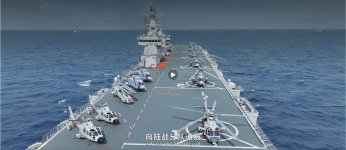
An easter egg at the end hints that the CVN-19 will soon become deployed.

To view this content we will need your consent to set third party cookies.
For more detailed information, see our cookies page.
 
An easter egg at the end hints that the CVN-19 will soon become deployed.
To view this content we will need your consent to set third party cookies.
For more detailed information, see our cookies page.


This one?

To view this content we will need your consent to set third party cookies.
For more detailed information, see our cookies page.
 
This one?

To view this content we will need your consent to set third party cookies.
For more detailed information, see our cookies page.


The thumbnail also shows marching one, two, three, four.

So it is the fourth carrier AKA Type 004/CVN-19.

I think the CVN-19 by 2030, and the CVN-20 by 2035.
 

China teases new aircraft carrier in video, vows to build up islands​

April 23, 20261:10 PM GMT+8

A satellite image of fishing vessels at the entrance to the disputed Scarborough Shoal, in the South China Sea

A satellite image of fishing vessels at the entrance, which is blocked by a floating barrier, to the disputed Scarborough Shoal, in the South China Sea, April 11, 2026. Vantor/Handout via REUTERS Purchase Licensing Rights, opens new tab
  • Summary
  • China marks 77th anniversary of its navy
  • Navy video teases potential new aircraft carrier
  • China urges further build-up of its many islands
BEIJING, April 23 (Reuters) - China teased in a video an aircraft carrier that could be its fourth, and the first using nuclear power, while vowing to further build up its islands, as it looks to boost maritime power, secure resources and ‌bolster territorial claims.

The video issued on the eve of the 77th founding anniversary of the Chinese People's Liberation Army Navy featured fictional officers with names that are homophones of three commissioned aircraft carriers, the Liaoning, Shandong and Fujian.

Titled "Into the Deep", it showed a 19-year-old named "He Jian" joining the group, unleashing public speculation that it was referring to a nuclear-powered aircraft carrier, as the navy recruit's name is a homophone of "nuclear vessel" in Mandarin.

The three aircraft carriers now in service are all conventionally powered, carrying sequential pennant numbers 16, 17, and 18. The new recruit's age, 19, suggests "He Jian" will conform to ⁠the numbering convention.

China's defence ministry did not immediately respond to Reuters requests for comment on Wednesday's video.

Beijing is spending billions of dollars to build a "bluewater navy" allowing it to project power far from its shores, a goal dating from 2012, when President Xi Jinping became leader of the ruling Communist Party.

Action sequences in the video featured military drills and strikes in the Pacific. But it also sent a message to democratically-governed Taiwan, which China claims as its territory, despite Taipei's rejection of the claim.

The video showed an exchange between a naval officer and his son "Xiao Wan", the latter's name an allusion to Taiwan.

"I don't want to go home just yet. I want to play out a little longer," the boy says.
His father responds, "Xiao Wan, don't be difficult. Mum is waiting for you at home. Let's go home."


China Developing Fourth Nuclear Aircraft Carrier to Surpass U.S. Ford-Class Air Power​

24 Apr, 2026 - 10:08

China is advancing the construction of its fourth aircraft carrier, a nuclear-powered supercarrier expected to surpass the U.S. Navy’s Ford-class in size and onboard air power capacity, marking a major escalation in naval capability. This matters because a larger air wing and greater endurance would enable Beijing to sustain longer, more intense air operations across the Indo-Pacific, directly challenging U.S. maritime dominance.

The Chinese aircraft carrier is designed to deliver higher sortie generation, extended operational range, and continuous deployment without refueling limits. If realized, it would push China closer to parity in blue-water carrier warfare and accelerate competition in high-end naval aviation.

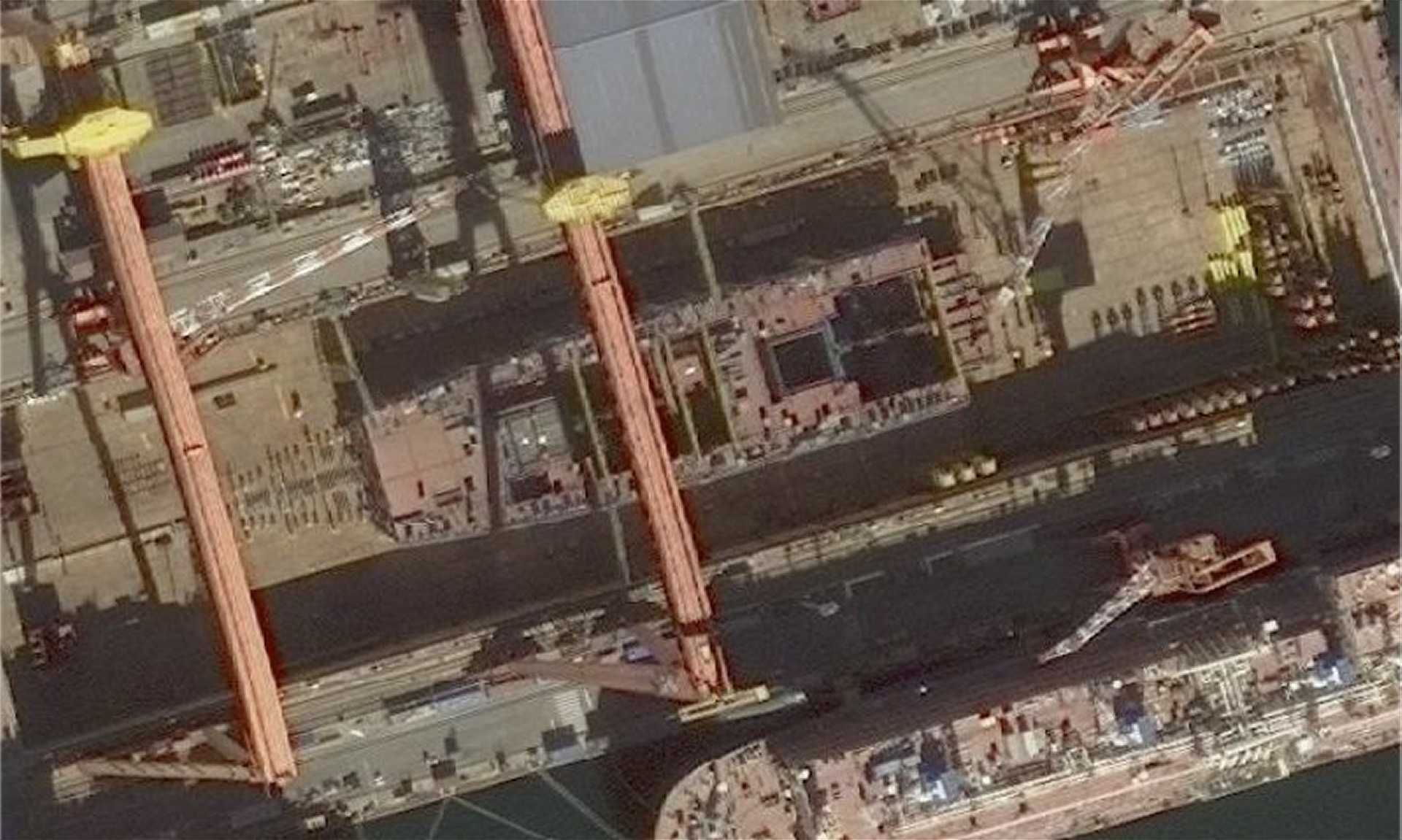
Satellite image published in December 2025 by PLA Military Updates on X shows China’s Type 004 nuclear aircraft carrier under construction at Dalian, with an estimated displacement of 110,000 to 120,000 tons and sea trials projected between mid-2028 and early 2029.

Satellite image published in December 2025 by PLA Military Updates on X shows China’s Type 004 nuclear aircraft carrier under construction at Dalian, with an estimated displacement of 110,000 to 120,000 tons and sea trials projected between mid-2028 and early 2029 (Picture source: PLA Military Update X account)

According to recent open-source information from China on April 24, 2026, the vessel’s hull is complete, and overall progress has reached approximately 25 percent as of early 2026. Expected to enter service around 2030, the platform would mark China’s first nuclear-powered carrier and a decisive shift toward sustained global naval operations.

With an estimated displacement of 120,000 tons, the future Chinese carrier would exceed the U.S. Ford-class, which displaces about 100,000 tons. This increase in size is not only symbolic but operationally significant, as it suggests greater onboard fuel storage, expanded weapons capacity, and the ability to support a larger and more diverse air wing, directly impacting sortie endurance and combat persistence.

The projected Chinese air wing of up to 105 aircraft would also surpass the typical Ford-class deployment of around 75 aircraft. This mix, reportedly including J-35 stealth fighters, J-15T multirole naval aircraft, and KJ-600 AEW&C platforms, indicates a strong emphasis on layered air dominance, long-range strike capability, and enhanced battlespace awareness. In comparison, the Ford-class relies on F-35C stealth fighters, F/A-18E/F Super Hornets, and E-2D Advanced Hawkeye aircraft, forming one of the most integrated and combat-proven carrier air wings currently in service.

Rising U.S.–China rivalry at sea drives Beijing’s push for a nuclear-powered Type 004 supercarrier, designed to deliver global strike, air defense, and surveillance capabilities.

A critical area of convergence is launch technology. The U.S. Ford-class is equipped with the Electromagnetic Aircraft Launch System, enabling higher sortie generation rates and reduced aircraft stress. China is expected to field a similar electromagnetic catapult system on its new carrier, building on experience from the Type 003 Fujian. If fully matured, this would allow China to match U.S. capabilities in launching heavier aircraft with greater efficiency, including AEW platforms essential for long-range detection and command and control.

Nuclear propulsion represents another key parity objective. The Ford-class carriers benefit from virtually unlimited range and sustained high-speed operations, giving the U.S. Navy unmatched global responsiveness. China’s move toward nuclear propulsion would replicate this advantage, eliminating one of the major operational limitations of its current fleet and enabling continuous deployments far from home ports without logistical interruption.

However, despite these projected similarities in size and raw capacity, the U.S. Ford-class retains critical qualitative advantages. These include a more mature ecosystem of carrier strike group integration, advanced combat systems, superior deck automation, and decades of operational experience in high-intensity naval warfare. Systems such as the Dual Band Radar, advanced weapons elevators, and integrated power systems enable the Ford-class to optimize sortie generation and resilience under combat conditions.

China’s approach appears focused on achieving near parity in platform metrics, size, air wing volume, and endurance, while rapidly closing technological gaps in launch systems and aviation integration. This suggests a strategic intent not only to match but to eventually compete with U.S. carrier strike groups in contested environments, particularly in the Indo-Pacific theater.

Over the past decade, China has significantly accelerated the expansion of its carrier fleet and broader naval capabilities. Starting with the refurbished Liaoning, followed by the domestically built Shandong and the more advanced Fujian equipped with electromagnetic catapults, Beijing has demonstrated a rapid learning curve in carrier design, construction, and operations. Parallel investments in escort vessels, such as Type 055 destroyers, advanced submarines, and integrated anti-access and area-denial systems, have reinforced the survivability and combat effectiveness of future carrier strike groups.

This sustained modernization effort directly affects the balance of power in Asia. A nuclear-powered Chinese supercarrier supported by a modern escort fleet would enable a persistent presence in contested areas such as the South China Sea, Taiwan Strait, and beyond into the Western Pacific. For the United States, this represents a growing challenge to freedom of maneuver, as Chinese carrier groups could operate with extended air coverage, layered defenses, and long-range strike capabilities designed to hold U.S. assets at risk.

In operational terms, a 120,000-ton nuclear-powered Chinese carrier with over 100 aircraft would significantly alter the dynamics of force projection. It would allow the PLAN to achieve higher sortie rates over longer durations, extend defensive perimeters through AEW coverage, and sustain strike operations at greater distances, capabilities that define modern carrier warfare.

For the United States, this development reinforces the importance of maintaining superiority not just in platform size, but in networked warfare, pilot training, and multi-domain integration. While China’s future carrier may approach or even exceed the Ford-class in physical scale and theoretical air wing capacity, the decisive factor will remain the effectiveness of combat integration and operational execution in real-world scenarios.

Ultimately, China’s fourth aircraft carrier represents a clear attempt to replicate and challenge the benchmark set by the Ford-class, signaling an intensifying competition in naval aviation where scale, technology, and operational doctrine will determine dominance at sea.

Beyond platform comparisons, the broader trajectory of China’s naval expansion over the last decade underscores a systemic effort to reshape maritime power balances. The People’s Liberation Army Navy has transitioned from a primarily regional force into the world’s largest navy by hull count, supported by rapid shipbuilding cycles, the modernization of naval aviation, and the integration of long-range missile systems, such as anti-ship ballistic missiles, designed to counter carrier strike groups.

For the United States, the emergence of a Chinese nuclear-powered carrier must be assessed within this wider operational ecosystem. The combination of large-deck carriers, dense surface escorts, submarines, and land-based anti-access systems creates a layered threat environment that complicates U.S. force projection in the Indo-Pacific. In a potential high-intensity scenario, U.S. carriers could face increased risk from coordinated air, surface, subsurface, and missile threats operating under an integrated command network.

Strategically, China’s investment in carrier aviation also supports its objective of securing sea lines of communication, protecting overseas interests, and demonstrating presence in distant theaters such as the Indian Ocean and, potentially, the Middle East. This evolution challenges the long-standing U.S. advantage in sustained naval air operations and requires continuous adaptation in U.S. doctrine, distributed maritime operations, and allied interoperability to maintain credible deterrence in the region.

Additional open-source details from Chinese reporting and satellite imagery analysis further suggest that the carrier’s overall length could exceed 340 meters, with a beam approaching 90 meters at its widest point and an expanded waterline width estimated at around 43 meters. Such dimensions would slightly surpass those of the Ford-class, reinforcing the emphasis on deck space optimization and aircraft handling capacity, which are critical for high-tempo flight operations.

Chinese sources also point to the possible use of high-strength HSLA-115 steel, reportedly offering improved structural resilience compared to previous carrier generations. Combined with a refined hull design featuring a U-shaped underwater structure and optimized angles above the waterline, these elements are intended to enhance stability, reduce hydrodynamic resistance, and sustain high-speed operations while carrying heavy air wings.

Further indications of nuclear propulsion include observed structural features consistent with reactor compartment layouts, as well as reports of land-based reactor testing in Sichuan province. Estimates suggest the carrier could be powered by twin pressurized water reactors in the 300 MW class, enabling extended endurance and sustained power generation for advanced onboard systems, including electromagnetic launch technology.

Open-source reports also indicate that the vessel could be equipped with up to four electromagnetic catapults, potentially increasing aircraft launch rates beyond those of current Chinese carriers. Some estimates suggest sortie generation could exceed 150 to 190 launches per day under optimal conditions, although such figures remain unverified and depend heavily on operational maturity and crew proficiency.

The embarked air wing is expected to center on the J-35 stealth fighter, with a reported combat radius of around 1,200 km, supported by J-15T aircraft capable of carrying anti-ship missiles for maritime strike missions. The KJ-600 AEW&C aircraft, with an estimated detection range exceeding 400 km, would provide critical airborne surveillance and command capabilities, enabling coordinated long-range engagements.

While some Chinese assessments claim performance advantages over the Ford-class in areas such as electromagnetic launch efficiency and sortie rates, these assertions remain difficult to verify and should be treated with caution. U.S. carriers benefit from decades of operational testing, real-world deployments, and continuous upgrades, factors that remain decisive in combat effectiveness beyond raw technical specifications.

Nevertheless, if even part of these projected capabilities are realized, China’s fourth aircraft carrier would represent a significant leap in naval aviation power, reinforcing Beijing’s ability to contest U.S. naval dominance and sustain high-intensity operations across the Indo-Pacific and beyond.


Users who are viewing this thread

Latest Posts

Back
Top