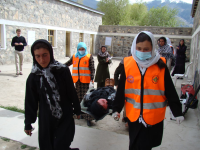
As you know I worked in Afghanistan and traveled parts of the country so I have a good understanding of the dynamics both in Kabul and outside. One thing that really irked me and will stay with me was when I visited Nuristan province. We were on a program funded by USAID to invest in disaster management training for teachers in schools.
At the end of the training one of the teachers a young woman in her mid 20's came to us and said how grateful she was for us coming to teach them these life saving skills and she said,
"I will use this training to teach a hundred more girls like me and they will teach their children and we will find our place beyond the confines of our four walls!"
View attachment 28560
This is what Afghan women wanted, the same freedoms every other woman enjoys, but they are once more denied it by insecure men who live in the dark ages.
Thanks for sharing more about more specifics of your experience. Would be grateful for more light shed on the training programmes and your involvement. Your perspective as a foot-soldier of a programme that's been amply criticised helps to put in perspective your views, as well as some of the benefits of said programme.
Let me tell you, before the collapse of the Afghan Government, in Kabul in Shahr-e Naw there was a small coffee place that was run by an Afghan family. On my trips to the country it was one place I would frequent, the father would tell me how before 2011 he had nothing but his hand cart business and how he built the place by borrowing money from his extended family.
His son Abdullah was in school at the time I met them and he was so proud, he told me how his son would become an engineer and build Afghanistan, he said openly that he had no love for ISAF but one thing he was grateful for was opening Afghanistan to the world, to opportunities they never had before and this time they would change the country for the better...

These are all human stories, the stories people never get to hear because they are far removed from the ground reality of conflict and the human suffering that it naturally involves. To them all they see is what they want to see. Their own fetish if you will, without care or concern for the actual people on the ground.
Your assertion here is sharp but understandable and far more constructive than vitriolic spew of an inherently hateful agenda that, sadly, the other end of the horseshoe from so-called "taliban fanbois" adhere to.
That being said, these human stories can't by themselves be seen as a gauge for how optimal the means were that led to them i.e. without historical context, including colonial subjugation.
For example, the Afghan regime seems to draw a lot of their opposition towards the status quo they inherited from their perception that it is a Western agenda;
Michael Schiffer of USAID states the following:
"As one of the most serious humanitarian crises in the world, USAID’s work in Afghanistan requires a highly adaptive and flexible strategic framework to respond nimbly to Afghanistan’s rapidly changing environment
while aligning with the U.S. government’s broader foreign policy priorities. I and my staff have been working on a plan that brings the donor community together around our priorities.
Since the Taliban takeover in August 2021, the United States has provided approximately $2 billion in humanitarian assistance to support the Afghan people amid the country’s ongoing humanitarian crisis, including more than $1.4 billion from USAID. This humanitarian assistance complements more than $700 million in additional basic needs assistance."
What it seems like at the moment is that the current regime is working to decontaminate what they see as a colonial rot instilled into their society not just in the past 20 years but before that (communist rule). Supposedly, they still claim to recognise a religious duty (defining their ideology) to educate girls. Can their principles not then be evaluated, and their practices then critiqued accordingly?
They have, in total, been in power for less than a decade. With global isolation/opposition and a global media agenda against them. Is that not worthwhile considering?
The discussion should primarily focus on the principles. Any justifications presented for the current Afghan regime's actions regarding womens' education and economic participation can be countered with critique from the same body of source material they claim to base their actions on. The discussion should not be allowed to be hijacked by the barbarity of ethnic nationalists who have no moral standing.