US Economy - News, Updates and Discussion

That would require the US focusing on domestic infrastructure, labor, societal challeges and companies and not a trillion dollar military and endless foreign wars. I am afraid "catching up to China" is a ship that sailed a long time ago.
 
When your printed paper in green can buy any industrial products literally free, you can not force your labour force to work harder and be paid cheaper than Chinese workers who are currently more skilful and in much bigger numbers .
 
04/14/26

Nationwide Survey: Most Farmers Can’t Afford Fertilizer​


An overwhelming majority of America’s farmers who responded to a nationwide survey say they cannot afford to purchase enough fertilizer to get them through the year. The percentage who pre-purchased fertilizer varies significantly by region.

Conducted by the American Farm Bureau Federation April 3-11, the survey shows 70% of respondents say fertilizer is so expensive that they will not be able to buy all the fertilizer they need.
 

What countries do Americans think are gaining and losing influence in today’s world?​

APRIL 28, 2026

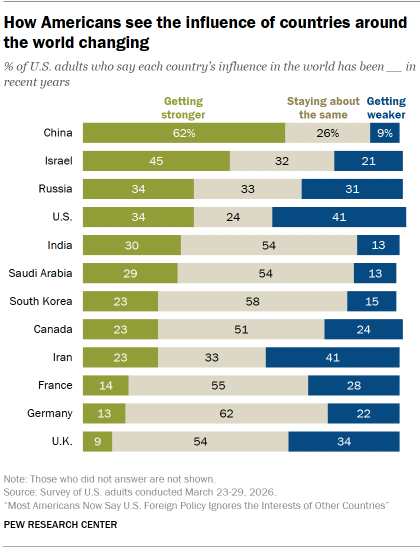
Americans believe the global influence of several nations is shifting, including the influence of the United States itself, according to a March survey of 3,507 U.S. adults.

To better understand how Americans view the global power landscape, we asked if each of 12 countries’ influence in the world has been getting stronger, getting weaker or staying about the same in recent years.
pg_2026.04.28_us-role-world_1_01.png


  • China is the only country that a majority of Americans say is getting stronger, though a 45% plurality also say Israel is getting stronger.
  • On balance, Americans think U.S. influence is getting weaker rather than stronger. Still, the share who think its influence is strengthening has grown in recent years, especially among Republicans. (Read the first section of this report for more on how Americans view their country’s role in the world.)
  • Around four-in-ten (41%) believe Iran’s global influence is waning, up from 28% last year. (The survey was conducted about three weeks after the Iran war began.)
  • While evaluations of Russia are currently split – about one-third each see its influence getting stronger, getting weaker and staying the same – the share of those who say it is weakening has increased since last year.
  • Most see the influence of France, Germany and the United Kingdom staying about the same, but more say these European powers are getting weaker than getting stronger.
  • Majorities also describe the influence of India, Saudi Arabia and South Korea as staying about the same, but more say they are strengthening than weakening.
  • Around half of Americans (51%) say Canada’s influence is staying about the same, while roughly a quarter each think it’s getting stronger and getting weaker.

How have ratings of global influence changed over time?​

The survey highlights significant changes in the way Americans think about the influence of several countries, including those that they most often name as global superpowers: the U.S., China and Russia.

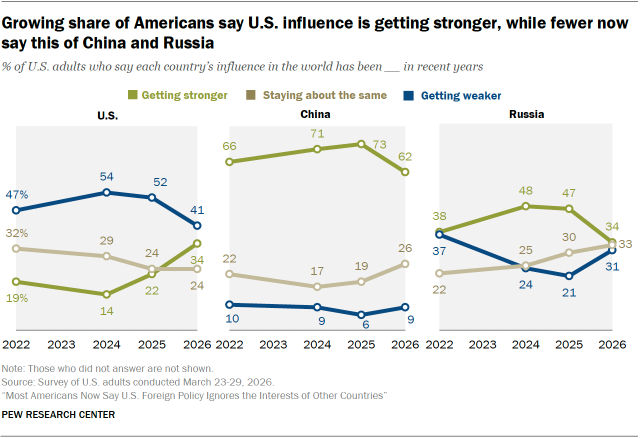
The most common stance on the U.S. is that its influence has been getting weaker, but the share saying this is down 11 percentage points since 2025. At the same time, the share saying U.S. influence is getting stronger has grown. This is the result of shifting views among Republicans, who are now far more likely to say U.S. influence is getting stronger and far less likely to say it is getting weaker than at any point since we first asked the question in 2022.

pg_2026.04.28_us-role-world_1_02.png


When it comes to China, fewer Americans say its influence has been getting stronger than said so last year, though this is still the majority opinion (held by 62%).

Similarly, Americans are now 13 points less likely to say Russia’s influence is growing. This marks a significant change in pattern: Where Americans were more likely to see Russia’s influence getting stronger than anything else in 2025, about one-third each now say its influence is getting stronger, weaker and staying the same.

Read our recent reports on Americans’ overall opinions of China and Russia for more.

There have been additional shifts in opinion since last year:

  • More Americans see Iran getting weaker now than last year (41% vs. 28%) making this the plurality opinion for the first time since we began tracking these views in 2024.
  • A growing share say Israel’s global influence is strengthening: 45%, up 7 points from last year. Simultaneously, Americans’ overall opinion of Israel is getting more negative.
  • The share of those who say the U.K. is getting stronger has dropped 7 points, while the share who see it getting weaker has grown 6 points.
  • Germany’s influence is perceived to be leveling off: Just 13% say it’s getting stronger, down 8 points from last year, while the share who see it staying about the same is up 9 points.

 
Real gross domestic product (GDP) increased at an annual rate of 2.0 percent in the first quarter of 2026 (January, February, and March), according to the advance estimate released today by the U.S. Bureau of Economic Analysis. In the fourth quarter of 2025, real GDP increased 0.5 percent.


US GDP grew 2% in Q1
 
To view this content we will need your consent to set third party cookies.
For more detailed information, see our cookies page.
 
To view this content we will need your consent to set third party cookies.
For more detailed information, see our cookies page.
 
To view this content we will need your consent to set third party cookies.
For more detailed information, see our cookies page.

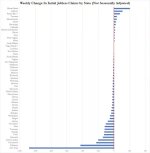
"US initial jobless claims fall to the lowest level since 1969."

Those wondering what was behind the unprecedented drop in claims, the answer appears to be a crash in New York State initial claims.

1777566781865.jpeg

😂

I will wait for the usual revision a month later.
 

GDP Shocker: 75% Of US Growth In The First Quarter Was Due To AI​


And there you have it: between Software (0.7% of the GDP growth) and Nonresidential Equipment (0.88%), AI - which was the primary driver behind growth in both - contributed just over 1.5% to GDP growth of 2.0%; in other words about 75% of all US growth in Q1 was due to AI.

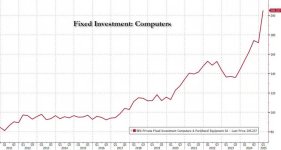
Another way to visualize the remarkable impact of spending on "computers" is the chart below: it clearly shows just how reliant the US has become on spending on computer products.

1777569641638.jpeg

And that's why AI is now not only a market bubble, but it has become a core anchor propping up the entire US economy; it's also why the US government will have no choice but to backstop it once the inevitable AI bubble pops.
 

GDP Shocker: 75% Of US Growth In The First Quarter Was Due To AI​


And there you have it: between Software (0.7% of the GDP growth) and Nonresidential Equipment (0.88%), AI - which was the primary driver behind growth in both - contributed just over 1.5% to GDP growth of 2.0%; in other words about 75% of all US growth in Q1 was due to AI.

Another way to visualize the remarkable impact of spending on "computers" is the chart below: it clearly shows just how reliant the US has become on spending on computer products.

View attachment 194997

And that's why AI is now not only a market bubble, but it has become a core anchor propping up the entire US economy; it's also why the US government will have no choice but to backstop it once the inevitable AI bubble pops.

AI is in the same type of bubble phase that internet shopping was in, for the original "dot com boom" that went bust. The Ai bubble will pop in terms of valuations of companies, while the technology itself will remain.

Hard times ahead on this front, esp. if the bubble pops alongside the upcoming depression that is coming online "nicely" due to the Iran/Israel/USA war.
 

Users who are viewing this thread

Pakistan Defence Latest

Latest Posts

Back
Top