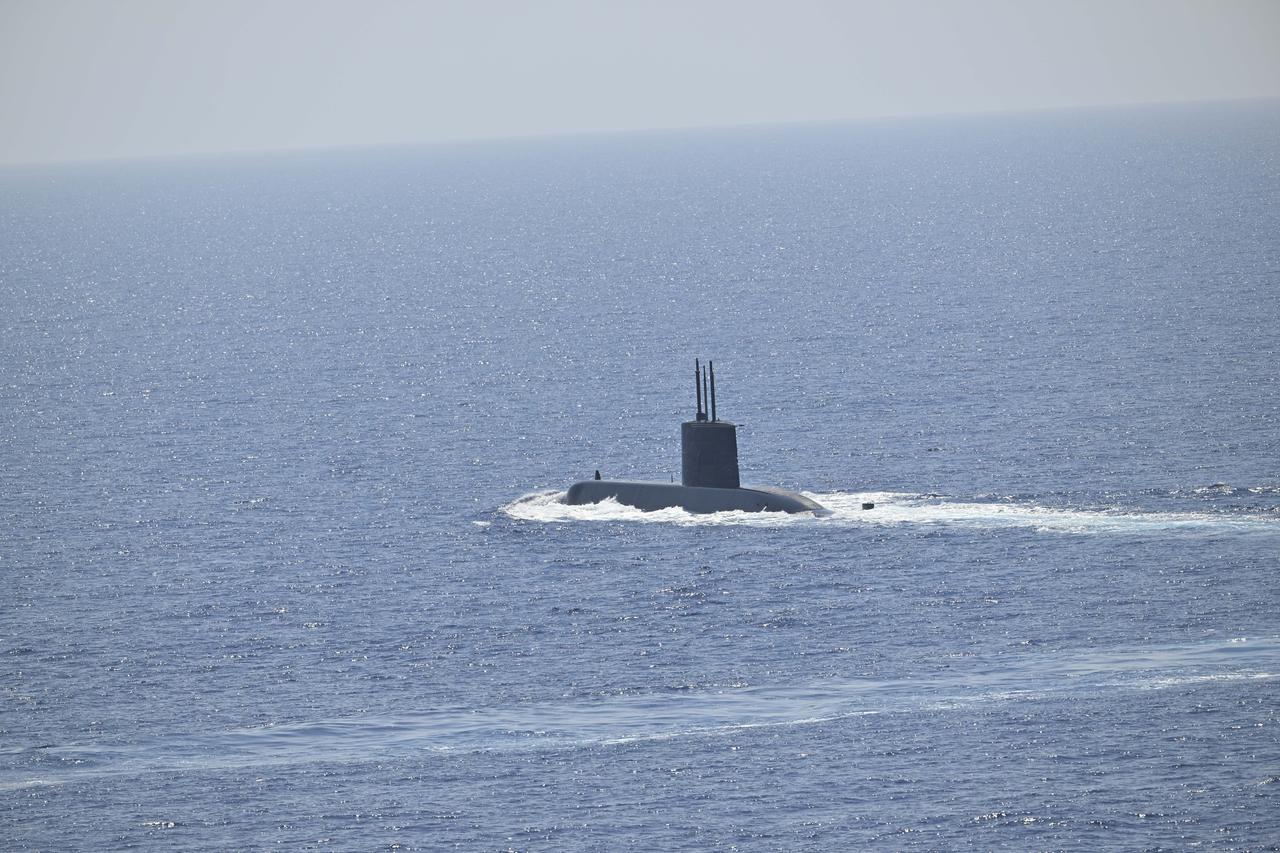
Hangor Class Submarine | Updates & Discussion

The statement "we will eat grass, even go hungry, but we will have our own" by ZA Bhutto was specifically for nukes.
IMHO the Pak Deep State has taken it beyond this initial understanding....
 
IMHO the Pak Deep State has taken it beyond this initial understanding....

That's a different argument. Of course, Pakistan was going to pursue new types of conventional weapons, including missiles, over time. However, ZA Bhutto's statement you cited was specifically in the context of nuclear weapons. By "eat grass," Bhutto meant Pakistan would be willing to suffer sanctions, but it would develop nukes, because India was.
 
It’s very reasonable if that’s more than enough. I just worried that Indian navy is a bit bigger than our navy. I know Indian Navy is not only focus on Pakistan coast but also China and Bangladesh coasts.
Its something we will have to accept and live with. India population, economy, armed forces are bigger than Pakistan, they will always have bigger army, airforce and Navy, what Pakistan needs is minimum deterrence. Its like Russia v Usa, Russia has everything in small quantity but they work hard towards keeping a minimum deterrence to keep Usa away. The same way Pakistan 11 subs Plus 4 more if we replace Agosta 70s will be enough till 2050s, India as expected will have or is able to have double the quantity.

One correction from my part, Chinese Type 41 or Turkish Nukden are not ballistic missile but cruise missile subs.
Ballistic missile submarines are expensive and have huge tonnage, not sure when will Pakistan buy or produce them, but atleast 3 to keep minimum deterrence against India are needed.
 
Last edited:
To view this content we will need your consent to set third party cookies.
For more detailed information, see our cookies page.


Turn volume high and listen carefully to see if you can detect submarine (radar)
 
You're correct. 2005 was the year where everyone was surprised by Pakistan acquiring cruise missile technology. It took the US intelligence by surprise. From that point onwards, Pakistan never looked back.

Some great developments, especially in the last decade.

1998: Ghauri tested.
1998: Nuclear weapons tested.
1999: Shaheen tested.
2005: Babur cruise missiles tested.
2005: C-130 transport aircraft acquired
2006: Zulfiqar frigates ordered.
2007: JF-17 Thunder inducted.
2008: ZDK-03 AWACS ordered.
2009: Saab 2000 (AEW&C) acquired.
2009: Ilyushin Il-78 Midas air refueler acquired.
2009: F-16s ordered
2011: Nasr tested.
2015: AH-1Z helicopters order (sanctioned)
2015: Hangoor submarines ordered
2017: Submarine launched Babur cruise missile tested.
2017: Ababeel MIRV tested.
2017: Yarmook corvettes ordered.
2018: Tughril frigates ordered.
2018: Milgem corvettes ordered.
2018: T129 ATAK ordered (sanctioned)
2018::VT4 tanks ordered.
2019: SH-15 155mm howitzers ordered.
2021: J-10Cs acquired.
2024: J-35s ordered.


There are tons of more but it's Saturday.
I tried to get AI to compile a more comprehensive and detailed list with confirmed systems, rumoured ones, and probable future developments.
 

Attachments

YJ-18,YJ=鹰击(YING JI)Means the attack of the eagle
I am delighted to see your interest in Chinese culture.

The term "Yingji" (鹰击) carries multiple meanings within the Chinese context. Naturally, your interpretation constitutes one of these meanings. Its other meanings include:

1. The name of an official post in ancient China. Originating during the Han Dynasty, this official position—known as "Yingji"—conveyed the concept of governance through stern and fierce means, much like a falcon spreading its wings to seize its prey.

2. A reference to the poem *沁园春·长沙(Qinyuanchun: Changsha)*, written by Mao Zedong in 1925. A specific passage within this work reads: "鹰击长空,鱼翔浅底,万类霜天竞自由." This imagery depicts majestic eagles soaring vigorously across the boundless expanse, symbolizing a spirit of struggle, freedom, and unyielding forward momentum.
The name of China's "Yingji" series of anti-ship missiles is derived precisely from this poetic line; by drawing upon its connotations of swiftness and precision, it imbues this weaponry with profound cultural symbolism.
 

Underwater Power Shift: Pakistan’s PNS Hangor Enters Service as India’s Project 75-I Delays Deepen Strategic Imbalance​

The induction of PNS Hangor underscores Pakistan’s accelerating submarine capability as India struggles to finalise its next-generation fleet, raising concerns over regional maritime balance.

On May 2, 2026

(DEFENCE SECURITY ASIA) — The commissioning of PNS Hangor signals an immediate recalibration of underwater force posture in the Arabian Sea, as Pakistan transitions from procurement to operational deployment while India’s long-delayed Project 75-I submarines remain trapped in final-stage negotiations despite a projected cost of US$8–10 billion (RM30.4–RM38 billion).

Pakistan President Asif Ali Zardari, attending the commissioning in Sanya, underscored the strategic urgency by declaring the platform a “critical enhancement of maritime deterrence,” a statement reflecting Islamabad’s accelerated shift toward sea-denial dominance amid evolving Indo-Pacific naval competition.

The widening asymmetry between Pakistan Navy induction timelines and Indian Navy acquisition delays introduces immediate operational consequences, particularly as AIP-equipped submarines redefine survivability metrics, underwater endurance, and strike reach in contested maritime corridors linked to regional energy security.

Hangor-Class-Submarine-Type-039B.jpg

Hangor-class submarine

The induction timeline achieved by Pakistan compresses the traditional submarine capability development cycle, enabling near-term operational availability that directly alters deterrence signalling dynamics across the Arabian Sea and adjacent Indian Ocean chokepoints critical to global energy flows.

By contrast, India’s extended negotiation phase introduces a temporal vulnerability window in which conventional submarine fleet regeneration lags behind strategic requirements, potentially constraining sustained underwater presence during crisis escalation scenarios involving simultaneous maritime theatres.

The integration of air-independent propulsion systems within the Hangor-class enhances submerged persistence, allowing Pakistan Navy platforms to operate undetected for extended periods, thereby complicating adversary anti-submarine warfare planning and increasing uncertainty in maritime domain awareness.

India’s insistence on indigenous construction under Project 75-I reflects a long-term strategic calculus prioritising industrial sovereignty, yet this approach inherently extends acquisition timelines and delays immediate operational reinforcement of its conventional submarine fleet.

The cost differential between Pakistan’s US$4–5 billion (RM15.2–RM19 billion) programme for eight submarines and India’s US$8–10 billion (RM30.4–RM38 billion) allocation for six units underscores divergent procurement philosophies centred on speed and affordability versus technological depth and autonomy.

This emerging disparity in force availability is likely to influence regional naval doctrines, particularly in shaping patrol patterns, deterrence postures, and escalation thresholds in the Arabian Sea where both navies maintain critical operational interests.

As subsequent Hangor-class units enter service through 2026–2028, the cumulative effect of phased induction will further expand Pakistan’s underwater operational envelope, intensifying strategic pressure on India to accelerate contract finalisation and construction timelines under Project 75-I.

Pakistan’s Hangor-class programme demonstrates a compressed acquisition-to-deployment cycle, achieving operational commissioning within approximately 11 years from contract signature in 2015, leveraging a hybrid construction model combining Chinese shipyard output with domestic assembly at Karachi Shipyard.

The dual-track production strategy—four submarines constructed in China and four assembled locally—enabled parallel industrial throughput, effectively bypassing bottlenecks typically associated with single-location indigenous manufacturing frameworks.

The April 2026 commissioning of PNS Hangor marks the first operational milestone in an eight-boat fleet that is expected to reach full induction between 2028 and 2030, thereby ensuring sustained force regeneration and layered deployment capability.

Subsequent units launched throughout 2025 indicate a production tempo that aligns with phased operational integration, allowing incremental expansion of Pakistan Navy’s underwater presence without waiting for full fleet completion.

This staggered delivery model provides Pakistan with immediate capability increments, enabling operational deployment even as additional units remain under construction, thereby compressing the time gap between procurement and strategic effect.
 
I am delighted to see your interest in Chinese culture.

The term "Yingji" (鹰击) carries multiple meanings within the Chinese context. Naturally, your interpretation constitutes one of these meanings. Its other meanings include:

1. The name of an official post in ancient China. Originating during the Han Dynasty, this official position—known as "Yingji"—conveyed the concept of governance through stern and fierce means, much like a falcon spreading its wings to seize its prey.

2. A reference to the poem *沁园春·长沙(Qinyuanchun: Changsha)*, written by Mao Zedong in 1925. A specific passage within this work reads: "鹰击长空,鱼翔浅底,万类霜天竞自由." This imagery depicts majestic eagles soaring vigorously across the boundless expanse, symbolizing a spirit of struggle, freedom, and unyielding forward momentum.
The name of China's "Yingji" series of anti-ship missiles is derived precisely from this poetic line; by drawing upon its connotations of swiftness and precision, it imbues this weaponry with profound cultural symbolism.

Thank you for your wonderful explanation my dear friend. I am striving to learn Mandarin next!
 
Thank you for your wonderful explanation my dear friend. I am striving to learn Mandarin next!
Excellent!
If you encounter any difficulties while studying, or perhaps would like to learn more interesting information, feel free to call upon me.
 
man the Hangor Class will definitely add some VERY serious firepower to Pakistan

can you image 8 of these units ? Indian Ocean will be a dangerous place

I am sure these submarines work with Chinese undersea sensors and military satellites

a fully integrated battle unit

after the 8 units are done Pakistan should start with Chinese Nuclear Hunter Killers with VLS

China is moving away from diesel electric and wants 50% nuclear by 2035

with submarines like Type 093B + Type 095 we can see where this is going
 
Excellent!
If you encounter any difficulties while studying, or perhaps would like to learn more interesting information, feel free to call upon me.

Thank you for your generous offer. Although I am worried the western providers are not ss good enough substitute compared to a Chinese teacher. I will do the basics then go learn in person or online from mainland speakers.
 
Nice to see the first new Submarines arriving in Pakistan Navy , I was thinking all 4 will arrive at same time, but 1 at time I suppose is acceptable as well
 

Users who are viewing this thread

Country Watch Latest

Back
Top