Navigation
Install the app
How to install the app on iOS
Follow along with the video below to see how to install our site as a web app on your home screen.
Note: This feature may not be available in some browsers.
More options
Style variation
You are using an out of date browser. It may not display this or other websites correctly.
You should upgrade or use an alternative browser.
You should upgrade or use an alternative browser.
US Defence related thread
- Thread starter Hendarto
- Start date
More options
Who Replied?




F-22Raptor
Elite Member

Congrats to the Ford carrier group! Amazing deployment for all those sailors!

SolarWarden
Trusted Member
Two airshow Growlers tried mating in front of crowd
Thank God all crew are safe.
Oh to be a fly on the wall the ass chewing they will get.
Thank God all crew are safe.
Oh to be a fly on the wall the ass chewing they will get.
SolarWarden
Trusted Member
Imagine the awkward conversation they had floating down.

AZ_HighCountry
INT'L MOD
Two airshow Growlers tried mating in front of crowd
Thank God all crew are safe.
Oh to be a fly on the wall the ass chewing they will get.
What a waste of two critical aircraft. There's only about 150 in service.
SolarWarden
Trusted Member
These two were demo Hornets which don't deploy with carrier anymore but still keep their squadron name. No radar pretty much hollowed out to make them light and maneuverable just like demo F-15, F-16, F-22, etc etc...What a waste of two critical aircraft. There's only about 150 in service.
F-22Raptor
Elite Member
F-22Raptor
Elite Member
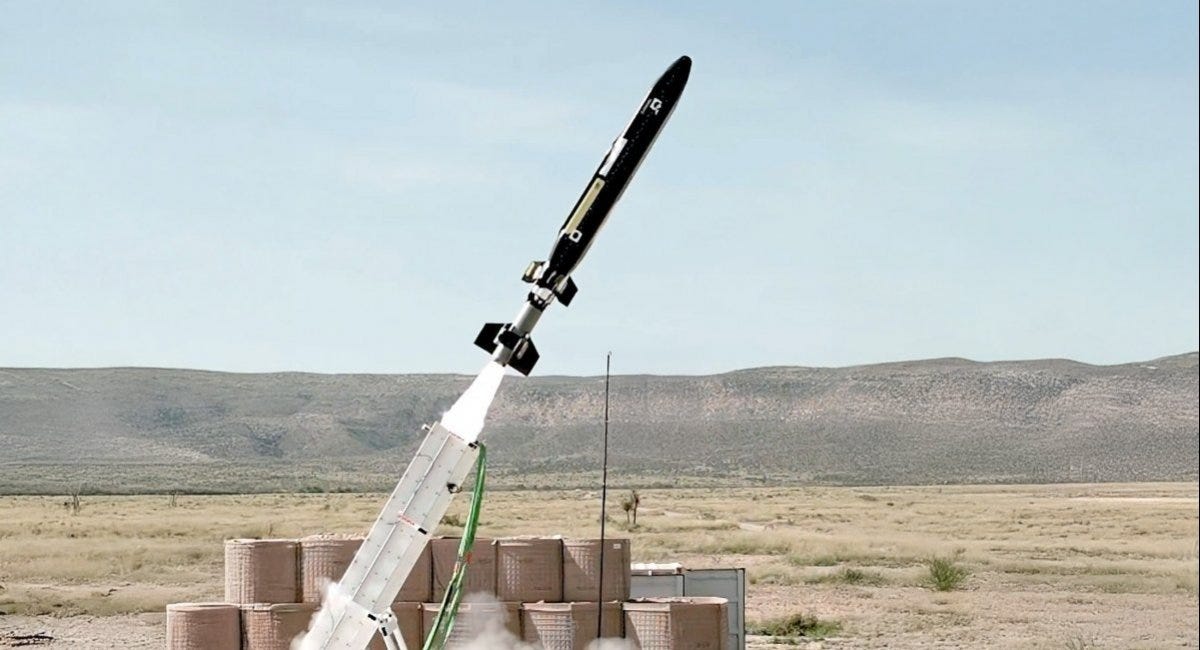
Picture: Anduril / Screenshot from video
On 13 May, the U.S. Department of Defense announced the signing of framework agreements with five American missile manufacturers for the potential production and delivery of over 10,000 low-cost cruise missiles and 12,000 aeroballistic missile systems capable of maneuvering at hypersonic speeds.
The programs established through these agreements are the latest step in the United States' accelerating effort to build missile production capacity across the full spectrum of long-range strike systems. This post examines the individual capabilities covered by the agreements and situates them within the broader U.S. missile industrial ramp-up.
Low-cost containerized missile program
Four American companies have been selected to potentially deliver over 10,000 mini cruise missiles between 2027 and 2029 under the Low-Cost Containerized Missile program. These are Anduril’s SLB-500M, CoAspire’s GHOST, and as yet unconfirmed systems from Leidos and Zone 5 Technologies. Production contracts will be awarded following an evaluation and assessment phase scheduled to begin in June 2026.
Anduril’s SLB-500M has a range exceeding 930 kilometers and carries a relatively light 45-kilogram payload. The air-launched version, the Barracuda-500M, has recently been designated AGM-189A. The designation of the ground-launched variant included in the program is not yet known.
GHOST is the ground-launched variant of CoAspire’s RAACM-ER, itself an extended-range variant of the RAACM, which emerged from the U.S. Air Force’s ERAM program, conceived to meet the urgent need for a low-cost standoff weapon for allied air forces. According to the manufacturer, the air-launched RAACM-ER has a range exceeding 1,800 kilometers. Whether GHOST retains that range in ground-launched configuration is unclear, though a range well above 1,000 kilometers appears plausible. Payload capacity has not been disclosed, but is likely comparable to that of the SLB-500M.
Less is known about Zone 5 Technologies’ offering, though it is very likely based on the Rusty Dagger, an air-launched mini cruise missile that recently received the designation AGM-188A. Like the RAACM, it was initially offered under the ERAM program. It is unclear whether Zone 5 will adapt the missile for ground-launch or continue to focus on air-launch capability — for example, by offering a palletized container launcher compatible with transport aircraft such as the C-130 and C-17. The Rusty Dagger’s range is known to exceed 450 kilometers, potentially by a significant margin. Payload capacity is unknown but likely comparable to the SLB-500M and GHOST.
The Leidos system is the least documented of the four. It is a ground-launched system with no confirmed designation, and Leidos has not publicly released range and payload specifications. The system will leverage technologies from the company’s AGM-190A Black Arrow, an air-launched mini cruise missile weighing only 91 kilograms with a demonstrated range of at least 740 kilometers. The variantincluded in the LCCM program will be twice the size of the Black Arrow, meaning it could plausibly retain or even exceed that range in ground-launch configuration. Payload capacity will likely remain limited and below that of the other three systems.
None of the four missiles relies on a particularly sophisticated guidance suite. All use GPS/INS as their primary midcourse guidance mode. The Rusty Dagger and SLB-500M are confirmed to feature some form of image-based visual navigation to supplement GPS/INS in denied environments, though similar capability appears plausible for the other two systems, which would also provide a terminal guidance function and improve accuracy.
Low-cost hypersonic missile program
The May 2026 framework agreement also covers the procurement of the Blackbeard missile from Castelion, a defense startup founded in 2022 (not to be confused with the above-mentioned Black Arrow from Leidos). The Blackbeard is an aeroballistic missile designed to operate at speeds exceeding Mach 5 while retaining atmospheric maneuverability. According to the manufacturer, it is intended for engagement of time-sensitive and hardened targets.
Castelion has been working on both a ground-launched variant, the Blackbeard-GL, and an air-launched variant. The U.S. Navy has separately selected the air-launched variant under its MACE program, awarding Castelion a $105 million contract to integrate it with the F/A-18E/F, with early operational capability targeted for 2027. It remains unclear whether the May 2026 framework agreement covers the air-launched or ground-launched variant, or whether it is related to the MACE program or entirely independent of it (shoutout to Colby Badhwarfor clarifying this).
Specific range and payload figures remain undisclosed. The U.S. Army describes the Blackbeard-GL as delivering 80 percent of the capability of the Precision Strike Missile Increment 4, which could imply a range of around 800 kilometers (if referring to PrSM Inc. 4’s ~1,000 km range, though it could similarly refer to payload capacity or other specifications). The MACE program included a payload requirement of at least 75 pounds (34 kilograms), indicating a relatively small warhead. The hard-target kill capability specified by the manufacturer may therefore be achieved by maintaining a very high terminal velocity.
The U.S. Navy has indicated a target unit cost of approximately $300,000 for the air-launched variant, with joint Army and Navy procurement expected to generate economies of scale. The framework agreement establishes a guaranteed minimum of 500 missiles per year for two years once testing and validation are complete, with a pathway to procure over 12,000 missiles across five years, subject to funding allocation.
U.S. missile production ramp-up: context and scale
The May 2026 framework agreements represent the latest step in an ongoing, accelerating effort to expand U.S. missile production capacity across the full spectrum of long-range strike systems. Operational experience in Ukraine and Iran has demonstrated that modern high-intensity conflict consumes precision munitions at rates that existing Western industrial capacity cannot sustain — a lesson the United States has moved aggressively to address in preparation for a potential confrontation with China.
At the high end, scheduled JASSM-ER production for 2026 stands at approximately 396 units, though the production line can reportedly surge to around 860 if fully dedicated to the JASSM-ER. Production is being scaled toward 1,100 units per year, constrained primarily by turbofan engine supply and shared infrastructure with the LRASM anti-ship cruise missile. Raytheon is targeting an increase in Tomahawk production to over 1,000 units annually under framework agreements signed in February 2026. The Precision-Strike Missile (PrSM) Increment 1 is ramping from a baseline of 152 units per year (the number planned to buy in 2026) toward its established full-rate production target of 400 annually, with a new seven-year framework contract paving the way to quadruple those numbers.
At the lower end of the spectrum, Operation Epic Fury saw the first operational deployment of LUCAS, a low-cost one-way attack drone similar to the Iranian Shahed-136 or Russian Geran-2. Near-term output is likely to scale to the hundreds per year, with thousands feasible subject to funding.
The low-cost cruise missile and Blackbeard programs fill the middle of this spectrum — above expendable drones in range, payload, and speed, but well below the unit cost of JASSM-ER or Tomahawk — completing a layered strike architecture designed to generate volume, overwhelm enemy air defenses, and sustain high-tempo operations without exhausting missile inventories.
Conclusion
On 28 December 2025, in my final post of that year, I concluded that “several European states are likely to pursue a mini cruise missile capability in 2026.” This assumption rested on the unmistakable utility of affordable cruise missile systems and unused industrial production capacity in this sector. It is the United States, not Europe, that has pulled the trigger first, establishing large-scale procurement frameworks for mini cruise missiles alongside low-cost aeroballistic missiles.
It is also worth emphasizing that the current U.S. ramp-up is being implemented in a peacetime setting. In wartime, U.S. industry could feasibly produce thousands of high- and low-end missiles per month, potentially alongside tens of thousands of long-range drones. Reliable figures on Chinese missile production are notoriously difficult to obtain. Still, if fully implemented, the current effort should, at a minimum, put the United States on a competitive footing with China in the long-range strike domain.
F-22Raptor
Elite Member
The low cost containerized missile program is just for ground launched variants.
In total, the US military is procuring around 50,000 total strike missiles in the high/low mix over the next 5 years.
In total, the US military is procuring around 50,000 total strike missiles in the high/low mix over the next 5 years.
AZ_HighCountry
INT'L MOD
This can be discussed in the US Defense related thread.
Merged with US Defense Related.
Merged with US Defense Related.


More than 40 US aircraft lost during Iran air campaign combat: report
The tally includes 24 MQ-9A Reaper drones, seven KC-135 tankers and four MH-6 Little Bird Helicopters.
That's a lot of Aircraft down considering they are USA only
Nothing about Israeli losses

KAL-EL
VIP Member
I mean the USA lost some planes in war. In real world terms it barely makes a dent in the USA arsenal
LOL at some people actually thinking USA was losing the war because of some planes.
USA just didn't achieve any strategic objectives
LOL at some people actually thinking USA was losing the war because of some planes.
USA just didn't achieve any strategic objectives

Watandar
Elite Member
Iran won this war due to the US and Israel failing to achieve any of their stated objectives. The loss of expensive hardware and hard-won image is cherry on top.Now in some people's narritive they will say USA lost the war because they lost planes
Who won this campaign
USA Israel due to huge infrastructure damage
Or
Iran because of USA aircraft losses
Users who are viewing this thread
Total: 1 (members: 0, guests: 1)
Pakistan Defence Latest
-
PAF pilot highlights how chinese J10C fighters have left US F16's Obsolete (13 Viewers)
- Latest: TsAr
-
-

-

-
Country Watch Latest
-

-
-

-
TF-X / KAAN / Hürjet Turkish Fighter & Trainer Aircrafts News & Discussions (3 Viewers)
- Latest: hyperman
Latest Posts
-

-
 Makkah Defence Alliance: Turkey, Saudi Arabia, and Pakistan, news & updates (10 Viewers)
- Latest: Falcon29
-
-