Lebanon-Israel War | 2023-present

To view this content we will need your consent to set third party cookies.
For more detailed information, see our cookies page.
 
To view this content we will need your consent to set third party cookies.
For more detailed information, see our cookies page.
 
Israeli Channel 13: Netanyahu discusses expanding operations in Lebanon and returning to target Beirut #AlArabiya_Breaking

To view this content we will need your consent to set third party cookies.
For more detailed information, see our cookies page.
 
To view this content we will need your consent to set third party cookies.
For more detailed information, see our cookies page.
 
Urgent | Al Jazeera correspondent on the ground: Israeli armored vehicle targeted and hit in Al-Hamra farm in the Nabatieh district, southern #Lebanon

To view this content we will need your consent to set third party cookies.
For more detailed information, see our cookies page.
 
To accurately read the battlefield, a clear distinction must be made between the war that took place in 2024, which lasted 66 days, and the current conflict.

In 2024, Hezbollah adopted a positional, martyrdom-based defensive posture. The fighters stood firm inside every single border village, refusing to retreat. The priority was absolute territorial preservation, and as a result of this static, unyielding defense, not a single border village fell into Israeli hands.

Today, Hezbollah is operating on a completely different playbook. Instead of a rigid defense, the resistance is deliberately utilizing an elastic strategy designed to provoke the Israeli army into leaving its fortified positions. By drawing the Israeli military deeper, Hezbollah is forcing them to stretch their lines. This tactical stretching (to stretch the army) creates longer, highly vulnerable supply lines across difficult terrain, rendering Israeli troops and logistics prime targets for ambush and high-intensity resistance fire. For the Israeli military, territorial depth is traditionally a metric of victory, but in this environment, depth is a trap.

The true indicator of who holds the upper hand is not where the Israeli army stands, but rather what happens to the volume of resistance operations as they advance. If Hezbollah’s capabilities were being destroyed, the number of operations would decrease with every Israeli mile gained. Instead, the reality on the ground shows the exact opposite: the deeper the Israeli army penetrates, the more the resistance intensifies. Every forward movement extracts a heavier price in Israeli lives and armor, transforming the battlefield from a war of geography into a brutal war of attrition, a contest of sheer wills to see who has the endurance to sustain the fight.

Currently, the Israeli army is attempting to push through three primary axes, yet it has failed to establish permanent, stabilized positions anywhere.

Beyond the frontlines, Israel's logistical backbone is under daily fire, as newly established assembly points and supply lines along the border are targeted systematically. A defining feature of this war is Hezbollah’s aggressive deployment of First-Person View (FPV) loitering munitions, or suicide drones. To this day, the Israeli military has failed to find a technological or tactical countermeasure for these highly maneuverable, low-altitude drones, which bypass heavy defenses and inflict daily fatal casualties among Israeli troops.

The contrast between the two wars reveals a stark reality: in 2024, Hezbollah chose to fight to the death to keep the border intact, but in this war, Israel is playing entirely inside Hezbollah's backyard, being drawn into a terrain prepared specifically for their attrition.

This dynamic proves one fundamental truth: no matter how long this war drags on, Israel will not be able to stabilize or secure permanent positions in South Lebanon, and their soldiers will continue to be targeted even if the conflict lasts for another decade.

Ultimately, Hezbollah has effectively boxed Israel into a strategic dead-end with only two choices: continue a futile, absurd war that will endlessly drain Israeli lives, military hardware, and financial resources, or accept reality and withdraw completely from South Lebanon.
 
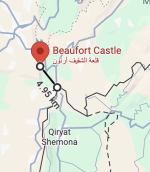
Screenshot 2026-05-31 at 18.24.42.png

Israel has temporarily occupied the Beaufort Castle which is less than 5km from the border

they occupied it before during 1982-2000, and we know how that ended
 
Hezbollah: We targeted an Israeli force positioned in a house in the vicinity of the historic Shaqif Castle in southern Lebanon with an Ababil attack drone and achieved a confirmed hit.

To view this content we will need your consent to set third party cookies.
For more detailed information, see our cookies page.
 
To accurately read the battlefield, a clear distinction must be made between the war that took place in 2024, which lasted 66 days, and the current conflict.

In 2024, Hezbollah adopted a positional, martyrdom-based defensive posture. The fighters stood firm inside every single border village, refusing to retreat. The priority was absolute territorial preservation, and as a result of this static, unyielding defense, not a single border village fell into Israeli hands.

Today, Hezbollah is operating on a completely different playbook. Instead of a rigid defense, the resistance is deliberately utilizing an elastic strategy designed to provoke the Israeli army into leaving its fortified positions. By drawing the Israeli military deeper, Hezbollah is forcing them to stretch their lines. This tactical stretching (to stretch the army) creates longer, highly vulnerable supply lines across difficult terrain, rendering Israeli troops and logistics prime targets for ambush and high-intensity resistance fire. For the Israeli military, territorial depth is traditionally a metric of victory, but in this environment, depth is a trap.

The true indicator of who holds the upper hand is not where the Israeli army stands, but rather what happens to the volume of resistance operations as they advance. If Hezbollah’s capabilities were being destroyed, the number of operations would decrease with every Israeli mile gained. Instead, the reality on the ground shows the exact opposite: the deeper the Israeli army penetrates, the more the resistance intensifies. Every forward movement extracts a heavier price in Israeli lives and armor, transforming the battlefield from a war of geography into a brutal war of attrition, a contest of sheer wills to see who has the endurance to sustain the fight.

Currently, the Israeli army is attempting to push through three primary axes, yet it has failed to establish permanent, stabilized positions anywhere.

Beyond the frontlines, Israel's logistical backbone is under daily fire, as newly established assembly points and supply lines along the border are targeted systematically. A defining feature of this war is Hezbollah’s aggressive deployment of First-Person View (FPV) loitering munitions, or suicide drones. To this day, the Israeli military has failed to find a technological or tactical countermeasure for these highly maneuverable, low-altitude drones, which bypass heavy defenses and inflict daily fatal casualties among Israeli troops.

The contrast between the two wars reveals a stark reality: in 2024, Hezbollah chose to fight to the death to keep the border intact, but in this war, Israel is playing entirely inside Hezbollah's backyard, being drawn into a terrain prepared specifically for their attrition.

This dynamic proves one fundamental truth: no matter how long this war drags on, Israel will not be able to stabilize or secure permanent positions in South Lebanon, and their soldiers will continue to be targeted even if the conflict lasts for another decade.

Ultimately, Hezbollah has effectively boxed Israel into a strategic dead-end with only two choices: continue a futile, absurd war that will endlessly drain Israeli lives, military hardware, and financial resources, or accept reality and withdraw completely from South Lebanon.
Good analysis. Though they definitely did seize some villages but more importantly they razed many villages to the ground before this latest Israeli escalation on the ground so it's quite different than 2006 if people are expecting immediate intense small arms exchanges. Much of southern Lebanon was already battered before the war with Iran broke out.

Despite that Hezbollah ground forces appear pro-active in an structured manner which is a testament to their ability to handle attrition.

I agree if Israel expanded scale or ground offensive it will be a mistake for them. They had no choice (from military standpoint) while they were trying to station in southern Lebanon and got targeted by Hezbollah FPV drones.

I foresee Hezbollah emerging with a strategic victory in any case of return to pre-2023 status quo.
 
Hezbollah: We targeted a radar for jamming drones belonging to the Israeli enemy army in the vicinity of the historic Shaqif Castle in southern Lebanon with an Ababil attack drone and achieved a confirmed hit.

To view this content we will need your consent to set third party cookies.
For more detailed information, see our cookies page.
 
Hezbollah: We targeted a radar for jamming drones belonging to the Israeli enemy army in the vicinity of the historic Shaqif Castle in southern Lebanon with an Ababil attack drone and achieved a confirmed hit.

To view this content we will need your consent to set third party cookies.
For more detailed information, see our cookies page.

To view this content we will need your consent to set third party cookies.
For more detailed information, see our cookies page.


the bastards admit Hezbollah was not using the castle in any way yet they brag about occupying it like it is a military achievement
 
To view this content we will need your consent to set third party cookies.
For more detailed information, see our cookies page.


the bastards admit Hezbollah was not using the castle in any way yet they brag about occupying it like it is a military achievement


They like to occupy civilian sites where there is no resistance and call it a glorious victory.... gutless ball less bastards...
 
They like to occupy civilian sites where there is no resistance and call it a glorious victory.... gutless ball less bastards...
they just raised the flag then left

if any IDF terrorist shows its face near that castle they will probably be targeted quickly
 
To view this content we will need your consent to set third party cookies.
For more detailed information, see our cookies page.


another iron dome launcher hit by Hezbollah

and Hezbollah also fired a drone at Haifa today
 

Users who are viewing this thread

Back
Top