Reforestation, Xinjiang fighting back the desert and replace it with forest

China Planted So Many Trees Around the Taklamakan Desert It Turned It Into a Carbon Sink

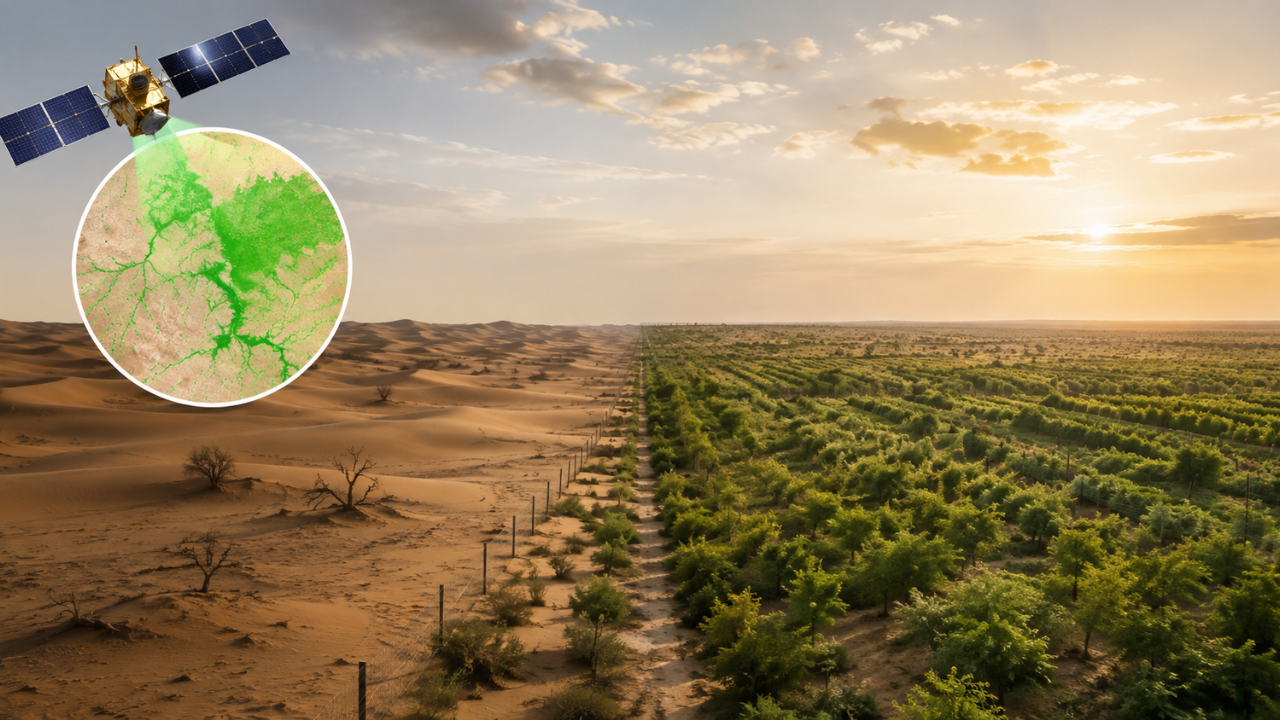
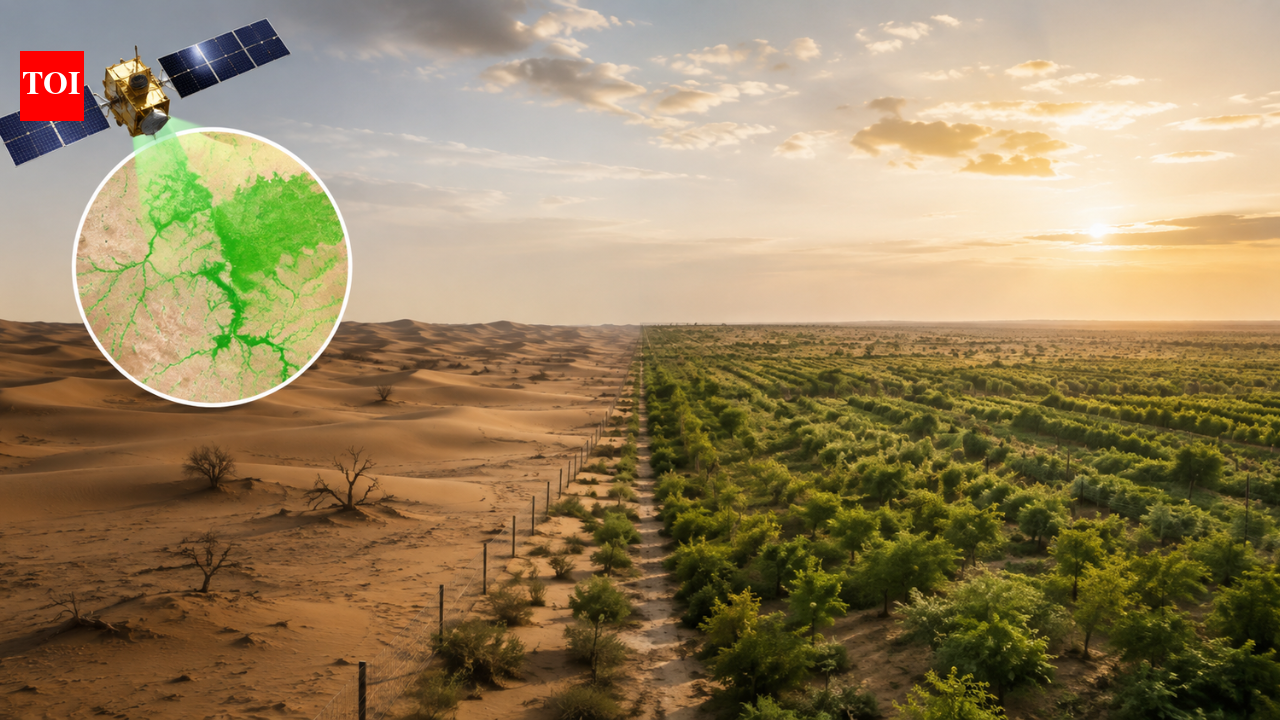
Researchers led by Salma Noor used a technique called Solar-Induced Fluorescence (SIF). When plants photosynthesize, they emit a faint near-infrared glow. Our eyes can’t see it, but NASA’s Orbiting Carbon Observatory (OCO) can. The more the Taklamakan glows, the more photosynthesis happens and the more carbon it is eating.
The fact that it’s drawing down CO2 at all, and doing it consistently, is something positive we can measure and verify from space.”
This is indeed crazy, the massive effect even can be clearly observed from space...
 

Why This Matters

The new study suggests the carbon sequestration benefits in the Taklamakan currently outweigh the heat absorption. The increased vegetation also leads to more “evapotranspiration” — basically, the plants sweat, which can lead to localized cooling and even more rainfall.
Already happening, The Taklamakan Desert was repeatedly hit by heavy rainfall in the last couple of years, is this massive desert turning into a huge swamp?

To view this content we will need your consent to set third party cookies.
For more detailed information, see our cookies page.

To view this content we will need your consent to set third party cookies.
For more detailed information, see our cookies page.
 

China Planted So Many Trees Around the Taklamakan Desert It Turned It Into a Carbon Sink

Tree planting is often "green washing." Not in this case.

by Mihai Andrei
February 17, 2026
in Climate, Environment, News

The Taklamakan Desert has a name that translates, roughly and ominously, to “The Place of No Return.” For centuries, this 130,000-square-mile expanse in western China was exactly that — a furnace of shifting dunes and suffocating dust. Bounded by the towering Kunlun, Pamir, and Tian Shan mountains, it remained a “biological void” until 1978.

That’s when China launched the Three-North Shelterbelt Program. This audacious, almost hubristic plan aimed to plant a “Great Green Wall” of billions of trees to stop the Gobi and Taklamakan deserts from swallowing local communities. Against the odds, the plan appears to be working. Vegetation is reclaiming the desert’s edge, turning a wasteland into a functioning carbon sink.

The Glow of Success​

China’s tree planting program has its fair share of critics. Scientists have pointed to a low survival rate for trees planted in China’s arid north. These “thirsty” forests can actually worsen desertification by aggressively draining underground aquifers, leaving native grasses to wither and die, which ironically exposes more soil to wind erosion. Water is the ultimate currency here, and China bet it on a risky gamble.

But the gamble is working out.

Topographic model of the Taklamakan Desert and surrounding areasTopographic model of the Taklamakan Desert and surrounding elements. Image via Google Earth.

Researchers led by Salma Noor used a technique called Solar-Induced Fluorescence (SIF). When plants photosynthesize, they emit a faint near-infrared glow. Our eyes can’t see it, but NASA’s Orbiting Carbon Observatory (OCO) can. The more the Taklamakan glows, the more photosynthesis happens and the more carbon it is eating.

The numbers are small but significant.

“This is not a rainforest,” notes UCR atmospheric physicist King-Fai Li. “It’s a shrubland like Southern California’s chaparral. But the fact that it’s drawing down CO2 at all, and doing it consistently, is something positive we can measure and verify from space.”

Why We Can’t Plant Our Way Out of a Crisis​

The Taklamakan project works because of a very specific geographical lucky break. The desert is surrounded by massive mountains. As the climate warms, the glaciers on those mountains are melting faster, providing a temporary surge in runoff. This water flows down the Tarim River and into the irrigation systems that keep the “Great Green Wall” alive.

In every system like this, the main limitation is water, and you can’t make water out of nothing.

If that water disappears, which it might as glaciers vanish, the green wall could turn brown and we could slide into the scenario where the green wall does more harm than good. This is the central tension of afforestation: it requires resources that are already in short supply.

If you tried to do this in another desert, like the Sahara, you’d run into major issues. The Sahara lacks the high-mountain runoff that feeds the Taklamakan. Replicating this success would require massive desalination projects or tapping into ancient, non-renewable underground aquifers.

There’s also another cost to greening a desert. Deserts are bright; they reflect sunlight back into space (this is called “albedo”). Trees and shrubs are dark; they absorb heat. Some scientists worry that by “greening” the desert, we might actually be warming the local area by absorbing more solar radiation, even if we are pulling CO2 from the air.

Why This Matters​

The new study suggests the carbon sequestration benefits in the Taklamakan currently outweigh the heat absorption. The increased vegetation also leads to more “evapotranspiration” — basically, the plants sweat, which can lead to localized cooling and even more rainfall.

“We’re not going to solve the climate crisis by planting trees in deserts alone. But understanding where and how much CO₂ can be drawn down, and under what conditions, is essential,” Li said. “This is one piece of the puzzle.”

The Taklamakan project proves that human intervention can halt desertification and create stable carbon sinks in “hopeless” landscapes.

Even though the jury isn’t out on how this will affect the environment, for now, it seems to be a net positive.

“Even deserts are not hopeless,” Li said. “With the right planning and patience, it is possible to bring life back to the land, and, in so doing, help us breathe a little easier.”

China Turns Taklamakan Desert Into Unexpected Carbon Sink​

To view this content we will need your consent to set third party cookies.
For more detailed information, see our cookies page.
 
China's Desert Is Shrinking Because of a Phone Game — The Before/After Doesn't Look Real

Feb 17, 2026

To view this content we will need your consent to set third party cookies.
For more detailed information, see our cookies page.


750 Million People Got Addicted to This Game — It Accidentally Planted a Forest in the Desert.

China’s deserts have been expanding for decades, swallowing grasslands and sending massive sandstorms into major cities. Few people expected that one of the most effective tools to slow that expansion would come not from bulldozers or policy mandates, but from a phone game used by hundreds of millions of people.

This documentary examines how Ant Forest, a gamified feature inside China’s largest mobile payment app, turned everyday actions into real ecological change. By rewarding low-carbon behaviors like walking, using public transport, or paying bills digitally, the app allows users to grow virtual trees that are later planted as real ones in some of China’s most fragile desert regions.

We will learn how this system helped plant over six hundred million trees across Inner Mongolia, Gansu, Qinghai, and Shanxi, stabilizing shifting sands and slowing desert expansion that once advanced by nearly one thousand square kilometers per year. The film explains why the saxaul tree was chosen, how its deep roots anchor loose soil, and why large-scale reforestation only works when ecological limits are respected.

The story also explores the human dimension behind the numbers. Farmers and herders were paid to plant and maintain forests, creating jobs in areas long affected by poverty. Ordinary city residents, many thousands of kilometers away, were given a direct connection to land they would never visit, yet helped restore.
  • How gamification changed individual behavior at massive scale
  • Why satellite images reveal a striking before-and-after in desert regions
  • What this experiment teaches about technology, incentives, and ecosystem recovery
 

Drone seeding brings new greenery to Taklamakan Desert​

To view this content we will need your consent to set third party cookies.
For more detailed information, see our cookies page.
 
搜狗截图20260809211234.png

Aug 08, 2026, 12:41 IST

chinas-taklamakan-desert-is-now-capturing-more-carbon-than-it-emits.jpg
For decades, the Taklamakan Desert has stood as one of the harshest landscapes in Asia. Stretching across China's Xinjiang region, it is defined by vast sand dunes, sparse rainfall and conditions that leave little room for plant life. Yet the edges of this immense desert have been changing slowly, almost quietly. Rows of shelter forests, shrubs and restored vegetation have gradually spread across areas once dominated by bare sand. What began as an ambitious effort to slow desert expansion has developed into something with wider environmental significance.

Recent satellite observations now suggest that parts of this restored landscape are removing more carbon dioxide from the atmosphere than they release, offering a rare example of large-scale desert-edge afforestation producing measurable climate benefits under very specific conditions. Ultimately, the Taklamakan's transformation stands as a cautious success story rather than a universal blueprint, one that underscores how ecological restoration depends less on ambition alone and more on the specific natural resources a landscape happens to provide.

How China built a green barrier around the Taklamakan

As reported by the Department of Economic and Social Affairs, China began its Three-North Shelterbelt Programme in 1978 to tackle growing desertification across the country's northern regions.

Often referred to as the "Great Green Wall", the project stretches across several provinces and aims to reduce wind erosion, stabilise shifting sands and protect farmland and settlements from advancing deserts.

The Taklamakan became one of the programme's most challenging frontiers. Rather than attempting to fill the desert itself with forests, planners concentrated on its margins, where carefully selected vegetation could survive with irrigation and provide a protective barrier against blowing sand.

Over many years, this strategy expanded into an extensive network of planted trees, shrubs and shelterbelts surrounding sections of the desert.

Satellites revealed the desert was quietly absorbing carbon​


According to the study published in PNAS, titled ‘Human-induced biospheric carbon sink: Impact from the Taklamakan Afforestation Project’ reveals that the latest evidence comes from observations made using Solar-Induced Fluorescence, or SIF. During photosynthesis, plants release a faint signal in the near-infrared part of the spectrum. It cannot be seen by the human eye, but satellites are capable of detecting it from space.

By tracking this fluorescence over time, scientists can estimate how actively vegetation is absorbing carbon dioxide. Instead of relying solely on ground measurements, the approach provides a broad picture across remote landscapes where regular field monitoring would be difficult.

The observations showed persistent photosynthetic activity around the restored areas bordering the Taklamakan. That activity indicates the vegetation is functioning as a carbon sink, storing more carbon than it emits under present conditions.

Scientists involved in the research stress that the effect should not be compared with dense tropical forests. Plant cover around the desert remains relatively sparse, resembling dry shrubland rather than continuous woodland. Even so, detecting consistent carbon uptake in such an arid environment is considered an important finding.

Mountain meltwater made the project possible​

The success of the project depends far less on the trees themselves than on the landscape surrounding the desert. The Taklamakan is enclosed by several major mountain ranges, including the Kunlun, Pamir and Tian Shan mountains. Snow and glaciers in these high elevations feed rivers flowing into the Tarim Basin. Meltwater supports irrigation systems that allow planted vegetation to survive despite the desert's extremely dry climate.

Without that water supply, maintaining large-scale planting would be far more difficult. In dry environments, water usually determines whether vegetation expands or disappears, regardless of planting efforts.

This also explains why the findings cannot easily be applied elsewhere. Similar projects in deserts without reliable mountain runoff would require alternative water sources, whether through desalination or groundwater extraction, both of which bring environmental and economic limitations.

The science behind the Taklamakan's changing climate​

Planting vegetation will impact more than just the amount of carbon sequestered. Vegetation also changes the interactions that take place between the Earth's surface and sunlight.

Desert sands in an unbroken state are highly reflective. Trees and bushes, however, are much darker, and thus reflect less sunlight back into space. This is called a lower albedo effect, which has led some scientists studying the climate question whether large-scale desert greening might lead to warming.

On the other hand, vegetation does play an important role in the process of evaporation-transpiration. Through this process, water is emitted into the atmosphere, leading to a cooling effect. It is possible that the presence of vegetation could even lead to more precipitation due to higher humidity levels.

Present data in the Taklamakan shows that the current cooling effect of plants outweighs the warming effect due to their presence in the area.

What the Taklamakan Desert project really shows​

The Taklamakan project does not suggest deserts can simply be transformed into forests or that tree planting alone can offset global greenhouse gas emissions.

Instead, it demonstrates that carefully planned ecological restoration can work under favourable environmental conditions. Geography, water availability and long-term management all appear to have been essential ingredients behind the outcome.

The study also highlights the importance of measuring restoration projects rather than assuming they succeed. Satellite observations now allow scientists to monitor carbon uptake across vast landscapes, providing evidence that was difficult to obtain only a few years ago.

For now, the vegetation surrounding the Taklamakan offers an example of how degraded land can regain ecological function when natural resources, engineering and sustained management align. Whether those gains endure over the coming decades will depend largely on the future of the water systems that made them possible in the first place.


Users who are viewing this thread

Back
Top