China Planted So Many Trees Around the Taklamakan Desert It Turned It Into a Carbon Sink
Tree planting is often "green washing." Not in this case.
by
Mihai Andrei
February 17, 2026
in
Climate,
Environment,
News
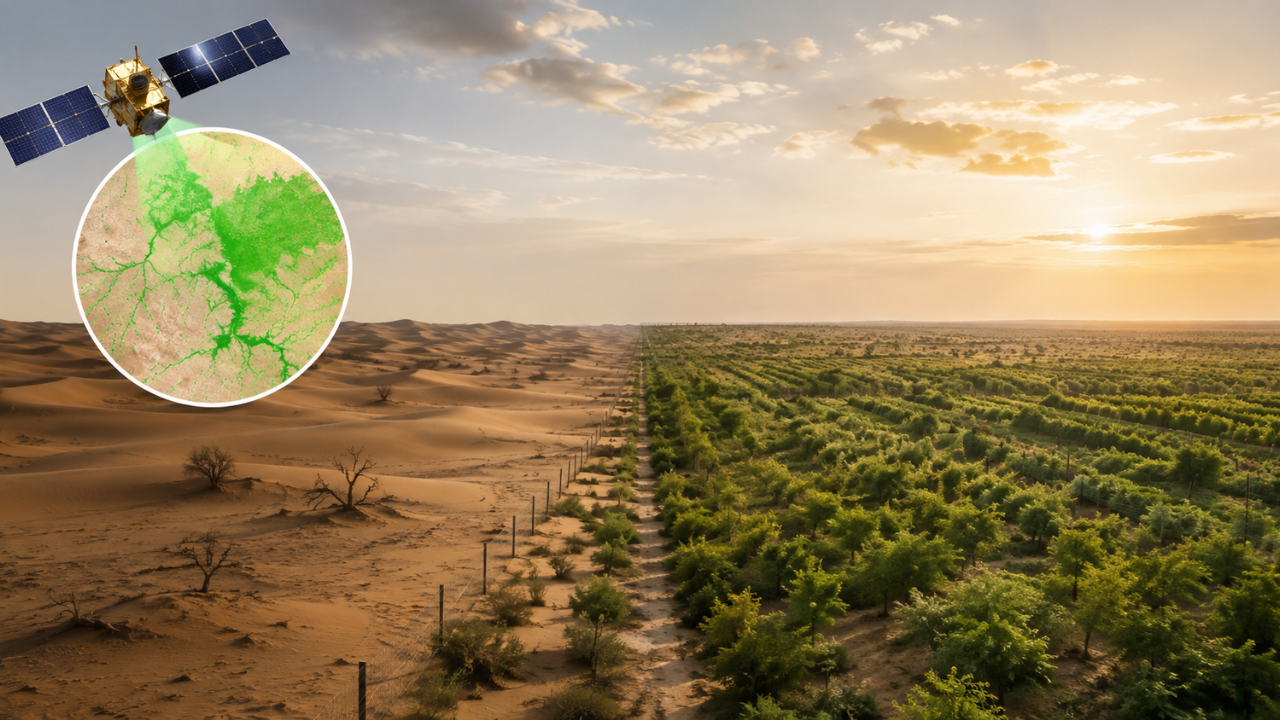
The Taklamakan Desert has a name that translates, roughly and ominously, to “The Place of No Return.” For centuries, this 130,000-square-mile expanse in western China was exactly that — a furnace of shifting dunes and suffocating dust. Bounded by the towering Kunlun, Pamir, and Tian Shan mountains, it remained a “biological void” until 1978.
That’s when China launched the Three-North Shelterbelt Program. This audacious, almost hubristic plan aimed to plant a “Great Green Wall” of billions of trees to stop the Gobi and Taklamakan deserts from swallowing local communities. Against the odds, the plan appears to be working. Vegetation is reclaiming the desert’s edge, turning a wasteland into a functioning carbon sink.
The Glow of Success
China’s
tree planting program has its fair share of critics. Scientists have pointed to a low survival rate for trees planted in China’s arid north. These “thirsty” forests can actually worsen desertification by aggressively draining underground aquifers, leaving native grasses to wither and die, which ironically exposes more soil to wind erosion. Water is the ultimate currency here, and China bet it on a risky gamble.
But the gamble is working out.

Topographic model of the Taklamakan Desert and surrounding elements. Image via Google Earth.
Researchers led by Salma Noor used a technique called Solar-Induced Fluorescence (SIF). When plants photosynthesize, they emit a faint near-infrared glow. Our eyes can’t see it, but NASA’s Orbiting Carbon Observatory (OCO) can. The more the Taklamakan glows, the more photosynthesis happens and the more carbon it is eating.
The numbers are small but significant.
“This is not a rainforest,” notes UCR atmospheric physicist King-Fai Li. “It’s a shrubland like Southern California’s chaparral. But the fact that it’s drawing down CO2 at all, and doing it consistently, is something positive we can measure and verify from space.”
Why We Can’t Plant Our Way Out of a Crisis
The Taklamakan project works because of a very specific geographical lucky break. The desert is surrounded by massive mountains. As the
climate warms, the glaciers on those mountains are melting faster, providing a temporary surge in runoff. This water flows down the Tarim River and into the irrigation systems that keep the
“Great Green Wall” alive.
In every system like this, the main limitation is water, and you can’t make water out of nothing.
If that water disappears, which it might as glaciers vanish, the green wall could turn brown and we could slide into the scenario where the green wall does more harm than good. This is the central tension of afforestation: it requires resources that are already in short supply.
If you tried to do this in another desert, like the Sahara, you’d run into major issues. The Sahara lacks the high-mountain runoff that feeds the Taklamakan. Replicating this success would require massive desalination projects or tapping into ancient, non-renewable underground aquifers.
There’s also another cost to greening a desert. Deserts are bright; they reflect sunlight back into space (this is called “albedo”). Trees and shrubs are dark; they absorb heat. Some scientists worry that by “greening” the desert, we might actually be warming the local area by absorbing more solar radiation, even if we are pulling CO2 from the air.
Why This Matters
The new study suggests the
carbon sequestration benefits in the Taklamakan currently outweigh the heat absorption. The increased vegetation also leads to more “evapotranspiration” — basically, the plants sweat, which can lead to localized cooling and even more rainfall.
“We’re not going to solve the
climate crisis by planting trees in deserts alone. But understanding where and how much CO₂ can be drawn down, and under what conditions, is essential,” Li said. “This is one piece of the puzzle.”
The Taklamakan project proves that human intervention can halt desertification and create stable carbon sinks in “hopeless” landscapes.
Even though the jury isn’t out on how this will affect the environment, for now, it seems to be a net positive.
“Even deserts are not hopeless,” Li said. “With the right planning and patience, it is possible to bring life back to the land, and, in so doing, help us breathe a little easier.”
Tree planting is often "green washing." Not in this case.

www.zmescience.com