Beijingwalker
VIP Member

Ranked: Countries with the Largest Currency Reserves
June 25, 2026
Key Takeaways:
- China holds over $3.4 trillion in foreign exchange reserves, nearly 3x more than Japan.
- Seven of the world’s 10 largest reserve holders are in Asia, reflecting decades of export-led growth.
- Despite being the world’s largest economy, the U.S. ranks only 13th because the dollar is the world’s primary reserve currency.
After the 1997 Asian Financial Crisis exposed the risks of relying on foreign capital during market turmoil, many governments began building massive foreign exchange reserves as a form of economic self-insurance.
Using data from the IMF’s International Reserves and Foreign Currency Liquidity (IRFCL) database, this visualization ranks countries by their foreign exchange reserves excluding gold, based on the latest available reporting periods from mid-2025 through Q2 2026.
The Countries Holding the Most Reserves
The table below shows the countries with the largest foreign exchange reserve holdings.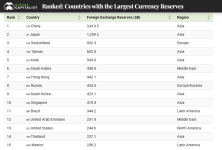
One clear pattern stands out in the rankings: Asia dominates.
Seven of the world’s 10 largest reserve holders are located in the region, together accounting for roughly two-thirds of global foreign exchange reserves. This concentration reflects decades of export-led growth, persistent trade surpluses, and a policy focus on maintaining large financial buffers.
Why Countries Build Massive Currency Reserves
Foreign exchange reserves act as a country’s emergency fund. Central banks can use them to stabilize currencies during market turmoil, pay for essential imports, service foreign debt, or reassure investors during periods of capital flight.The larger the reserve buffer, the greater a country’s ability to respond to external economic shocks without relying on foreign assistance.
The importance of reserve accumulation became especially clear after the 1997 Asian Financial Crisis. Many Asian economies experienced severe currency collapses and were forced to seek external assistance. In the years that followed, governments across the region adopted a strategy of building substantial reserve buffers as a form of economic self-insurance.