Very interesting observations by our friend Naser al-Tamimi. I talked about many of the topics long ago on PDF.
China and the Gulf Economy: Influence Without Protection
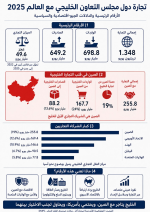
Trade figures for the Gulf Cooperation Council (GCC) countries in 2025 reveal a clear strategy: The Gulf has become economically closer to China, yet it remains securely under the American umbrella.
China is no longer just a buyer of Gulf oil and gas; it has become part of the daily fabric of the Gulf economy: goods, technology, equipment, manufacturing inputs, and supply chains.
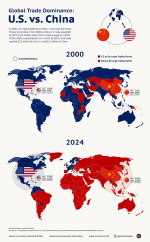
Most importantly, the Gulf's trade with China now exceeds its trade with the United States and the European Union combined.
This is not a passing commercial observation, but evidence of a shift in the Gulf's economic center of gravity to the East.
But the economy alone does not create a security system. China entered the Gulf through ports, markets, and companies, not through military bases or defense alliances. Herein lies the paradox: the Gulf's economy is heading East, while its armament/security remains Western. This is the essence of geo-economic centrality without security ownership:
China gains influence without bearing the cost of protection, and the United States shoulders the security burden without monopolizing the economic returns.
The war on Iran has exposed the fragility of this equation.
Beijing is highly exposed to Gulf energy, trade, infrastructure, and technology networks, but it lacks the tools to protect the system it relies on.
Thus, China may appear to be a relative geopolitical winner, but it is a direct economic loser. It has held out so far and can leverage the crisis to underscore the limits of the American umbrella and bolster its narrative of declining Western hegemony. But in the end, it pays the cost of disruptions it cannot prevent—and perhaps does not wish to—while lacking the ability to manage them securely.
In conclusion: The war serves the Chinese narrative, but it reveals the limits of Chinese power.
View attachment 204361
"


The report accurately captures an emerging post-American moment in Gulf security. This is not because the United States is withdrawing, but because its credibility as a reliable security guarantor has eroded -- most sharply during the war with Iran. Gulf states have drawn a clear lesson: reliance on a single external protector is risky when that power’s commitments appear increasingly volatile and its leadership less predictable.
That said, it is important not to overstate the strategic reorientation. Saudi Arabia is not choosing China over the United States; it is choosing optionality over dependence. The US continues to underpin the regional security architecture through arms sales, missile defence systems, training, and intelligence cooperation -- capabilities China cannot currently replicate in the Gulf security domain.
Riyadh’s shift, therefore, is best understood as a move from exclusive patronage to portfolio-based alignment. The United States remains central, but no longer singular. This represents a profound departure from the alliance logic that has structured Middle Eastern security since the 1970s.
The key question -- whether Saudi hedging is reversible -- has a nuanced answer: only partially, and largely at the margins.
There is a short-term political layer that is reversible. Changes in the US administration, or a reduction in personalised tensions, such as those associated with the Trump-MBS dynamic, could improve trust and temporarily slow Saudi Arabia’s deepening engagement with China.
But the deeper shift is structural. Successive regional crises, including the Iran war, have reinforced a Saudi perception that the United States is no longer a fully dependable crisis guarantor -- still present, but increasingly constrained by domestic polarisation and more conditional in its commitments.
This perception has already reshaped Saudi strategic behaviour in durable ways. Hedging is no longer episodic; it has become an embedded doctrine rather than a tactical adjustment.
Within this framework, China is not positioned as a substitute for the United States but as a complementary pillar -- providing economies of scale, diplomatic flexibility, and strategic optionality without directly competing in the security sphere.
As a result, even under improved US–Saudi relations, a return to the pre-2010s model of exclusive dependence is unlikely. The more plausible trajectory is a sustained dual-track strategy: tactical stabilisation with Washington alongside permanent strategic diversification.
In short, the United States can still influence the speed of strategic realignment, but it can no longer fully reverse its direction."