China Turns Rooftops Into Rainclouds: New Mist Technology DROPS Heat To 8°c | VIRAL VIDEO

Beijingwalker

VIP Member
Joined
Nov 4, 2011
Messages
92,380
Reaction score
113,128
Reputation
2,106.8
Country of Origin
Country of Residence

China Turns Rooftops Into Rainclouds: New Mist Technology DROPS Heat To 8°c | VIRAL VIDEO​

To view this content we will need your consent to set third party cookies.
For more detailed information, see our cookies page.


Jul 2, 2026

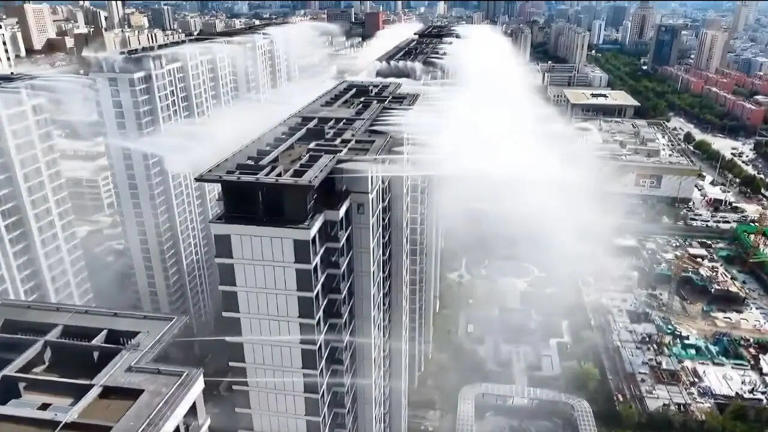
China’s innovative rooftop mist cooling system is going viral after videos showed high-rise buildings releasing artificial “raincloud-like” mist to combat extreme summer heat. The technology, installed in Yuncheng City, Shanxi Province, uses high-pressure nozzles and smart sensors to spray ultra-fine water droplets that evaporate quickly in the air, reducing surrounding temperatures significantly.Reports suggest rooftop surfaces can cool by up to 5–8°C within minutes, while nearby outdoor areas also experience noticeable temperature drops. The system works on evaporative cooling principles and activates automatically during extreme heat conditions.

Unlike traditional air conditioning, this energy-efficient system does not rely on heavy power consumption and instead uses natural evaporation to cool urban spaces. The viral videos have sparked global attention, showcasing a futuristic approach to fighting heatwaves in densely populated cities.

As heatwaves intensify worldwide, China’s rooftop mist technology is being seen as a possible glimpse into the future of urban cooling solutions.
 

China's rooftop 'rain' cooling system is going viral: Here's the science behind it​

Story by Times Now Digital
Jul 2, 2026

china's rooftop 'rain' cooling system is going viral: here's the science behind it


china's rooftop 'rain' cooling system is going viral: here's the science behind it

As temperatures continue to soar across parts of China, one residential neighbourhood has found a surprisingly simple way to take the edge off the heat. In Yuncheng, a city in Shanxi Province, apartment buildings have been equipped with rooftop misting systems that release a fine spray of water into the air. The result is a scene that almost looks like rain cascading from the rooftops. Videos of the project have spread rapidly across social media, leaving many people asking the same question: how does it actually work? Here's everything you need to know about this.


How China's Rooftop Cooling System Works

The idea is based on evaporative cooling, the same natural process that helps cool your body when sweat evaporates. High-pressure nozzles installed on rooftops release an ultra-fine mist that quickly disappears into the air. As those tiny droplets evaporate, they absorb heat from the surrounding environment, bringing down the temperature around buildings, roads and walkways.

According to Chinese media reports, the system can reduce nearby air and surface temperatures by around 5°C to 8°C when outdoor temperatures climb to nearly 38°C.

Because the mist is extremely fine, it evaporates almost instantly instead of leaving people soaked or creating slippery roads. It also uses far less electricity than traditional air conditioning systems since it mainly depends on water pumps and high-pressure nozzles rather than compressors. Similar misting systems are already being used in parks, pedestrian streets, public squares and bus stops across several Chinese cities during the hottest months of the year.


Why China Is Looking At New Ways To Beat The Heat

Heatwaves have become more frequent and more intense across China in recent years, something many scientists link to climate change. On top of that, cities often experience the urban heat island effect, where buildings, roads and concrete surfaces trap heat, making urban areas noticeably warmer than nearby rural regions. The rooftop misting project in Shanxi is one attempt to make densely populated neighbourhoods more comfortable without dramatically increasing energy consumption.

 
To view this content we will need your consent to set third party cookies.
For more detailed information, see our cookies page.
 
Similar to this world tallest bridge

To view this content we will need your consent to set third party cookies.
For more detailed information, see our cookies page.
 
We don't need to show it; it's not worth promoting. Many countries are not suitable for this technology. Most countries lack water.
 
There's certain caveats here that should also be acknowledged

1. Drying water means increasing humidity, this only works upto a certain point, beyond which at high humidity you end up with sticky more warm feeling temperatures than they actually are, defeating the purpose

2. This works best in low humidity, well ventilated geographies but the trade off is, well ventilation brings in newer, warmer air, making it a constant fight against the temperatures, requiring more water and power to maintain the ideal temperature. At what point does the resource bill outweight the benefits and individual home ACs are the cheaper option, defeating the technology purpose

3. Scaling it at a large scale( as demonstrated here) requires enormous amounts of water that is being evaporated. Thats water that is now unavailable for immediate consumption, so again effective upto a point

Not sure what the flex here is
 
Last edited:

Users who are viewing this thread

Pakistan Defence Latest

Latest Posts

Back
Top