Reusable Rocket Success in China 🚀

chinasun

Registered Member
Joined
Apr 11, 2024
Messages
711
Reaction score
857
Reputation
1,461.1
Country of Origin
Country of Residence
To view this content we will need your consent to set third party cookies.
For more detailed information, see our cookies page.


China reports reusable rocket breakthrough as it vies to catch up with the US

China has successfully recovered the first stage of a carrier rocket during an orbital launch test, state media reported Friday – a breakthrough for the country as it vies to catch up with American rivals in reusable rocket technology.
 
Last edited:
It must be said that the engineers came up with a clever alternative—using ropes, which indeed serves as an example of achieving excellent results at the lowest cost.
 
China just made a big breakthrough in reusable rockets - that's very impressive!

I think everyone missed those invisible cables supporting the rockets at the end.

To view this content we will need your consent to set third party cookies.
For more detailed information, see our cookies page.


English Translation:
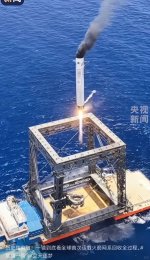
China's offshore booster recovery: the concept I spotted in 2024 is actually working properly. Wires stretched to anchors moving on rails are arranged to hold the rocket in a crisscross pattern.

To view this content we will need your consent to set third party cookies.
For more detailed information, see our cookies page.


To view this content we will need your consent to set third party cookies.
For more detailed information, see our cookies page.
 

China retrieves booster in reusable rocket breakthrough

Richard Connor with AP, Reuters
2 hours ago

77902737_1004.webp

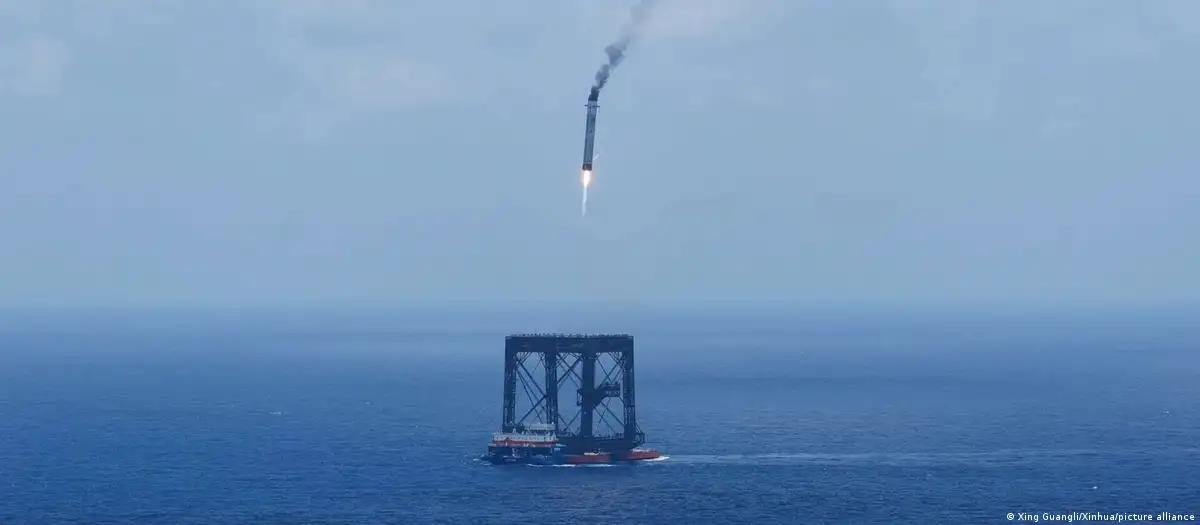
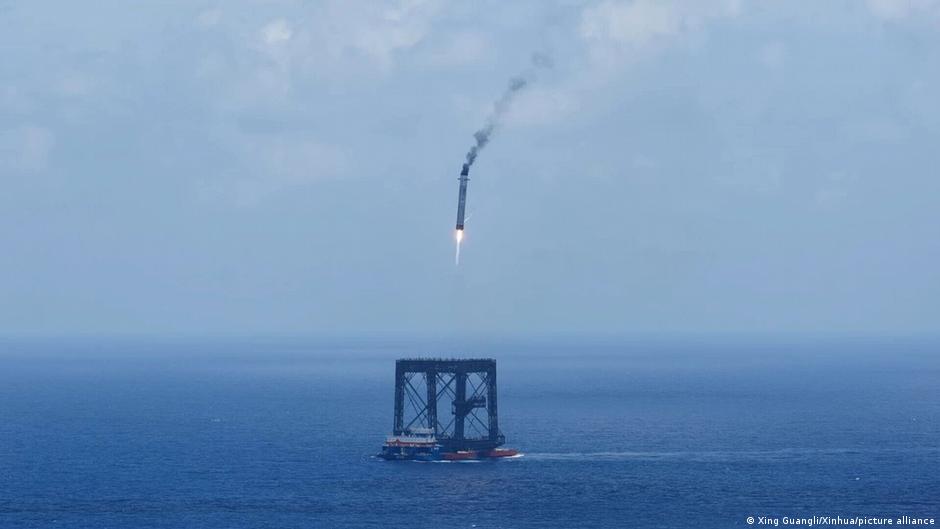
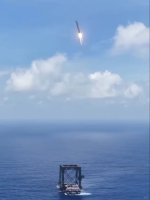
The booster descends toward an offshore recovery platformImage: Xing Guangli/Xinhua/picture alliance

China on Friday successfully recovered the booster of an orbital-class rocket for the first time, marking a major advance in its push to develop reusable launch systems.

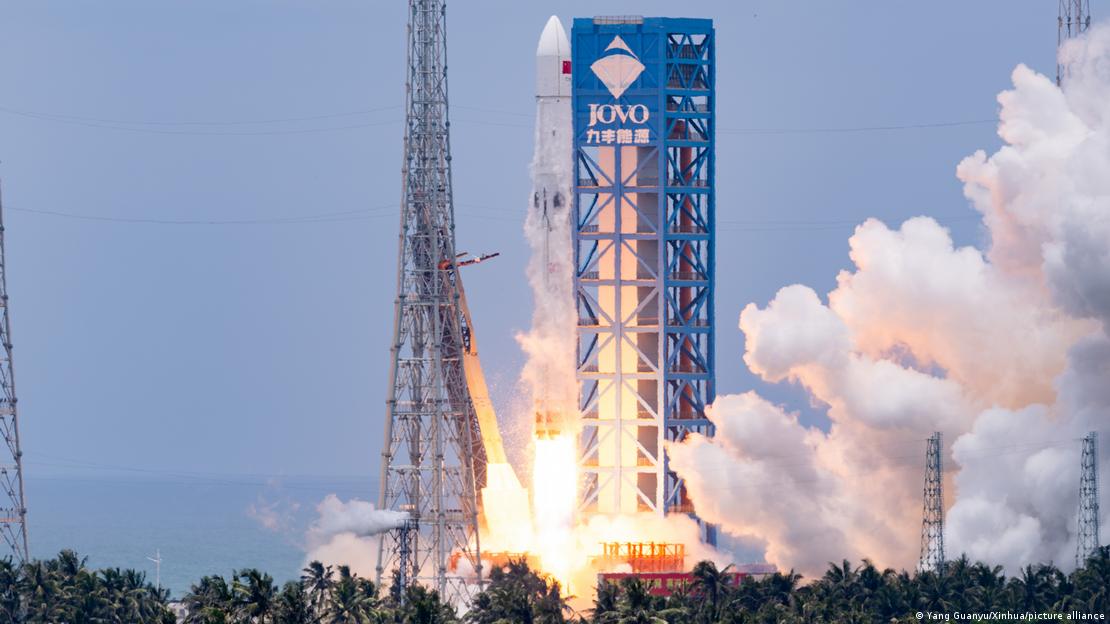
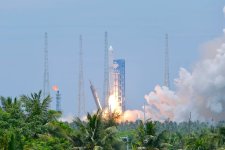
The Long March 10B lifted off from the Hainan commercial space launch site in southern China at 12:15 p.m. on Friday and placed a satellite into its designated orbit, state media reported.

What do we know about the Long March flight?​

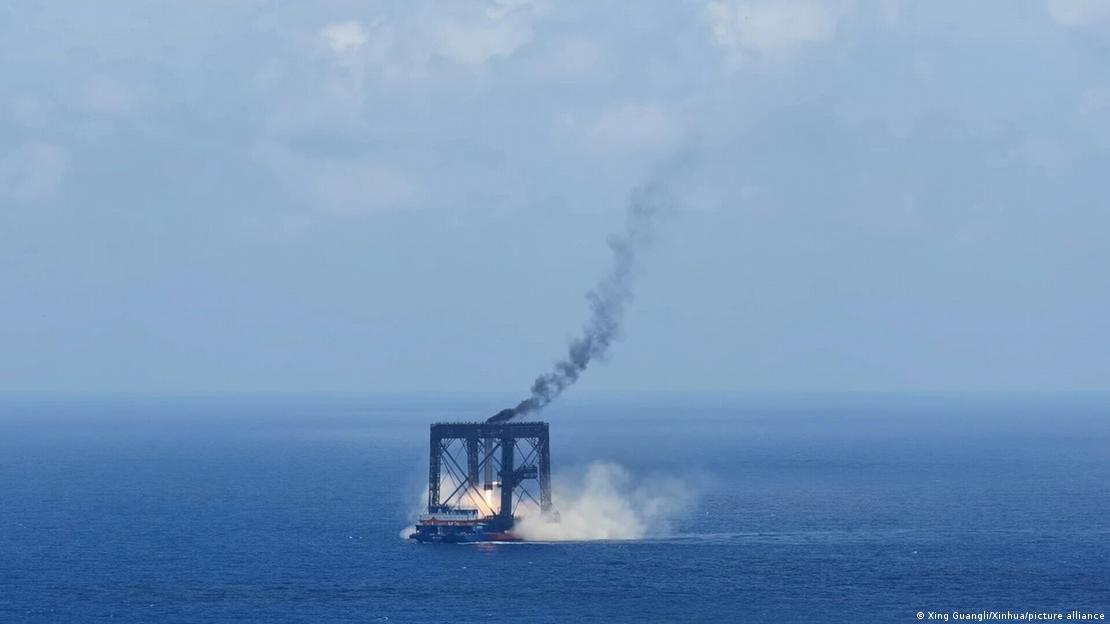
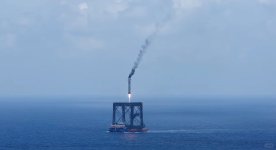
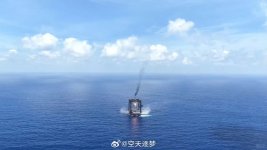
Around six minutes after the booster separated from the rocket's upper stage, it descended vertically toward an offshore platform and was captured by a net-based retrieval system.

Unlike the rockets used by US companies SpaceX and Blue Origin, which land autonomously on deployable legs, the Long March 10B uses four hooks to catch a net suspended above the sea platform.

China Academy of Launch Vehicle Technology expert Chen Muye said the approach simplifies the rocket's onboard structure, reduces its weight and could increase payload capacity.

77902709_906.jpg

China's Long March 10B lifts off from the Hainan commercial space launch siteImage: Yang Guanyu/Xinhua/picture alliance

"It is also highly adaptable to landing-point deviations, as coordinated net systems can effectively expand the capture window," Muye told state media agency Xinhua.

How is China planning to deploy reusable rockets?​

China has spent nearly a decade developing reusable rocket technology as it seeks to cut launch costs and support its rapidly expanding commercial satellite networks.

Previous recovery attempts by private company LandSpace and the state-owned China Aerospace Science and Technology Corporation failed during the final landing stage last year.

77902773_906.jpg

The rocket was successfully retrieved using a net capture systemImage: Xing Guangli/Xinhua/picture alliance

The Long March 10B is also part of the broader Long March 10 family that China is developing for planned crewed lunar missions before 2030. Data from Friday's flight could help validate technology for the country's lunar program.

Shares in several Chinese aerospace companies surged following the test, with China Spacesat and China Satellite Communications reaching their daily trading limits.

The Long March 10B can carry at least 16 metric tons into low-Earth orbit and has been compared to SpaceX's Falcon 9, which has a maximum payload of 22.8 metric tons.

SpaceX first landed a Falcon 9 booster following an orbital mission in December 2015. It now launches the rocket around 150 times a year, frequently reusing individual boosters dozens of times.

 
Some would again say that China "steals" other's technology.
"This marks China's first successful implementation of controlled recovery of a launch vehicle's first stage, as well as the world's first net-based recovery of a launch vehicle," according to the Beijing-based Global Times newspaper.
“Net-based recovery helps ‌simplify the rocket’s onboard structure, reduces vehicle mass and increases payload capacity. It is also highly adaptable to landing-point deviations, as coordinated net systems can effectively expand the capture window,” CALT’s expert Chen Muye told state agency Xinhua.
 
Last edited:
Progress is rapid. We have already achieved the reuse of steps and anticipate that technological iteration and upgrades will develop swiftly. Satellite launches will become more frequent and significantly less costly, and we are working on developing our own Starlink.
Would you like to use the Chinese 99.9 yuan package to price the Starlink satellite service?
 

With a Successful Rocket Launch, China Clears a Key Hurdle in Race With SpaceX

The launch and recovery of the Long March 10B could represent a long-awaited breakthrough for Chinese satellite companies.
A crowd of people gathers to watch a white rocket lift off from a launchpad in the distance.

A Long March 10B rocket blasting off from the Wenchang spaceport in Hainan, China, on Friday.Credit...Visual China Group, via Getty Images

The New York Times

By Selam Gebrekidan and Pei-Lin Wu
July 10, 2026, 3:39 a.m. ET

China’s space program took an important step on Friday toward its elusive goal of competing with Elon Musk’s company SpaceX, in the race to dominate the satellite industry.

The China Aerospace Science and Technology Corporation, a government entity, launched a Long March 10B rocket and recovered its bottom part, called the first stage, a few minutes later. This essential step toward reusing the rocket’s parts for future missions could signal a long-awaited breakthrough for Chinese satellite companies.

SpaceX revolutionized the industry with its partially reusable Falcon 9 rocket, whose first stage returns to the launchpad upright after launch. Falcon 9 can send satellites into orbit in rapid succession, which has given SpaceX a significant edge. Every day that passed without a reusable Chinese launcher, SpaceX pulled further ahead. SpaceX has more than 10,000 satellites in orbit and is a world leader in satellite internet.

Chinese companies have been launching satellites with single-use rockets, letting their parts tumble back to Earth or become space debris after every launch. Two Chinese satellite constellations that hope to rival SpaceX’s have launched just over 400 satellites between them.

That may be about to change.

The rocket’s bottom part returned upright to a platform at sea, six minutes after separating from the upper part. It slowly descended to a pad that was fitted with nets to capture the rocket parts, according to a video released by Chinese state media. The nets proved to be China’s nifty solution for recovering rocket boosters.

It is the “world’s first net‑based recovery of a launch vehicle,” the China Aerospace Science and Technology Corporation said.

The country built the offshore platform last year and tested it in February. The first stage of a predecessor rocket ended up splashing down at sea. Friday’s mission built on the results of that test, according to official statements.

The Long March 10B rocket was developed by the China Academy of Launch Vehicle Technology, a subsidiary of the government corporation. It is part of the Long March 10 series of rockets, some of which are designed for China’s first crewed mission to the Moon expected by 2030.

It is about 200 feet high and is designed to deliver up to 16 metric tons of spacecraft, such as satellites, to low-earth orbit. During Friday’s test, the rocket’s upper stage successfully launched an unspecified number of satellites, the government said.

Future flight tests will be done by the end of this year, the company said. It did not respond to questions.

 
[Satellite Communication Working Group Officially Established in Beijing] "Science and Technology Innovation Board Daily" reported on the 10th that the China Academy of Information and Communications Technology announced today that, under the guidance of the Information and Communication Administration of the Ministry of Industry and Information Technology, the Satellite Communication Working Group of the Industrial Internet Industry Alliance (hereinafter referred to as the "Satellite Communication Working Group") was officially established in Beijing. The satellite communication working group is led by the China Academy of Information and Communications Technology, in collaboration with China Satellite Network Group Co., Ltd., China Space-Time Information Group Co., Ltd., Shanghai Yuanxin Satellite Technology Co., Ltd., China Satcom Group Co., Ltd., China Academy of Space Technology, Beijing Guodian Gaoke Technology Co., Ltd., and Zhejiang Space-Time Daoyu. More than 60 units, including Science and Technology Co., Ltd., China Telecom Group Co., Ltd., China Mobile Communications Group Co., Ltd., and China United Network Communications Group Co., Ltd., were jointly established, bringing together various industries such as satellite enterprises, telecommunications operators, equipment vendors, terminal enterprises, financial institutions, and research institutions.


Today, immediately advance the establishment of national-level resource investment, including more experts and substantial funding.and related industries.
 
World's first: China recovers rocket booster with net system at sea

To view this content we will need your consent to set third party cookies.
For more detailed information, see our cookies page.


Jul 10, 2026

China has recovered the first stage of a Long March-10B carrier rocket using a net system at sea – a world first for reusable rocket technology.

The launch took place from the Hainan International Commercial Aerospace Launch Center in south China, sending a satellite into preset orbit.About six minutes later, the rocket booster was captured by a cable recovery system on a specially designed vessel off the coast of Hainan.

The mission marks China's first controlled recovery of a rocket's first stage and the world's first rocket recovery using a net system.
 
To view this content we will need your consent to set third party cookies.
For more detailed information, see our cookies page.


capability.png

No, the key SpaceX capability was to land the Starship back at the launch tower for a quick turnaround time of refueling and re-launching
 

Users who are viewing this thread

Back
Top