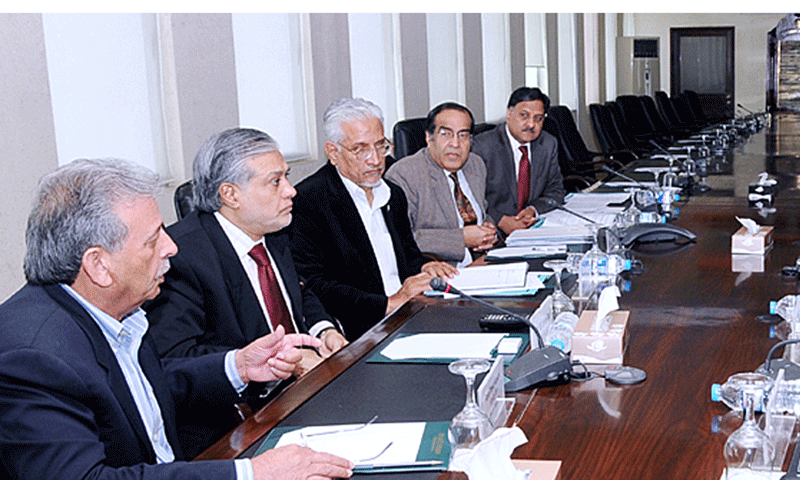
Pakistan begins commercial shipbuilding after four decades, official says

hydrabadi_arab

Trusted Member
Joined
Jul 31, 2015
Messages
6,968
Reaction score
13,598
Reputation
5,205.3
Country of Origin
Country of Residence
  • State-run Pakistan National Shipping Corporation spearheads shipbuilding project at Karachi Shipyard, says official
  • Commercial shipbuilding will allow Pakistan to save foreign exchange to import ships, create manufacturing jobs
ISLAMABAD: Pakistan has started building its first commercial container ship since the early 1980s, an official said on Thursday, implementing a state-backed strategy to modernize the country’s ports, overhaul customs and revive its defunct shipbuilding and ship-recycling industries.

The project at the Karachi Shipyard & Engineering Works (KS&EW), executed under a contract with the state-run Pakistan National Shipping Corporation (PNSC), ends a four-decade pause in commercial manufacturing of ships. It serves as one of the key elements of a push by the Prime Minister’s Task Force on Maritime Reforms, established in August 2024, to tap into the country’s underutilized blue economy that officials estimate stands at $1billion.

“For the first time since the early ‘80s, commercial container ship construction has started there [Karachi Shipyard] under a contract signed with the PNSC,” Vice Admiral (retired) Iftikhar Ahmad Rao, the task force’s chairman, said during a press briefing.

“Construction has already begun, the steel cutting has been completed, and its cost is several million lower than the market rate.”

The task force identified 99 bottlenecks to maritime issues, Rao said, out of which the task force has implemented 84 of its recommendations within a year. Citing one of them, he said heavy fiscal barriers previously forced private Pakistani shipowners to register vessels with foreign countries such as Panama or Liberia.

To counter regional competitors such as India, which provides a 30 percent subsidy on shipbuilding, Pakistan has abolished a 22 percent domestic sales tax on vessel purchases and shipbuilding materials, Rao said.

The overarching goal of these reforms by the task force is to tap into an estimated $100 billion annual blue economy potential by 1947, he said.

Pakistani officials have said that while the maritime sector currently contributes less than 1 percent to the national GDP, the country aims to enhance this share through modernized ports and more fleets.

Officials have said that logistical upgrades brought about by the task force’s recommendations have already boosted Pakistan’s standing in the global maritime indexes. Over the past five years, Karachi Port Trust climbed 30 places to 69 in the World Bank’s Container Port Performance Index, while Port Qasim ranked fifth among the world’s fastest-improving container ports.

These recommendations include reducing average customs clearance times toward a 12-hour target by deploying advanced container scanners, introducing round-the-clock shift structures, and relocating third-party testing laboratories directly inside port premises.

Pakistan is also moving to revive its once-dominant shipbreaking sector at Gadani, a coastal town in southwestern Pakistan, Rao said. The shipbreaking industry collapsed after failing to meet modern environmental mandates.

Following Pakistan’s accession to the International Maritime Organization’s Hong Kong Convention for safe ship recycling, five local yards have achieved full compliance, the official said.

Commercial shipbuilding will allow Pakistan to save foreign exchange earnings that it usually spends on importing ships. This would also create manufacturing jobs and help the South Asian country potentially export ships to other countries in the future.
 
“Construction has already begun, the steel cutting has been completed, and its cost is several million lower than the market rate.”

Pakistan since 80's. Lets waste as much $ as possible on imports which can be made at home. Don't increase exports.
 
plz start e port dince 1980s its stagnant
 
Any idea how long it will PNSC construct the first container? Is it years or months?
 
Pakistan since 80's. Lets waste as much $ as possible on imports which can be made at home. Don't increase exports.


We Had A Brilliant Chance In Early 2010s By Japan and South Korea But


But Sadly Maybe Sharifs and Zardaris Didn't Get Their Cut
 
Great news. Please build a manufacturing based economy in Pakistan. We need to build a shipbuilding industry in Pakistan to compete with South Korea's shipbuilding industry.
 
If China allows it. They are biggest shipbuilders and they will destroy any such small attempt. It is not economically feasible to compete with them.
 
Great news. Please build a manufacturing based economy in Pakistan. We need to build a shipbuilding industry in Pakistan to compete with South Korea's shipbuilding industry.

Pakistan should have invested in Ormara and Pasni but lack of vision and incompetence run in Pakistan like blood runs in the body. For more than four decades, Pakistan’s maritime strategy or the absence of one has shaped the country’s economic stagnation. The story begins in Karachi, where political, bureaucratic, and business elites built a tight monopoly over the country’s trade routes. That monopoly became so entrenched that every other potential port along Pakistan’s 1,000‑kilometer coastline was quietly suffocated before it could even take its first breath.

This is the backdrop against which Gwadar emerged. And the truth is simple. Gwadar was built because China needed it, not because Pakistan envisioned it. Anyone insisting that Gwadar was a Pakistani masterstroke is rewriting history. The project was conceived, financed, engineered, and operationalized by China to serve its own strategic and commercial interests, a shorter route for western Chinese provinces, access to the Arabian Sea, and proximity to the Strait of Hormuz.

Pakistan, meanwhile, merely hosted the port. It did not plan it, and it certainly did not build it.

Pakistan’s coastal planning was driven by security agencies, not economic strategists. As a result, key locations were treated as military assets rather than commercial opportunities:
  • Ormara became home to PNS Ahsan, a naval base.
  • Jiwani was valued for its strategic location near Iran.
  • Pasni remained a small fishing harbor with occasional naval use.
Ports thrive when paired with industry, logistics, energy infrastructure, and rail connectivity. None of these were ever built.
 
This is the backdrop against which Gwadar emerged. And the truth is simple. Gwadar was built because China needed it, not because Pakistan envisioned it. Anyone insisting that Gwadar was a Pakistani masterstroke is rewriting history. The project was conceived, financed, engineered, and operationalized by China to serve its own strategic and commercial interests, a shorter route for western Chinese provinces, access to the Arabian Sea, and proximity to the Strait of Hormuz.

Partly true but incorrect on conceived part. Developing a deep-water port at Gwadar was a long-standing Pakistani dream dating back to the 1960s.

In 1973, Bhutto formally pitched the United States to build the port, even offering the U.S. Navy use of the logistic facilities. The U.S. declined.

Gwadar wasn't even part of Pakistan at independence. Govt of Pakistan purchased Gwadar from Oman in 1958. In the 90s, different federal govts had plans ready for Gwadar port and were seeking fundings but could not do so due to US sanctions on Pakistan (because of nuclear weapon program). Once sanctions were lifted Musharraf made a pitch to Chinese govt (not the other way around) to provide fundings. Chinese agreed and in early 2000s Pakistan paid initial minor funding and chinese the major funding to start the project.
 
Pakistan should have invested in Ormara and Pasni but lack of vision and incompetence run in Pakistan like blood runs in the body. For more than four decades, Pakistan’s maritime strategy or the absence of one has shaped the country’s economic stagnation. The story begins in Karachi, where political, bureaucratic, and business elites built a tight monopoly over the country’s trade routes. That monopoly became so entrenched that every other potential port along Pakistan’s 1,000‑kilometer coastline was quietly suffocated before it could even take its first breath.

This is the backdrop against which Gwadar emerged. And the truth is simple. Gwadar was built because China needed it, not because Pakistan envisioned it. Anyone insisting that Gwadar was a Pakistani masterstroke is rewriting history. The project was conceived, financed, engineered, and operationalized by China to serve its own strategic and commercial interests, a shorter route for western Chinese provinces, access to the Arabian Sea, and proximity to the Strait of Hormuz.

Pakistan, meanwhile, merely hosted the port. It did not plan it, and it certainly did not build it.

Pakistan’s coastal planning was driven by security agencies, not economic strategists. As a result, key locations were treated as military assets rather than commercial opportunities:
  • Ormara became home to PNS Ahsan, a naval base.
  • Jiwani was valued for its strategic location near Iran.
  • Pasni remained a small fishing harbor with occasional naval use.
Ports thrive when paired with industry, logistics, energy infrastructure, and rail connectivity. None of these were ever built.
Agreed, Pakistan needs to have the initiative to make such projects. Agreed, China built Gwadar because it needed it, not because it cared about Pakistan.
 
Partly true but incorrect on conceived part. Developing a deep-water port at Gwadar was a long-standing Pakistani dream dating back to the 1960s.

In 1973, Bhutto formally pitched the United States to build the port, even offering the U.S. Navy use of the logistic facilities. The U.S. declined.

Gwadar wasn't even part of Pakistan at independence. Govt of Pakistan purchased Gwadar from Oman in 1958. In the 90s, different federal govts had plans ready for Gwadar port and were seeking fundings but could not do so due to US sanctions on Pakistan (because of nuclear weapon program). Once sanctions were lifted Musharraf made a pitch to Chinese govt (not the other way around) to provide fundings. Chinese agreed and in early 2000s Pakistan paid initial minor funding and chinese the major funding to start the project.

The “Gwadar was Pakistan’s dream since the 1960s” narrative is adorable like a bedtime story for people who mistake talking for doing.
Pakistan didn’t “conceive” Gwadar; Pakistan daydreamed about Gwadar the same way it daydreams about making Lahore look like Paris. Spoiler: neither happened.

1. Pakistan’s Gwadar ‘vision’ was a 50‑year nap.

Yes, Pakistan bought Gwadar in 1958.
Yes, Bhutto pitched it to the U.S. in 1973.
And yes, governments scribbled “Gwadar Port” in planning documents in the 1990s.

But here’s the punchline….
Pakistan built nothing except a tiny fish harbor in 1988.
That’s not vision, that’s procrastination with a flag on it.

2. Bhutto begging the U.S. Navy wasn’t ‘strategy.’ It was ‘please build this for us.’

If Gwadar was a national priority, Pakistan would’ve built it.
Instead, Bhutto offered the U.S. Navy access to Gwadar like a clearance sale.
The U.S. still preferred Iran’s Chabahar.
That’s how “strategic” Pakistan’s pitch was.

3. The 1990s plans were the usual Pakistani specialty: paperwork with zero execution.

Sanctions didn’t stop Pakistan from building:

• nuclear weapons
• motorways
• airports
• naval bases
• expansions at Karachi and Port Qasim

But somehow Gwadar was “impossible” because of sanctions?
Right. And Lahore is “Paris.”

4. China didn’t join a Pakistani dream, China filled a Pakistani vacuum.

Musharraf “pitched” Gwadar to China because Pakistan had no money, no capacity, and no plan.
China provided the engineering, the strategy, and the bulk of the financing.
Pakistan contributed… patriotic speeches.

And let’s drop the fairy tale about “iron brother.”
China’s loans are not charity.
They’re high‑interest, collateral‑heavy, and never forgiven loans, only refinanced. China is a ruthless businessman who brings a calculator, not flowers.

5. Lahore‑Paris syndrome: Pakistan’s national hobby of delusion.

Billions were poured into Lahore to “make it Paris.”
After all that spending, Lahore still can’t compete with mid‑tier Iranian cities like Shiraz or Mashhad, let alone Tehran.
But sure, tell me more about how Pakistan “conceived” Gwadar.

Having said that, recent statements of government is even strange, Pakistan will hit $100B exports by 2035.
Sure, and I’ll be the next CEO of SpaceX.
 

Users who are viewing this thread

Back
Top